
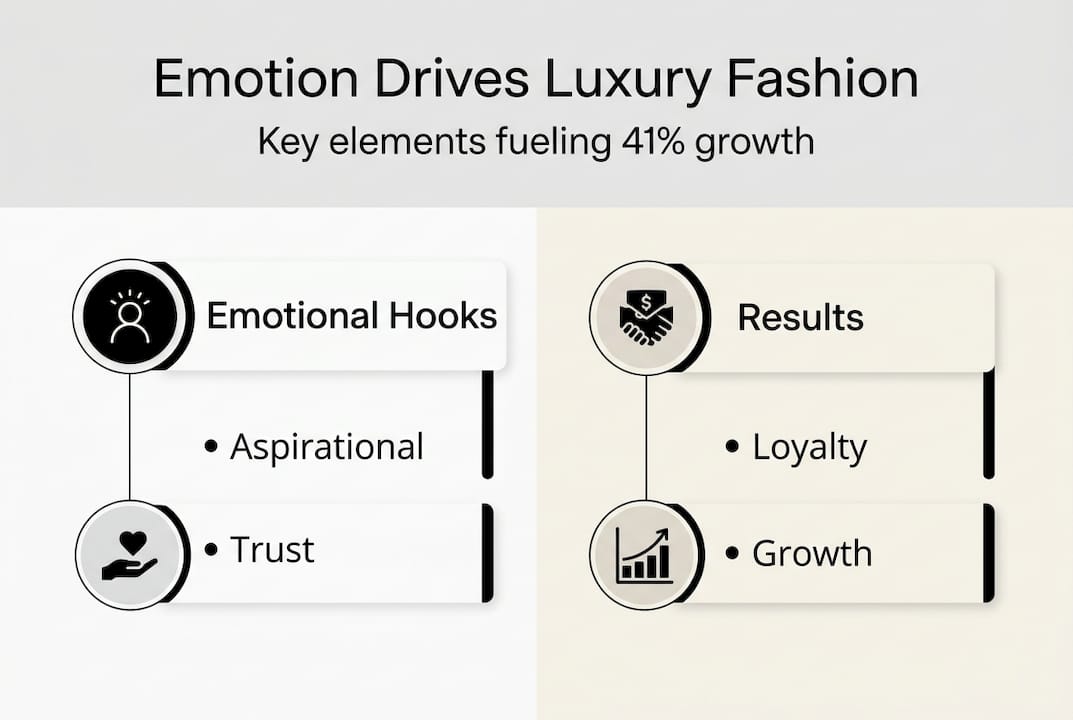
Most luxury fashion campaigns fail because they focus on features instead of feelings. While competitors showcase craftsmanship and heritage, the brands winning loyalty understand a fundamental truth: trust-building campaigns are 41% more effective for driving growth. This guide reveals how emotion-based strategies transform casual buyers into devoted advocates, providing frameworks, comparisons, and actionable steps to elevate your luxury marketing.
Table of Contents
- Why emotion matters in luxury campaigns
- Core frameworks for emotion-based luxury campaigns
- Luxury industry nuances: Emotion, inclusivity, and exclusivity
- Applying emotion-based strategies: A step-by-step approach
- Common pitfalls and expert solutions
- Unlock next-level brand growth with proven strategies
- Frequently asked questions
Key Takeaways
| Point | Details |
|---|---|
| Emotion wins loyalty | Emotionally focused campaigns dramatically increase customer retention and advocacy in luxury fashion. |
| Trust-building drives growth | Strategies that blend emotion and rational trust are up to 41 percent more effective for business outcomes. |
| Luxury needs nuance | The tension between inclusivity and exclusivity is unique in luxury campaigns and must be balanced carefully. |
| Measure emotional KPIs | Track campaign success with metrics like brand sentiment and repeat purchases, not just sales. |
Why emotion matters in luxury campaigns
Emotion, not logic, triggers desire and loyalty in high-value purchases. When someone invests in luxury fashion, they’re buying identity, status, and belonging. Rational features matter, but emotional resonance seals the decision.
Research confirms this reality. 93% of large business effects are driven by trust-building and emotional strategies. For luxury brands, this means campaigns centered on aspiration, exclusivity, and self-expression consistently outperform product-focused messaging.
The emotions luxury brands leverage include:
- Aspiration: The desire to embody a better version of oneself
- Exclusivity: The appeal of joining a select community
- Belonging: Connection to like-minded individuals who share values
- Self-expression: The freedom to communicate identity through style
These emotional drivers create lasting connections. When you craft emotion-driven campaigns that speak to these desires, you build relationships that transcend transactions.
“The most effective luxury campaigns don’t sell products. They sell transformation, status, and membership in an aspirational world.”
Understanding storytelling in luxury helps you weave these emotions into compelling narratives that resonate with your audience’s deepest desires.
Core frameworks for emotion-based luxury campaigns
Successful emotion-based campaigns require structured approaches. The table below compares pure emotional strategies with balanced frameworks:
| Approach | Benefits | Best For | Potential Pitfalls |
|---|---|---|---|
| Pure Emotional | Maximum resonance, strong brand loyalty | Brand launches, repositioning | May lack credibility without rational support |
| Balanced (Emotion + Rational) | Broad appeal, trust-building | Established brands, high-investment items | Can dilute emotional impact if poorly executed |
| Rational-Heavy | Clear value proposition | Technical products | Fails to inspire loyalty in luxury context |
Key psychological frameworks that drive luxury campaign success:
- Maslow’s hierarchy applied to luxury: Position your brand as fulfilling self-actualization and esteem needs, not just basic desires.
- Exclusivity versus inclusivity tension: Balance the appeal of being part of an elite group with the warmth of community belonging.
- Trust-building touchpoints: Create consistent emotional experiences across every customer interaction, from discovery to post-purchase.
- Aspirational identity mapping: Help customers see themselves as the person they want to become through your brand.
Even in B2B luxury contexts, emotion dominates. B2B buyers are 80% influenced by emotions in decision making, proving that professional purchasers respond to feelings just like individual consumers.
Pro Tip: Combine trust-building elements with aspirational messaging for double impact. Start with emotional hooks that capture attention, then layer in credibility markers like heritage, craftsmanship details, or sustainability commitments to reinforce the emotional appeal.
Explore comprehensive emotional branding strategies to deepen your understanding of these frameworks in action.
Luxury industry nuances: Emotion, inclusivity, and exclusivity
Luxury brands face a unique challenge: managing the tension between inclusivity and exclusivity in emotional outreach. Too exclusive, and you alienate potential customers. Too inclusive, and you dilute the prestige that makes luxury desirable.

The emotional axes below show how different feelings impact luxury appeal:
| Emotional Axis | Effect on Appeal | Risk if Overemphasized | Ideal Balance |
|---|---|---|---|
| Aspiration | Elevates desire | Can feel unattainable | Pair with achievability cues |
| Heritage | Builds trust and credibility | May seem outdated | Blend with innovation |
| Peer Validation | Creates social proof | Reduces uniqueness | Highlight individual expression |
| Belonging | Fosters community | Weakens exclusivity | Emphasize selective membership |
Practical scenarios where emotional balance matters:
- Product launches: Lead with aspiration and exclusivity, then introduce belonging through limited community access
- Collaborations: Leverage peer validation while maintaining brand heritage and uniqueness
- Limited editions: Emphasize scarcity and exclusivity without alienating loyal customers who miss out
- Community events: Create belonging and peer validation while preserving the aspirational brand image
“The brands that win in luxury are those that make customers feel simultaneously special and part of something bigger than themselves.”
Mastering prestige storytelling helps you navigate these tensions with finesse. Additionally, optimizing luxury social media requires careful calibration of these emotional elements across platforms.
Applying emotion-based strategies: A step-by-step approach
Implementing effective emotion-based campaigns requires a systematic process:
- Gather emotional insights: Conduct qualitative research to understand what truly drives your audience. Go beyond demographics to uncover aspirations, fears, and identity goals.
- Map emotional journey: Identify key touchpoints where emotional connections form, from initial awareness through post-purchase advocacy.
- Develop concept and creative: Translate insights into compelling narratives that speak to core emotional drivers while maintaining brand authenticity.
- Select channels strategically: Choose platforms where your audience is most receptive to emotional messaging. Instagram and experiential events often outperform rational channels for luxury.
- Implement feedback loops: Monitor sentiment, engagement, and conversion to refine emotional messaging continuously.
- Optimize based on data: Use A/B testing to identify which emotional appeals resonate strongest with different audience segments.
Campaign KPIs for emotion-based efforts:
- Brand sentiment scores: Track how people feel about your brand through social listening and surveys
- Repeat purchase rate: Emotional connection drives loyalty and repeat business
- Organic advocacy: Measure unsolicited recommendations and user-generated content
- Customer lifetime value: Emotional bonds extend relationship duration and spending
- Engagement depth: Monitor time spent with content and interaction quality, not just clicks
Pro Tip: Slight shifts in creative or copy can dramatically increase emotional resonance. Test campaigns with real focus groups before full launch. A single word change in a headline can shift perception from aspirational to alienating.
Research shows trust-building and emotional engagement drive the largest business effects across sectors. Apply these principles systematically through luxury loyalty strategies tailored to your brand.
Common pitfalls and expert solutions
Even sophisticated luxury brands make critical mistakes in emotion-based campaigns:
- Overly generic messages: Using broad emotional appeals that could apply to any brand dilutes impact. Solution: Root emotional messaging in your specific brand heritage and values.
- Misreading exclusivity desire: Assuming all luxury customers want maximum exclusivity ignores segments seeking community. Solution: Segment audiences and customize emotional appeals accordingly.
- Ignoring emotional KPIs: Focusing solely on sales metrics misses the sentiment shifts that predict long-term success. Solution: Implement comprehensive measurement including brand health tracking.
- Inconsistent emotional tone: Varying emotional messaging across channels confuses customers. Solution: Develop clear brand emotional guidelines that govern all communications.
- Copying competitor emotions: Mimicking rivals’ emotional strategies creates commoditization. Solution: Identify unique emotional territory your brand can own authentically.
Data reveals many luxury brands misjudge the balance between emotional and rational messaging, either going too far in one direction or failing to integrate both effectively.
Pro Tip: Conduct regular emotion-mapping workshops with sales and customer service teams. These frontline employees hear customer language and concerns that reveal emotional drivers you might miss in formal research.
“The most successful luxury campaigns emerge from deep customer understanding, not creative hunches. Measure emotional outcomes rigorously, then optimize based on evidence.”
Learn from proven approaches in effective luxury storytelling to avoid these common traps.
Unlock next-level brand growth with proven strategies
You now understand how emotion-based campaigns drive superior results for luxury fashion brands. The frameworks, comparisons, and step-by-step processes outlined here provide a foundation for transforming your marketing approach.
Ready to implement these strategies with expert guidance? Explore comprehensive resources designed specifically for luxury marketers seeking psychology-driven growth. Discover growth tactics for luxury brands that combine emotional intelligence with practical execution. Access the luxury branding checklist to ensure your campaigns hit every critical emotional touchpoint.
For deeper insights into the psychological principles that make luxury brands irresistible, review psychology-backed branding tips that translate academic research into actionable marketing strategies. These resources provide the next step in elevating your brand’s emotional impact and building the lasting loyalty that defines luxury success.
Frequently asked questions
What is the main benefit of emotion-based campaigns for luxury brands?
They drive significantly higher brand loyalty, advocacy, and long-term growth. Trust-building campaigns are 41% more effective for growth compared to rational approaches.
How can luxury brands balance exclusivity and inclusivity in messaging?
By weaving both belonging and aspiration into campaigns and customizing emotional appeals for different audience segments. Luxury brands must manage the tension between inclusivity and exclusivity carefully.
Which emotional KPIs matter most in campaign measurement?
Brand sentiment, organic advocacy, and repeat purchase rates reveal emotional effectiveness. These metrics predict long-term value better than immediate conversion rates.
Is there a best emotional framework for luxury marketing?
Success often comes from combining aspirational drivers with trust-building elements, tailored to each campaign’s goal. Balanced emotional and rational frameworks maximize impact.
How quickly can results be seen from emotion-based strategies?
Improved sentiment and engagement can be observed in weeks, while revenue impact usually takes one or more quarters. Emotional shifts precede behavioral changes, so track both leading and lagging indicators.