

TL;DR:
- Exclusivity marketing manages perception, access, and storytelling to build long-term desire.
- Authentic exclusivity relies on controlled demand, heritage, and selective communication, not short-term scarcity.
- Maintaining exclusivity requires discipline, avoiding misleading tactics, and integrating it into brand DNA.
Loro Piana generates less online search volume than Gucci, yet commands premium prices that rival far louder competitors. That paradox sits at the heart of exclusivity marketing, a discipline that goes well beyond limiting supply. It shapes who gets access, what story gets told, and how desire compounds over time. For marketing professionals and brand strategists in luxury fashion, lifestyle, and automotive sectors, understanding this discipline at a granular level is no longer optional. This article breaks down the mechanics, risks, and real-world frameworks that separate brands that manufacture desire from those that simply manufacture product.
Table of Contents
- What is exclusivity marketing?
- Core mechanics of exclusivity marketing in luxury sectors
- Exclusivity vs. scarcity: Strategic distinctions and risks
- Managing exclusivity amid massification and digital era challenges
- The overlooked discipline: What most luxury strategists miss about exclusivity marketing
- Implementing exclusivity: Elevate your luxury brand strategy
- Frequently asked questions
Key Takeaways
| Point | Details |
|---|---|
| Exclusivity vs. scarcity | True exclusivity is about strategic audience alignment, not just limiting product supply. |
| Core mechanics drive value | Positioning, controlled demand, selective narrative, and measured channels sustain brand aura and pricing power. |
| Regulatory vigilance required | Brands must ensure scarcity claims and access systems are transparent to avoid legal risks. |
| Discipline over tactics | Ongoing discipline in curation, voice, and access protects long-term brand equity and loyalty. |
What is exclusivity marketing?
With this shift in mind, it’s essential to define exclusivity marketing itself. At its core, exclusivity marketing is the deliberate management of perception, access, and communication to build lasting desire and premium value. It is not a campaign. It is not a product drop. It is an ongoing strategic posture that governs how a brand presents itself, who it speaks to, and what it chooses to withhold.
The distinction from mainstream marketing is stark. Mass-market brands optimize for reach. Luxury brands optimize for resonance with a precisely defined audience. Exclusivity in branding is about making the right people feel chosen, not making everyone feel welcome.
“Exclusivity marketing prioritizes selective positioning, controlled access, and communication to craft desire and premium value.”
In the fashion, lifestyle, and automotive verticals, this plays out through four core pillars:
- Selective positioning: Aligning the brand with a tightly defined cultural and socioeconomic identity
- Limited access: Controlling who can buy, when, and through which channels
- Intentional narrative: Telling a story that is consistent, layered, and resistant to trend cycles
- Controlled presence: Choosing silence as often as speech across media and social platforms
These pillars are not decorative. They are operational. A brand that claims exclusivity but distributes through discount channels, or one that claims heritage but chases every cultural moment, is not practicing exclusivity marketing. It is performing it, and sophisticated consumers notice the difference.
The role of exclusivity in fashion is especially pronounced because fashion operates on cycles of desire and obsolescence. Brands that master exclusivity step outside those cycles entirely. They create their own tempo. Hermès does not follow fashion weeks the way others do. Patek Philippe does not run seasonal campaigns. Their exclusivity is structural, not seasonal, and that is precisely what makes it so durable.
Understanding what makes a luxury brand exclusive requires looking beyond product quality. Quality is the baseline. Exclusivity is the architecture built on top of it.
Core mechanics of exclusivity marketing in luxury sectors
After clarifying exclusivity’s role, let’s unpack how leading brands operationalize it. The mechanics are specific, measurable, and replicable if you understand the logic behind them.
Four key mechanics used by leading luxury brands:
- Heritage positioning: Anchoring brand identity in a verifiable history that competitors cannot replicate. This is not nostalgia. It is a moat.
- Controlled demand: Using production caps, invitation-only purchasing, and boutique-only distribution to manage access. Selective positioning and limited production are how brands convert scarcity into cultural currency.
- Selective digital presence: Choosing platforms and formats that match brand tone rather than chasing algorithm-friendly volume.
- Relevance and attention metrics: Measuring depth of engagement, not breadth. Time on site, repeat visits, and referral quality matter more than impressions.
| Dimension | Silent luxury (Loro Piana) | Logo-heavy luxury (Gucci) |
|---|---|---|
| Communication style | Minimal, material-focused | Bold, culturally referential |
| Distribution | Highly controlled, limited doors | Broader, multi-channel |
| Audience | Established wealth, low visibility | Aspirational, status-signaling |
| Brand impact | Deep loyalty, low churn | High visibility, trend-dependent |
The contrast above is not a value judgment. Both models work. But they serve fundamentally different psychological needs and require entirely different strategic playbooks.
Real-world examples make this concrete. Louis Vuitton has implemented purchase limits on select items, requiring clients to demonstrate purchase history before accessing certain pieces. Hermès operates an invitation-only model for its Birkin and Kelly bags, creating a waiting dynamic that no advertising budget could replicate. Patek Philippe controls annual production volumes so tightly that demand consistently outpaces supply by design, not accident. These brands treat exclusivity in luxury branding as a core operational discipline, not a marketing afterthought.

The automotive sector mirrors this. Ferrari limits production to protect residual values and brand prestige. The waiting list is not a logistics problem. It is a strategy.
Pro Tip: Build VIP tiers with transparent criteria for access. Clients who understand why they have access feel more valued, and brands that communicate scarcity honestly face fewer regulatory complications. Pair this with scarcity in luxury marketing frameworks to keep both desirability and compliance intact.
For a broader view of how luxury brand management integrates these mechanics at the organizational level, the operational and academic perspectives align closely.
Exclusivity vs. scarcity: Strategic distinctions and risks
Knowing the core mechanics, it’s vital to avoid strategic confusion between exclusivity and scarcity. They are related but not interchangeable, and conflating them creates both brand and legal exposure.
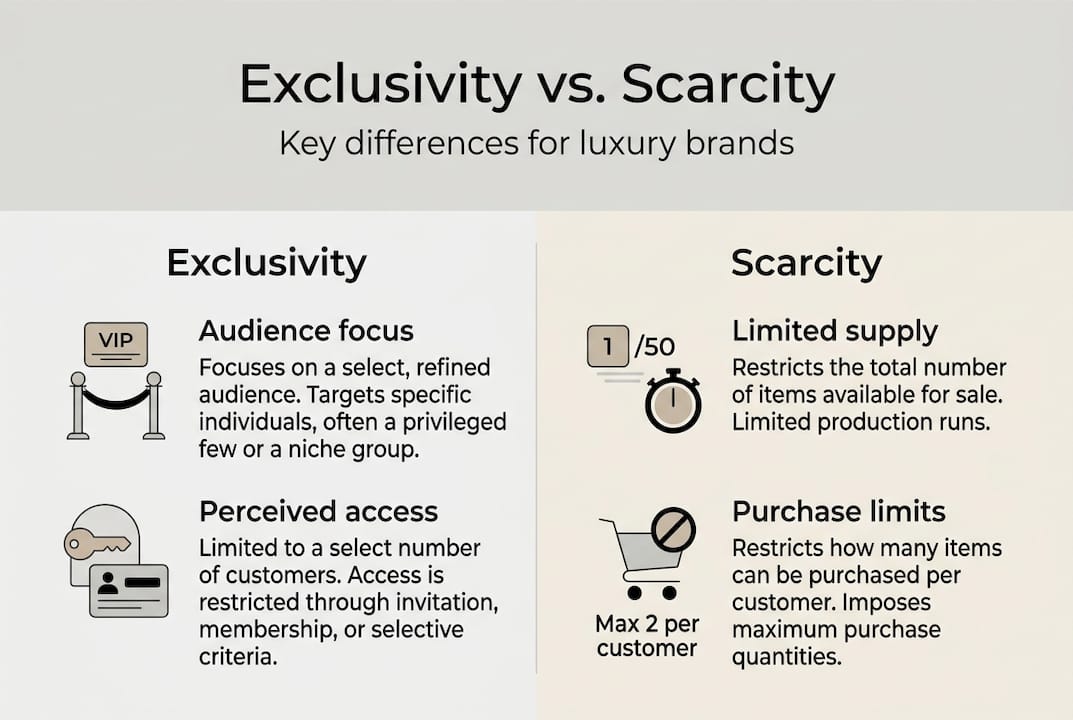
| Dimension | Exclusivity | Scarcity |
|---|---|---|
| Definition | Audience alignment and perception management | Supply limitation |
| Duration | Long-term, structural | Tactical, campaign-level |
| Brand impact | Builds enduring equity | Creates short-term demand spikes |
| Legal risks | Low if authentic | High if claims are misleading |
Exclusivity is about audience alignment and long-term equity, while scarcity is tactical. The legal risks emerge when scarcity claims misrepresent reality.
The major legal risk points brands must monitor:
- Misleading scarcity claims: Advertising a “limited edition” that is not genuinely limited invites regulatory action in the EU and US markets
- Tying arrangements: Requiring clients to purchase other products to access exclusive items, as alleged in the Hermès Birkin antitrust case in the United States
- Trademark non-use: Registering marks for exclusive product lines without genuine commercial use can result in cancellation proceedings
“Transparency in exclusivity claims is not just ethical best practice. It is increasingly a legal requirement as regulators scrutinize luxury sector access policies more closely.”
The Hermès Birkin case is instructive. Plaintiffs alleged that Hermès required clients to spend significant amounts on other products before being offered a Birkin. Whether or not the legal claims succeed, the reputational scrutiny alone demonstrates the risk of opacity in access policies. Ferrari faced EU trademark challenges over how it managed exclusive model designations. Using scarcity to drive exclusivity is legitimate. Misrepresenting it is not.
The strategic lesson is simple. Exclusivity built on genuine audience curation and authentic heritage is legally and reputationally resilient. Scarcity manufactured through artificial supply games or opaque access policies is fragile. Scarcity in luxury fashion has a long history, but the regulatory environment in 2026 demands more transparency than ever before.
Managing exclusivity amid massification and digital era challenges
Distinguishing exclusivity from scarcity highlights new obstacles brands face in today’s landscape. The pressure is real and structural. Global demand for luxury has expanded the consumer base, while digital platforms have democratized access to brand narratives. Both forces threaten the aura that exclusivity depends on.
Mass-market pressures force luxury brands to balance inclusivity with exclusivity through hybridized and curated digital strategies. This is the massification paradox. Growth is good for revenue but dangerous for perception. The brands navigating this best are those that expand access to brand story while restricting access to product.
The social media paradox compounds this. A brand that appears everywhere loses the mystique that makes it desirable. But a brand that disappears entirely loses cultural relevance. The answer is not a middle ground. It is a deliberate curation strategy.
Actionable ways to maintain aura in the digital era:
- Curated content calendars: Publish less, but make every piece of content feel like an event
- Invitation-only digital experiences: Private previews, members-only content, and early access for verified clients
- Controlled influencer access: Work with a small number of deeply aligned voices rather than broad ambassador networks
- Platform discipline: Resist pressure to be on every platform. Choose channels that match brand tone and audience behavior
- Community gatekeeping: Build private communities where access itself signals status
Pro Tip: Treat your content calendar the way Hermès treats its production schedule. Every piece that goes out should feel considered and intentional. Silence is not absence. It is a signal. Branding luxury value is built as much through what you withhold as through what you share.
The quiet luxury movement is not a trend. It is a market correction. Consumers with real purchasing power are moving toward brands that do not need to shout. That shift rewards brands that have invested in exclusivity as a discipline, not a tactic.
The overlooked discipline: What most luxury strategists miss about exclusivity marketing
These modern challenges call for a more rigorous, long-range perspective. Most luxury strategists understand exclusivity conceptually. Few practice it with genuine discipline over time.
The common failure is treating exclusivity as a campaign lever. A brand launches a limited drop, generates press, and then returns to business as usual. That cycle does not build exclusivity. It borrows from it. Each manufactured moment of scarcity that is not grounded in authentic brand logic erodes the very equity it claims to activate.
True exclusivity discipline means audience refinement is never finished. It means resisting the temptation to chase PR spikes by widening access. It means that when a campaign performs exceptionally well, the response is not to scale it. The response is to protect it.
The brands that get this right treat exclusivity as part of their DNA, not their marketing calendar. It shows up in hiring decisions, in retail design, in how client services teams are trained, and in which partnerships they decline. Brand loyalty through exclusivity is not won in a single campaign. It is accumulated through hundreds of consistent micro-decisions that signal to the right audience that this brand is for them, and not for everyone else.
Implementing exclusivity: Elevate your luxury brand strategy
If your team is ready to put these principles into action, here’s where real results begin. Exclusivity marketing requires more than strategic intent. It requires frameworks built on consumer psychology, behavioral data, and sector-specific expertise.
Corrado Manenti’s resources for luxury brand professionals offer exactly that. From fashion growth tactics designed for high-end market positioning, to frameworks that help you analyze buyer behavior in luxury contexts, to deep dives into psychology and luxury branding for 2026 engagement strategies, the toolkit covers every layer of exclusivity execution. If your brand is navigating massification pressures, digital curation challenges, or access policy design, these are the resources built for your context.
Frequently asked questions
What is the core definition of exclusivity marketing?
Exclusivity marketing is a strategy where brands manage perception, access, and communication to create lasting desire and premium value beyond mere supply limitation. It is selective positioning and controlled access applied as a long-term brand discipline.
How do exclusivity and scarcity differ in luxury marketing?
Exclusivity is about audience alignment and perception, while scarcity limits supply. As scarcity and luxury research shows, brands blend both, but exclusivity builds the enduring equity that scarcity alone cannot.
Are there risks in using scarcity tactics?
Yes. Misleading scarcity can trigger regulatory scrutiny and legal action. Legal boundaries of limited-edition offers are increasingly enforced, particularly in EU and US markets.
Which luxury brands are benchmarks for exclusivity marketing?
Hermès, Rolex, Ferrari, and Loro Piana set the standard through controlled production, invitation-only access, and disciplined narrative. Their economics of exclusivity are studied precisely because they are structurally consistent, not campaign-dependent.
What metrics should measure exclusivity marketing success?
Prioritize retention, relevance, and quality of attention over impressions or raw volume. Relevance and retention metrics reflect the depth of brand relationship that exclusivity is designed to build.