


TL;DR:
- Scarcity marketing limits product availability to boost perceived value and drive consumer action. It relies on psychological triggers like loss aversion, reactance, and social proof to create urgency and exclusivity. Authentic scarcity strategies strengthen brand trust, while false tactics can damage credibility and long-term relationships.
Scarcity marketing is defined as a strategy that limits the availability of a product, offer, or experience to increase perceived value and accelerate consumer decisions. The psychological engine behind it is loss aversion, a principle Robert Cialdini identified in Influence as one of the six core drivers of human persuasion. The numbers confirm the effect: 69% of millennials experience FOMO, and 60% of consumers make impulsive purchases when exposed to scarcity-based messaging. That is not a coincidence. It is a predictable behavioral response that brands like Girlfriend Collective have turned into measurable revenue. Understanding scarcity marketing means understanding why humans value what they might lose more than what they already have.
What is scarcity marketing and why does it work?
Scarcity marketing works because the human brain treats limited availability as a signal of value. Robert Cialdini’s scarcity principle states that consumers assign higher value to items that are less available. This is not a soft preference. It is a hardwired cognitive response.
Three psychological mechanisms drive the effect:
- Loss aversion: People feel the pain of losing something more intensely than the pleasure of gaining it. A “last 3 in stock” badge triggers that pain before the purchase even happens.
- Reactance theory: When freedom to obtain something is threatened, desire for it increases. Telling a consumer they can’t have something makes them want it more.
- Quality inference: Scarcity signals popularity. If something is running out, the brain concludes other people want it, which means it must be worth having.
Social proof amplifies all three. Scarcity combined with social proof, such as showing “47 people bought this today,” stacks two persuasion triggers simultaneously. The result is a consumer who feels both urgency and validation at the same time.
“Scarcity marketing is most effective when the limitation is real, visible, and verifiable. The moment a consumer suspects the scarcity is manufactured, the psychological contract breaks.”
One distinction matters here. Scarcity, urgency, and exclusivity are related but not identical. Scarcity limits quantity. Urgency limits time. Exclusivity limits who can buy. Each activates different psychological levers, and combining them is where the real conversion power lives.
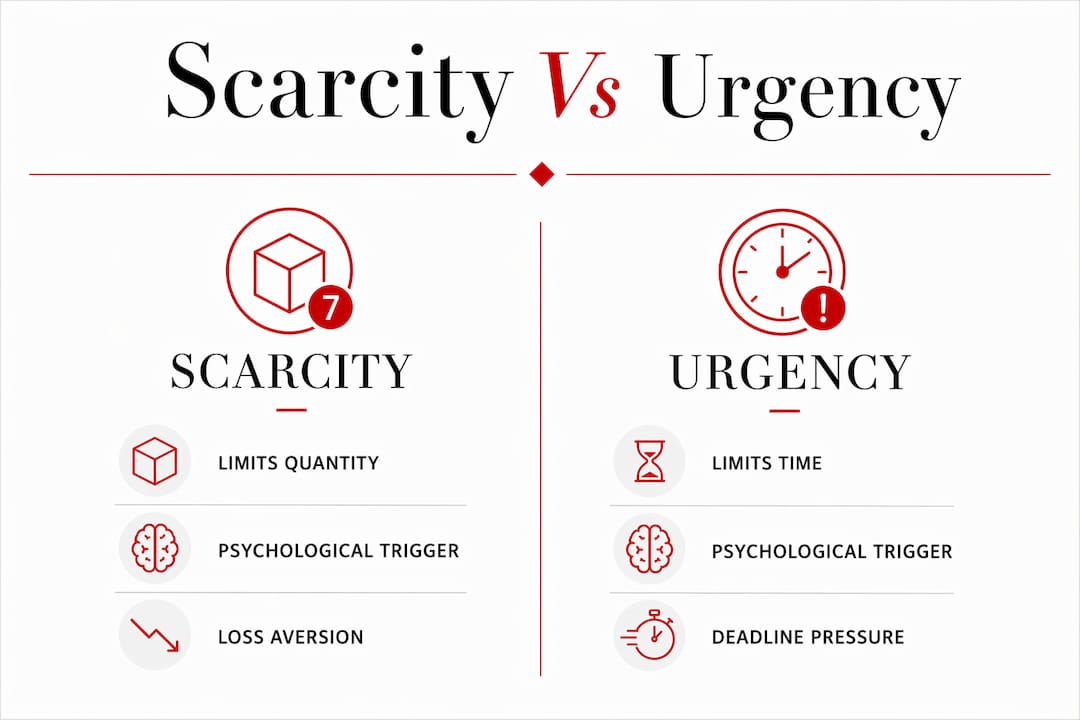
How does scarcity compare to urgency and exclusivity?
Marketers often use scarcity, urgency, and exclusivity interchangeably. That is a strategic mistake. Each concept operates on a different psychological axis, and confusing them leads to messaging that underdelivers.
| Concept | Core Mechanism | Example | Psychological Trigger |
|---|---|---|---|
| Scarcity | Limits quantity | “Only 4 left in stock” | Loss aversion, quality inference |
| Urgency | Limits time | “Sale ends at midnight” | Time pressure, deadline effect |
| Exclusivity | Limits access | “Members only drop” | Status, identity, belonging |
Scarcity answers the question: How many are available? Urgency answers: How long do I have? Exclusivity answers: Am I allowed to buy this at all?
The most effective campaigns combine at least two of these. Combining scarcity with urgency activates loss aversion from two directions at once, a method sometimes called the “two-cue stack.” An example: “Only 5 pairs left. Offer ends tonight.” That single line hits quantity scarcity and time urgency in six words.
Exclusivity adds a third layer. Luxury brands use it to signal that not everyone qualifies, which elevates perceived status. Luxury brands use scarcity marketing to create exclusivity, elevate perceived value, and drive demand in premium segments. The Hermès Birkin bag is the textbook case. Production is deliberately limited, waitlists are long, and access is controlled. The result is a product that appreciates in value over time.
Pro Tip: When building a campaign, decide which lever to pull first based on your brand positioning. Urgency works well for mass-market flash sales. Exclusivity works better for premium and luxury positioning where status matters more than speed.
What are the most effective scarcity marketing tactics?
Scarcity marketing strategies include limited quantity offers, flash sales, exclusive access, and timed discounts. Each tactic targets a specific stage of the consumer decision process. Here are seven that consistently produce results:
- Limited stock alerts: Display real-time inventory counts (“Only 2 left”) on product pages. This works because it makes the scarcity concrete and verifiable.
- Flash sales: Time-boxed discounts that expire within hours. The short window forces a decision before rational deliberation can override impulse.
- Countdown timers: Visual clocks on landing pages or email campaigns. The ticking clock makes time pressure visceral, not abstract.
- Limited edition products: A product that will never be restocked carries permanent scarcity. Supreme’s weekly drops built an entire brand identity on this mechanic.
- VIP early access: Giving a select group first access to a product combines scarcity with exclusivity. It rewards loyalty and creates a secondary wave of FOMO among those who missed out.
- Waitlists: Requiring consumers to queue for access signals high demand and builds anticipation. Brands like Notion and Clubhouse used waitlists to generate buzz before launch.
- Bundle scarcity: Offering a discounted bundle available only while stock lasts combines price incentive with quantity pressure.
The Girlfriend Collective case study is worth studying closely. The brand sold 10,000 pairs of leggings in one day using a limited-time free offer. The offer was real, the deadline was fixed, and the social buzz amplified the scarcity signal organically. No fake countdown. No manufactured urgency. The campaign worked because every element was credible.
Scarcity also works at the psychological level of FOMO and impulse purchases, particularly among younger consumers who are highly attuned to social signals. When a product is visibly selling out, the fear of missing out overrides price sensitivity. That is why limited drops often sell at full price while comparable products sit unsold at a discount.

Pro Tip: Pair your scarcity messaging with social proof. Show how many units sold in the last 24 hours alongside the remaining stock count. The combination of “going fast” and “almost gone” is more persuasive than either signal alone.
What are the ethical risks of scarcity marketing?
False scarcity is the fastest way to destroy the trust you spent years building. Artificial scarcity tactics such as static “only 2 left” badges that never change and countdown timers that reset after expiry signal dishonesty to any consumer who notices. And consumers notice more than brands assume.
The risks are specific and serious:
- Credibility collapse: A consumer who catches a fake countdown will not only distrust that campaign. They will distrust every future message from that brand.
- Social amplification of distrust: Screenshots of manipulative tactics spread quickly on social media. One viral post exposing a fake scarcity badge can undo months of brand building.
- Regulatory exposure: In several markets, false urgency claims in advertising are subject to consumer protection regulations. The legal risk is real, not theoretical.
- Long-term conversion damage: Excessive false scarcity erodes brand trust and damages long-term campaign credibility. Consumers who feel manipulated convert less, not more, over time.
The fix is straightforward. Effective scarcity marketing relies on real-time inventory integration or fixed deadlines to ensure scarcity claims are accurate and verifiable. If you say “only 5 left,” that number must reflect actual stock. If you say “offer ends Friday,” it must end on Friday.
Authenticity also means knowing when not to use scarcity. Overuse creates FOMO fatigue. If every product launch, every email, and every campaign screams “limited,” the signal loses meaning. Overuse of scarcity fatigues audiences, so the tactic should be used selectively within a broader brand strategy.
Pro Tip: Audit your current campaigns for any scarcity claims that cannot be verified in real time. Replace static badges with live inventory feeds. If your platform cannot support real-time stock counts, use fixed-deadline urgency instead. A real deadline is always more credible than a number that never moves.
Key takeaways
Scarcity marketing drives conversions when the limitation is real, the messaging is specific, and the tactic fits the brand’s positioning.
| Point | Details |
|---|---|
| Psychology is the foundation | Loss aversion, reactance, and quality inference all make scarcity a reliable conversion driver. |
| Three levers, not one | Scarcity, urgency, and exclusivity are distinct tools. Combining them multiplies impact. |
| Real examples outperform theory | Girlfriend Collective’s 10,000-unit day proves that genuine scarcity with social buzz delivers measurable results. |
| False scarcity backfires | Static badges and resetting timers destroy credibility faster than any campaign can rebuild it. |
| Use it selectively | Overuse fatigues audiences. Reserve scarcity tactics for high-priority launches and key conversion moments. |
Scarcity marketing in luxury: what i’ve learned working in the field
Working with fashion and luxury brands for years, I have seen scarcity marketing used brilliantly and used badly. The difference almost always comes down to one thing: whether the brand believes in the scarcity or is just performing it.
The brands that do it well treat scarcity as a structural decision, not a campaign tactic. They produce fewer units by design. They control distribution deliberately. They create waitlists because demand genuinely exceeds supply. When that is the foundation, every scarcity signal the brand sends is credible because it reflects reality.
The brands that do it badly reach for scarcity as a conversion shortcut. They add countdown timers to evergreen products. They display “only 3 left” on items that are never actually out of stock. Consumers in the luxury segment are particularly sensitive to this. They are experienced buyers who have seen every trick. When they detect manipulation, the brand does not just lose a sale. It loses the relationship.
What I tell clients is this: layering scarcity with urgency and exclusivity triggers multiple psychological motivators at once, but only if each layer is earned. Exclusivity must be real. Urgency must have a genuine deadline. Scarcity must reflect actual supply. When all three are authentic, the combined effect is powerful. When any one of them is manufactured, the whole structure collapses.
The other mistake I see is mismatched positioning. A brand that has spent years communicating abundance and accessibility cannot suddenly flip to scarcity without confusing its audience. Scarcity messaging must align with how your brand builds perceived value over time. For luxury, scarcity is a natural extension of the brand promise. For mass-market brands, it requires more careful framing.
My honest recommendation: use scarcity as a signal of genuine quality and genuine demand. If you have to manufacture the scarcity, the product probably needs more work, not more urgency.
— Corrado
How Corradomanenti helps luxury brands use scarcity strategically
Scarcity marketing is one of the most psychologically precise tools available to brand strategists. Used correctly, it builds desire, elevates perceived value, and drives conversion without discounting. Used carelessly, it erodes the trust that luxury brands spend years building.
Corradomanenti works with fashion, luxury, and lifestyle brands to build marketing strategies grounded in consumer psychology. From fashion brand growth tactics to buyer behavior analysis, the approach connects psychological insight to real commercial outcomes. If you want to apply scarcity marketing in a way that strengthens your brand rather than risks it, explore the strategies built specifically for the luxury market.
FAQ
What is scarcity marketing in simple terms?
Scarcity marketing is a strategy that limits the availability of a product or offer to increase its perceived value and push consumers to act faster. It works by triggering loss aversion, the psychological tendency to fear missing out more than we desire gaining something.
What are the main types of scarcity marketing tactics?
The main types include limited stock alerts, flash sales, countdown timers, limited edition products, VIP early access, and waitlists. Each tactic creates urgency or exclusivity through a different form of limitation.
How does scarcity marketing differ from urgency?
Scarcity limits quantity (“only 5 left”), while urgency limits time (“offer ends tonight”). Both activate loss aversion, but from different angles. Combining them, the two-cue stack, produces stronger conversion results than either tactic alone.
What are the risks of false scarcity in advertising?
False scarcity, such as static stock badges or resetting countdown timers, destroys consumer trust and damages long-term campaign credibility. Consumers who detect manipulation are less likely to convert in future campaigns and may share their distrust publicly.
How do luxury brands use scarcity marketing?
Luxury brands use scarcity to create exclusivity, elevate perceived value, and control demand in premium segments. Unlike mass-market brands, luxury labels often build scarcity into their production and distribution model by design, making the limitation structural rather than tactical.