


Every week presents a new challenge for American luxury brand leaders intent on sustaining a seamless client experience. Luxury marketing demands more than beautiful visuals; it requires every detail, from superior craftsmanship to emotional messaging, to feel unified across every American, Canadian, and international touchpoint. By exploring the core principles of brand consistency, executives will gain strategies to weave authentic connections that deepen brand loyalty and elevate retention among discerning consumers.
Table of Contents
- Defining Brand Consistency In Luxury Marketing
- Psychology Behind Consistent Brand Experiences
- Types Of Consistency: Visual, Messaging, And Service
- Impact On Client Retention And Brand Loyalty
- Risks Of Inconsistency In High-End Positioning
- Practical Steps To Achieve Brand Consistency
Key Takeaways
| Point | Details |
|---|---|
| Brand Consistency is Essential | Maintaining a coherent brand identity across all touchpoints is critical for luxury brands to resonate with consumers and create lasting emotional connections. |
| Psychological Impact Matters | Emphasizing emotional consistency and psychological safety in brand experiences can deepen consumer relationships and enhance brand loyalty. |
| Types of Consistency are Interconnected | Visual, messaging, and service consistency work together to establish brand credibility and trust, essential for luxury market positioning. |
| Inconsistency Presents Significant Risks | Brand inconsistency can undermine consumer trust and erode brand prestige, making regular audits and strategic alignment critical. |
Defining Brand Consistency in Luxury Marketing
Brand consistency represents the deliberate alignment of a luxury brand’s core identity, values, and visual elements across all consumer interactions. In the sophisticated world of luxury marketing, brand consistency transcends mere visual uniformity – it’s about crafting a comprehensive narrative that resonates emotionally and intellectually with discerning consumers.
Luxury brands must maintain a coherent identity that communicates superior craftsmanship and emotional connections while adapting to evolving market dynamics. This delicate balance requires strategic precision, ensuring that every touchpoint – from digital platforms to physical retail spaces – communicates a unified brand essence.
The critical components of brand consistency in luxury marketing include:
- Visual Identity: Uniform color palettes, typography, and design language
- Emotional Positioning: Consistent representation of brand values and heritage
- Communication Tone: Maintaining a distinctive voice across all channels
- Product Quality: Unwavering commitment to exceptional standards
These elements work synergistically to create a memorable brand experience that distinguishes luxury brands in a competitive marketplace. By meticulously orchestrating every interaction, luxury brands transform mere transactions into profound emotional connections.
Pro tip: Conduct quarterly brand audits to ensure every communication channel authentically reflects your luxury brand’s core narrative and emotional promise.
Psychology Behind Consistent Brand Experiences
Luxury brands leverage sophisticated psychological mechanisms to create deeply resonant consumer experiences that transcend traditional marketing approaches. At the core of these experiences lies emotional consistency, a powerful psychological strategy that transforms brand interactions from transactional exchanges into meaningful connections.
Research reveals that consistent brand experiences trigger positive psychological responses through intricate mental processes of imagery and social presence. These psychological triggers enhance brand authenticity and emotional engagement, creating a profound connection that goes beyond superficial brand interactions.
Key psychological dimensions of consistent brand experiences include:
- Emotional Predictability: Creating a sense of psychological safety
- Sensory Alignment: Coordinating visual, auditory, and tactile brand signals
- Narrative Coherence: Maintaining a unified brand storytelling approach
- Trust Reinforcement: Building credibility through consistent interactions
Consumer psychology demonstrates that brands which master these subtle psychological nuances can transform casual interactions into deep, lasting emotional relationships. The most successful luxury brands understand that consistency is not about rigid uniformity, but about creating a flexible yet recognizable emotional landscape that adapts to individual consumer needs.
Pro tip: Map your brand’s emotional touchpoints and audit their psychological consistency to create more authentic and resonant consumer experiences.
Types of Consistency: Visual, Messaging, and Service
Luxury brands navigate complex brand management by strategically implementing three critical dimensions of brand consistency that collectively shape consumer perceptions and experiences. These interconnected domains – visual, messaging, and service consistency – work in harmony to create a seamless and compelling brand narrative.

Brand consistency requires uniformity across multiple dimensions, each playing a unique role in establishing brand credibility and emotional connection. Visual consistency provides the foundational aesthetic language, messaging consistency communicates the brand’s core values, and service consistency ensures a reliable and predictable consumer interaction.
Key elements of brand consistency include:
-
Visual Consistency:
- Standardized logo usage
- Uniform color palettes
- Consistent typography
- Synchronized design elements across platforms
-
Messaging Consistency:
- Uniform brand tone
- Aligned core value communication
- Consistent storytelling approach
- Coherent verbal and written communication
-
Service Consistency:
- Predictable customer experience
- Uniform service standards
- Consistent quality across touchpoints
- Reliable interaction protocols
Successful luxury brands recognize that these consistency types are not rigid templates but flexible frameworks that allow for nuanced adaptation while maintaining a recognizable brand essence. The most sophisticated brands develop a consistency strategy that feels both familiar and dynamically responsive to evolving consumer expectations.
Here’s a concise overview of the three main types of brand consistency in luxury marketing:
| Consistency Type | Key Business Benefit | Challenge to Maintain |
|---|---|---|
| Visual | Instills instant brand recognition | Adapting designs across markets |
| Messaging | Strengthens brand values alignment | Keeping tone unified globally |
| Service | Builds dependable loyalty | Training staff consistently |
This table summarizes the primary risks luxury brands face when inconsistent branding occurs:
| Risk Category | Short-Term Effect | Long-Term Consequence |
|---|---|---|
| Reputation | Loss of consumer confidence | Erosion of brand exclusivity |
| Consumer Psychology | Increased uncertainty | Alienation from brand identity |
| Financial Performance | Revenue unpredictability | Decreased market share |
Pro tip: Develop a comprehensive brand guidelines document that meticulously details visual, messaging, and service consistency standards to ensure unified brand representation.
Impact on Client Retention and Brand Loyalty
Brand consistency emerges as a critical strategic lever for luxury brands seeking to cultivate deep, lasting consumer relationships. Client retention represents more than transactional loyalty – it is a sophisticated psychological contract built through predictable, meaningful brand interactions that consistently meet and exceed consumer expectations.
Product and service consistency significantly influence brand loyalty by constructing a foundation of trust and emotional connection. Luxury consumers do not merely purchase products; they invest in experiences that reflect their personal identity, making each interaction a critical opportunity to reinforce brand commitment.
Key factors driving client retention through brand consistency include:
-
Emotional Trust:
- Predictable brand experiences
- Consistent quality across interactions
- Reliable performance expectations
- Authentic brand representation
-
Psychological Safety:
- Reduced consumer uncertainty
- Reinforced brand credibility
- Sense of familiarity and comfort
- Validated consumer choices
-
Relationship Deepening:
- Progressive emotional investment
- Enhanced brand perception
- Increased likelihood of repeat purchases
- Positive word-of-mouth recommendations
The most successful luxury brands understand that client retention is not a destination but a continuous journey of creating meaningful, consistent experiences that resonate deeply with consumer aspirations and emotional needs.
Pro tip: Develop a comprehensive customer journey map that identifies and optimizes every potential consistency touchpoint to maximize emotional engagement and loyalty.
Risks of Inconsistency in High-End Positioning
In the precision-driven world of luxury branding, brand inconsistency represents a catastrophic strategic vulnerability that can rapidly erode decades of carefully constructed market positioning. Luxury consumers demand an uncompromising standard of excellence, where even minor deviations can trigger profound psychological disconnections from the brand narrative.
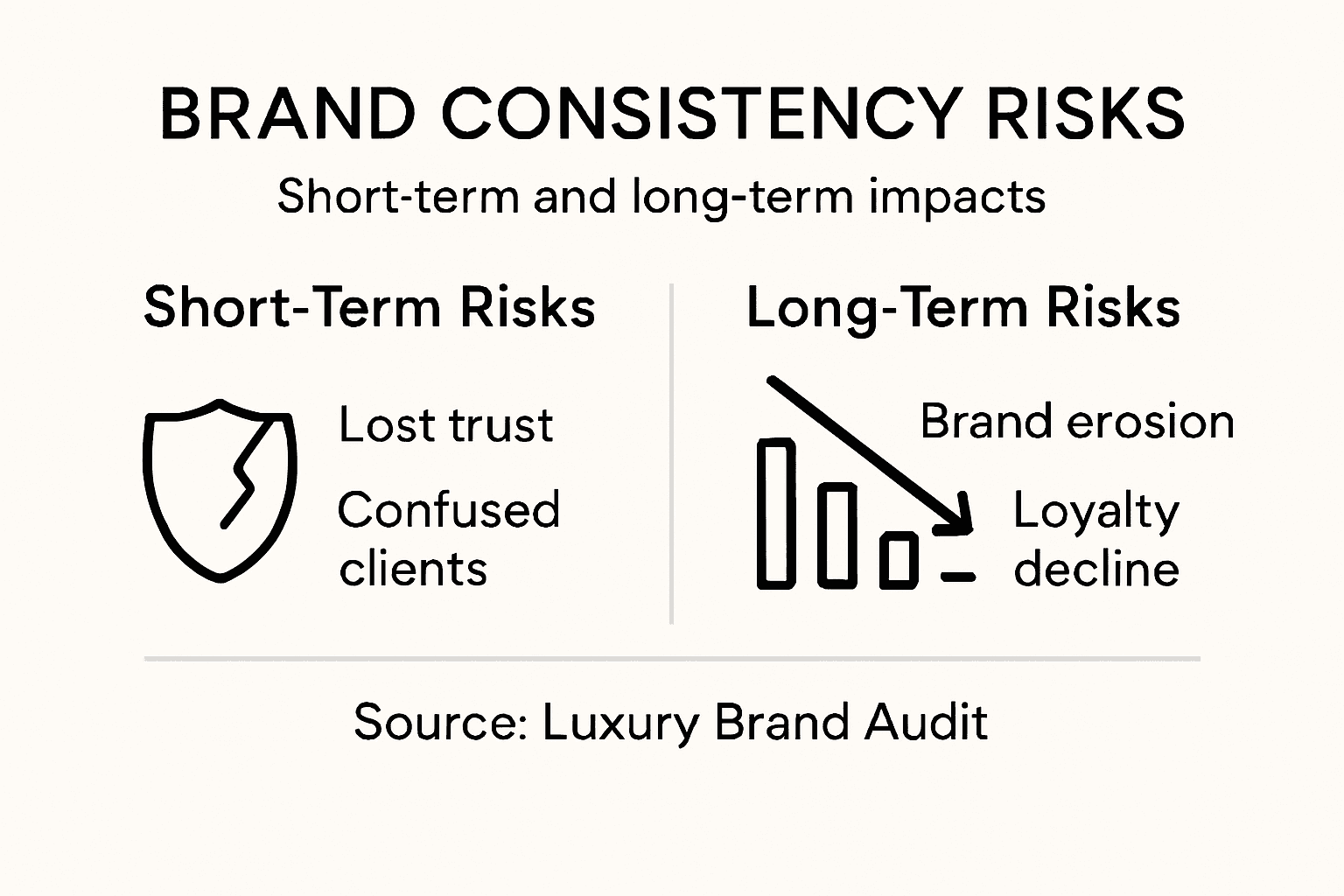
Inconsistent brand positioning risks diluting brand prestige by undermining the delicate ecosystem of consumer trust and perceived value. The consequences extend far beyond aesthetic misalignment, potentially triggering a cascading effect of diminished consumer confidence and irreparable brand reputation damage.
Key risks of brand inconsistency include:
-
Strategic Reputation Risks:
- Loss of luxury market credibility
- Erosion of brand exclusivity
- Diminished consumer perception of quality
- Reduced pricing power
-
Consumer Psychology Impacts:
- Increased consumer uncertainty
- Weakened emotional brand connection
- Reduced trust in brand promises
- Potential consumer alienation
-
Financial Performance Consequences:
- Decreased customer loyalty
- Higher customer acquisition costs
- Reduced market share
- Potential revenue volatility
Luxury brands operate in a nuanced ecosystem where perception is reality. Inconsistency acts as a silent corrosive force, gradually undermining the intricate psychological contract between brand and consumer that sustains premium market positioning.
Pro tip: Implement a rigorous quarterly brand audit that meticulously evaluates every consumer touchpoint for potential inconsistencies and misalignments.
Practical Steps to Achieve Brand Consistency
Brand consistency emerges as a sophisticated strategic imperative that requires meticulous planning, systematic implementation, and continuous refinement. Brand governance represents the foundational architecture through which luxury brands can systematically align their visual, communication, and experiential elements across diverse global touchpoints.
Organizations should conduct comprehensive brand asset audits to establish structured systems that empower distributed teams to produce consistently high-quality, on-brand content. These audits serve as diagnostic tools that reveal potential inconsistencies and provide strategic roadmaps for brand alignment.
Key practical steps for achieving brand consistency include:
-
Strategic Documentation:
- Develop comprehensive brand guidelines
- Create detailed visual identity manuals
- Establish clear communication protocols
- Define brand voice and tone specifications
-
Centralized Brand Management:
- Implement centralized asset management systems
- Control brand template access
- Develop approval workflows
- Create digital brand repositories
-
Continuous Monitoring:
- Conduct quarterly brand consistency reviews
- Track brand perception across channels
- Measure brand alignment metrics
- Implement feedback loops
Successful brand consistency transcends rigid rules; it represents a dynamic, adaptive framework that allows luxury brands to maintain their core identity while remaining responsive to evolving market nuances and consumer expectations.
Pro tip: Create a cross-functional brand consistency task force that includes representatives from marketing, design, product, and customer experience teams to ensure holistic brand alignment.
Strengthen Your Luxury Brand with Consistent, Psychology-Driven Marketing
Brand consistency is the cornerstone of lasting luxury loyalty and trust. If you struggle with maintaining a unified brand image across visuals, messaging, and service, or worry about the risks of inconsistency eroding your premium reputation, you are not alone. Achieving emotional alignment and seamless brand experiences is essential but challenging without expert guidance.
Corrado Manenti specializes in crafting personalized marketing strategies rooted in psychology to help luxury brands like yours deliver consistent, meaningful encounters that deeply engage discerning consumers. His fashion and luxury consulting ensures meticulous attention to every branding detail while leveraging innovative digital strategies to keep your brand fresh and relevant.
Unlock your brand’s full potential today with a strategic approach that integrates human behavioral insights and luxury expertise. Explore transformative solutions in Personal Branding – Corrado Manenti and discover how consistency builds emotional trust. Visit Corrado Manenti now to begin elevating your luxury brand experience.
Don’t let inconsistencies weaken your market position. Act now and partner with a consultant who understands that true luxury loyalty starts with authentic, consistent brand storytelling. Learn how to transform every customer touchpoint into an opportunity for lasting emotional connection through personalized marketing strategies.
Frequently Asked Questions
What is brand consistency in luxury marketing?
Brand consistency in luxury marketing refers to the alignment of a brand’s identity, values, and visual elements across all consumer interactions, ensuring a coherent narrative that resonates emotionally with consumers.
How does brand consistency affect client retention in luxury brands?
Brand consistency enhances client retention by building emotional trust and psychological safety, creating reliable brand experiences that deepens consumer relationships and encourages repeat purchases.
What are the main types of brand consistency?
The main types of brand consistency include visual consistency, which focuses on standardized design elements; messaging consistency, which aligns communication with brand values; and service consistency, which ensures a predictable customer experience.
What are the risks of brand inconsistency for luxury brands?
Brand inconsistency can lead to diminished consumer confidence, erosion of brand prestige, increased consumer uncertainty, and ultimately, financial performance issues such as decreased customer loyalty and market share.
Recommended
- Understanding the Role of Trust in Luxury Marketing – Corrado Manenti
- Complete Guide to Brand Trust in Luxury Markets – Corrado Manenti
- Complete Guide to Brand Trust in Luxury Markets – Corrado Manenti
- Role of Trust in Luxury Sales: Impact on Customer Loyalty – Corrado Manenti
- Dog Accessory Collections That Define Style And Quality