

TL;DR:
- True finesse in branding is about skillful, subtle handling of strategy to evoke specific emotions.
- Implementing finesse requires defining brand essence, designing explicit guidelines, and maintaining consistency across touchpoints.
- Finesse builds trust and loyalty by delivering emotional continuity, contrast, curiosity, and engagement over time.
Most brand strategists think finesse is about looking expensive. It’s a reasonable assumption. Sleek visuals, editorial photography, carefully chosen typography. But that framing misses the real engine behind luxury brand performance. True finesse, in its most useful sense, is skillful, subtle handling of strategy rather than force, a quiet architecture of decisions that shapes how people feel about your brand over time. This guide will decode what finesse actually means in a luxury context, show how it gets operationalized, and give you frameworks you can apply right now.
Table of Contents
- The true meaning of finesse in branding
- Mechanics of finesse: From strategy to execution
- The psychology of luxury: How finesse builds trust and loyalty
- Finesse vs. polish: Avoiding dilution in the digital age
- Applying brand finesse: Frameworks and real-world strategies
- Perspective: Why true finesse is a discipline, not a vibe
- Advance your brand finesse with expert support
- Frequently asked questions
Key Takeaways
| Point | Details |
|---|---|
| Finesse is strategic depth | True finesse is a disciplined system translating brand strategy into every detail, not just superficial polish. |
| Psychology builds lasting loyalty | Finesse in luxury branding relies on creating emotional bonds and sustained experiences that shift desire to devotion. |
| Consistency prevents dilution | Intentional continuity across all brand touchpoints ensures luxury brands remain memorable and differentiated. |
| Digital demands opinionated detail | Online channels increase the risk of dilution, making disciplined, brand-specific choices critical for longevity. |
| Application is measurable | Brand health KPIs, repeat engagement, and emotional resonance are practical ways to track finesse in action. |
The true meaning of finesse in branding
The word “finesse” gets borrowed freely in marketing conversations, usually as a synonym for “polished” or “refined.” That’s a surface-level reading, and it costs brands a great deal of strategic clarity.
In practice, finesse refers to something far more precise. It is the ability to translate brand strategy into thousands of small, intentional decisions that collectively create a specific emotional experience. Every word in a product description, the weight of a packaging box, the pacing of an in-store conversation, these are not decoration. They are finesse in action.
“In everyday business usage, ‘finesse’ means skillful, subtle handling of a situation, often with clever, smooth strategy rather than force.” (Finesse Meaning)
For luxury brands, the stakes are higher because the audience is more sophisticated. Your clients notice what’s missing. They detect inconsistency. They feel when something is off, even if they can’t articulate why. This is why finesse in luxury operates on three dimensions:
- Charisma: A distinct brand personality that draws people in without needing to explain itself
- Consistency: A relentless sameness of tone, quality, and experience across every touchpoint
- Emotional journey: A structured arc that moves the customer from initial curiosity through desire and, ultimately, into devotion
Finesse is not an aesthetic choice. It is a strategic discipline. And the brands that understand this distinction are the ones that sustain pricing power and cultural relevance across decades.
Mechanics of finesse: From strategy to execution
Knowing what finesse is gives you the vocabulary. Knowing how it works gives you the tools. The operational challenge for most luxury brands is the translation gap: the space between a brilliant brand strategy document and what actually happens when a customer interacts with your brand on a Tuesday afternoon.
Think of finesse as a translation layer between strategy and touchpoint execution, a system designed to preserve intentionality at every level of the organization.
Here is how that system works in practice:
- Clarify your brand essence: Before any execution, define what your brand actually stands for at an emotional level. Not your features. Not your heritage talking points. The emotional truth.
- Design your brand system: Develop explicit decision rules for tone of voice, visual identity, service language, and product presentation. These rules should be specific enough that a new team member can apply them without guessing.
- Implement with specificity: Every touchpoint, from your email footer to your packaging tissue paper, should reflect a deliberate choice. Vagueness is the enemy of finesse.
- Audit for drift: Luxury brands erode when they allow small inconsistencies to accumulate. Build regular brand audits into your operating rhythm.
- Train your people: Systems only work if people understand the why behind them. Train teams not just on what to do, but on what the brand is trying to make customers feel.
The table below illustrates how finesse changes the experience across key brand touchpoints:
| Touchpoint | Without finesse | With finesse |
|---|---|---|
| Product packaging | Attractive but generic | Weight, texture, and opening ritual reinforce brand values |
| Customer service tone | Professional and polite | Warm, specific, and emotionally intelligent |
| Social media content | On-trend and visually pleasing | Opinionated, consistent, and unmistakably branded |
| In-store environment | Well-designed | Every sensory detail aligned to the emotional story |
| Email communication | Informative | Reads like a personal letter from a trusted curator |
Pro Tip: Brand consistency in luxury is not about rigidity. It is about disciplined flexibility, knowing which elements are non-negotiable and which can evolve with context.
The brands that execute finesse most effectively treat it not as a creative aspiration but as an operational standard. Hermes does not accidentally wrap a bag in orange tissue. That is a system decision, made deliberately, enforced consistently, and understood by everyone in the organization.
The psychology of luxury: How finesse builds trust and loyalty
Execution matters. But the real reason finesse works is psychological. Luxury consumers are not just buying products. They are buying feelings, specifically the feeling of being understood, valued, and elevated. Finesse is the mechanism that delivers those feelings reliably.
Emotional consistency is the cornerstone. When a brand delivers the same quality of emotional experience across every interaction, it builds a neurological shortcut in the customer’s mind. Your brand becomes associated with a specific feeling state, and that association becomes self-reinforcing. The customer seeks you out because of how you make them feel, not just because of what you sell.
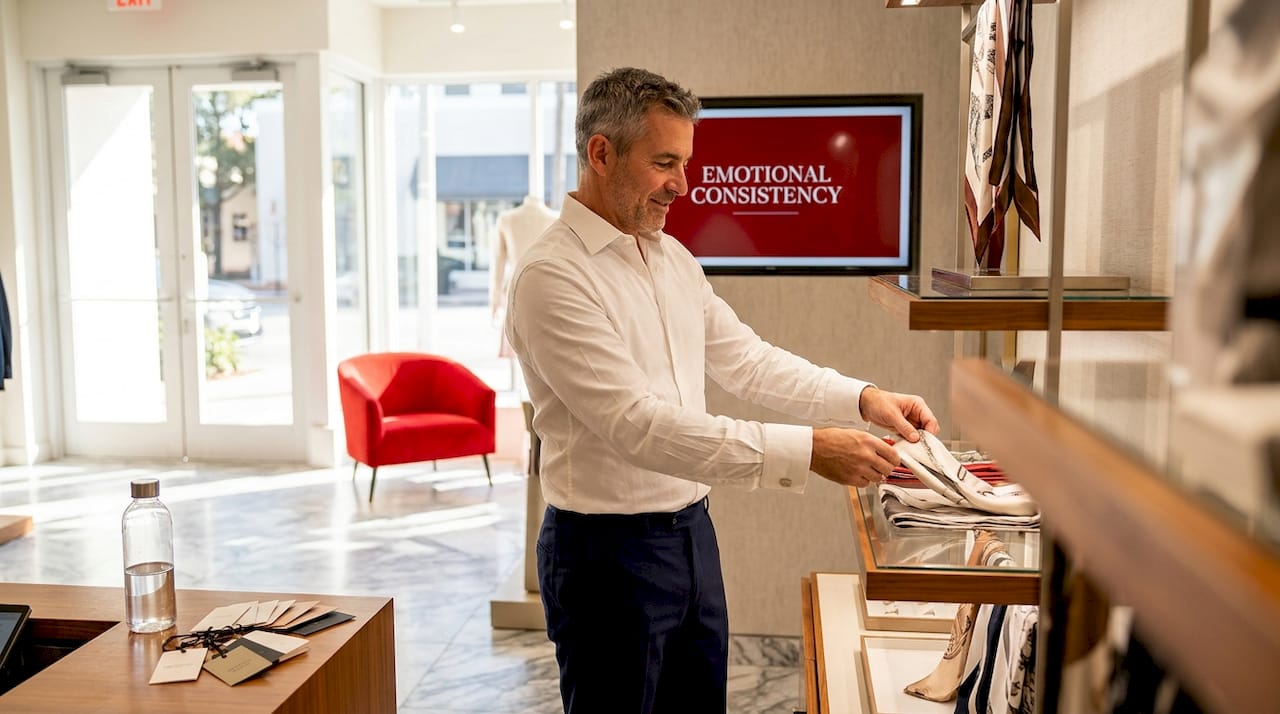
Research in consumer psychology consistently confirms this: luxury devotion builds from accumulated positive experience rather than from clever marketing tactics. This is a critical insight for strategists who focus too heavily on acquisition and not enough on the depth of ongoing engagement.
Finesse strengthens emotional bonds through four key psychological levers:
- Clarity: Customers should never be confused about what your brand stands for or who it is for. Ambiguity breeds distrust.
- Contrast: The best luxury brands stand out by being specific, even provocative, about their point of view. Contrast creates memorability.
- Curiosity: A brand with true finesse leaves room for discovery. There is always another layer, another detail, another story that rewards the attentive customer.
- Continuous engagement: Loyalty is not an event. It is the product of consistent, meaningful interactions over time.
The emotional and commercial case for this is strong. Consider what happens when you get it right:
| Psychological effect | Brand outcome | Business metric |
|---|---|---|
| Trust through consistency | Reduced price sensitivity | Higher margin |
| Emotional attachment | Repeat purchase behavior | Lifetime value |
| Brand devotion | Word-of-mouth advocacy | Lower acquisition cost |
| Perceived exclusivity | Prestige positioning | Stronger pricing power |
Pro Tip: Map your customer’s emotional journey, not just their purchase journey. Identify the moments where your brand should make them feel seen, and design those moments with the same rigor you would apply to a product launch. You can explore this more deeply through the lens of boosting luxury loyalty and psychology in luxury customer experience.
The brands that understand emotional architecture are the brands that earn devotion. Think about what makes certain luxury objects compelling beyond their functional purpose. It is the accumulated meaning, the ritual, the story. Finesse is how brands build that accumulated meaning intentionally.
Finesse vs. polish: Avoiding dilution in the digital age
There is a trap that catches even sophisticated brand teams. It is the confusion between finesse and polish. Polish is surface quality, and it is relatively easy to buy. A strong creative director, a premium photo studio, a well-funded paid media campaign. Polish makes brands look right.
Finesse is harder because it requires conviction. It demands that your brand make opinionated, specific choices and hold them consistently, even when trends pull in another direction. And in digital environments, that pressure to follow trends is relentless.
Here is what dilution looks like in practice:
- A luxury brand starts creating Reels because every competitor is doing it, without asking whether short-form video fits the brand’s emotional register
- A fashion house adopts the visual language of streetwear to chase younger demographics, undermining the heritage story that justified its prices
- A brand produces high volumes of content to stay “present” on every platform, sacrificing depth for breadth
- Influencer partnerships are chosen for reach rather than for alignment with the brand’s values and aesthetics
“Brands often need disciplined specificity, ‘opinionated’ details, and long-horizon consistency, or else they risk becoming forgettable or diluted, especially online.” (Grind Brand Director Interview)
The antidote is not to avoid digital channels. It is to apply finesse to how you use them. That means selective presence over blanket coverage, depth of engagement over volume of content, and a willingness to say no to channels or tactics that do not serve the brand’s emotional story.
True luxury brands understand that defining their standards means knowing what they will not do as clearly as what they will. This discipline is what separates brands that age beautifully from brands that become irrelevant within a decade. You can explore how luxury branding consistency and emotional engagement in fashion reinforce each other in practice.
Applying brand finesse: Frameworks and real-world strategies
Theory without application is just vocabulary. Here is how to actually embed finesse into your brand operations.
The core framework has five steps:
- Audit your brand essence: Write a one-paragraph statement of your brand’s emotional promise. If you cannot do this in plain language, your team cannot deliver it consistently.
- Design intentional systems: Create explicit guidelines for every customer touchpoint. These should specify not just what to do but why, so teams can make judgment calls that align with the brand.
- Train for emotional intelligence: Your frontline team members are finesse delivery mechanisms. Invest in training that builds emotional awareness, not just procedural compliance.
- Measure relationship depth: Track brand recall, emotional engagement scores, Net Promoter Scores, and repeat purchase rates. These tell you more about finesse than impressions or clicks.
- Refine through feedback loops: Build structured mechanisms for capturing qualitative feedback from your most loyal customers. They will tell you where the experience breaks down.
Real industry practice supports this framework. Chanel’s touchpoint design is a case study in disciplined finesse. Every retail environment, every piece of communication, every product launch is governed by decisions that trace back to a coherent brand philosophy. Nothing is accidental. Similarly, Hermès uses brand charisma through clarity, contrast, and an almost obsessive commitment to craft storytelling to maintain its position as the defining luxury brand of the modern era.
What both brands share is a refusal to compete on trend. They compete on emotional resonance and accumulated meaning. That is finesse as a long-term competitive strategy.
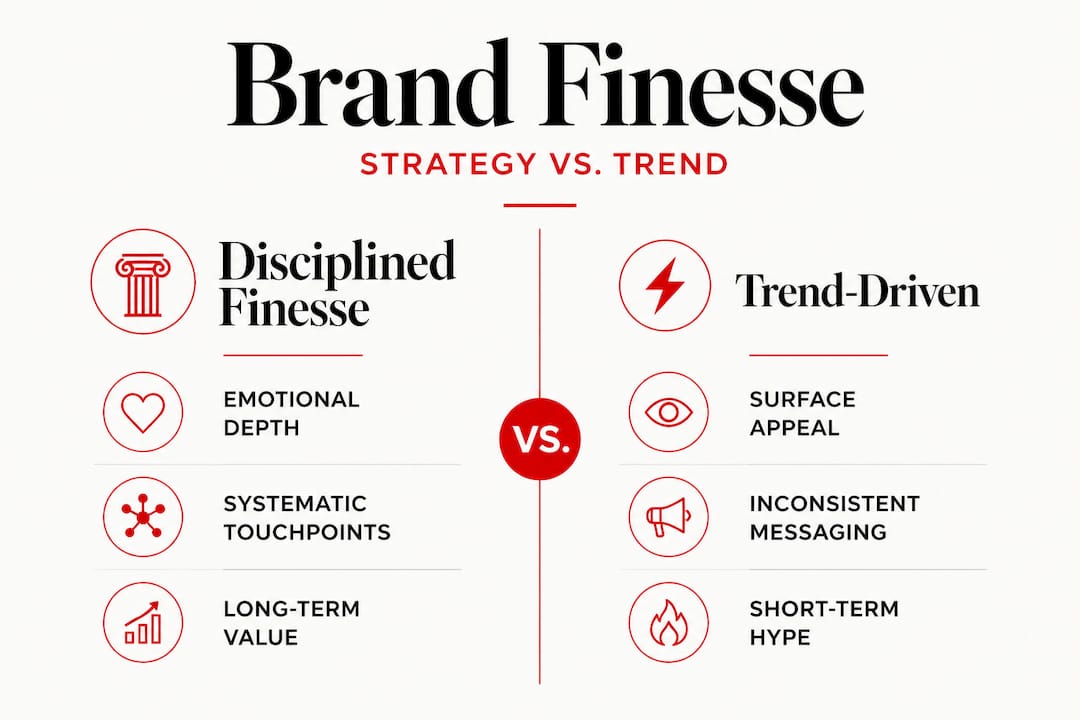
Pro Tip: Revisit your brand’s key performance indicators and ask whether they measure relationship quality or just transaction volume. If your metrics don’t capture emotional engagement, you are flying blind. Start with psychology in luxury branding to understand which signals actually predict long-term brand health.
Perspective: Why true finesse is a discipline, not a vibe
Here is something most brand conversations avoid saying directly: the majority of brands that claim to pursue finesse are actually pursuing aesthetics. They are spending budget on look and feel while neglecting the systemic discipline that makes those investments compound over time.
Finesse, real finesse, is uncomfortable. It requires saying no repeatedly. It means your brand will look “boring” to trend-obsessed observers because you are not chasing every new format, palette, or cultural moment. It means your team needs to understand the brand at a conceptual level, not just follow a style guide.
The rare brands that get this right, the ones that maintain cultural gravity across generations, have one thing in common: they treat their brand consistency guide not as a document but as a living discipline. Every decision, large or small, is filtered through the question: does this deepen or dilute our emotional promise?
Trends are, by definition, temporary. A brand that hitches its identity to trends will need to reinvent itself every few years, losing equity with each cycle. A brand that builds through disciplined finesse accumulates equity. The customer’s memory of how this brand made me feel becomes a competitive moat that no budget can easily replicate.
My strong belief, informed by years of working at the intersection of psychology and luxury marketing, is that the most powerful thing a brand can invest in is not creative execution. It is strategic clarity, expressed consistently, over a long time horizon. That is the discipline behind finesse. And it is, frankly, rarer than it should be.
Advance your brand finesse with expert support
Translating the concept of finesse into daily brand operations is where most teams get stuck. The gap between a compelling strategy and consistent execution is real, and it costs brands both revenue and reputation.
If your team is ready to move from theory to results, specialized consulting can help you systematize finesse, design meaningful measurement frameworks, and turn psychological insights into brand decisions that actually hold under pressure. Corrado Manenti’s work at the intersection of consumer psychology and luxury brand strategy offers exactly that kind of structured support. Explore curated fashion brand growth tactics and hands-on frameworks for psychology-driven luxury branding to see how these principles translate into competitive advantage for fashion and luxury brands.
Frequently asked questions
How is finesse different from traditional brand polish?
Finesse prioritizes subtlety, systemized strategy, and emotional continuity over simple aesthetic polish. A polished brand looks right; a brand with finesse makes customers feel something specific and consistent, regardless of the channel or context.
Why does finesse matter more in luxury branding?
Luxury consumers are highly attuned to inconsistency and inauthenticity, making emotional continuity essential. Luxury devotion builds through accumulated positive experience rather than clever tactics, meaning finesse is the primary driver of long-term pricing power and loyalty.
Can digital-first brands achieve finesse?
Yes, but only by resisting the pressure to optimize for reach at the expense of depth. Digital-first brands can apply finesse by making opinionated brand choices, maintaining consistent emotional registers across platforms, and measuring brand health rather than just engagement volume.
What are practical ways to measure brand finesse?
Metrics like brand recall, emotional engagement scores, repeat purchase rates, and qualitative relationship depth best capture finesse in action. These indicators reflect the emotional bond built over time that defines genuine finesse, far better than impressions or follower counts.