


TL;DR:
- Consumer insight interprets consumer data by revealing why people behave a certain way, not just what they do. It guides strategic decisions by linking observed patterns to emotional motivations and offering actionable recommendations. Most brands mistake demographic data for insights, leading to ineffective marketing and missed opportunities.
Consumer insight is defined as the interpretation of consumer data that reveals why people behave the way they do, not just what they do. Raw data tells you that 60% of shoppers prefer mobile checkout. A genuine consumer insight tells you they prefer it because they shop during their morning commute, which means your checkout flow needs to work in 30 seconds on a small screen. That distinction separates brands that react from brands that lead. For marketing professionals and business leaders, understanding consumer insight is the difference between guessing at strategy and building one that holds.
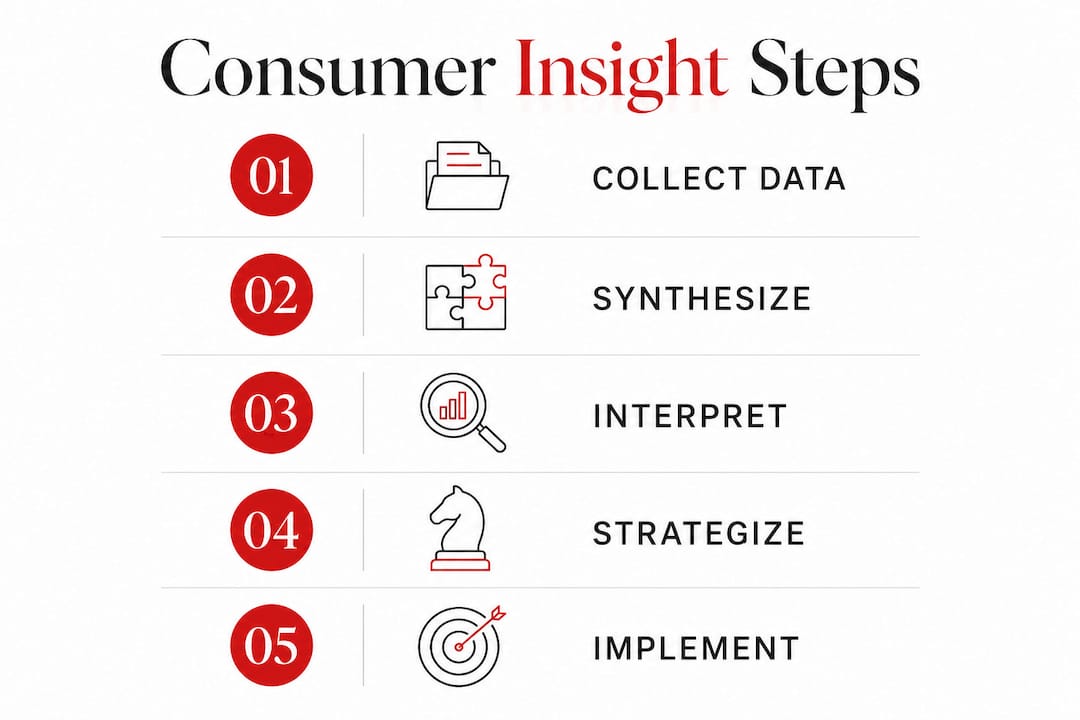
What is consumer insight, and how does it differ from market research?
Consumer insight and market research are not the same thing. Market research collects the “what” — percentages, preferences, and purchase frequencies. Consumer insight interprets the “why” behind those numbers and connects them to a business decision.
Think of market research as the raw ingredient and consumer insight as the finished dish. A research report might show that a luxury brand’s repeat purchase rate dropped 12% in a quarter. That is useful data. The insight is that repeat buyers felt the post-purchase experience was impersonal, which means the brand needs to redesign its client follow-up program, not its product.
The main output of consumer insight is a strategic recommendation that a CMO can defend in a board meeting. Market research produces data-heavy reports. Consumer insights produce direction. One tells you what happened; the other tells you what to do about it.
The timeline also differs. Market research is often a project with a start and end date. Consumer insight is an ongoing process that synthesizes findings from sales data, customer service logs, social sentiment, and behavioral analytics into a living picture of your customer.
Pro Tip: Before presenting any research finding to leadership, ask yourself: “So what?” If you cannot answer that question with a clear business action, you have data, not an insight.
What methods and tools uncover consumer insights?
No single method produces a complete consumer insight. Qualitative and quantitative approaches work together, each filling gaps the other leaves behind.
Qualitative methods reveal motivations and emotional drivers:
- In-depth interviews uncover the personal reasoning behind purchase decisions that surveys never capture.
- Ethnographic observation shows how consumers actually use products in real environments, which often contradicts what they say in focus groups.
- Thematic analysis of open-ended survey responses surfaces recurring language patterns that point to unmet needs.
- Social listening captures unprompted, real-time consumer sentiment. Social data provides honest signals of actual frustrations and desires that prompted methods like surveys rarely surface.
Quantitative methods validate and scale what qualitative methods find:
- Correlation analysis identifies which behaviors predict future purchases or churn.
- CRM data integration connects purchase history with demographic and behavioral data to build predictive segments.
- Behavioral analytics from web and app platforms shows where consumers drop off, hesitate, or convert.
The critical discipline is synthesis. Layering findings from diverse sources — sales data, social sentiment, and ethnographic studies — produces multi-dimensional insights rather than static reports. A single data source produces a data point. Multiple sources, interpreted together, produce an insight.
Pro Tip: Map your data sources before you start any insight project. If all your inputs come from surveys, you are only hearing from people willing to answer surveys. That is a biased sample by definition.

What are practical examples of consumer insights in action?
Consumer insights examples show the gap between knowing a fact and knowing what to do with it. The following scenarios illustrate how insights translate into decisions across marketing, product, and experience design.
-
Mobile checkout preference. Data shows 60% of users complete purchases on mobile. The insight is that they shop during commutes, meaning they need a checkout process that works in under 30 seconds with one hand. The decision: redesign the mobile checkout to reduce steps and enable biometric payment.
-
Luxury buyer motivation. A fashion brand’s data shows strong sales among 35-to-45-year-old professionals. A demographic observation is not an insight. The insight is that this group buys to signal competence and taste to peers, not to display wealth. The decision: shift campaign messaging from exclusivity to craftsmanship and quiet authority. Corradomanenti applies exactly this kind of motivational analysis when building luxury brand positioning for clients in the fashion sector.
-
Habitual purchase behavior. Consumers often skip formal decision-making stages for habitual purchases, jumping directly from need recognition to purchase. The insight for a skincare brand is that loyalty is built in the replenishment moment, not the discovery moment. The decision: invest in subscription reminders and auto-replenishment programs rather than awareness campaigns.
-
Post-purchase experience gaps. Customer service data shows a spike in contacts 48 hours after delivery. The insight is that buyers feel uncertain about their purchase and need reassurance. The decision: send a personalized post-delivery message that reinforces the value of what they bought and introduces the brand’s care services.
Each of these examples follows the same structure: observed pattern, underlying motivation, and clear business action. That structure is what separates a genuine insight from a data point dressed up as one.
What role do consumer insights play in shaping marketing strategy?
Consumer insights are the foundation of every marketing decision that actually works. Without them, segmentation is guesswork, messaging is generic, and product development is driven by internal assumptions rather than real customer needs.
Consumer insights drive marketing strategy by revealing motivations, enabling targeted messaging, and anticipating how behavior will evolve. That last point is underappreciated. Most brands use insights reactively, to explain what already happened. The most competitive brands use them predictively, to get ahead of shifts before they show up in sales data.
The role of insights across key marketing functions includes:
- Segmentation: Insights replace demographic buckets with motivation-based segments. “Women aged 28–40” is a demographic. “Professionals who buy luxury goods to reward personal milestones” is a segment you can write a campaign for.
- Messaging: When you know why a consumer buys, you know which emotional trigger to activate. Messaging built on insight converts at a higher rate because it speaks to the real reason, not the assumed one.
- Product development: Insights surface unmet needs before competitors do. Understanding consumer behavior as a blend of psychology, sociology, and economics gives brands the ability to predict what customers will want next, not just what they want now.
- Loyalty programs: Insight-driven loyalty programs reward the behaviors that actually drive retention, not just repeat purchases. A luxury brand might reward clients for attending private events, because the insight shows that experiential engagement predicts long-term loyalty better than transaction frequency.
- Channel strategy: Knowing where and when your consumer is most receptive determines where you spend media budget. An insight about commute-time shopping behavior changes your paid social scheduling, your push notification timing, and your content format.
For brands in the fashion and luxury sector, Corradomanenti’s consumer behavior analysis approach connects these insight-driven functions into a single, coherent strategy rather than treating them as separate workstreams.
Key Takeaways
Consumer insight is the interpretation of consumer behavior that links observed patterns to motivations and produces clear business recommendations, not just data reports.
| Point | Details |
|---|---|
| Insight vs. research | Market research collects “what” data; consumer insight explains “why” and recommends what to do next. |
| Methods require layering | Combining qualitative and quantitative sources produces insights; relying on one source produces data points. |
| Pass the “so what?” test | Every insight must link a pattern to a motivation and end with a specific business action. |
| Demographics are not insights | Knowing a buyer’s age and income is not an insight; knowing their motivation and trigger is. |
| Insights drive strategy | Segmentation, messaging, product development, and loyalty programs all perform better when built on genuine insights. |
Why most brands are still confusing data with insight
I have worked with fashion and luxury brands long enough to recognize a pattern that costs companies real money. They commission research, receive a 60-page report full of charts, and then make the same decisions they were already planning to make. The report gets filed. Nothing changes.
The problem is not the data. The problem is that many marketers confuse demographic data with true insights. Knowing that your buyer is a 38-year-old urban professional with a household income above $150,000 tells you almost nothing about how to sell to her. Knowing that she buys luxury goods to mark personal achievements, and that she researches purchases for weeks before committing, tells you everything about your campaign timing, your messaging tone, and your content strategy.
The second mistake I see constantly is treating insight as a project rather than a process. A brand runs a focus group in march, gets some findings, and considers the insight work done for the year. Real insight requires ongoing synthesis. Sales data from last week, social sentiment from yesterday, and a customer interview from this morning all belong in the same picture. The brands that win are the ones that build that picture continuously, not annually.
The hardest part is internal. Insights gathered by the research team rarely reach the product team or the retail experience team in a usable form. Building a shared language for insights across functions is as important as the research itself. If the insight lives only in a deck that three people have read, it has no value.
My advice: apply the psychology behind luxury consumer behavior to every insight you generate. Ask not just what your consumer does, but what that behavior means to them emotionally. That is where the real competitive advantage lives.
— Corrado
How Corradomanenti applies consumer insights to luxury brand growth
Corradomanenti works with fashion, luxury, and lifestyle brands that need more than data. They need interpretation, strategy, and execution grounded in how consumers actually think and decide.
The approach combines psychology-driven research with applied marketing experience in high-end contexts. That means going beyond survey results to understand the emotional and social motivations that drive purchase behavior in the luxury sector. For brands ready to turn consumer knowledge into a real competitive advantage, the fashion brand growth tactics developed by Corradomanenti offer a structured path from insight to market impact. Every engagement starts with understanding the consumer at a level most brands never reach.
FAQ
What is the definition of consumer insight?
Consumer insight is the interpretation of consumer data that explains why people behave as they do and recommends a specific business action. It goes beyond raw data to connect observed patterns with underlying motivations.
How does consumer insight differ from market research?
Market research collects data about what consumers do. Consumer insight explains why they do it and translates that understanding into a strategic recommendation a business can act on.
What are the best methods for gathering consumer insights?
The most effective approach combines qualitative methods like in-depth interviews and social listening with quantitative methods like correlation analysis and CRM data integration. Layering multiple sources produces insights; relying on one source produces data points.
Why do marketers confuse demographics with consumer insights?
Demographic data describes who a consumer is, not why they buy. A genuine insight links a behavior to a motivation and ends with a clear direction for messaging, product, or experience design.
How do consumer insights improve marketing strategy?
Consumer insights improve segmentation, messaging, product development, loyalty programs, and channel strategy by replacing assumptions with evidence about what actually motivates purchase decisions.