

Niche marketing means focusing your product and promotional efforts on a specific, well-defined audience segment rather than trying to appeal to everyone. Instead of casting the widest net possible, you identify a smaller group with shared characteristics, unmet needs, or distinct preferences, then build your messaging, product, and channels around exactly that group. The result is deeper resonance, stronger loyalty, and often a price premium that mass-market brands simply cannot command.
What separates niche marketing from mass marketing comes down to scope and intention. Mass marketing speaks to the broadest possible audience with a single message. Niche marketing speaks to a precise group with a message that feels personal. The core elements that define a niche approach:
- Demographic focus: age, income, location, occupation
- Psychographic focus: values, lifestyle, interests, and buying motivations
- Unmet needs: friction points where mainstream products fall short
- Tailored messaging: language and tone that mirrors how the audience actually talks
- Specialized channels: platforms and communities where the niche actively gathers
What are the real benefits of niche marketing?
Niche marketing drives efficiency by focusing budgets on channels where the niche audience is active, making feedback more actionable. That focus compounds over time. When every dollar targets people who are already predisposed to care, acquisition costs drop and conversion rates climb.
- Reduced competition: fewer brands fight for a specific segment, so you can own a category rather than compete on price
- Premium pricing power: a product built for a specific need commands higher prices than a generic alternative
- Stronger loyalty: customers who feel genuinely understood stay longer and advocate louder
- Clearer product roadmaps: feedback from a tight audience is specific and usable, not diluted by noise from unrelated buyers
- Faster advocacy: niche communities talk to each other constantly, so word-of-mouth spreads faster than in fragmented mass markets
Niche brands act as specialized partners by deeply understanding customer pain points, which builds the kind of loyalty that broad-market brands rarely achieve.
Niche marketing can also serve as a beachhead for future growth, letting you establish credibility in one segment before expanding into adjacent markets. Many category leaders started with a single, tightly defined audience and grew outward only after they had earned trust.
How to develop a niche marketing strategy step by step
Building a niche strategy is not about guessing. It follows a repeatable process that moves from research to validation to execution.
-
Segment the broader market. Start with demographic, psychographic, and firmographic data to identify underserved needs within a larger category. “University students” is a market. “International graduate students who need on-campus childcare” is a niche.
-
Identify friction points. Successful niches address the places where mainstream options fall short. Ask: what does this group need that nobody is building specifically for them?
-
Validate demand. Use Google’s autocomplete, keyword research tools like Google Keyword Planner or Semrush, and community platforms to confirm that people are actively searching for solutions in your niche.
-
Analyze competitors. Map who already serves this segment and where the gaps are. A gap in quality, price, or messaging is your entry point.
-
Craft tailored messaging. Write copy that uses the audience’s own vocabulary. Generic advertising language signals that you do not really know them.
-
Select specialized channels. Reddit communities, niche newsletters, LinkedIn groups, and Instagram hashtag communities often outperform broad paid media for niche audiences.
-
Measure with niche-specific KPIs. Track engagement rate within the community, customer lifetime value, net promoter score, and repeat purchase rate rather than raw traffic volume.
Pro Tip: Avoid “niche creep” by maintaining brand focus and turning away customers who fall outside your core segment. Serving everyone is the fastest way to stop serving anyone well.
Real-world examples of niche marketing across industries
The clearest way to understand niche marketing is to see it in action across different categories.
- Vegan pet food: pet owners who apply their own dietary values to their animals represent a distinct psychographic segment. Brands that built specifically for this group captured loyalty that mainstream pet food companies could not replicate with a single product line extension.
- Left-handed tools: an estimated 10% of the population is left-handed, yet most tools are designed for right-handed users. Brands that built ergonomic tools for left-handed professionals filled a friction point that mass manufacturers ignored for decades.
- Handbags for new moms: functional, stylish diaper bags that do not look like diaper bags. The niche sits at the intersection of new parenthood, fashion consciousness, and practicality. Brands that nailed this messaging built devoted communities almost entirely through word-of-mouth and Instagram.
- Luxury athletic wear for petite women: standard athletic sizing excludes a large portion of buyers. Brands that addressed fit specifically for petite frames built a loyal base willing to pay a premium for clothes that actually fit.
- Specialty coffee subscriptions for light-roast purists: the specialty coffee market is itself a niche, but within it, light-roast enthusiasts who want single-origin beans from specific farms represent an even tighter segment. Subscription brands that spoke directly to this group built high-retention businesses.
The brands that win in niche markets are not the ones with the biggest budgets. They are the ones that make a specific group of people feel genuinely seen. Storytelling that reflects the audience’s own experience, values, and language does more than polished advertising ever could. For examples of how brand storytelling drives this kind of emotional connection, the pattern holds across luxury, lifestyle, and consumer goods alike.
Established enterprises use niche tactics too. Sub-branding lets large companies capture high-margin segments without cannibalizing their main markets, a strategy documented across fashion, automotive, and consumer packaged goods.
Psychology-driven insights for niche marketing success
The psychology behind niche loyalty is different from mass-market loyalty. In a niche, customers are not just buying a product. They are affiliating with a group that reflects their identity. That distinction changes how you build trust.
Listening to niche community vernacular and adopting it in branding accelerates trust and authentic connection far faster than polished advertising language. When a brand speaks the way the community speaks, it signals membership rather than salesmanship.
- Mirror the language: social listening on Reddit, Discord, and niche forums reveals the exact phrases your audience uses. Adopt them in copy, not as mimicry, but as evidence that you understand the problem from the inside.
- Respect the culture: every niche has unwritten rules. Violating them, even accidentally, signals that you are an outsider trying to sell rather than a partner trying to help.
- Avoid premature expansion: the risk of stagnant growth tempts brands to broaden too early. Expanding before you have saturated the core niche usually dilutes the message and erodes the loyalty you built. Corradomanenti’s approach to luxury market segmentation illustrates how maintaining a tight focus actually accelerates growth rather than limiting it.
- Build identity, not just utility: niche customers often see their purchases as expressions of who they are. Messaging that speaks to identity, not just features, converts at a higher rate and retains longer.
Understanding consumer behavior in luxury contexts reveals the same pattern at a premium price point: the more a brand signals deep understanding of its audience’s world, the stronger the emotional bond.
Common challenges and pitfalls in niche marketing

The biggest failure in niche marketing is losing focus. “Niche creep,” the gradual drift toward serving a broader audience, erodes the core loyal base in pursuit of short-term revenue. It usually starts with a reasonable-sounding decision: adding a product for a slightly different customer, softening the messaging to avoid alienating anyone, or chasing a larger segment because the niche feels too small. Each step feels logical in isolation. Collectively, they hollow out the brand.
Other pitfalls worth watching:
- Overestimating niche size: a segment can be too small to sustain a business. Validate demand with real search volume and purchase data before committing resources.
- Underestimating competition: niche markets attract specialists. Research who already owns the space before assuming it is uncontested.
- Messaging drift: as teams grow, brand voice tends to generalize. Build a clear style guide anchored in the niche’s language and enforce it.
- Ignoring adjacent threats: once you establish credibility, larger brands notice. Niching down further and deepening product specificity is the best defense.
Criteria for identifying an effective and profitable niche
Not every small segment is worth targeting. A viable niche meets several criteria simultaneously.

Sufficient demand: people in the segment are actively searching for solutions. Keyword volume, community size on platforms like Reddit or Facebook Groups, and existing competitor revenue all signal real demand.
Willingness to pay: the segment values the specific solution enough to pay a price that sustains your business. Niches built around price-sensitive buyers rarely support premium positioning.
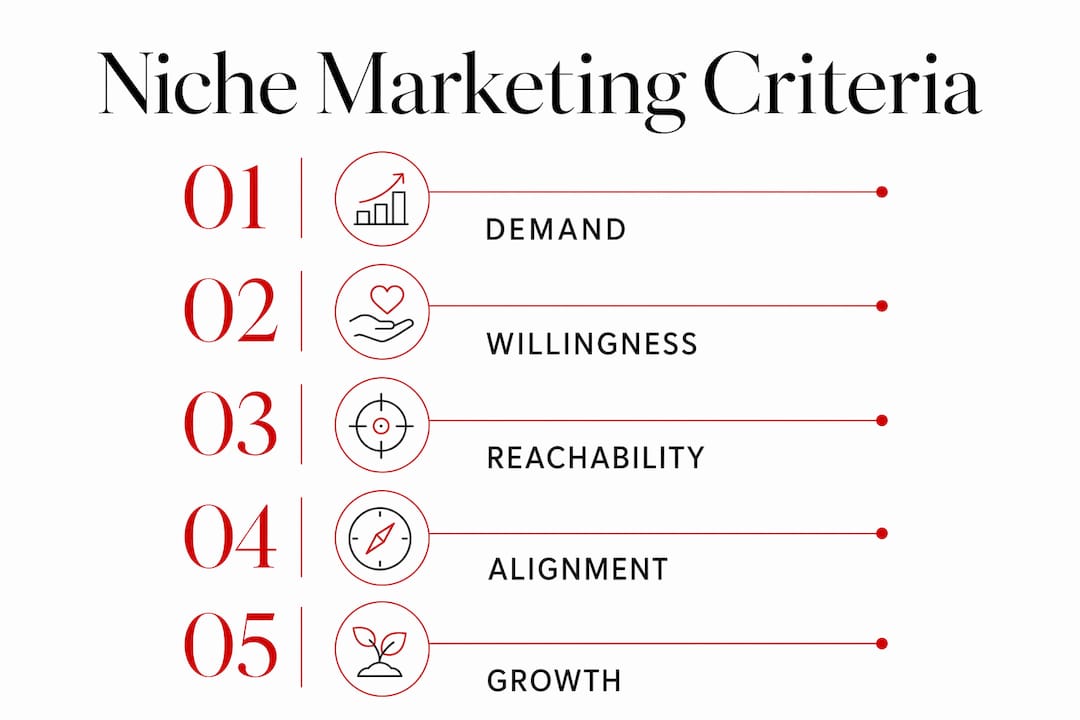
Reachability: you can find and communicate with this audience through specific, cost-effective channels. A niche you cannot reach affordably is not a viable niche, regardless of how well-defined it is.
Alignment with your capabilities: the niche should match what you can credibly deliver. Credibility in a niche comes from genuine expertise, not just targeted messaging.
Growth potential: the niche should have room to expand, either by deepening within the segment or by using it as a foundation to move into adjacent markets later.
Tools and methods for researching and analyzing niche markets
Solid niche research combines quantitative data with qualitative community insight. No single tool gives you the full picture.
Google Keyword Planner and Semrush reveal search volume and competition for niche-specific queries. Start broad, then narrow by looking at long-tail variations where intent is specific and competition is lower.
Reddit and niche forums surface the exact language, frustrations, and aspirations of a community. Search for your category on Reddit and read the top posts from the past year. The vocabulary people use to describe their problems is your copywriting brief.
Google Trends shows whether interest in a niche is growing, stable, or declining. A niche with rising search interest is easier to build in than one that has already peaked.
Social media listening tools like Sprout Social or Brand24 track conversations around specific topics, hashtags, and communities. They help you monitor sentiment and spot emerging friction points before competitors do.
Census.gov and Bureau of Labor Statistics data provide demographic and economic context for sizing a niche. If your niche targets a specific occupation or income band, BLS occupational data can confirm whether that segment is growing.
Competitor analysis using tools like SimilarWeb or SpyFu shows where competitors get their traffic and which keywords they rank for. Gaps in their coverage are your opportunities.
Pro Tip: Run a small paid social campaign targeting your hypothetical niche before building the product. Click-through rate and cost per click on a landing page with no product yet is one of the fastest ways to validate real demand.
Key Takeaways
Niche marketing works because it concentrates resources on a specific audience with unmet needs, producing stronger loyalty, higher margins, and faster advocacy than mass-market approaches.
| Point | Details |
|---|---|
| Focus beats breadth | Targeting a well-defined segment produces higher engagement and lower acquisition costs than broad campaigns. |
| Avoid niche creep | Drifting toward a wider audience erodes core loyalty; maintain brand focus even when growth pressure builds. |
| Validate before committing | Confirm demand with keyword data, community size, and competitor revenue before investing in a niche. |
| Language signals trust | Adopting the niche community’s own vocabulary in messaging builds authentic connection faster than polished ad copy. |
| Niche as a growth foundation | Establishing credibility in one segment creates a platform for expanding into adjacent markets on solid footing. |
Ready to apply niche principles to a fashion or luxury brand? Corradomanenti’s luxury brand growth tactics break down the exact frameworks used to position premium brands within high-value niche segments.