


Every Luxury Marketing Director in Europe knows that client trust does not come from secrecy but from strategic disclosure. High-net-worth clients scrutinize what is shared and what remains hidden, seeing gaps not as mystique but as evasion. In a sector where luxury brands tend to lag in supply chain disclosures compared to others, building loyalty means mastering a transparency balance rooted in legitimacy and selective openness. This article reveals how to transform selective transparency into lasting client confidence.
Table of Contents
- Defining Transparency In The Luxury Sector
- Key Variations: Sourcing, Pricing, And Communication
- How Transparency Drives Consumer Trust And Loyalty
- Risks Of Opaqueness For Luxury Brands
- Strategies For Implementing Effective Transparency
Key Takeaways
| Point | Details |
|---|---|
| Strategic Transparency | Luxury brands must adopt a strategic approach to transparency that aligns with client expectations, focusing on curated information that fosters trust without compromising exclusivity. |
| Consumer Psychology | Understanding client values is crucial; tailored disclosures that prioritize heritage, ethical sourcing, and sustainability enhance customer confidence and loyalty. |
| Risks of Opaqueness | Remaining opaque can lead to increased consumer skepticism and reputational damage, especially as modern affluent clients demand more ethical clarity. |
| Implementation Strategy | Brands should deploy technology for visibility, engage trusted clients for feedback, and create layered communication strategies that respect client preferences without overwhelming them. |
Defining Transparency in the Luxury Sector
Transparency in luxury differs fundamentally from mass-market definitions. For luxury brands, it’s not simply about releasing information—it’s about strategic disclosure that builds trust while preserving exclusivity. Your high-net-worth clients demand different things than regular consumers.
The core involves three interconnected elements:
- Sustainability practices: How materials are sourced, environmental impact, ethical production
- Supply chain visibility: Where components originate, manufacturing locations, quality controls
- Corporate governance: Leadership decisions, business ethics, long-term vision
Unlike mass-market brands, luxury brands tend to lag in supply chain disclosures compared to competitors. This gap creates vulnerability. Your clients notice this absence and interpret it as evasion rather than mystique.
Transparency helps assess sustainability impacts and ethical practices—crucial for maintaining consumer trust while addressing global demands for responsible business practices.
What makes luxury transparency unique? Your audience doesn’t want every detail. They want curated information that demonstrates competence without diminishing prestige. A jewelry brand explaining craftsmanship builds value. Revealing margin calculations destroys it.
The Luxury Transparency Index now measures transparency quantitatively across the sector. This framework evaluates how effectively brands communicate their values, which directly influences brand perception among affluent consumers.
Key transparency areas European luxury directors should address:
- Heritage and authenticity stories
- Artisan partnerships and fair compensation
- Environmental initiatives with measurable results
- Quality assurance processes
- Ownership structure and leadership continuity
Your HNW clients care about exclusivity rooted in legitimacy. They’re suspicious of brands that hide information, yet overwhelmed by those providing excessive disclosure. The balance requires understanding consumer psychology—knowing what information actually builds confidence versus what creates doubt.
Transparency also connects to deeper brand perception. When clients understand the reasoning behind pricing, the sourcing decisions, and the production standards, they transform from customers into advocates. They become convinced they’re investing in genuine value, not marketing hype.
Pro tip: Start by identifying which transparency elements matter most to your specific clientele. Survey existing HNW customers about what information builds their confidence, then prioritize disclosing those factors first. This targeted approach maximizes impact without overwhelming your audience.
Key Variations: Sourcing, Pricing, and Communication
Transparency doesn’t look the same across all luxury operations. Your sourcing strategy differs dramatically from pricing disclosure, which differs from how you communicate with clients. Each requires distinct thinking.
Sourcing Transparency
Luxury brands traditionally guard sourcing details to maintain mystique. Your competitors still operate this way. However, supply chain transparency in luxury fashion is now a competitive advantage, not a liability.
The shift involves:
- Disclosing material origins without revealing suppliers
- Highlighting artisan partnerships and heritage craftsmanship
- Sharing sustainability certifications transparently
- Using blockchain for product authentication
Gucci and Stella McCartney lead here. They’ve proven that selective sourcing disclosure builds trust rather than destroying exclusivity. Your HNW clients want to know the leather comes from ethical sources—they don’t need the tannery’s address.
Brands must balance heritage exclusivity with modern consumer expectations for ethical sourcing practices.
Pricing Transparency
This is where luxury directors hesitate most. Pricing opacity traditionally signals exclusivity. Yet transparency varies significantly in how brands justify premium prices, and increasingly, wealthy consumers demand justification.
Consider these approaches:
- Explain craftsmanship investment clearly
- Justify premium positioning through quality metrics
- Communicate limited production runs and exclusivity
- Detail heritage and brand longevity
- Share innovation investments in materials
Don’t reveal margins. Reveal value creation. Your clients understand that artisanal production costs more. They respect transparency about why—not transparency about profit.

Communication Strategy
Your messaging channels matter enormously. Digital tools now enable targeted transparency that reaches HNW audiences differently than mass communication.
Effective luxury communication:
- Uses storytelling over specification sheets
- Employs digital product passports for traceability
- Leverages video content showing craftsmanship
- Creates exclusive client portals for detailed information
- Personalizes disclosures by client segment
Your wealthiest clients respond to curated narratives backed by data. A 90-second video of a craftsman at work, followed by certification details available on request, outperforms generic sustainability reports.
Pro tip: Map which transparency elements resonate with each client segment before designing your disclosure strategy. Your ultra-wealthy collectors care about heritage and authenticity; younger affluent buyers prioritize sustainability. Tailor your sourcing, pricing, and communication messaging accordingly.
Here’s a summary of how transparency differs across key areas in the luxury sector:
| Area | Common Approach in Luxury | Modern Client Expectation | Key Challenge |
|---|---|---|---|
| Sourcing | Limited disclosure | Ethical origin information | Preserving brand mystique |
| Pricing | Opacity signals exclusivity | Justification of premium value | Avoiding margin exposure |
| Communication | Generic or mass messaging | Curated, data-driven narratives | Personalizing disclosures |
How Transparency Drives Consumer Trust and Loyalty
Transparency isn’t about being vulnerable. It’s about being credible. Your HNW clients evaluate luxury brands through a psychological lens: Does this brand have something to hide?
When you demonstrate openness about sourcing, pricing, and ethics, you answer that question directly. Transparency fosters consumer trust by providing open insights into operations and business practices. Your clients notice, and they respond with loyalty.
Here’s what transparency actually accomplishes:
- Builds emotional connections between brand and client
- Demonstrates integrity and willingness to admit mistakes
- Creates perception of brand stability and confidence
- Reduces skepticism about premium pricing
- Encourages word-of-mouth advocacy among peers
The psychology is straightforward. When a luxury brand communicates proactively—especially about ethical sourcing or sustainability—clients interpret this as strength, not weakness. A brand hiding information appears to have something to fear.
Transparency shifts luxury from exclusivity alone to values-based purchasing marked by openness about sourcing and environmental impact.
Your competitors still operate in opacity. That silence now reads as evasiveness to educated, wealthy consumers. The internet exposes discrepancies instantly. A single negative story about labor practices spreads faster than any positive marketing claim.
But here’s what separates strategic transparency from oversharing: selective disclosure tied to client values. Your ultra-wealthy collectors don’t want every operational detail. They want assurance that the brand aligns with their ethics and standards.
Loyalty follows trust naturally:
- Client discovers brand transparency
- Skepticism transforms into confidence
- Premium pricing feels justified
- Client becomes advocate within circles
- Lifetime value increases dramatically
This chain isn’t theoretical. Brands demonstrating values-based purchasing through transparency experience measurable loyalty gains. Your clients shift from transactional relationships to community participation.
The shift matters economically. Loyal clients spend more, buy across product lines, and recruit peers. They forgive occasional missteps because trust is established. They become your brand ambassadors.
Pro tip: Identify the three transparency elements most aligned with your target clients’ values—perhaps sustainable sourcing, fair labor practices, and heritage preservation. Build your communication strategy around these, and measure client sentiment before and after transparency initiatives to prove ROI.
Compare the benefits of strategic transparency to the risks of remaining opaque:
| Strategic Transparency Benefit | Opaqueness Risk |
|---|---|
| Builds long-term client trust | Breeds consumer skepticism |
| Enhances brand advocacy | Heightens reputational scandals |
| Supports loyalty and repeat sales | Drives clients to competitors |
| Meets regulatory expectations | Increases legal and financial risks |
Risks of Opaqueness for Luxury Brands
Opaqueness feels safe. It protects secrets. Yet in today’s market, secrecy reads as guilt. Your brand’s silence creates the exact opposite of what you intend.
Hidden information invites speculation. When clients don’t know where materials come from, they assume the worst. When pricing isn’t justified, they question whether the premium is warranted. Opacity breeds skepticism.
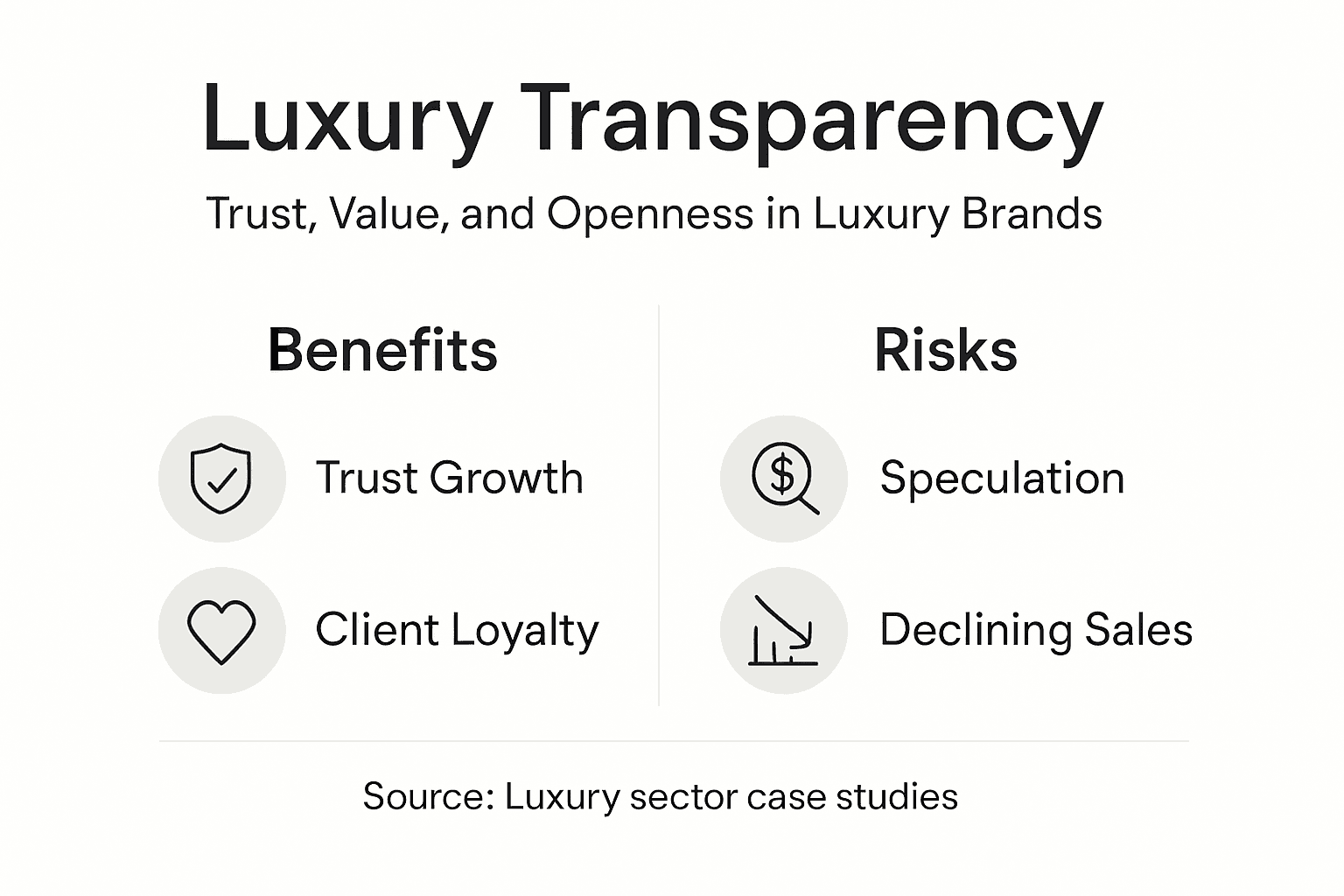
Opaqueness exposes luxury brands to reputational risks, including associations with unethical practices that can damage decades of brand equity. A single labor scandal uncovers what silence protected. Regulatory scrutiny increases globally, and brands failing to enhance transparency face legal penalties and market share loss.
Here’s what happens when you maintain opacity:
- Consumer skepticism grows despite marketing efforts
- Competitors embracing transparency steal market share
- Negative stories spread faster than positive communications
- Regulatory bodies increase investigations and fines
- Younger, affluent buyers simply choose different brands
The economics are brutal. A luxury brand takes 50 years to build trust and six months of scandal to destroy it. Your HNW clients have options. They’ll move their loyalty instantly if they suspect ethical compromise.
Lack of transparency leads to diminished consumer trust and market irrelevance as luxury brands face pressure from younger, socially conscious consumers demanding authenticity.
Your industry’s historical mystique no longer protects you. The internet exposes everything. Investigative journalism targets luxury because the stakes are high and the stories sell. A hidden labor violation becomes viral faster than any brand message can counter.
The risk compounds over time:
- Brand resists transparency
- Competitors embrace openness
- Market perception shifts toward competitors
- Younger wealth cohort abandons traditional brands
- Brand becomes irrelevant despite historical prestige
Brands resisting transparency face declining sales and market alienation as consumer expectations evolve. This isn’t theoretical—it’s happening now across the sector.
Investor confidence matters too. Institutional money increasingly demands ethical clarity. Funds divest from opaque operations. This financial pressure compounds reputational damage.
Pro tip: Audit your current disclosures by asking: What would I be embarrassed to reveal? Start there. That’s exactly where competitors will probe and regulators will focus. Address vulnerability now through controlled transparency rather than reactive crisis management later.
Strategies for Implementing Effective Transparency
Implementing transparency requires strategy, not just good intentions. You need systems, not announcements. Your HNW clients notice the difference immediately.
Start with your foundation. What transparency actually matters to your specific audience? Different client segments value different disclosures. Ultra-wealthy collectors prioritize heritage and authenticity. Younger affluent buyers demand sustainability proof. Ask before you build.
Digital Product Passports enable comprehensive supply chain visibility from raw material through delivery. This technology transforms abstraction into concrete proof. Your clients scan a code, see exactly where leather originated, understand the production timeline. No guessing. No skepticism.
Core implementation steps:
- Identify which transparency elements resonate with your target clients
- Deploy technology that makes transparency visible and verifiable
- Train staff to communicate transparency consistently
- Create storytelling around sourcing and production
- Monitor client sentiment and adjust accordingly
Technology alone isn’t enough. You need narrative. A blockchain record of supply chain means nothing without the story behind it. Why did you choose this tannery? What makes this artisan special? How does this connect to your brand heritage?
Brands must balance transparency with strategic confidentiality to protect competitive advantage while maintaining authenticity and trustworthiness.
Educate your clients, don’t overwhelm them. Provide information in layers. Basic facts upfront. Detailed documentation available on request. Technical specs for those who want depth. This approach respects different engagement levels without hiding anything.
Technology-driven relationship marketing personalizes customer interactions while protecting brand heritage. Use data analytics to understand what information each client values. Then tailor your communications accordingly.
Implementation challenges to anticipate:
- Data security concerns with digital traceability systems
- Information overload causing client confusion
- Maintaining exclusivity while being transparent
- Organizational resistance to operational visibility
- Managing crisis communication protocols
These aren’t showstoppers. They’re manageable with planning. Build your transparency framework deliberately, test with trusted clients first, then scale across your portfolio.
One critical insight: transparency builds competitive advantage only when competitors aren’t doing it. Start now, establish credibility early, and you’ll own this positioning before rivals catch up.
Pro tip: Pilot your transparency initiative with 10-15 trusted HNW clients before full rollout. Gather their feedback on what information proves most valuable and what feels excessive. This approach reduces implementation risk while building champions who evangelize your transparency to peers.
Elevate Your Luxury Brand With Strategic Transparency
Luxury brands today face the critical challenge of balancing exclusivity with strategic disclosure to build trust among high-net-worth clients. The article highlights how curated transparency around sourcing, pricing, and communication can transform consumer skepticism into lasting loyalty. If your brand struggles to align transparency with exclusivity or fears losing mystique, you are not alone.
At Corrado Manenti, we specialize in psychology-driven marketing and luxury consulting designed to address these exact pain points. Our approach helps luxury brands craft narratives that resonate emotionally while showcasing authenticity without oversharing. We leverage innovation and digital strategies to implement controlled transparency that elevates brand prestige and boosts client confidence. Start turning transparency into your strongest competitive advantage today.
Discover how to communicate your brand’s unique heritage and ethical commitments with precision and impact. Visit Corrado Manenti now to learn more about tailored solutions that build trust in the modern luxury marketplace. Don’t wait for competitors to define transparency first. Make your transparency a reason clients choose you every time.
Frequently Asked Questions
What are the key elements of transparency that luxury brands should focus on?
Transparency in luxury brands revolves around sustainability practices, supply chain visibility, and corporate governance. These elements help build trust with high-net-worth customers while maintaining exclusivity.
How does transparency impact consumer trust in luxury brands?
Transparency fosters consumer trust by demonstrating openness about sourcing, pricing, and ethical practices. When clients perceive a brand as transparent, they are more likely to feel confident and loyal, turning from customers into advocates.
What differentiates sourcing transparency in the luxury sector from mass-market brands?
Sourcing transparency in luxury brands involves selective disclosure about material origins and artisan partnerships, which builds trust. Unlike mass-market brands, luxury brands must balance the need for mystique with modern consumer expectations for ethical sourcing information.
How can luxury brands implement effective transparency strategies?
Luxury brands can implement transparency by identifying which elements resonate with their target clients, deploying technology for visibility, and crafting compelling narratives around sourcing and production. This strategy should involve monitoring client sentiment and adjusting communications accordingly.