

Most luxury brand managers assume their consumers are weighing quality, craftsmanship, and price before making a purchase. The reality is far more surprising. Emotional factors drive 70-80% of luxury purchases and loyalty, meaning the rational case for your product is almost never what closes the deal. This article breaks down the psychological forces that actually move luxury consumers, the research methods that reveal them, and a practical framework you can apply to your next campaign to build deeper engagement and lasting brand affinity.
Table of Contents
- Understanding the foundations: What is consumer psychology in luxury?
- Core psychological triggers of luxury purchases
- Evidence-based consumer psychology methods: From research to brand strategy
- Generational shifts and nuanced applications in luxury brands
- From science to strategy: Activating consumer psychology in luxury marketing
- Power your luxury brand with advanced consumer psychology
- Frequently asked questions
Key Takeaways
| Point | Details |
|---|---|
| Emotion drives luxury | Emotional motivations account for the majority of luxury fashion purchases and brand loyalty. |
| Scarcity and exclusivity matter | Scarcity and the promise of exclusivity boost perceived value and engagement in luxury consumers. |
| Generational differences exist | Younger buyers prioritize uniqueness and FoMO, requiring adapted strategies. |
| Research methods unlock insights | Surveys and modeling reveal the deep psychological triggers behind luxury buying. |
| Strategic application required | Brands must integrate these insights into their storytelling, exclusivity, and campaign design for maximum impact. |
Understanding the foundations: What is consumer psychology in luxury?
Consumer psychology is the study of how thoughts, emotions, and social influences shape purchasing decisions. In most categories, marketers can win by communicating functional benefits clearly. Luxury fashion is a different game entirely. Here, the product is rarely the point. The feeling the product creates, the identity it signals, and the story it carries are what drive desire.
“Luxury is not about the object. It is about the meaning the object confers on its owner.”
Standard marketing optimizes for awareness and conversion. Luxury marketing must optimize for aspiration and belonging. The gap between those two goals is where most brands lose ground. Consumer psychology in luxury fashion drives engagement through a specific set of principles:
- Scarcity: Limited availability triggers reactance theory, making consumers want something more intensely when access is restricted.
- Emotional resonance: Campaigns that connect to personal identity or life milestones create memory and loyalty.
- Status signaling: Luxury items serve as social currency, communicating taste, success, and belonging to a desired group.
- Heritage: A brand’s history and craftsmanship narrative adds psychological weight that newer brands cannot replicate.
- Exclusivity: The perception that not everyone can access a product elevates its desirability beyond its physical attributes.
Shifting your strategy from functional benefits to psychological allure is not a creative choice. It is a structural one, and it starts with understanding which triggers your audience responds to most.
Core psychological triggers of luxury purchases
Now that you understand the core concepts, here is how luxury brands translate psychology into purchase triggers.
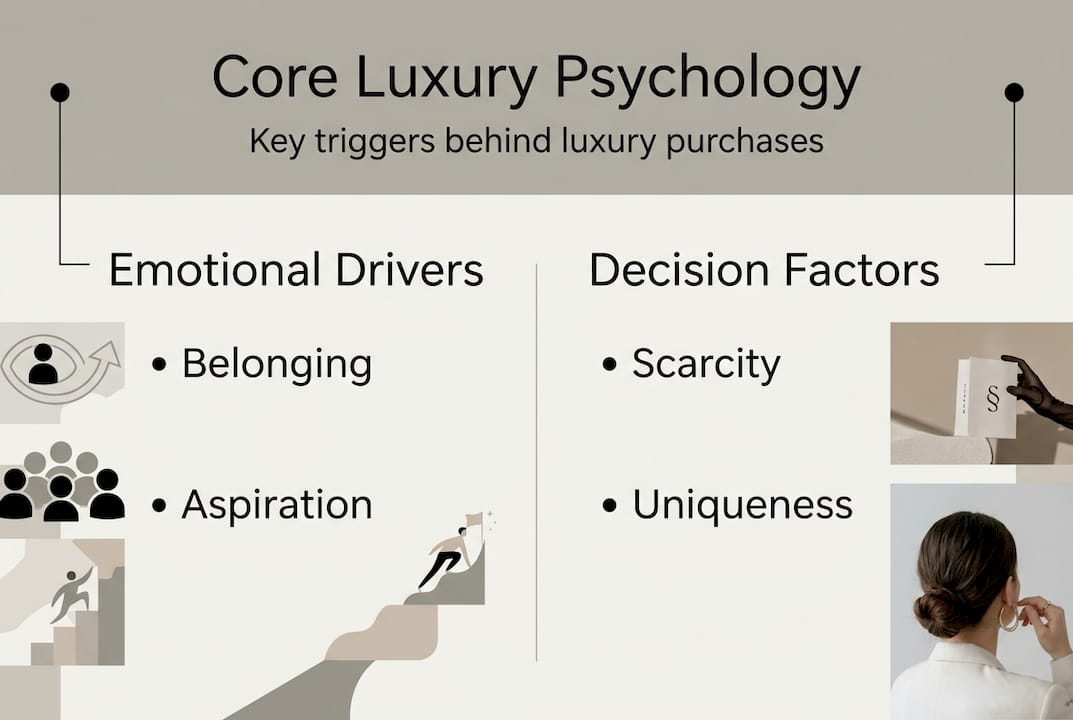
The most powerful triggers are not used in isolation. They work in combination, and the most effective luxury campaigns layer several of them simultaneously. Here is a breakdown of the five primary mechanisms:
- Scarcity and reactance theory: When supply is visibly limited, perceived value rises. Limited edition drops, waitlists, and invitation-only access all activate this response. Luxury scarcity strategies are among the most studied and replicated tools in high-end marketing.
- Emotional resonance through storytelling: Consumers who feel emotionally connected to a brand spend more and stay longer. Luxury storytelling strategies that anchor a product in heritage, personal transformation, or cultural meaning create this connection at scale.
- Status signaling: Visible logos, recognizable silhouettes, and brand associations with cultural icons all serve as social proof. Consumers use luxury items to communicate who they are and who they aspire to be.
- Social proof and belonging: Seeing aspirational peers or admired figures wearing a brand creates a pull that advertising alone cannot replicate. This is why ambassador selection in luxury is a strategic, not cosmetic, decision.
- Heritage and provenance: A brand with a documented history of excellence carries psychological authority. Consumers pay a premium not just for the object but for the story they inherit with it.
Emotional factors motivate 70-80% of luxury purchases and loyalty. That number should reframe every brief you write.
| Trigger | Strongest segment | Primary effect | Context |
|---|---|---|---|
| Scarcity | Boomers, Gen X | Urgency and perceived value | Limited editions, waitlists |
| NFU (Need for Uniqueness) | Gen Z, Millennials | Identity differentiation | Customization, co-creation |
| Emotional resonance | All segments | Loyalty and advocacy | Storytelling campaigns |
| Status signaling | Gen X, Millennials | Social currency | Visible branding, events |
| Heritage | Boomers, Gen X | Trust and justification | Brand history content |
Research on NFU and FoMO interactions shows that for Gen Z and Millennials, the need for uniqueness outperforms scarcity as a purchase driver, and FoMO amplifies that effect significantly.
One important nuance: anthropomorphizing luxury products, treating them as if they have human personalities, actually reduces perceived luxury value. Keep your brand voice authoritative and aspirational, not relatable in a casual sense.
Pro Tip: For high willingness-to-pay segments, prioritize social sustainability messaging over environmental claims. Brand self-congruity, the sense that a brand reflects who the consumer is, drives premium pricing power more reliably than green credentials alone.
Evidence-based consumer psychology methods: From research to brand strategy
Understanding the triggers is only step one. Here is how leaders use research methodology to systematically reveal consumer insight.
The brands that consistently outperform in luxury do not rely on intuition. They use structured research to map the psychological landscape of their audience before designing a single campaign element.
- Surveys and focus groups: These surface stated preferences and emotional associations. They are most useful for identifying which heritage narratives resonate and which status signals feel authentic to your target segment.
- Structural equation modeling (SEM): SEM allows you to test causal relationships between psychological variables. A study using 208 respondents confirmed that NFU predicts purchase intent, with FoMO acting as a moderating variable. This kind of rigor separates assumption from evidence.
- Storytelling measurement: Track emotional engagement metrics across content formats to identify which narrative structures generate the deepest response. Effective storytelling in luxury is measurable, not just intuitive.
- Personalization experiments: A/B testing personalized versus generic messaging reveals how much lift identity-based content generates for your specific audience.
| Method | What it reveals | Example metric |
|---|---|---|
| Surveys | Stated emotional drivers | Top 3 brand associations |
| Focus groups | Narrative resonance | Story recall and sentiment |
| SEM | Causal trigger relationships | NFU to purchase intent path |
| Personalization tests | Identity-based content lift | Conversion rate delta |
Pro Tip: Avoid anthropomorphizing luxury items in your research stimuli and campaigns. Psychological distance, the sense that a product exists in a rarefied world above everyday life, reinforces prestige. Casual, human-like brand voices erode that distance and reduce perceived value.
Generational shifts and nuanced applications in luxury brands
With evidence-driven methods in hand, let us examine how nuanced triggers play out across demographics.
Generational differences in luxury buying are not just about age. They reflect fundamentally different relationships with identity, social proof, and the meaning of exclusivity. Getting this wrong means running campaigns that feel tone-deaf to your most valuable growth segments.
Key generational drivers at a glance:
- Gen Z: Driven by NFU over scarcity, they want products that express individual identity, not just group membership. FoMO amplifies their purchase intent when uniqueness is at stake.
- Millennials: Respond to both emotional resonance and social proof. Heritage narratives work when they feel culturally relevant, not museum-like.
- Gen X: Status signaling and scarcity remain strong motivators. They respond well to visible brand equity and limited access mechanics.
- Boomers: Heritage, trust, and craftsmanship narratives carry the most weight. Emotional resonance tied to legacy and quality justifies premium pricing.
Mental accounting is another underused insight. Consumers mentally categorize spending into buckets, and luxury purchases are often justified through a self-reward or milestone framing. Campaigns that acknowledge and validate this internal justification process, without being explicit about it, see higher conversion rates among all segments.
The color psychology in luxury fashion also plays a role in how different generations perceive brand signals. Younger consumers often respond to unexpected color choices as a marker of creative authority, while older segments associate classic palettes with reliability and prestige.
For segment-specific strategy, the practical takeaway is this: do not run a single scarcity-based campaign and expect it to perform equally across all age groups. Map your triggers to your segments, then test before you scale. Exclusivity in branding means different things to a 24-year-old and a 54-year-old, and your messaging needs to reflect that.
From science to strategy: Activating consumer psychology in luxury marketing
With generational and segment nuances in focus, here is how you can operationalize these insights for measurable brand impact.
- Research your audience’s psychological profile: Use surveys and focus groups to identify which triggers, scarcity, NFU, heritage, or emotional resonance, are most active for your core segment.
- Select your primary and secondary triggers: Choose one dominant trigger per campaign and one supporting mechanism. Layering too many dilutes the effect.
- Craft authentic storytelling: Build your narrative around the trigger. For heritage, anchor the story in specific historical moments. For NFU, center the consumer as the protagonist of a unique experience.
- Test before you scale: Run controlled experiments with different trigger combinations across segments. Measure emotional engagement, not just clicks.
- Measure and iterate: Track uplift in brand affinity, purchase intent, and loyalty metrics. Storytelling, personalization, and social proof are validated methods for engaging luxury consumers, but their relative power varies by audience.
A campaign using social proof might feature a curated community of cultural figures wearing the product in aspirational contexts, with no explicit call to action. A campaign leveraging emotional resonance might tell the story of a single artisan whose craft spans three generations. Both are psychologically grounded. Both require different creative executions. The science tells you which to choose. The craft determines how well it lands.
Luxury storytelling prestige is not a soft metric. Brands that invest in narrative-driven campaigns consistently outperform those that rely on product-led advertising in luxury categories.
Pro Tip: Iterate based on measured uplift, not intuition. The most common mistake luxury marketers make is assuming that what worked last season will work again. Consumer psychology shifts with culture, and your research cadence should match that pace.
Power your luxury brand with advanced consumer psychology
You now have a clear picture of the psychological forces that drive luxury consumer behavior, the research methods that reveal them, and the strategic frameworks that put them to work. The next step is applying this knowledge with precision and consistency across every touchpoint of your brand.
Corrado Manenti specializes in exactly this intersection of psychology and luxury marketing. Whether you need to analyze buyer behavior for a specific segment, build a campaign grounded in psychology and luxury branding, or develop a long-term growth strategy using fashion brand growth tactics, the methodology is always evidence-based and tailored to the premium market. Explore the consulting resources available and take the guesswork out of your next campaign.
Frequently asked questions
What is the main role of consumer psychology in luxury branding?
Consumer psychology shapes luxury branding by leveraging emotional motivations, status signaling, and exclusivity to drive engagement and loyalty. It shifts the focus from product features to the meaning and identity a brand confers on its consumer.
Why do emotional factors matter so much for luxury consumers?
Emotional resonance creates lasting connections that rational messaging cannot replicate. 70-80% of luxury purchases and brand loyalty are driven by emotional factors, making it the single most important variable in luxury campaign design.
How does Gen Z differ from older generations in luxury buying motivations?
Gen Z and Millennials respond more to NFU and FoMO than to traditional scarcity mechanics, so brands must adapt campaigns to emphasize individual identity and unique access rather than limited supply alone.
Which research methods are most effective for decoding luxury consumer behavior?
Surveys, focus groups, and SEM are proven methods to reveal the deeper drivers of luxury brand engagement, with SEM offering the most rigorous causal insight into trigger relationships.
Does sustainability affect luxury consumer psychology?
Social sustainability boosts willingness to pay through brand self-congruity, making it more impactful than environmental actions for luxury consumers who want the brand to reflect their personal values and identity.