

Luxury brand managers face a complex challenge: converting high-value prospects into devoted brand ambassadors. Traditional onboarding fails with discerning clients who expect exceptional, personalized experiences from first contact. This guide reveals proven strategies to transform your client onboarding process, leveraging segmentation, CRM technology, and psychology-driven tactics that turn one-time buyers into lifelong advocates while reducing acquisition costs and maximizing retention ROI.
Table of Contents
- Understanding The Luxury Client Onboarding Challenge
- Preparation: Segmenting And Profiling Luxury Clients By Lifestyle
- Execution: Implementing Personalized Client Onboarding Strategies
- Verification: Measuring Onboarding Success And Optimizing Retention
- Optimize Your Luxury Brand Growth With Expert Guidance
- Frequently Asked Questions
Key takeaways
| Point | Details |
|---|---|
| Segment by lifestyle and generation | Tailoring onboarding to generational preferences and lifestyle profiles increases engagement and conversion rates. |
| Personalization drives retention | Companies excelling at personalization generate 40% more revenue than competitors who use generic approaches. |
| Unified CRM reduces costs | Centralizing online and offline data enables seamless personalization while cutting customer acquisition expenses. |
| Exclusive access builds loyalty | VIP events and early product access transform high-spenders into brand advocates and ambassadors. |
| SMS and AI deliver massive ROI | Premium brands achieve 30-49x ROI using thoughtful SMS campaigns and AI-powered personalization tools. |
Understanding the luxury client onboarding challenge
High-end brands consistently struggle with inefficient client capture despite substantial marketing investments. A luxury fashion retailer faced high Customer Acquisition Cost despite strong site traffic, revealing systemic onboarding failures. The root causes are predictable yet persistently overlooked.
Guest checkout represents the silent killer of luxury brand growth. When clients complete purchases without creating accounts, you forfeit the data foundation needed to personalize high-end marketing effectively. You’ve secured the transaction but lost the relationship.
Even worse, only 40% of registered accounts were active post-registration at leading luxury retailers. This staggering abandonment rate signals that registration alone means nothing without strategic follow-through. Your database becomes a graveyard of dormant contacts who never developed brand affinity.
The fragmentation problem compounds these issues:
- Offline boutique experiences remain disconnected from digital touchpoints
- Client service teams lack visibility into online browsing and purchase history
- Marketing campaigns blast identical messages to vastly different client segments
- Mobile and desktop experiences feel disjointed rather than seamlessly integrated
- Social media interactions never inform personalization strategies
Promotion oversaturation presents another serious threat. Luxury brands desperate for conversions often resort to discount-heavy tactics that erode brand equity. When your onboarding strategy relies on price cuts rather than value demonstration, you attract bargain hunters instead of brand devotees.
Preparation: segmenting and profiling luxury clients by lifestyle
Successful onboarding begins before the first transaction. You must understand who your clients are, what motivates their purchasing decisions, and how their preferences differ across generations and lifestyles.
Generational psychology shapes luxury expectations profoundly. Gen Z clients prioritize sustainability credentials and digital-first experiences. They research extensively online, expect transparent brand values, and respond to authentic storytelling over traditional prestige markers. Meanwhile, older generations value heritage craftsmanship, in-person consultations, and the tangible ritual of luxury shopping.

Clienteling in luxury retail becomes significantly more effective when you recognize these generational preferences. A 25-year-old fashion enthusiast and a 55-year-old collector require entirely different onboarding journeys, communication cadences, and product introductions.
Lifestyle-based profiling takes segmentation deeper. Beyond age demographics, consider:
- Career professionals seeking signature pieces that project authority
- Social influencers building personal brands through fashion choices
- Collectors investing in limited editions and heritage items
- Gift buyers purchasing for special occasions and milestones
- Lifestyle enthusiasts curating complete aesthetic experiences
Each segment responds to distinct value propositions. Career professionals appreciate efficiency and versatility. Collectors want exclusivity and provenance stories. Gift buyers need confidence and presentation excellence.
The evolution toward hyper-personalization reflects rising client expectations. 73% of customers expect brands to understand their unique needs, yet only a third of brands currently meet these expectations. This gap represents your competitive advantage opportunity.
Hyper-personalization treats each client as a unique, evolving individual rather than a demographic category. Track browsing patterns, purchase history, communication preferences, and lifestyle signals to build comprehensive profiles. When a client explores sustainable materials, your system should flag this interest and adjust recommendations accordingly.
Segment clients behaviorally into high-spenders and occasional buyers. High-value clients deserve white-glove onboarding with personal consultations and exclusive previews. Occasional buyers benefit from education-focused nurturing that builds confidence and desire over time.
Pro Tip: Create detailed client personas documenting not just demographics but emotional drivers, shopping triggers, and lifestyle aspirations. Reference these personas when crafting every onboarding touchpoint to ensure alignment with client psychology and personalization strategies for premium brands.
Align your onboarding messaging with stated and implied client values. If sustainability matters to a segment, highlight ethical sourcing. If heritage resonates, emphasize craftsmanship traditions. Generic luxury messaging fails because it ignores the specific values that drive individual purchase decisions within your luxury customer journey steps.
Execution: implementing personalized client onboarding strategies
With segmentation complete, execute targeted onboarding tactics that transform data into meaningful client relationships. The foundation rests on technological infrastructure that enables personalization at scale.
The first step in powerful luxury retail clienteling is identifying and segmenting your audience, but execution requires a central CRM system unifying online and offline data. Your CRM should capture boutique visits, digital browsing, email engagement, social media interactions, and purchase history in one accessible profile.
This unified view enables seamless personalization regardless of channel. When a client browses handbags online then visits your boutique, sales associates should access that browsing history instantly. When someone abandons a cart, your system should trigger personalized follow-up reflecting their specific interests.
Deploy these tactical onboarding approaches based on segment:
- Welcome high-spenders with exclusive early access to new collections before public launch
- Invite top-tier clients to intimate VIP events showcasing upcoming seasons and designer insights
- Assign dedicated brand ambassadors or stylists to your highest-value client relationships
- Send personalized video messages from creative directors welcoming new clients to the brand
- Offer complimentary services like alterations, monogramming, or home delivery for premium segments
- Create custom gift packaging that transforms purchases into memorable unboxing experiences
- Follow up with occasional buyers through personalized recommendations based on browsing history
- Provide styling guides and lookbooks tailored to individual aesthetic preferences and lifestyles
High-spenders appreciate exclusive early access, while occasional splurgers benefit from personalized follow-ups that inspire confidence and repeat purchases. The execution must match segment psychology.
Incorporate SMS marketing as a premium, direct communication channel. Unlike email, SMS feels personal and immediate. Use it sparingly for truly exclusive offers, appointment reminders, and personalized recommendations. SMS marketing can be a powerful channel for customer engagement when done thoughtfully in the luxury space.
The financial impact justifies investment. Companies excelling at personalization generate 40% more revenue than their peers. This revenue lift stems from higher conversion rates, increased average order values, and dramatically improved retention.
| Onboarding Tactic | Best For | Expected Impact |
|---|---|---|
| VIP event invitations | High-spenders, collectors | Builds emotional connection and exclusivity |
| Personalized styling guides | New clients, occasional buyers | Increases confidence and repeat purchases |
| Early product access | Brand advocates, high-value segments | Strengthens loyalty and word-of-mouth |
| SMS exclusive offers | All active clients | Drives immediate engagement and urgency |
| Dedicated brand ambassadors | Top 10% revenue clients | Maximizes lifetime value and referrals |
Deploy AI tools for real-time data analysis that anticipates client needs before they articulate them. Machine learning algorithms can identify patterns suggesting a client might appreciate a particular product category, color palette, or style direction. These insights enable proactive outreach that feels intuitive rather than intrusive.
Pro Tip: Ensure all personalized messaging aligns perfectly with your established brand voice. Personalization without brand consistency feels transactional rather than relationship-focused. Every touchpoint should reinforce your brand’s unique positioning while acknowledging individual client preferences and connecting to types of personalized marketing.
Measure engagement at every onboarding stage to identify friction points. Track email open rates, SMS response rates, event attendance, and time between first purchase and second purchase. Use this data to continuously refine your approach and analyze high-end consumer behavior patterns.
Verification: measuring onboarding success and optimizing retention
Execution without measurement wastes resources and opportunities. Establish clear metrics that reveal onboarding effectiveness and guide continuous optimization.
Track the ratio of active registered clients versus guest checkouts. Your goal should be converting at least 70% of purchases into registered accounts with complete profiles. Lower ratios indicate friction in your registration process or insufficient value proposition for account creation.
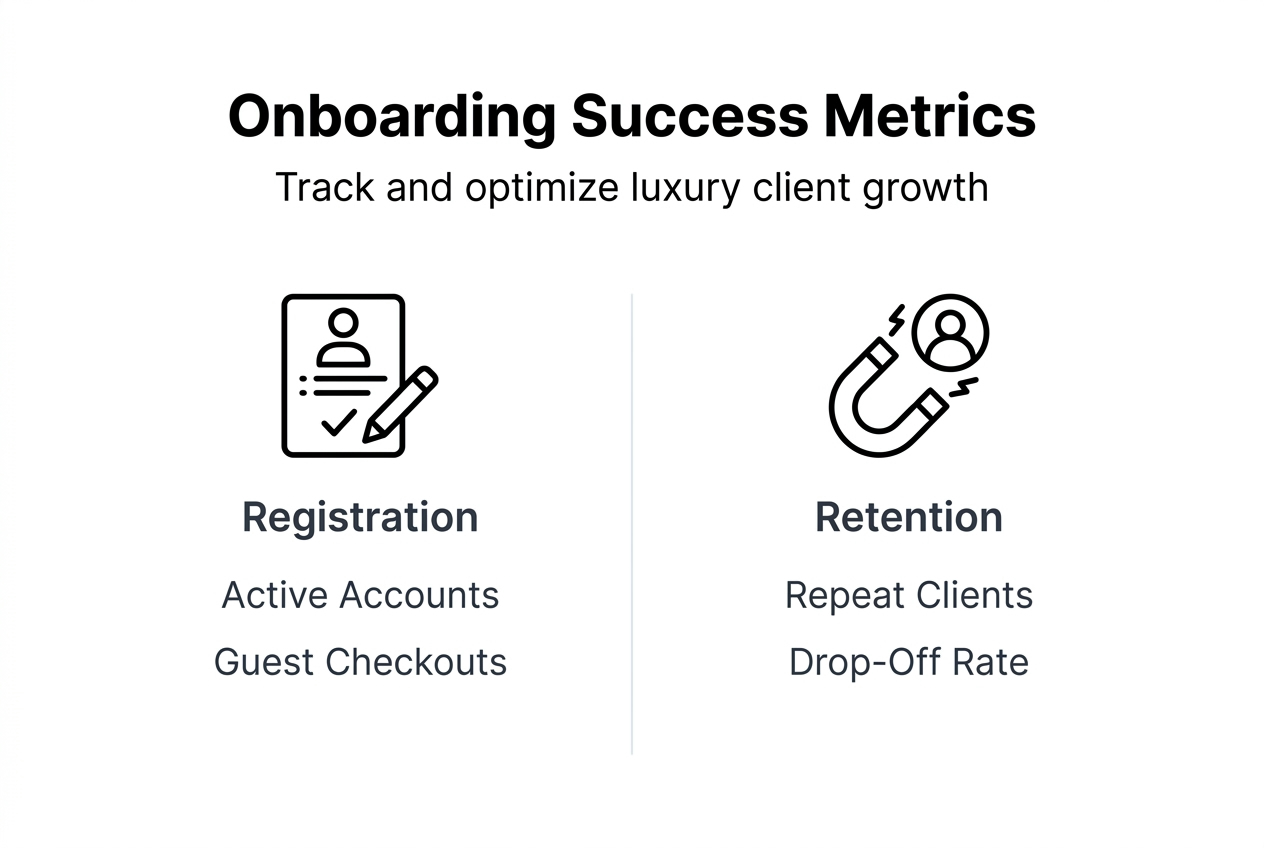
Compare retention rates before and after implementing enhanced onboarding strategies. Calculate the percentage of clients making second purchases within 90 days, six months, and one year. Improvements in these timeframes directly correlate with onboarding quality and relationship strength.
The financial implications are substantial. A 5% increase in customer retention rates can boost profits by 25% to 95%. This dramatic range reflects varying business models, but the direction remains consistent: retention improvements deliver exponential profit growth.
Use this retention data to estimate profit growth potential:
- Calculate current annual revenue per client segment
- Project revenue increases from improved retention rates
- Factor in reduced acquisition costs as retention improves referral rates
- Estimate lifetime value increases from extended client relationships
Evaluate ROI from specific technologies and tactics. SMS marketing and AI personalization tools require investment, but the returns justify costs when implemented strategically. Victoria Beckham’s SMS marketing program achieved a 49x global program ROI, while the brand saw a 30x ROI from AI Pro.
| Metric | Benchmark Target | Measurement Frequency |
|---|---|---|
| Registered account rate | 70%+ of transactions | Weekly |
| 90-day repeat purchase | 35%+ of new clients | Monthly |
| Email engagement rate | 25%+ open, 4%+ click | Per campaign |
| SMS response rate | 15%+ engagement | Per message |
| Client lifetime value | Year-over-year increase | Quarterly |
| Net Promoter Score | 50+ for luxury brands | Quarterly |
Regularly survey clients to assess perceived personalization quality. Ask specific questions:
- How well do our recommendations match your preferences?
- Do you feel recognized and valued across different touchpoints?
- What would make your experience feel more personalized?
- How does our personalization compare to other luxury brands?
Qualitative feedback reveals nuances that quantitative metrics miss. A client might complete purchases (positive metric) while feeling the experience lacks personal connection (negative sentiment). Both data types inform optimization.
Monitor segment-specific performance. Your high-spender onboarding should achieve different metrics than occasional buyer programs. Set distinct benchmarks reflecting segment potential and investment levels.
Test variations continuously. Try different welcome email sequences, SMS timing strategies, and event invitation approaches. A/B testing reveals what resonates with your specific client base rather than relying on industry generalizations.
Pro Tip: Create a quarterly onboarding review process examining both macro trends and individual client journeys. Analyze why specific high-value prospects didn’t convert or why certain segments show declining engagement. These insights drive meaningful improvements in your premium brand personalization strategies.
Optimize your luxury brand growth with expert guidance
Transforming client onboarding requires specialized expertise combining psychology, technology, and luxury market dynamics. Professional consulting accelerates implementation while avoiding costly missteps that damage brand equity.
Access proven fashion brand growth tactics luxury market strategies tailored specifically to high-end brands. Expert analysis helps you understand and engage discerning clients through psychology-driven approaches that feel authentic rather than manipulative. Learn how to analyze buyer behavior luxury brands exhibit and map personalized journeys that maximize lifetime value. Specialized guidance ensures your onboarding investments deliver measurable returns while strengthening brand positioning. Explore comprehensive frameworks through this luxury customer journey guide designed for premium market success.
Frequently asked questions
What is lifestyle client onboarding in luxury branding?
Lifestyle client onboarding refers to welcoming new luxury clients through personalized experiences aligned with their values, preferences, and aspirations. It segments clients by lifestyle factors and generational psychology, then delivers customized communications, product recommendations, and service approaches. Effective onboarding transforms first-time buyers into engaged brand advocates by demonstrating understanding of individual needs from initial contact.
How does segmentation by lifestyle improve client onboarding?
Segmenting by lifestyle enables targeted communications that resonate with specific client motivations and preferences. Career professionals, collectors, and social influencers respond to entirely different value propositions and messaging styles. This precision increases engagement rates, conversion likelihood, and long-term retention by ensuring every touchpoint feels relevant rather than generic.
What role does CRM technology play in luxury client onboarding?
CRM systems centralize client information from online browsing, offline purchases, event attendance, and service interactions into unified profiles. This comprehensive view facilitates sophisticated segmentation and enables personalized outreach across all channels. Sales associates access complete client histories instantly, ensuring seamless experiences whether clients engage digitally or in boutiques.
Why is SMS marketing effective for luxury client retention?
SMS offers immediacy and exclusivity that email cannot match, making it ideal for premium communications. Messages feel personal and direct, cutting through digital noise to reach clients instantly. When used sparingly for truly exclusive offers and personalized recommendations, SMS drives exceptional engagement rates and repeat purchases while reinforcing brand prestige through selective, thoughtful outreach.