


Silent luxury brands like Bottega Veneta and Loro Piana command higher average handbag prices than their logo-heavy counterparts, yet most marketing teams still pour resources into logo visibility over craftsmanship cues. That gap between assumption and evidence is exactly where brand equity gets lost. This article challenges the reflex to lead with logos, unpacks the psychology behind why minute details drive consumer loyalty, and gives you a practical framework to embed detail-driven thinking into every layer of your brand strategy.
Table of Contents
- Why detail is the ultimate differentiator in luxury branding
- Logo-heavy vs. detail-driven branding: A strategic comparison
- How brands deploy signature details: Case studies from Dior, Fendi, Hermès, Bottega Veneta
- Nuance and pitfalls: Overestimating fame, underestimating uniqueness, and the danger of dilution
- Turning insight into action: How to operationalize detail-driven branding for luxury success
- Elevate your luxury brand with expert detail-driven strategies
- Frequently asked questions
Key Takeaways
| Point | Details |
|---|---|
| Detail drives exclusivity | Meticulous attention to detail creates luxury brand distinction and higher perceived value. |
| Quiet luxury outperforms logos | Brands with detail-focused, subtle branding see greater price premiums and faster growth. |
| Signature elements must be protected | Strict guidelines and empirical testing are essential to maintain uniqueness and avoid dilution. |
| Operationalize with frameworks | Practical steps and guidelines anchor successful detail-driven branding strategies for teams. |
Why detail is the ultimate differentiator in luxury branding
Luxury consumers are not buying a product. They are buying a signal, a feeling, and a story told through every stitch, texture, and proportion. When a brand gets those micro-decisions right, it creates something a logo alone never can: a perception of precision that feels earned rather than declared.
Understanding why detail matters in branding starts with recognizing that exclusivity is built through specificity. A motif placed two millimeters off-center, a lining color that references archival collections, a clasp that requires a particular hand movement to open: these are not accidents. They are deliberate choices that separate a luxury object from a premium one.
The role of detail in luxury branding extends beyond aesthetics. As noted in research on luxury branding details, details build the consumer’s perception of precision, craftsmanship, and exclusivity in ways that broad brand gestures simply cannot replicate. The emotional connection formed through a perfectly weighted zipper pull or a hand-finished seam is neurologically distinct from the recognition triggered by a monogram.
Key differentiators that separate luxury from mass-market include:
- Material quality and provenance: the origin story of a fabric or leather grade
- Detail placement: where a motif sits relative to the garment’s structure
- Brand signatures: recurring micro-elements that appear across collections
- Sensory cues: weight, sound, scent, and tactile finish
- Guideline consistency: how rigorously those elements are protected across every touchpoint
“The most enduring luxury brands treat their guidelines not as restrictions but as the architecture of desire. Every detail is a deliberate act of communication.” — Elle India on luxury branding details
Use the luxury branding checklist to audit whether your current brand system enforces these differentiators at every consumer touchpoint.
Logo-heavy vs. detail-driven branding: A strategic comparison
The debate is not about which approach is superior in absolute terms. It is about which approach serves your brand’s strategic position and long-term margin goals. Quiet luxury brands are growing faster as logo contraction accelerates across the sector, but logo-heavy brands still attract broader search interest and faster initial recognition.
Here is how the two approaches compare across key strategic metrics:
| Metric | Logo-heavy branding | Detail-driven branding |
|---|---|---|
| Average price premium | Moderate | High |
| Consumer recognition speed | Fast | Slower, but deeper |
| Growth trajectory (2024-2026) | Slowing | Accelerating |
| Margin potential | Lower | Higher |
| Target consumer | Aspirational, broad | Connoisseur, selective |
| Brand dilution risk | Higher | Lower with strong guidelines |
Empirical luxury branding data confirms that silent luxury brands outperform logo-heavy rivals on average price, even when logo-heavy brands generate more search volume. That is a critical insight for executives managing both brand equity and revenue targets simultaneously.
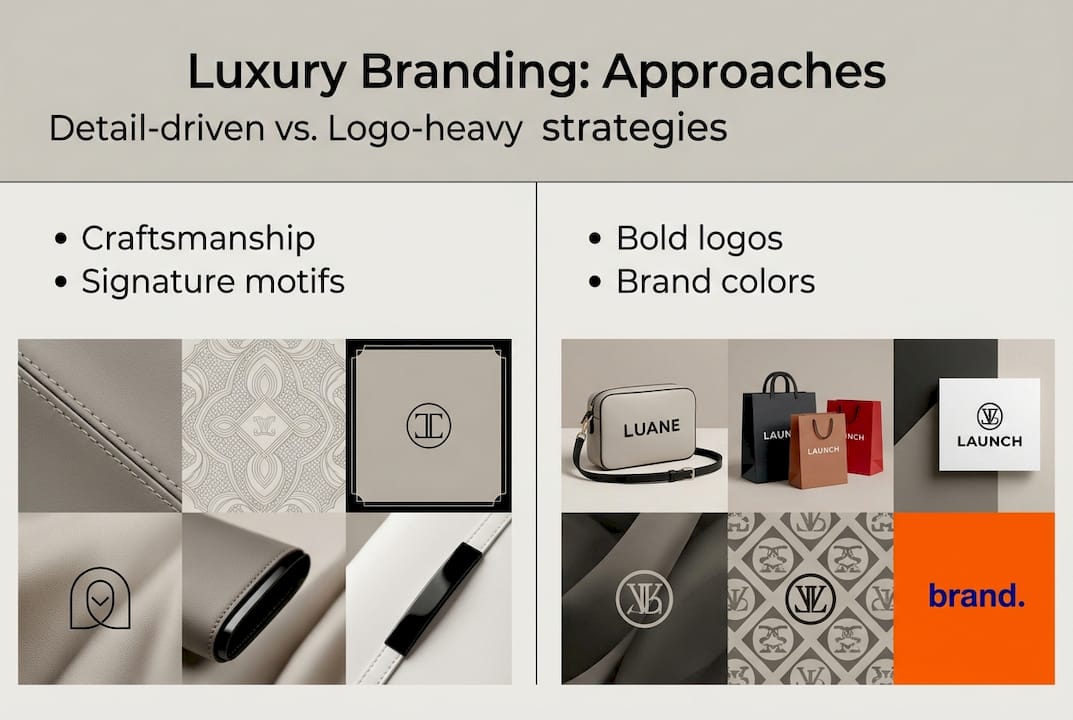
For brand managers focused on branding detail and luxury loyalty, the strategic takeaway is clear: if your goal is margin expansion and long-term loyalty among high-net-worth consumers, detail-driven branding is not a stylistic preference. It is a financial strategy.
How brands deploy signature details: Case studies from Dior, Fendi, Hermès, Bottega Veneta
Theory becomes credible when you can point to brands that have built billion-dollar identities on details most consumers cannot consciously name. These luxury detail case studies illustrate how signature micro-elements translate into measurable brand equity.

| Brand | Signature detail | Consumer impact |
|---|---|---|
| Dior | Tiny bows, ladybug motifs | Emotional recognition, archival loyalty |
| Fendi | Peekaboo interior reveals | Surprise, intimacy, perceived craftsmanship |
| Bottega Veneta | Intrecciato weave variations | Tactile exclusivity, connoisseur signaling |
| Hermès | Silk scarf texture, personalization | Multi-sensory loyalty, heirloom perception |
What each of these brands does exceptionally well is transform a detail into a narrative. Consider how each brand executes this:
- Dior embeds tiny bows and ladybugs as recurring motifs that reward attentive consumers with a sense of discovery
- Fendi’s Peekaboo uses interior reveals to create an intimate moment between object and owner, invisible to everyone else
- Bottega Veneta varies its intrecciato weave subtly across seasons, making each piece identifiable to insiders without ever using a logo
- Hermès layers sensory personalization, from the specific texture of a silk scarf to monogramming rituals, into a multi-sensory ownership experience
These are not decorative choices. They are premium positioning examples of how detail becomes the primary vehicle for brand storytelling. The luxury brand storytelling that sustains these houses across generations is built on the consistent repetition of these micro-elements, not on logo refreshes.
Nuance and pitfalls: Overestimating fame, underestimating uniqueness, and the danger of dilution
Even the most sophisticated brand teams make predictable mistakes when managing detail-driven systems. The consequences range from gradual equity erosion to outright consumer confusion. Knowing where the traps are is the first step to avoiding them.
Common pitfalls in detail-driven luxury branding:
- Overestimating element fame: Assuming consumers recognize a signature detail when empirical testing would reveal they do not. Marketers misjudge element strength far more often than they realize.
- Underestimating uniqueness requirements: Believing a detail is distinctive enough when competitors have adopted similar cues, diluting the signal.
- Guideline gaps: Allowing detail execution to vary across markets, seasons, or product categories without a governing framework.
- Misplaced associations: Attaching brand details to cultural references or characters that reduce perceived distance and exclusivity.
- Brand dilution through overexposure: Repeating a signature detail so frequently across price tiers that it loses its connoisseur signal.
Research on luxury brand pitfalls shows that anthropomorphism, giving brand elements human-like qualities or character associations, can actually reduce perceived luxury value by collapsing the aspirational distance consumers need to feel. That is a counter-intuitive finding that most brand teams have not internalized.
Pro Tip: Run a quarterly audit of your signature details using consumer perception surveys and competitive benchmarking. Do not assume your team’s internal familiarity with a detail reflects how consumers actually experience it. Use the brand consistency tips framework to structure that audit systematically.
The branding consistency checklist is a practical starting point for identifying where guideline gaps are most likely to appear in your current brand system.
Turning insight into action: How to operationalize detail-driven branding for luxury success
Knowing that details matter is not enough. The brands that sustain premium positioning over decades are the ones that build operational systems around detail management, not just creative inspiration. Here is how to move from insight to execution.
Steps for operationalizing detail-driven branding:
- Conduct a detail audit: Map every brand touchpoint and identify which signature elements are present, absent, or inconsistently applied
- Create enforceable guidelines: Document not just what the detail is, but how it should be executed across materials, scales, and contexts
- Test empirically: Use consumer research to measure recognition, perceived value, and emotional response to each signature element before scaling
- Train cross-departmentally: Ensure that product, marketing, retail, and digital teams share the same understanding of which details are non-negotiable
- Schedule ongoing reviews: Treat detail management as a living process, not a one-time brand exercise
- Benchmark against best-in-class: Aim for systems like Hermès sensory personalization, which empirically tests element strength before deployment
Pro Tip: Sensory branding is one of the most underused tools in luxury marketing. Hermès does not just design a scarf. It engineers the weight, the sound of the silk, and the ritual of the box opening. Map the sensory journey your consumer takes from first contact to post-purchase, and identify where detail-driven moments are missing.
For teams building out these systems, luxury brand consistency resources and the luxury branding checklist provide structured frameworks. If you want to understand how craftsmanship connects to long-term loyalty metrics, the research on luxury craftsmanship and detail is worth reviewing alongside your internal brand audits.
Elevate your luxury brand with expert detail-driven strategies
The gap between knowing that details matter and actually building a brand system that enforces them at every level is where most luxury brands lose ground. Closing that gap requires both strategic clarity and operational discipline.
If you are ready to move beyond theory and build a detail-driven brand architecture that holds up under competitive pressure, the resources at corradomanenti.it are designed specifically for executives in your position. Explore luxury brand growth tactics for sector-specific strategies, review premium branding examples to benchmark your current positioning, and use the luxury branding checklist to identify your most urgent gaps. Specialized consulting support is available for brands that need a structured approach to embedding detail-driven thinking across their entire organization.
Frequently asked questions
What specific details make a luxury brand stand out?
Luxury brands stand out through recurring signatures like intricate embroidery, precise motif placement, material texture, and sensory elements. These luxury branding cues communicate exclusivity and craftsmanship without requiring a visible logo.
How do you measure the impact of detail-driven branding?
Track consumer recognition rates, perceived value scores, and price premium over time. Because marketers misjudge element strength more often than expected, empirical consumer testing is essential before assuming a detail is working.
Are logo-heavy branding approaches becoming less effective in luxury?
Logo-heavy branding still drives broad awareness, but quiet luxury brands grow faster and command stronger price premiums. Empirical data confirms that silent luxury brands consistently achieve higher average prices than logo-heavy competitors.
What are common mistakes brands make with detail-driven branding?
The most frequent errors are overestimating how well-known a signature element is, neglecting guideline enforcement across markets, and making details too literal or character-driven. Research on luxury brand pitfalls shows these mistakes directly reduce perceived exclusivity and brand distance.