

Premium brand positioning isn’t just about charging more. Many marketing professionals in fashion and luxury mistakenly believe that premium status stems solely from high price tags. In reality, effective premium brand positioning weaves together exclusivity, heritage, and emotional resonance to justify pricing while building lasting customer relationships. This guide unpacks the strategic frameworks, methodologies, and practical implementation tactics that elevate fashion brands from commodity to coveted status. You’ll discover how to balance scarcity with accessibility, craft authentic narratives that command premium pricing, and avoid the pitfalls that dilute brand equity in competitive luxury markets.
Table of Contents
- Key takeaways
- Understanding premium brand positioning in fashion and luxury
- Core frameworks and methodologies for premium brand positioning
- Nuances, edge cases, and comparisons in premium brand positioning
- Implementing premium brand positioning: practical strategies and expert tips
- Explore expert consulting for premium fashion brand growth
- FAQ
Key Takeaways
| Point | Details |
|---|---|
| Exclusivity and heritage | Premium positioning relies on controlled availability and storytelling to justify value beyond price tags. |
| Frameworks guide positioning | Frameworks like the Luxury Pyramid and Brand Identity Prism help brands differentiate and sustain perceived value. |
| Silent luxury advantage | Subtle branding can command premium prices by signaling refinement without loud logos. |
| No discount policy | Implement a no discount policy to preserve value and avoid diluting brand equity. |
Understanding premium brand positioning in fashion and luxury
Premium brand positioning strategically defines a unique image combining exclusivity, superior quality, heritage, and emotional connection in consumers’ minds. This goes far beyond setting high prices. You’re creating a mental space where your brand occupies a distinct position that justifies premium pricing through perceived value rather than production costs alone.
Fashion and luxury brands depend heavily on storytelling to build this perception. Every element from product design to retail environment to customer service must reinforce your premium narrative. Consistency across touchpoints creates the seamless experience that affluent consumers expect and willingly pay for. When executed properly, premium positioning transforms products into symbols of aspiration and identity.
Emotional connection plays a crucial role in willingness to pay premium prices. Consumers don’t just buy products; they invest in the stories, values, and social signals your brand represents. This psychological dimension separates premium brands from standard offerings in crowded markets. Understanding high-end brand positioning psychology helps you tap into these deeper motivations.
Consider Louis Vuitton’s strict no-discount policy and consistent price increases. The brand achieves approximately 5% compound annual growth rate driven primarily by strategic price elevation rather than volume expansion. This approach maintains exclusivity while signaling confidence in brand value. Customers accept higher prices because the brand has successfully positioned itself as an investment in heritage and craftsmanship.
Key elements that define premium brand positioning include:
- Exclusivity through controlled distribution and limited availability
- Superior quality that justifies higher price points through tangible benefits
- Heritage storytelling that connects products to tradition and authenticity
- Emotional resonance that aligns with customer identity and aspirations
- Consistent premium pricing that signals value and avoids commoditization
Price justification extends beyond simple cost calculations. You must articulate why your product deserves premium pricing through clear value propositions. This might involve emphasizing artisanal craftsmanship, sustainable sourcing, innovative design, or cultural significance. Each element contributes to the overall perception that separates premium from mass market offerings.
Core frameworks and methodologies for premium brand positioning
Frameworks such as the Luxury Pyramid, Luxury 4Ps, Brand Identity Prism, and archetypes provide structured approaches to building premium brand positioning. These tools help marketing professionals make strategic decisions grounded in proven methodologies rather than intuition alone.
The Luxury Pyramid segments brands into tiers from accessible luxury to ultra-exclusive offerings. This classification helps you understand where your brand sits in the market hierarchy and guides strategic positioning decisions. Accessible luxury targets broader affluent audiences with entry-level premium products, while ultra-luxury focuses on extreme exclusivity and limited availability. Knowing your tier clarifies distribution strategies, pricing structures, and marketing approaches.
The Luxury 4Ps framework expands traditional marketing mix thinking specifically for premium contexts. Performance emphasizes product excellence and innovation. Premiumness focuses on price positioning and perceived value. Prestige addresses brand heritage and social status. Passion captures emotional connection and brand love. Together, these dimensions create a comprehensive view of premium brand health.
Brand Identity Prism and archetypal frameworks guide authentic narrative creation. The prism maps six facets: physique, personality, culture, relationship, reflection, and self-image. Archetypes like the Creator, Ruler, or Lover provide psychological templates that resonate with specific consumer segments. Aligning your brand with clear archetypes ensures consistency and helps consumers quickly grasp your positioning. Explore effective storytelling luxury guide for deeper narrative strategies.
A stepwise methodology for premium positioning follows this sequence:
- Define core brand values and unique heritage elements that differentiate you
- Identify target psychographics beyond demographics to understand motivations
- Build scarcity narratives through limited editions or controlled releases
- Ensure channel consistency across retail, digital, and experiential touchpoints
- Monitor brand perception regularly to catch dilution risks early
Pro Tip: Audit all brand touchpoints quarterly for consistency. A single discount promotion or off-brand partnership can undo years of premium positioning work. Create strict brand guidelines that govern everything from packaging to social media tone.
| Framework | Primary Focus | Best Application |
|---|---|---|
| Luxury Pyramid | Market tier classification | Determining distribution strategy and pricing structure |
| Luxury 4Ps | Comprehensive brand health | Evaluating overall premium positioning effectiveness |
| Brand Identity Prism | Narrative consistency | Building authentic storytelling across touchpoints |
| Archetypal Positioning | Psychological resonance | Creating emotional connections with target segments |
These frameworks work best when combined rather than applied in isolation. The Luxury Pyramid helps you understand competitive positioning, while the 4Ps evaluate execution quality. Brand Identity Prism and archetypes ensure your messaging resonates emotionally. Together, they create a robust strategic foundation for fashion branding workflow premium brands guide implementation.
Regular framework application prevents strategic drift. Markets evolve, competitors shift positioning, and consumer preferences change. Revisiting these frameworks annually ensures your premium positioning remains relevant and differentiated. Treat them as living tools rather than one-time exercises.
Nuances, edge cases, and comparisons in premium brand positioning
Silent luxury commands higher pricing despite lower brand search volume compared to logo-heavy approaches. Brands like Loro Piana and Brunello Cucinelli achieve premium pricing through subtle craftsmanship and material quality rather than visible branding. This minimalist approach signals confidence and appeals to sophisticated consumers who value discretion over display. The psychology behind silent luxury taps into insider knowledge and refined taste.
The vanishing mid-tier phenomenon squeezes brands between mass market and true luxury extremes. Consumers increasingly polarize toward either affordable fast fashion or aspirational luxury, leaving middle-positioned brands struggling for relevance. This shift forces strategic decisions: move upmarket toward premium positioning or downmarket toward volume-driven models. Staying in the middle often results in brand irrelevance.
Strategic domestication introduces local or mass-market elements carefully to avoid diluting exclusivity. Some luxury brands create diffusion lines or collaborate with mainstream retailers to capture broader audiences. When executed well, this expands reach without compromising core brand equity. When mishandled, it confuses positioning and erodes premium perception. The key lies in maintaining clear separation between tiers and protecting flagship brand integrity.
Premium brands typically operate with broader distribution networks and profit margins of 12-20%, while luxury brands maintain tighter control with margins reaching 20-35%. This distinction affects everything from retail strategy to marketing spend. Premium brands balance accessibility with aspiration, while luxury brands prioritize exclusivity over volume. Understanding these differences helps you set realistic performance expectations and resource allocation.
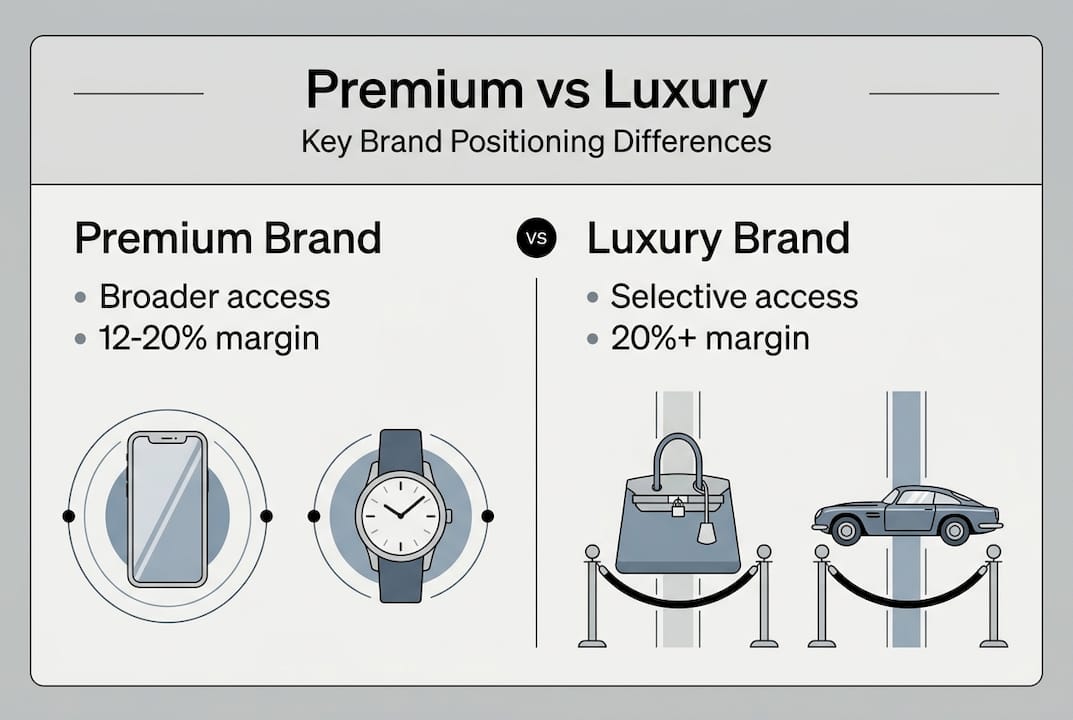
| Dimension | Premium Brands | True Luxury Brands |
|---|---|---|
| Distribution | Selective but accessible | Highly controlled and limited |
| Profit Margins | 12-20% | 20-35% |
| Target Audience | Affluent professionals | Ultra-high-net-worth individuals |
| Brand Visibility | Moderate logo presence | Often subtle or silent branding |
| Pricing Strategy | Consistent premium pricing | Ultra-premium with regular increases |
Balancing exclusivity with scale presents ongoing challenges. You want enough distribution to drive revenue but not so much that scarcity disappears. This tension requires constant calibration based on market feedback and brand health metrics. Monitor resale values, brand sentiment, and customer acquisition costs to gauge whether you’re maintaining optimal balance.
Pro Tip: Avoid hybrid strategies that confuse brand perception. Trying to be both accessible and exclusive simultaneously risks satisfying neither segment effectively. Choose your positioning clearly and commit to it consistently across all brand expressions. Mixed signals accelerate brand equity erosion and reduce pricing power.
Edge cases like celebrity collaborations or limited capsule collections require careful management. These initiatives can generate buzz and attract new audiences, but they must align with core brand values. A poorly chosen partnership dilutes authenticity and confuses loyal customers about what your brand represents. Evaluate every collaboration against strict brand fit criteria before proceeding.
Understanding exclusivity in branding luxury value helps navigate these nuances. Exclusivity isn’t just about limited quantity; it’s about creating experiences and narratives that make customers feel part of an elite group. This psychological dimension often matters more than actual scarcity in driving premium pricing power.
Implementing premium brand positioning: practical strategies and expert tips
Audit brand touchpoints systematically to ensure consistent exclusive messaging and premium experience delivery. Every interaction from website navigation to packaging unboxing to customer service must reinforce your premium positioning. Inconsistencies create cognitive dissonance that undermines pricing justification. Create detailed touchpoint maps and evaluate each against brand standards quarterly.
No-discount policies maintain perceived value and prevent brand commoditization. Once you start discounting, customers learn to wait for sales rather than paying full price. This pattern destroys premium positioning faster than almost any other mistake. If you must offer promotions, use value-added approaches like exclusive experiences or limited editions rather than price reductions. Protect your pricing integrity religiously.
Craft authentic brand narratives emphasizing heritage, craftsmanship, and emotional connection. Stories create the context that justifies premium pricing. Share founder journeys, artisan profiles, material sourcing adventures, and design philosophies that bring your brand to life. Authenticity matters; consumers quickly detect fabricated narratives. Build on genuine brand history and values rather than inventing false heritage.
Leverage psychographics targeting affluent consumers aged 18-54 with household incomes exceeding $75,000 for tailored marketing approaches. Demographics alone don’t capture the lifestyle aspirations and values that drive premium purchases. Dig deeper into motivations, media consumption patterns, and social identities. This precision targeting improves marketing efficiency and message resonance.
Practical implementation strategies include:
- Establish brand councils that review all marketing materials for consistency
- Invest in premium packaging that creates memorable unboxing experiences
- Train customer service teams to deliver white-glove service at every interaction
- Curate retail environments that immerse customers in brand worlds
- Develop content marketing that educates rather than sells directly
Pro Tip: Test scarcity tactics like limited editions or controlled releases to boost desirability without alienating customers. Start small with capsule collections to gauge response before committing to broader scarcity strategies. Monitor customer feedback closely; excessive scarcity frustrates loyal customers and drives them to competitors.
Channel consistency extends beyond owned touchpoints to wholesale partners and digital marketplaces. If you sell through department stores or online platforms, ensure they present your brand according to your standards. Provide detailed guidelines, approved imagery, and messaging frameworks. Poor presentation in third-party channels undermines premium positioning as effectively as inconsistent owned channels.
Explore expert fashion brand positioning tips for advanced strategies tailored to luxury market dynamics. Premium positioning requires ongoing refinement as markets evolve and competitors adjust strategies. Stay informed about industry trends while remaining true to core brand values.
Measure premium positioning effectiveness through metrics beyond sales volume. Track brand sentiment, price elasticity, customer lifetime value, and unprompted brand awareness. These indicators reveal positioning health more accurately than short-term revenue figures. Invest in regular brand tracking studies to catch perception shifts early.
Implementation success depends on organizational alignment. Everyone from design teams to sales associates must understand and embody premium positioning. Create internal brand training programs that bring positioning to life through examples and case studies. When your team believes in the brand story, they communicate it authentically to customers.
Discover how storytelling luxury elevates prestige through narrative techniques that transform products into cultural symbols. The most successful premium brands excel at storytelling that creates emotional bonds transcending functional product benefits.
Explore expert consulting for premium fashion brand growth
Building premium brand positioning in competitive luxury markets requires specialized expertise combining psychology, marketing strategy, and deep sector knowledge. Corrado Manenti offers targeted consulting that accelerates growth for fashion brands seeking to establish or strengthen premium positioning. His approach integrates consumer behavior insights with practical implementation frameworks tailored to luxury market dynamics.
Leverage proven strategies for fashion brand growth tactics luxury market success that balance exclusivity with sustainable business models. Whether you’re launching a new premium brand or repositioning an existing one, expert guidance helps you navigate complexities and avoid costly mistakes. Access specialized insights on positioning frameworks, storytelling techniques, and implementation best practices.
Discover advanced fashion brand positioning tips luxury success strategies that differentiate your brand in saturated markets. Learn to craft narratives that justify premium pricing while building authentic customer relationships. Explore techniques for maintaining brand equity as you scale and tools for measuring positioning effectiveness.
Understand your customers at deeper levels by learning to analyze buyer behavior luxury brands exhibit. Consumer psychology drives purchasing decisions in premium markets more than rational product evaluation. Gain insights into motivations, aspirations, and decision-making processes that inform more effective marketing strategies.
FAQ
What is the difference between premium and luxury brand positioning?
Premium brands offer high quality and broader accessibility with profit margins typically ranging from 12-20%, while luxury brands emphasize extreme exclusivity, heritage, and margins reaching 20-35%. Premium positioning targets affluent professionals seeking elevated products without ultra-exclusive price points. Luxury brands focus on ultra-high-net-worth individuals and often use silent branding to signal insider status. The distribution strategies differ significantly, with premium brands maintaining selective but accessible retail networks while luxury brands tightly control limited availability.
How can storytelling influence premium brand positioning?
Storytelling creates emotional bonds that justify premium pricing by conveying heritage, craftsmanship, and brand values beyond functional product benefits. Authentic narratives differentiate brands in saturated luxury markets where quality differences may be minimal. Stories transform products into symbols of identity and aspiration that consumers willingly pay premiums to access. Effective storytelling also builds customer loyalty by creating shared values and community around brand narratives. The most successful premium brands excel at weaving consistent stories across all touchpoints from advertising to retail experiences.
What are the risks of diluting a premium brand’s exclusivity?
Overexposure through excessive distribution, discount promotions, or inconsistent messaging rapidly erodes brand equity and pricing power. Once consumers perceive a brand as accessible or discounted, reversing that perception requires years of disciplined repositioning. Hybrid strategies that try to serve both mass and premium markets simultaneously confuse consumers about brand identity and value proposition. This confusion reduces willingness to pay premium prices and increases price sensitivity. Brand dilution also damages relationships with loyal customers who invested in exclusivity that no longer exists.
What psychographics are most important for targeting premium fashion consumers?
Affluent individuals aged 18-54 with household incomes exceeding $75,000 typically form the core premium brand consumer base, but income alone doesn’t capture the full picture. Target consumers who value exclusivity, craftsmanship, and brands that align with their identity and aspirations. Lifestyle factors like cultural engagement, travel frequency, and social consciousness often predict premium purchasing better than demographics alone. Focus on emotional drivers like desire for status signaling, appreciation for artisanal quality, or commitment to sustainable luxury. Understanding these deeper motivations enables more effective messaging and product development that resonates with premium consumers.
Recommended
- Master the Fashion Branding Workflow for Premium Brands – Corrado Manenti
- Luxury Brand Positioning Workflow: Elevate Your Prestige – Corrado Manenti
- Blog – Corrado Manenti
- Luxury Brand Positioning Checklist for 2025 Success – Corrado Manenti
- Streetwear vs. Fast Fashion: Why the Difference Still Matters – HRDLF