


Bold choices are shaping the future of luxury marketing. Over **60% of European luxury consumers now expect brands to prove their sustainability commitments without losing exclusivity. American and European market leaders face the challenge of merging high-end heritage with ethical innovation. For executives seeking inspiration beyond traditional green messaging, this guide spotlights actionable strategies that unite responsible practices and prestige.
Table of Contents
- Defining Sustainability In Luxury Markets
- Types And Models Of Sustainable Luxury
- Key Drivers: Consumer, Regulatory, And Market
- Integrating Sustainability Without Losing Exclusivity
- Risks, Challenges, And Reputation Pitfalls
- Best Practices For Sustainable Luxury Success
Key Takeaways
| Point | Details |
|---|---|
| Sustainability as Core Value | Luxury brands must integrate sustainability into their core business model, evolving from surface-level initiatives to authentic, measurable practices. |
| Consumer Demand for Transparency | Modern luxury consumers prioritize brands that showcase genuine commitment to ethical practices and environmental responsibility. |
| Regulatory Pressure for Change | Stricter regulations compel luxury brands to adopt sustainable practices, requiring investment in compliance and transparent reporting. |
| Risks of Inauthentic Claims | Greenwashing can severely damage brand credibility, making third-party verification essential for maintaining consumer trust. |
Defining Sustainability in Luxury Markets
Sustainability in luxury markets represents a sophisticated evolution beyond traditional environmental conservation. It encompasses a holistic approach that integrates ethical production, social responsibility, and strategic brand positioning. Luxury brands are increasingly recognizing that sustainability is not merely a trend, but a fundamental transformation of business philosophy and consumer expectations.
In contemporary luxury markets, sustainability transcends simple ecological considerations. It involves comprehensive strategies that address luxury brand differentiation through responsible sourcing, transparent supply chains, and meaningful social impact. Modern luxury consumers demand more than aesthetic excellence – they seek brands that demonstrate genuine commitment to environmental stewardship and ethical practices.
The definition of sustainability within luxury contexts involves multiple interconnected dimensions. These include environmental protection, fair labor practices, carbon footprint reduction, circular economy principles, and long-term resource management. Luxury brands must now balance traditional craftsmanship and exclusivity with demonstrable social and ecological consciousness. This requires reimagining product lifecycles, investing in sustainable technologies, and communicating authentic sustainability narratives that resonate with increasingly discerning consumers.
Pro tip: Develop a comprehensive sustainability framework that integrates quantifiable metrics and transparent reporting to establish credibility with environmentally conscious luxury consumers.
Types and Models of Sustainable Luxury
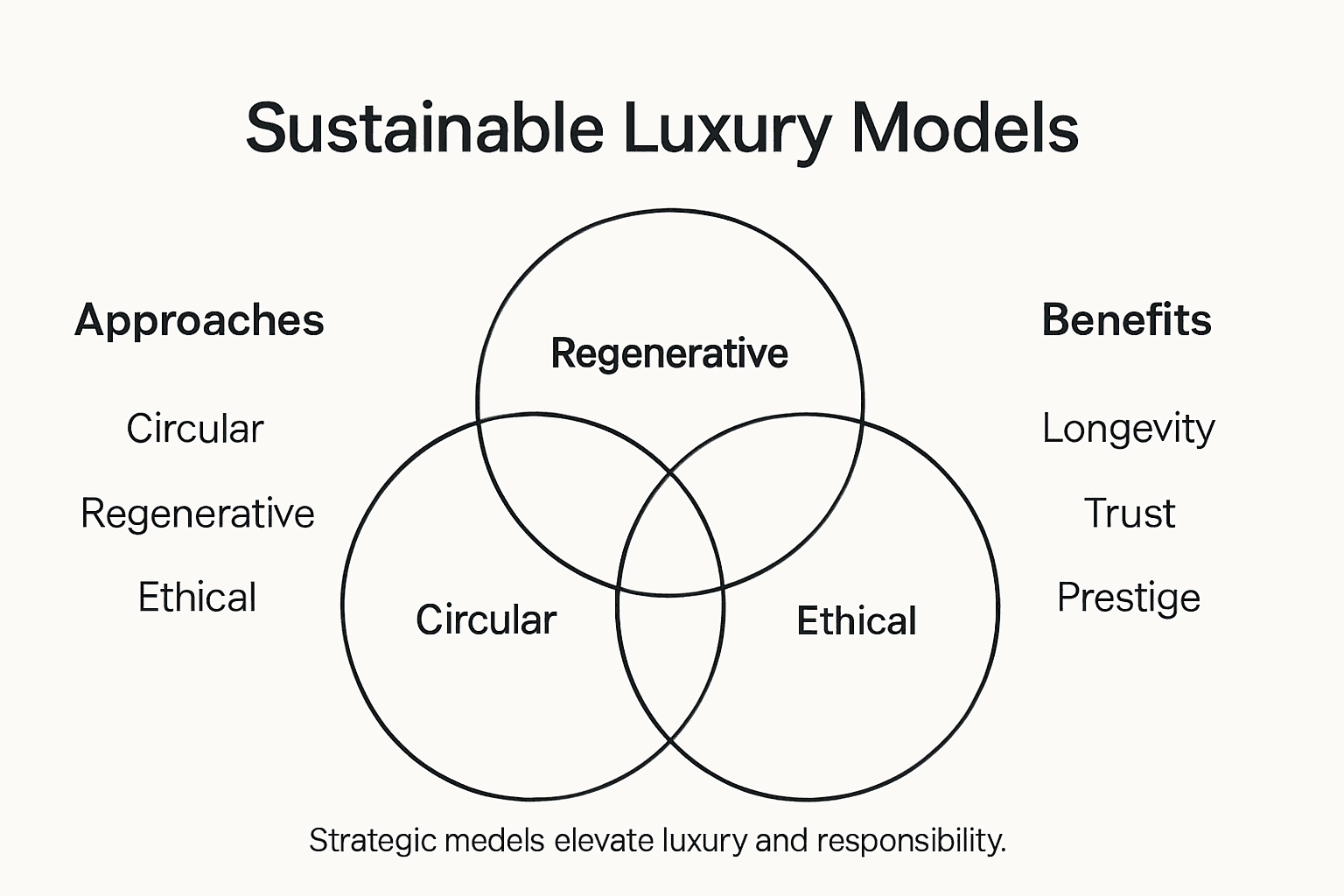
Sustainable luxury models represent a strategic intersection between environmental consciousness and premium brand positioning. Emerging business models are transforming how luxury brands approach sustainability, moving beyond traditional greenwashing tactics toward comprehensive, integrated approaches that fundamentally reimagine product creation and consumption.

These models typically encompass several core strategies. The circular economy model stands out, focusing on product lifecycles that minimize waste and maximize resource efficiency. Luxury brands are developing innovative approaches such as repair services, materials recycling, and design systems that allow products to be easily disassembled and reconstructed. Premium positioning strategies now integrate sustainability as a core value proposition, demonstrating that environmental responsibility can enhance rather than diminish brand exclusivity.
Key sustainable luxury models include regenerative design, wherein brands create products that actively restore environmental systems; transparent supply chain models that provide complete visibility into production processes; and collaborative consumption models that extend product lifecycles through rental, resale, and recommerce platforms. These approaches challenge traditional luxury paradigms by prioritizing long-term environmental impact and social responsibility alongside aesthetic and quality considerations.
Pro tip: Develop a comprehensive sustainability scorecard that tracks environmental impact, social responsibility metrics, and circular economy potential across your luxury brand’s entire product ecosystem.
Here is a summary of key sustainable luxury models and the unique value they offer:
| Model Type | Main Focus | Business Benefits |
|---|---|---|
| Circular Economy | Waste minimization, resource reuse | Extends product lifecycle, reduces costs |
| Regenerative Design | Environmental restoration | Builds positive brand reputation |
| Transparent Supply Chain | Visibility in sourcing and making | Increases consumer trust |
| Collaborative Consumption | Shared ownership, rental, resale | Expands customer base, drives engagement |
Key Drivers: Consumer, Regulatory, and Market
Luxury industry sustainability is propelled by a complex interplay of consumer expectations, regulatory pressures, and market dynamics. Modern luxury consumers are increasingly demanding transparency, ethical production, and demonstrable environmental responsibility, fundamentally reshaping how brands approach sustainability as a core strategic imperative.
Consumer behavior represents a critical driver of sustainable transformation. Emerging generations prioritize brands that align with their values, seeking products that demonstrate genuine environmental and social commitment. Consumer behavior analysis reveals a growing preference for luxury brands that can authentically communicate their sustainability credentials, with buyers willing to pay premium prices for products that meet rigorous ethical and environmental standards.
Regulatory frameworks are simultaneously creating powerful incentives for sustainable innovation. European Union regulations like the Green Deal and emerging global environmental policies are compelling luxury brands to redesign production processes, supply chains, and corporate governance models. These regulatory pressures intersect with market competition, driving technological innovations in materials science, circular economy strategies, and transparent reporting mechanisms that redefine luxury’s traditional value proposition.
Pro tip: Develop a comprehensive sustainability scorecard that integrates consumer preferences, regulatory compliance metrics, and market competitive analysis to drive strategic decision-making across your luxury brand ecosystem.
Integrating Sustainability Without Losing Exclusivity
Luxury brands are redefining exclusivity through strategic sustainability integration that maintains brand prestige while addressing environmental and social responsibilities. The key lies in transforming sustainability from a peripheral concern to a core element of brand identity, demonstrating that ethical practices can enhance rather than diminish luxury positioning.
Successful integration requires a nuanced approach that elevates sustainability as a marker of sophistication and discernment. This involves developing premium sustainable materials, implementing transparent and ethical production processes, and creating narratives that connect environmental responsibility with craftsmanship and heritage. Luxury brands must showcase sustainability as an extension of their commitment to quality, innovation, and social consciousness, positioning ecological awareness as an aspirational attribute that complements traditional luxury values.
Technological innovation and design excellence play crucial roles in maintaining exclusivity while pursuing sustainability. Advanced materials science, precision engineering, and artisanal techniques can create products that are simultaneously environmentally responsible and exceptionally crafted. By investing in cutting-edge sustainable technologies and design approaches, luxury brands can demonstrate that ecological considerations represent a sophisticated evolution of their brand philosophy, not a compromise of their core value proposition.
Pro tip: Develop a sustainability narrative that emphasizes innovation, craftsmanship, and environmental stewardship as complementary aspects of luxury brand excellence.
Risks, Challenges, and Reputation Pitfalls
Luxury brands face significant reputational risks when navigating sustainability claims, with greenwashing representing the most critical potential threat to brand credibility. The danger lies not just in making unsupported environmental claims, but in creating a perception of inauthenticity that can rapidly erode consumer trust and brand value.
Complex regulatory landscapes create additional challenges for luxury brands seeking to maintain sustainable practices. Emerging legal frameworks in regions like the European Union impose stringent requirements on carbon emissions, supply chain transparency, and environmental reporting. Brands must invest significantly in comprehensive compliance strategies that go beyond surface-level sustainability statements, developing robust internal mechanisms to validate and substantiate their ecological commitments.
Supply chain complexity represents another critical vulnerability for luxury brands attempting to integrate sustainability. Traditional luxury production processes often involve multiple international vendors, making comprehensive traceability and ethical verification extraordinarily challenging. Brands must develop sophisticated tracking and validation systems that provide transparent documentation of material sourcing, production conditions, and environmental impact, ensuring that sustainability claims can withstand rigorous external scrutiny.
Pro tip: Develop a comprehensive sustainability verification system that provides real-time documentation and third-party validation of your brand’s environmental and social responsibility claims.
The following table compares top risks and best practices for luxury brands when addressing sustainability:
| Challenge | Example Risk | Best Practice |
|---|---|---|
| Greenwashing | Damaged credibility | Use third-party verification |
| Regulatory Complexity | Costly compliance failures | Invest in monitoring systems |
| Supply Chain Traceability | Unverified sourcing | Implement digital tracking tools |
| Loss of Brand Exclusivity | Diluted brand value | Align sustainability with heritage |
Best Practices for Sustainable Luxury Success
Leading luxury brands strategically embed sustainability into their core business model, transforming environmental responsibility from a peripheral concern to a central strategic imperative. This approach requires a holistic reimagining of brand identity, production processes, and consumer engagement that goes far beyond superficial marketing claims.
Successful sustainable luxury strategies demand comprehensive, multidimensional approaches. Luxury consumer behavior insights reveal that authenticity is paramount – brands must develop genuine, measurable sustainability initiatives that demonstrate real commitment. This involves investing in innovative materials research, implementing transparent supply chain management, and creating compelling narratives that connect environmental stewardship with brand heritage and craftsmanship.
Technology and innovation play crucial roles in sustainable luxury transformation. Brands must leverage advanced materials science, digital tracking technologies, and circular design principles to create products that are simultaneously environmentally responsible and exceptionally crafted. This requires building internal capabilities that blend traditional artisanal expertise with cutting-edge sustainable technologies, ensuring that ecological considerations enhance rather than compromise product quality and brand prestige.
Pro tip: Develop a comprehensive sustainability strategy that integrates quantifiable environmental metrics, transparent reporting, and innovative design approaches to create a holistic approach to sustainable luxury.
Elevate Your Sustainable Luxury Strategy Without Compromising Prestige
Navigating the intricate balance between sustainability and exclusivity is one of the top challenges luxury brands face today. This article highlights the risks of greenwashing, supply chain complexity, and the urgent need for authentic, psychology-driven marketing that resonates deeply with conscious consumers. If you are seeking to preserve your brand’s prestige while embedding measurable sustainability, it is essential to adopt a holistic approach that aligns ethical innovation with refined craftsmanship.
At Corrado Manenti, we specialize in helping luxury brands like yours master this transformation. Combining insights from consumer psychology and luxury marketing expertise, we develop compelling narratives and strategic frameworks that ensure your sustainability efforts enhance—not dilute—your brand’s exclusivity. Explore how our tailored solutions in Marketing Fashion can empower you to meet evolving market expectations with confidence.
Ready to protect your brand’s reputation and lead your market with genuine sustainability? Visit Corrado Manenti now to discover the difference of marketing driven by deep consumer understanding and luxury sector expertise. Take the first step toward integrating innovation, precision, and ethical storytelling that captivates discerning audiences. Learn more about our Marketing Fashion services and transform your sustainable luxury vision into reality.
Frequently Asked Questions
What is the definition of sustainability in luxury markets?
Sustainability in luxury markets involves integrating ethical production, social responsibility, and brand positioning, moving beyond traditional environmental conservation to reflect consumer expectations and business philosophy.
How can luxury brands maintain exclusivity while embracing sustainability?
Luxury brands can maintain exclusivity by transforming sustainability into a core brand element, showcasing how ethical practices enhance craftsmanship, quality, and innovation.
What are some effective models of sustainable luxury?
Key models of sustainable luxury include the circular economy, regenerative design, transparent supply chains, and collaborative consumption, each focusing on minimizing waste and maximizing resource efficiency while preserving brand prestige.
Why is consumer behavior a critical driver of sustainability in luxury?
Modern luxury consumers prioritize brands that align with their values, demanding transparency and ethical practices, which compels luxury brands to adopt comprehensive sustainability strategies.