


TL;DR:
- Experiential marketing immerses consumers in live brand encounters, creating emotional bonds and lasting memories. It outperforms traditional advertising by generating higher engagement, immediate ROI, and valuable user content. Brands that strategically integrate it as a core channel see long-term growth and stronger customer loyalty.
Experiential marketing is defined as a strategy that immerses consumers in live, participatory brand encounters designed to generate emotional engagement and lasting memory. Unlike a banner ad or a 30-second spot, it turns a passive viewer into an active participant. Fifty-nine percent of marketers say experiential marketing delivers superior ROI to traditional advertising. That figure alone signals why marketing professionals and business owners are reallocating budgets toward immersive activations. The advantages of experiential marketing extend well beyond a single event: they compound through brand recall, organic content, and first-party data that no paid media channel can replicate.
What are the core advantages of experiential marketing?
Experiential marketing outperforms passive advertising in brand recall and emotional connection. The reason is neurological. Experiential memories encode more durably in the brain than purely visual or auditory content, while digital impressions fade within seconds. A consumer who touches, smells, or physically interacts with a product at a live activation carries that memory for months.
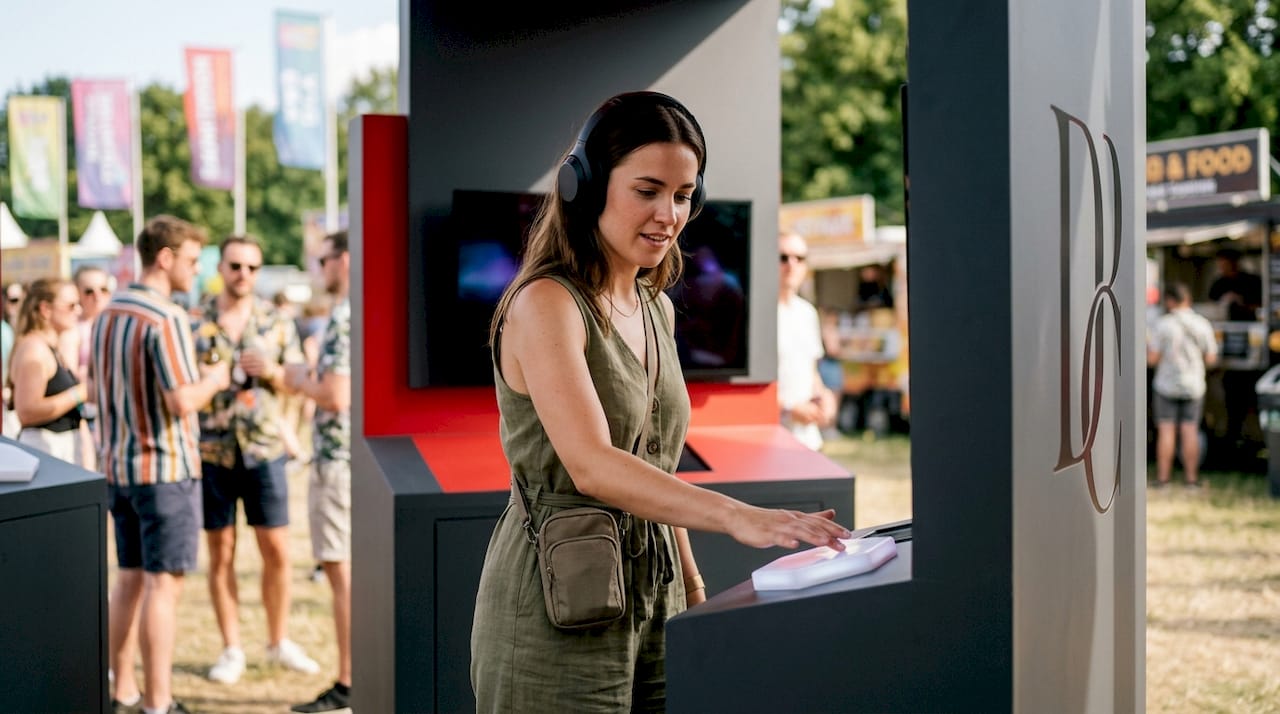
The second core advantage is participation. Experiential marketing bypasses consumer advertising filters by inviting participation rather than interrupting consumption. Consumers today skip pre-roll ads and scroll past sponsored posts. An immersive brand experience cannot be skipped. That structural difference in attention is the foundation of every other benefit covered below.
How does experiential marketing drive emotional connection and brand loyalty?
Emotional engagement is the primary driver of purchase behavior, not rational argument. Campaigns with emotional content perform twice as well as those focused on rational arguments alone. That gap widens when the emotional trigger is a lived experience rather than a viewed one.
Experiential marketing turns consumers from passive audiences into active brand participants, which drives deeper loyalty. When someone physically interacts with a brand, they develop a sense of ownership over that interaction. Psychologists call this the “IKEA effect”: effort invested in an experience increases perceived value. Brands that design activations around this principle consistently see stronger repeat purchase rates.
The benefits of experiential marketing for loyalty are especially pronounced in the fashion and luxury sectors. A consumer who attends a private atelier preview or a curated sensory installation does not just remember the product. They remember how the brand made them feel. That emotional residue is what luxury storytelling converts into long-term client relationships.
- Design for all five senses. Scent, texture, and sound deepen memory encoding far beyond what a visual alone achieves.
- Create a moment of personal relevance. Personalized activations, such as monogramming stations or bespoke consultations, give each attendee a story only they can tell.
- Build in a social trigger. A shareable moment, a striking installation, or an exclusive reveal gives attendees a reason to broadcast the experience.
- Follow up within 48 hours. Post-event communication that references the specific experience the attendee had reinforces the emotional bond before it fades.
Pro Tip: Design your activation around one dominant emotion, whether that is wonder, exclusivity, or nostalgia, and let every physical element in the space serve that single feeling. Divided emotional intent produces forgettable events.
Does experiential marketing deliver better ROI than traditional advertising?
The financial case for experiential marketing is concrete. Experiential marketing can deliver as much as 65% of a brand’s total marketing ROI. Event ROI typically ranges between 25%–34%, with pop-up experiences averaging 34%. Those numbers reflect direct revenue from trial-to-purchase conversion, not just awareness metrics.
Seventy-five percent of brands report positive ROI from experiential campaigns within the first year. That speed of return is unusual in marketing, where brand-building investments often take 18–24 months to show measurable results.
The table below compares key performance indicators across experiential and traditional advertising formats.
| Metric | Experiential marketing | Traditional advertising |
|---|---|---|
| Brand recall duration | Months | Days to weeks |
| Consumer attention | Active and voluntary | Passive and interruptive |
| ROI realization timeline | Within 12 months (75% of brands) | Often 18–24 months |
| Share of total marketing ROI | Up to 65% | Varies by channel |
| First-party data capture | High (event registration, CRM) | Low to none |
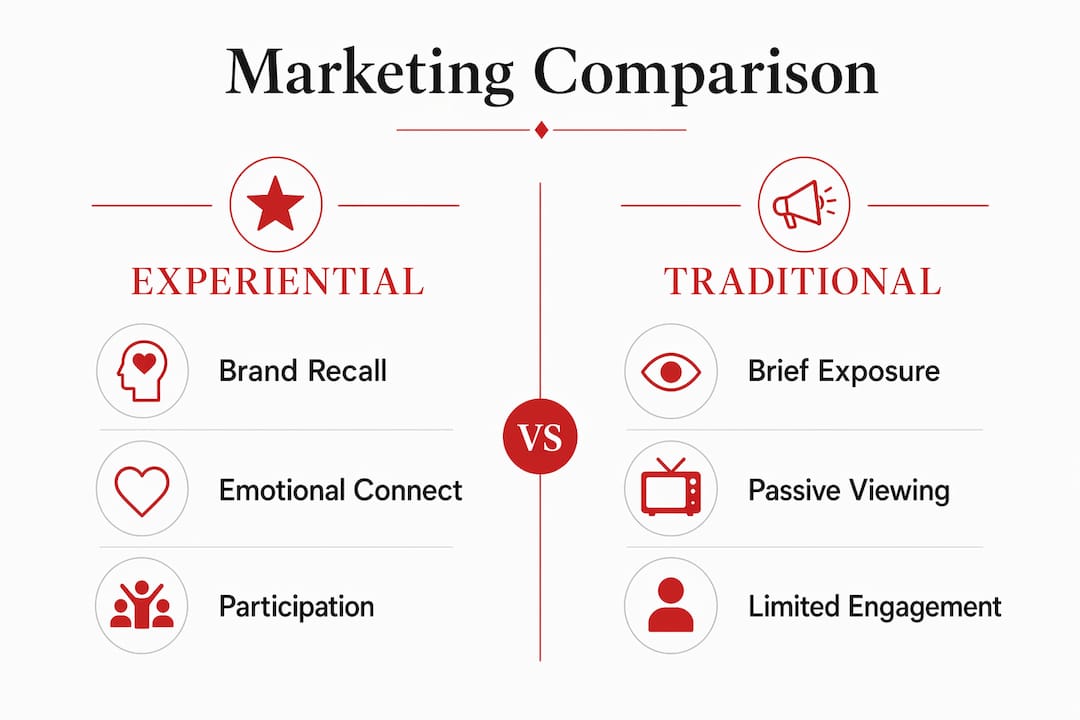
Framing experiential activations as drivers of both trial-to-purchase conversion and customer retention is the key to CFO-level ROI justification. Finance teams respond to two numbers: cost per acquired customer and customer lifetime value. Experiential marketing improves both simultaneously, which is a combination that paid digital rarely achieves.
How does user-generated content amplify experiential marketing reach?
User-generated content (UGC) is the organic amplification engine that makes experiential marketing disproportionately efficient. UGC from experiential events generates 4x higher click-through rates than traditional brand ads, and results in 50% lower cost per click in paid advertising compared to studio-produced assets. That means the content your attendees create for free outperforms the content your agency charges to produce.
Eighty-three percent of consumers say they will share a brand event on social media if they find it engaging. Eighty-seven percent of event attendees share content on Instagram specifically. Those shares extend the event’s reach to audiences who never attended, at zero additional media cost.
UGC also carries a trust advantage. Authentic content created by real participants feels transparent and credible in a way that branded advertising cannot replicate. Consumers treat peer content as a recommendation, not a sales message. That psychological distinction is why UGC consistently outperforms branded creative in conversion metrics.
Maximizing organic amplification requires deliberate design choices during the activation itself:
- Traffic flow: Route attendees through the most photogenic spaces before they reach the exit.
- Lighting: Warm, even lighting at eye level flatters subjects and produces shareable images without filters.
- Camera angles: Build installations at heights and depths that frame naturally well in a smartphone vertical format.
- Guest comfort: Comfortable attendees stay longer, share more, and return. Crowding and heat kill organic content output.
Pro Tip: After the event, collect the top 20 pieces of attendee UGC and repurpose them across paid social, email, and your website. UGC used in paid ads consistently outperforms studio assets, and the attendees who created it become brand advocates when you feature their content.
How does experiential marketing complement digital and other channels?
Experiential marketing does not replace digital channels. It feeds them. The content, data, and emotional associations generated at a live activation supply every other channel with higher-quality inputs than those channels could generate on their own.
Experiential activations enable capturing first-party data unreachable by traditional digital ads. Event registration, on-site surveys, and interactive product trials produce CRM records with verified intent signals. That data improves email segmentation, paid retargeting, and customer lifetime value modeling in ways that cookie-based tracking cannot.
The integration between experiential and digital works best when it follows a deliberate sequence:
- Pre-event digital seeding. Use teaser content on owned channels to build anticipation and drive registration. This primes the audience emotionally before they arrive.
- Live social activation. Designate a branded hashtag and a content capture zone. Give attendees a reason to post in real time.
- Post-event content harvest. Collect UGC, testimonials, and video clips within 48 hours. Organize them by theme for use across email, paid social, and organic content calendars.
- CRM follow-up sequence. Use event registration data to trigger personalized email flows that reference the specific experience each attendee had. Personalized follow-up converts trial to purchase at a significantly higher rate than generic outreach.
- Paid amplification of UGC. Run the strongest attendee content as paid social ads. The 4x click-through rate advantage of UGC over branded ads applies in paid placements as well as organic ones.
Experiential marketing also humanizes premium brands by enabling storytelling that reduces psychological purchase friction. That friction reduction is especially valuable in luxury, where the gap between brand aspiration and purchase decision is wide. A consumer who has physically experienced the brand crosses that gap more easily. For a deeper look at how relationship marketing reinforces this loyalty loop, the principles translate directly to experiential program design.
Key Takeaways
Experiential marketing delivers superior ROI, deeper brand loyalty, and organic content amplification because it converts passive consumers into active participants who remember, share, and return.
| Point | Details |
|---|---|
| Superior memory encoding | Experiential memories last months; digital impressions fade within seconds. |
| Proven ROI speed | 75% of brands report positive ROI from experiential campaigns within the first year. |
| UGC efficiency | Attendee content generates 4x higher click-through rates than branded ads. |
| First-party data capture | Live activations produce verified CRM data that digital ads cannot replicate. |
| Channel amplification | Experiential content feeds email, paid social, and organic channels with higher-quality inputs. |
Why I think most brands still underuse experiential marketing
After years of working with fashion and luxury brands, I keep seeing the same mistake. Brands treat experiential as a one-off event budget line rather than a core channel with compounding returns. They run a beautiful pop-up, collect no data, repurpose no content, and then wonder why the ROI is hard to measure.
The brands that win with experiential treat every activation as a content and data production event first, and a brand moment second. The emotional impact is real, but it is the UGC, the CRM records, and the retargeting audiences that make the CFO sign off on the next one.
The other underappreciated advantage is what experiential does to buyer psychology in premium categories. Luxury consumers do not buy products. They buy access to a world. An immersive activation is the most efficient way to let them inhabit that world before they commit. Brands that understand this stop competing on product features and start competing on the quality of the experience they create around the product. That is a much harder position for a competitor to copy.
My practical advice: budget for experiential as a percentage of your total marketing spend, not as a one-time experiment. The compounding effect of repeat activations, growing UGC libraries, and deepening CRM data is where the real financial advantage lives.
— Corrado
Experiential marketing services for luxury and premium brands
Brands in fashion, luxury, and lifestyle face a specific challenge: every activation must reflect the same standard of quality as the product itself. A poorly executed event does more damage than no event at all.
Corradomanenti works with premium brands to design and execute experiential programs that are psychologically grounded, meticulously produced, and built to generate measurable returns. From activation concept through post-event content strategy, the approach integrates consumer psychology with luxury brand standards. Explore the fashion brand growth tactics that Corradomanenti applies across luxury and lifestyle sectors, and see how experiential marketing fits within a full-channel brand growth plan.
FAQ
What is experiential marketing?
Experiential marketing is a strategy that immerses consumers in live, participatory brand encounters rather than delivering a passive advertising message. The goal is to create emotional engagement and durable brand memory through direct interaction.
Why use experiential marketing over traditional advertising?
Experiential marketing bypasses advertising filters by inviting participation, and campaigns with emotional content perform twice as well as rational-argument-only campaigns. It also generates first-party data and UGC that traditional ads cannot produce.
What ROI can brands expect from experiential campaigns?
Seventy-five percent of brands report positive ROI within the first year, and experiential marketing can account for as much as 65% of a brand’s total marketing ROI, with pop-up experiences averaging 34% event ROI.
How does UGC from experiential events benefit a brand?
UGC generated at experiential events produces 4x higher click-through rates than branded ads and reduces cost per click by 50% when used in paid placements. It also carries higher consumer trust than studio-produced content.
How does experiential marketing support digital channels?
Live activations generate first-party CRM data, branded UGC, and emotional associations that improve the performance of email, paid social, and organic content. The advantages of experiential branding are most visible when the activation is designed from the start to feed every downstream channel.