


TL;DR:
- Strategic co-branding enhances brand meaning while avoiding erosion of luxury prestige.
- Best models for luxury include Complementary Competency and Ingredient Branding collaborations.
- Careful assessment of audience fit, values, and long-term impact is essential for success.
Most luxury brand managers assume that any high-profile collaboration automatically elevates both partners. That assumption is expensive. Co-branding in fashion is a strategic collaboration between two or more brands to develop co-branded products or services, aiming for mutual benefits like innovation, market expansion, and enhanced brand equity. The real question is not whether to co-brand, but how to do it without eroding the prestige you have spent decades building. This guide breaks down every critical layer: the mechanics, the data, the risks, and the decision frameworks that protect your brand while unlocking genuine growth.
Table of Contents
- Defining co-branding in the fashion industry
- Types of co-branding collaborations and mechanics
- Benefits and risks: Data and real-world outcomes
- Key success factors and pitfalls to avoid in luxury co-branding
- A smarter approach to co-branding: Lessons luxury brands often overlook
- Take your co-branding strategy further
- Frequently asked questions
Key Takeaways
| Point | Details |
|---|---|
| Co-branding defined | Co-branding in fashion involves strategic collaborations to boost innovation, reach, and equity. |
| Four collaboration types | Mechanics include competency, endorsement, awareness, and ingredient-based models. |
| Luxury brand risks | Partnering down-market risks brand dilution; coherence and authenticity are critical for success. |
| Proven market impact | Data shows significant short-term sales increases but highlights need for long-term brand strategy. |
Defining co-branding in the fashion industry
Co-branding is not a sponsorship deal, and it is not a celebrity endorsement. Those are transactional arrangements where one party pays for visibility. Co-branding operates at a fundamentally different level. It is a structured, strategic alliance where both brands contribute distinct value and share in the outcome, both the upside and the downside.
In the high-end fashion context, this means two brands creating something neither could produce alone, whether that is a capsule collection, a co-engineered product, or a joint experiential campaign. The goal is not just sales. It is mutual brand benefit through shared positioning, expanded audience reach, and reinforced brand narratives.
Strategic motivations vary. Some luxury brands co-brand to signal innovation, others to penetrate a younger demographic, and some to gain credibility in a new category. These are legitimate objectives, but each carries a different risk profile. A heritage house entering a streetwear collaboration is making a very different bet than a watchmaker partnering with a complementary Swiss brand.
Here is where most managers get it wrong: they confuse co-branding with co-marketing. Co-marketing means two brands promote each other. Co-branding means they create something together. That distinction matters enormously in luxury because shared creation implies shared identity, at least temporarily.
Key distinctions worth keeping in mind:
- Endorsement: A celebrity or brand promotes your product without co-creating it
- Sponsorship: Financial support in exchange for logo placement or naming rights
- Co-marketing: Joint promotional campaigns without product integration
- Co-branding: Genuine collaboration resulting in a new, shared product or experience
“Strategic co-branding is not about doubling reach. It is about adding a dimension of meaning to your brand that your audience cannot get from you alone.”
Understanding this framework is essential before you approach any potential partner. Start with a luxury branding checklist to assess your brand’s readiness for partnership, and study how the most effective fashion branding strategies are already positioning this approach in 2026.
Types of co-branding collaborations and mechanics
Not all co-branding looks the same. The four core types are Complementary Competency, Promotional Endorsement, Awareness Enhancement, and Ingredient Branding. Each has specific mechanics, strategic purposes, and risk levels, especially in a luxury context.
Here is a breakdown of how they compare:
| Type | Core mechanic | Best for luxury when… | Risk level |
|---|---|---|---|
| Complementary Competency | Two brands combine expertise | Skills are genuinely distinct and premium | Low to medium |
| Promotional Endorsement | One brand elevates the other | The endorsing brand has strong aspirational pull | Medium |
| Awareness Enhancement | Both brands share audience exposure | Target demographics overlap significantly | Medium to high |
| Ingredient Branding | One brand is embedded inside the other’s product | The ingredient adds verifiable, premium value | Low |
In practice, luxury brands have adapted these models for their specific needs. Temporary capsule collections favor Awareness Enhancement because they create urgency without permanent identity entanglement. Long-term line extensions, on the other hand, require the deeper structural logic of Complementary Competency.
Consider these real-world examples:
- Apple Watch Nike+: Ingredient Branding where Nike’s performance credibility is embedded in Apple’s technology product. Both brands retain their identity while the product signals a shared aspiration.
- Adidas x Lego: Awareness Enhancement targeting younger consumers with a playful, limited-scope collaboration that does not threaten Adidas’s core positioning.
- Swatch x Omega: A classic Complementary Competency model where Omega’s horological prestige elevates Swatch’s collectibility. The collaboration produced the MoonSwatch, which drove extraordinary demand.
Pro Tip: For luxury brands, the safest entry point into co-branding is often Ingredient Branding or Complementary Competency. These preserve creative control while allowing genuine value exchange. Avoid Awareness Enhancement collaborations unless you have rigorously mapped your audience overlap and confirmed shared values.
For a structured approach to applying these mechanics within your existing brand system, the fashion marketing framework offers a practical starting point.
Benefits and risks: Data and real-world outcomes
The business case for co-branding in fashion is strong, but it is not unconditional. The data reveals both significant opportunity and measurable risk.

64.5% of Spanish consumers reported purchasing a co-branded fashion product, the Swatch x Omega MoonSwatch being a standout case study where sales velocity exceeded projections by a wide margin. Co-branding can also boost brand visibility by up to 30%, a meaningful number for brands competing in saturated luxury segments.
| Outcome | Potential upside | Potential downside |
|---|---|---|
| Brand visibility | Up to 30% increase | Overexposure in misaligned contexts |
| Sales velocity | Sharp short-term spikes | Post-collaboration demand drop |
| Audience expansion | Access to new demographics | Confusion among existing loyal customers |
| Brand equity | Reinforced through strong partnerships | Dilution through weaker or misaligned partners |
The equity transfer effect is particularly worth understanding. When two brands collaborate, consumers automatically associate some of each brand’s attributes with the other. If the partner brand has strong positive equity, this benefits you. If not, the negative transfer can be persistent and difficult to reverse.
Key stat: Co-branding collaborations that align on both values and audience demographics generate the highest sustained returns, while purely trend-driven partnerships often fade after the initial launch buzz.
For luxury brands specifically, the long-term impact on prestige is the primary concern. A single well-executed collaboration can reframe how an entire generation perceives your brand. A poorly chosen one can undermine decades of positioning. The fashion innovation cases that have worked share one feature: they felt inevitable in retrospect, not opportunistic.
Pro Tip: Measure co-branding success beyond sell-through rates. Track brand perception scores before and after the collaboration, monitor social sentiment, and assess whether new audience segments are converting into long-term customers, not just one-time buyers.
Key success factors and pitfalls to avoid in luxury co-branding
Most co-branding failures are not creative failures. They are strategic ones. The product might be beautiful, the campaign flawless, and the initial sell-through impressive. Yet three years later, the brand feels a little less like itself. That erosion is the real cost.
The two most critical success factors are coherence and authenticity. Coherence means the collaboration makes intuitive sense to your existing audience. Authenticity means both brands are contributing something genuine, not just renting each other’s equity for a quarter.
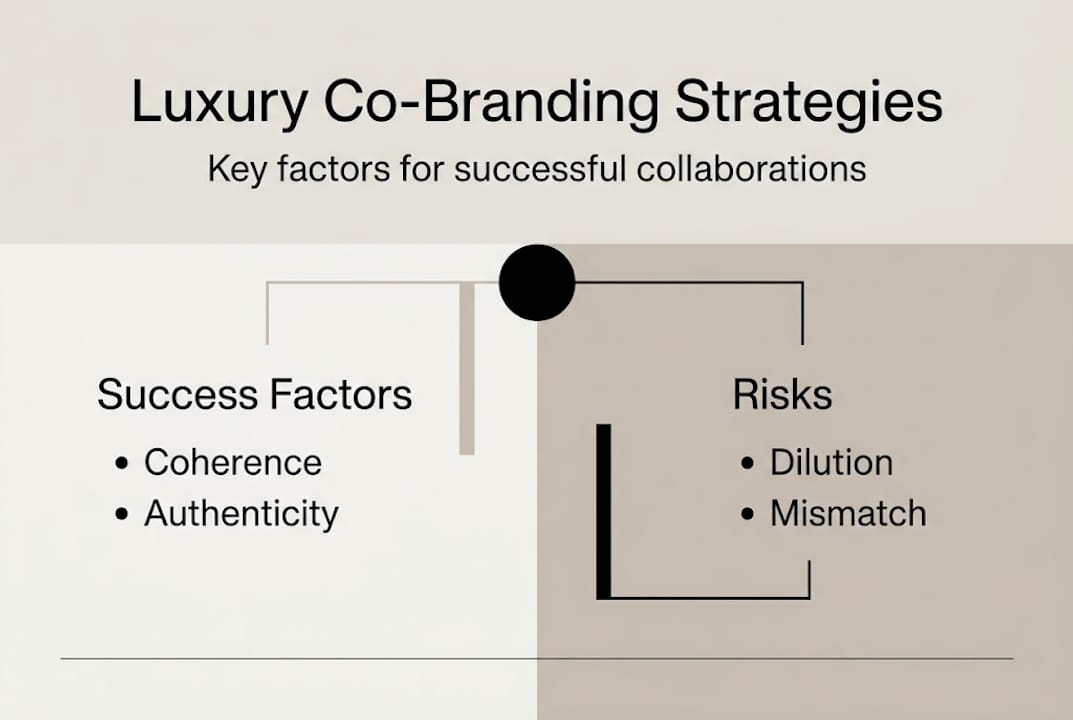
Brand dilution, misalignment, intellectual property conflicts, and reputational damage are the documented risks. And luxury brands that partner down-market face an accelerated dilution risk that is particularly difficult to recover from.
Here is a due diligence checklist before signing any co-branding agreement:
- Values alignment: Does the partner brand stand for principles compatible with yours?
- Audience fit: Do your target customers view the partner brand with respect, admiration, or aspiration?
- Creative control: Will you maintain sufficient governance over how your brand elements are used?
- Exit clarity: What happens to shared assets, campaigns, and product lines if the partnership ends?
- Reputation history: Has the partner brand faced any controversies that could transfer to you?
“A luxury brand’s most valuable asset is not its product catalog. It is the trust and desire it has built over time. No collaboration is worth trading that for short-term sales numbers.”
Temporary alliances are often safer than permanent line extensions for this reason. A limited capsule has a defined end point. A product line integration does not, and the longer a co-branded identity exists, the more it becomes part of your brand’s permanent record.
For guidance on maintaining brand trust through every strategic decision, including partnerships, the principles behind personal branding strategies apply directly to brand-level co-branding decisions in the luxury space.
Pro Tip: Always run a small-scale audience sentiment test before launching a major co-branding campaign. Focus groups drawn from your top-tier customer segment will reveal misalignments your internal team might overlook simply because they are too close to the creative work.
A smarter approach to co-branding: Lessons luxury brands often overlook
Here is the uncomfortable observation after working across dozens of luxury brand scenarios: the co-branding projects that generate the most press attention are often the ones that cause the most long-term damage. The viral moment, the sold-out drop, the headline in every trade publication, these feel like wins. Sometimes they are. But more often, they are expensive lessons in the difference between excitement and equity.
The brands that consistently get co-branding right are not the ones chasing youth culture or hype cycles. They are the ones that approach every potential collaboration with the same rigor they apply to product design: obsessive attention to fit, function, and long-term meaning.
Chasing reach for its own sake is a mass-market instinct. Luxury brands do not need reach. They need resonance. A collaboration that reaches ten million casual observers but confuses five thousand loyal customers is a net loss in any real brand accounting.
Strategic restraint is not timidity. It is the discipline that keeps premium positioning intact. Before signing any partnership, the only question that matters is this: will my best customers feel that this collaboration belongs in our story? If the answer requires qualification, the answer is no.
For a structured path to applying this thinking, the luxury brand marketing steps framework will help you build a co-branding evaluation process that is both rigorous and brand-aligned.
Take your co-branding strategy further
Understanding co-branding at a conceptual level is valuable. Translating that understanding into execution decisions for your specific brand is where the real work begins.
If you are evaluating a potential partnership or designing a co-branding strategy from the ground up, you need more than frameworks. You need hands-on guidance calibrated to the specific pressures and opportunities of the luxury market. The luxury brand growth tactics available through this site give you actionable, psychology-informed methods for high-stakes brand decisions. And if you want a complete strategic foundation, the fashion marketing guide is the most direct path to building a brand that grows without compromising its prestige.
Frequently asked questions
How does co-branding benefit luxury fashion brands specifically?
Luxury brands gain youth engagement and expanded reach through co-branding without harming perception, provided the partnership is authentic and strategically aligned. It is one of the few tools that can simultaneously build innovation credentials and market access.
What is the biggest risk of co-branding in luxury fashion?
Brand dilution and image misalignment are the most serious risks, particularly when a luxury brand partners with a brand that operates at a lower price point or carries conflicting values. This damage can persist long after the collaboration ends.
Which co-branding models work best in the high-end market?
Complementary Competency and Endorsement models consistently perform best for luxury brands because they preserve identity integrity while enabling genuine value exchange with a partner.
Can co-branding boost short-term sales without harming long-term value?
Temporary alliances often boost sales significantly in the short term, but sustained long-term value depends entirely on how well the collaboration reflects both brands’ authentic identities and whether it respects the expectations of core customers.