

TL;DR:
- Successful fashion marketing requires a solid brand foundation, seamless digital experience, and first-party data.
- Prioritize disciplined execution of omnichannel presence, creator partnerships, UGC, and real urgency tactics.
- Adapting strategies to luxury tiers and embracing AI and creator influence are essential for future growth.
Fashion marketing has never been more demanding. Brands are managing more channels, more consumer touchpoints, and more data than at any point in history, yet most marketing teams still operate from fragmented playbooks that miss critical steps. 71% of fashion leaders are increasing digital investment this year, and 80% of luxury sales are now digitally influenced, which means the margin for error is shrinking fast. This checklist is built for marketing professionals and brand managers who need a structured, evidence-based framework to audit what they have, fix what is broken, and execute with precision across every tier of the market.
Table of Contents
- Set a future-ready foundation
- Checklist steps for high-impact fashion marketing
- Integrate brand and performance marketing for measurable results
- Adapt checklist strategies for different luxury tiers
- Future-proofing: Activate AI, UGC, and creator partnerships
- What most fashion marketers overlook: Real execution trumps trendy tools
- Take your fashion marketing strategy further
- Frequently asked questions
Key Takeaways
| Point | Details |
|---|---|
| Foundational readiness | A frictionless website, clear brand code, and omnichannel basics are non-negotiable for fashion marketing success in 2026. |
| Actionable checklist steps | A step-by-step list—from social discovery to UGC integration—ensures no critical tactic is missed. |
| Performance plus brand alignment | Blending brand storytelling with performance marketing, tracked using specific KPIs, maximizes short- and long-term returns. |
| Segment-specific adaptation | Checklist strategies must be customized for accessible, premium, and ultra-luxury segments to be effective. |
| Future-proofing with AI and UGC | AI-powered curation and creator partnerships are key levers for staying ahead in consumer engagement. |
Set a future-ready foundation
To ground your efforts and avoid wasted execution, the first step is ensuring your core foundation matches what fashion marketing actually demands in 2026. Without this, every tactic you layer on top will underperform.
Start with your brand code. This is a set of 6-10 clear rules that govern how your brand looks, sounds, and behaves across every channel. Think of it as a behavioral constitution for your marketing team. Without it, your Instagram feels different from your email campaigns, and your in-store experience contradicts your digital presence.
Next, audit your website and cross-device experience. A frictionless website is non-negotiable. Slow load times, clunky mobile navigation, and inconsistent product imagery are brand equity killers. Pair this with integrated social storefronts so that discovery on Instagram or TikTok converts directly without forcing users through unnecessary steps.
Finally, build your first-party data infrastructure now. Privacy regulations are tightening globally, and third-party cookies are increasingly unreliable. Collecting consented data through loyalty programs, quizzes, and gated content gives you the personalization engine your campaigns need.
Pro Tip: Map your current marketing stack against the table below before investing in any new tools. Gaps in infrastructure cost more than gaps in budget.
| Infrastructure element | Status check | Priority |
|---|---|---|
| Mobile-optimized website | Audit quarterly | Critical |
| Social storefronts (Instagram, TikTok) | Live and shoppable | High |
| First-party data collection | CRM integrated | Critical |
| Brand code document | Reviewed annually | High |
| Cross-device analytics | Unified dashboard | Medium |
For a deeper look at how leading brands are approaching this, the McKinsey State of Fashion 2026 report offers strong benchmarks. You can also explore our fashion marketing blog and luxury digital strategy guide for applied frameworks.
Checklist steps for high-impact fashion marketing
With a solid brand and technical foundation, you are ready to execute the tactical checklist proven to drive outcomes. These steps are sequenced intentionally. Skipping ahead rarely works.
- Audit website UX against current mobile-first benchmarks
- Activate omnichannel presence across email, SMS, social, and in-store
- Build intent-based SEO targeting search terms that signal purchase readiness
- Launch content-to-commerce editorial that moves readers directly to product pages
- Collect first-party data through loyalty incentives and interactive content
- Establish creator partnerships with micro and macro influencers aligned to your brand codes
- Deploy real urgency tactics using limited editions, waitlists, and event-based drops
- Integrate UGC into product pages and paid campaigns to build social proof
- Optimize checkout by reducing steps and adding trust signals
- Review and iterate monthly using a KPI scorecard
Social discovery, intent-based search, creator partnerships, and urgency consistently rank as the highest-impact digital priorities for fashion brands. But execution focus, not just tool selection, is what separates brands that grow from brands that stagnate.
Pro Tip: Real urgency is built on genuine scarcity. Fake countdown timers and artificial stock warnings erode trust fast, especially with luxury consumers who research brands thoroughly before buying.
| Checklist step | Impact | Ease | Estimated cost |
|---|---|---|---|
| Website UX audit | High | Medium | Low |
| Omnichannel activation | High | Low | Medium |
| Intent-based SEO | Medium | Medium | Low |
| Creator partnerships | High | Medium | Medium/High |
| UGC integration | High | High | Low |
| Checkout optimization | High | Medium | Low/Medium |
For a printable version of this framework, visit our fashion strategy checklist. Deloitte’s research on luxury marketing also reinforces why omnichannel execution is the defining factor in 2026 brand performance.
Integrate brand and performance marketing for measurable results
Executing steps is not enough. Integrating brand narrative and rigorous performance tracking turns action into lasting value. The brands that win long-term are those that refuse to treat brand building and performance marketing as separate budgets.

Align your long-term brand equity work, such as editorial content, experiential events, and heritage storytelling, with short-term sales activation like retargeting, promotions, and conversion-optimized landing pages. Neither works as well in isolation.
Use a simple KPI scorecard updated weekly and reviewed monthly:
- Search lift: Are branded search queries increasing month over month?
- Online conversion rate: Industry benchmark sits between 4-6% for top performers
- Customer retention rate: Are repeat purchase rates improving?
- Omnichannel LTV: Customers engaged across channels show up to 30% higher lifetime value
- Email and SMS open rates: Signals of audience health and content relevance
- Return on ad spend (ROAS): Especially for paid social and search
“Brands that maintain consistent codes across digital and physical touchpoints close the value gap between awareness and conversion faster than those that treat each channel as a separate campaign.”
The 80% digital influence stat is not just a headline number. It means that even a consumer who buys in-store has almost certainly touched your digital presence first. Weak digital execution costs you physical sales too. Explore exclusivity messaging tactics and exclusivity and brand loyalty for strategies that reinforce both brand and performance goals. HubSpot’s luxury marketing insights also provide useful benchmarking context.
Adapt checklist strategies for different luxury tiers
Before applying the full checklist, adapt your approach for your specific segment. Accessible, premium, and ultra-luxury brands face very different consumer expectations, and the tactics that work brilliantly for one tier can actively damage another.
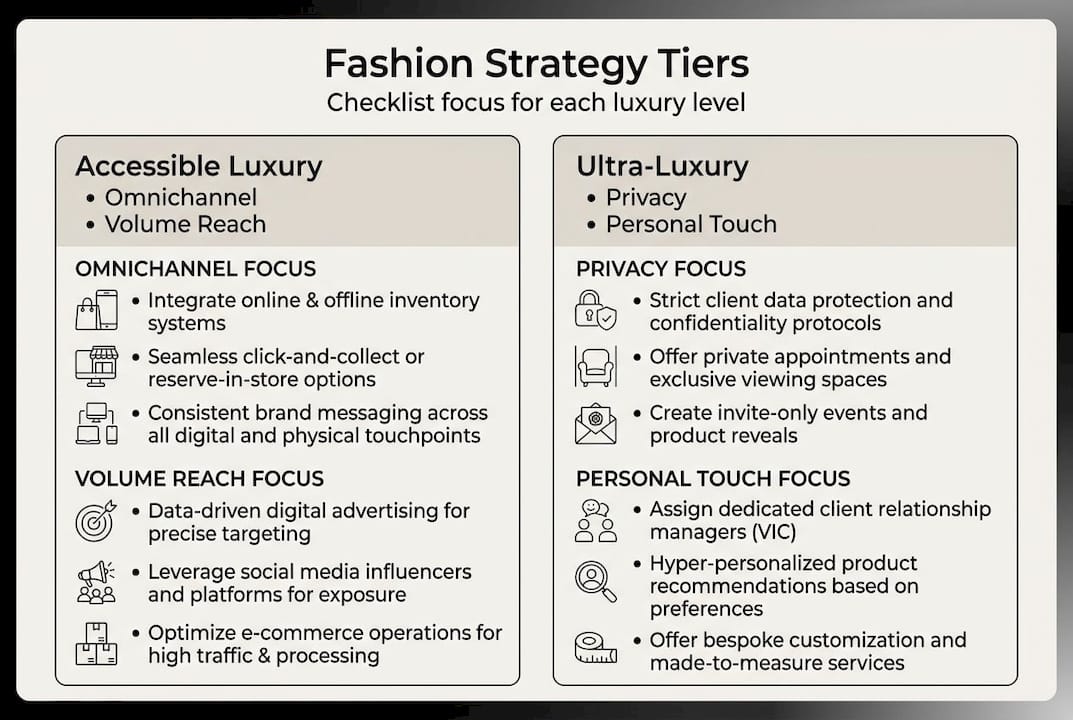
Ultra-luxury brands require minimal digital noise, while accessible luxury brands thrive on omnichannel reach and volume-driven discovery. Applying the same playbook across tiers is one of the most common and costly mistakes in fashion marketing.
| Segment | Digital approach | Urgency tactics | Sustainability messaging | Privacy focus |
|---|---|---|---|---|
| Accessible luxury | Full omnichannel, high volume | Promotions, drops, waitlists | Broad, values-led | Standard |
| Premium | Selective omnichannel, editorial | Limited editions, exclusives | Detailed, verified | Elevated |
| Ultra-luxury | Minimal, invitation-only digital | Genuine scarcity only | Cultural universe integration | Privacy-safe exchange |
What to avoid at each tier:
- Accessible: Inconsistent pricing signals and over-discounting that erode perceived value
- Premium: Mass-market creative that dilutes aspirational positioning
- Ultra-luxury: Any tactic that feels algorithmic, automated, or widely distributed
For ultra-luxury and high-net-worth clients, privacy-safe data exchanges and hospitality-integrated experiences outperform any digital ad format. The brand’s cultural universe, its history, its craft, its community, must be the primary communication vehicle. See our luxury branding checklist and exclusivity in luxury branding for tier-specific execution guides.
Future-proofing: Activate AI, UGC, and creator partnerships
Beyond segment adaptation, the new frontier is activating AI, UGC, and creator influence. These are not optional additions to your checklist. They are fast becoming table stakes.
Here is how to implement them systematically:
- Audit current AI use across your marketing stack and identify gaps in curation, personalization, and content generation
- Optimize for AI agents by ensuring your product pages use structured data markup so AI-powered search tools surface your catalog accurately
- Allocate a dedicated AI visibility budget separate from traditional paid search
- Launch a UGC program by incentivizing customers to share styled content in exchange for recognition, early access, or loyalty points
- Select creators based on audience alignment, not just follower count. Micro-creators with 10,000 to 100,000 engaged followers often outperform macro accounts in conversion
- Track creator performance using UTM parameters and dedicated landing pages
AI could automate 22% of marketing tasks in fashion, and generative AI is already accelerating merchandising and curation workflows. That is not a threat to creative teams. It is a productivity multiplier when used with discipline.
UGC builds trust and creator partnerships drive discovery, but only when the execution is intentional. Flooding your feed with low-quality creator content damages brand perception faster than having no creator strategy at all.
“Influencer marketing generates an average of $6.50 for every $1 spent when campaigns are aligned to brand codes and conversion goals.”
For a forward-looking view on where this is heading, explore branding innovation in luxury and HubSpot’s luxury brand strategy resources.
What most fashion marketers overlook: Real execution trumps trendy tools
With the future in mind, it is pivotal to focus on the fundamentals most brands now overlook. Here is the uncomfortable truth: the majority of fashion marketing teams that struggle are not under-tooled. They are under-disciplined.
Every quarter, new platforms, AI features, and analytics dashboards compete for attention and budget. Sophisticated luxury marketers are not immune to this distraction. The result is a marketing stack full of expensive software and a calendar full of half-executed campaigns.
The brands that consistently outperform are those that treat checklist execution as a non-negotiable operational rhythm, not a one-time strategy exercise. Brand consistency, real urgency, and genuine creator alignment are not exciting ideas. They are disciplines that compound over time.
Pro Tip: Audit your actual weekly execution against this checklist, not just your tech stack. If a tactic is not showing up on your calendar and your P&L, it is not strategy. It is theater.
The exclusive brand loyalty perspectives we have developed through years of luxury consulting consistently point to the same finding: execution frequency beats execution sophistication every time.
Take your fashion marketing strategy further
If you are ready to translate this checklist into rapid results, or need guidance for next-level execution, the resources below are built specifically for fashion and luxury brand managers who want to move faster and smarter.
Corrado Manenti’s consulting practice specializes in psychology-driven marketing for fashion and luxury brands. Whether you need a full strategy audit, a custom growth plan, or a structured framework to align your team, the work is built around your brand’s specific tier, positioning, and goals. Explore luxury fashion growth tactics, download the luxury branding checklist, or review the latest branding strategies for 2026 to identify your highest-leverage next steps.
Frequently asked questions
What are the must-have items on a fashion marketing strategy checklist for 2026?
Key checklist items include a frictionless website, omnichannel presence, AI-powered curation, creator partnerships, UGC integration, and privacy-safe first-party data collection. Each element supports the others, so gaps in one area limit the effectiveness of the rest.
How do luxury fashion brands measure marketing effectiveness?
Core metrics include branded search lift, online conversion rates between 2.5% and 6%, customer retention rates, and omnichannel lifetime value. Tracking these weekly and reviewing monthly gives teams the data needed to optimize in real time.
How should the checklist change for ultra-luxury or high-net-worth audiences?
For ultra-luxury, minimize digital noise, prioritize privacy-safe data practices, and center communications on brand heritage and cultural universe rather than performance-driven tactics. Exclusivity and discretion are the primary brand signals at this tier.
Is it necessary to use AI tools now in fashion marketing?
Yes. AI will automate 22% of fashion marketing tasks and already accelerates merchandising and curation workflows. Brands that delay adoption risk falling behind on both efficiency and consumer personalization.
What are the most common mistakes in fashion marketing execution?
Over-focusing on new technologies while neglecting foundational execution is the most consistent mistake. Brand inconsistency, fake urgency tactics, and misaligned creator partnerships are the specific failure points that most damage conversion and long-term brand equity.