


TL;DR:
- A brand manifesto is a public statement that declares a company’s core beliefs, who it serves, and what it rejects. It should include a specific enemy, target audience, beliefs, a falsifiable promise, and a clear invitation to join the movement. Effective manifestos take two weeks to craft, focus on operational friction, and are tested with skeptics before publication.
A brand manifesto is a concise, public declaration of what your brand believes, who it stands for, and what it refuses to accept. Unlike a mission statement, which describes what a company does, a manifesto declares what it believes and exists to persuade. Knowing how to craft a brand manifesto separates brands that generate loyalty from brands that generate transactions. Effective manifestos in 2026 run 200–400 words, focusing on purpose and conviction rather than product features. That constraint forces clarity and forces you to say something real.
How to craft a brand manifesto: the core components
Every effective brand manifesto shares five structural elements. Miss one and the document collapses into marketing copy.
-
A named enemy or problem. The enemy is never a competitor. It is a condition, a norm, or a belief the brand rejects. Think “disposable fashion” or “the idea that luxury is only for the few.” Naming an enemy gives the manifesto tension and moral weight.
-
A specific audience. Successful manifestos target one psychographic segment, not a broad demographic. “Women aged 25–45” is a demographic. “Women who refuse to apologize for wanting both ambition and elegance” is a psychographic. The second version creates recognition. The first creates nothing.
-
Declared beliefs. These are not values pulled from a corporate template. They are positions the brand can be publicly held to. “We believe slow production is the only ethical production” is a belief. “We value quality” is a placeholder.
-
A falsifiable promise. A manifesto must include a public commitment that customers can test. “Every garment is made in facilities we inspect annually and publish the results” is falsifiable. “We are committed to excellence” is not.
-
An explicit invitation. The manifesto must ask the reader to join something. Not buy something. Join something. This is the emotional architecture that turns a document into a movement.
Pro Tip: Read your manifesto aloud and ask: does this invite someone into a tribe, or does it describe a product? If it describes a product, rewrite the closing paragraph entirely.
The importance of brand manifesto writing in luxury and fashion markets is especially high because affluent audiences make decisions based on identity alignment, not price comparison.

What is the step-by-step process to write a brand manifesto?
The most reliable process for creating a brand manifesto runs two weeks. Week one identifies the enemy and the operational cost. Week two writes the promise and the invitation. Rushing this into a single afternoon produces generic copy that fails the “So what?” test.
Week one: find what you stand against
- Name the enemy. Write down every norm, assumption, or industry behavior your brand rejects. List at least ten. Then cut to the one that costs you something to oppose.
- Identify the operational cost. A real manifesto creates friction. If honoring your stated belief requires turning down revenue, a customer segment, or a partnership, you have found a real belief. If it costs nothing, it is decoration.
- Profile your audience psychographically. Pull your best customer insights and buyer profiles. Write one paragraph describing the inner life of your ideal customer, not their age or income.
- Gather evidence. Collect customer language from reviews, interviews, and social comments. The words your audience uses to describe their frustrations are the words your manifesto should echo.
Week two: write the promise and the invitation
- Draft an ugly first version. Write the full manifesto in one sitting without editing. Aim for 300 words. Do not stop to refine. The goal is raw conviction on the page.
- Edit for rhythm and brevity. Cut every sentence that could appear in a competitor’s manifesto. Rewrite passive constructions into active ones. Read it aloud and mark every sentence where your voice flattens.
- Write the promise. State one specific, testable commitment. Attach a mechanism: how will customers verify it?
- Write the invitation. Close with a direct call to join the belief system, not to purchase. Use second-person language: “If you believe this too, you belong here.”
Pro Tip: Share your draft with someone who is openly skeptical of your brand. If their response is “that’s nice,” the manifesto needs a full rewrite. A neutral reaction means the document has no edge.
Testing with cynical outsiders is the single most reliable quality check for emotional impact.
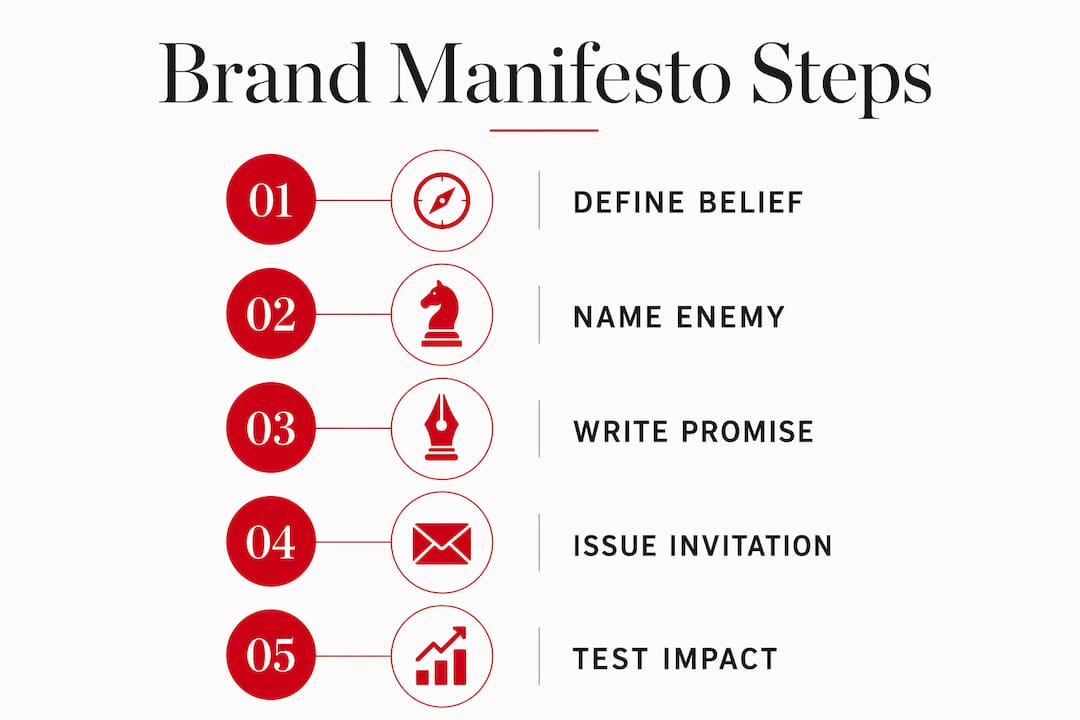
| Stage | Action | Output |
|---|---|---|
| Day 1–3 | Name the enemy and list operational costs | Confirmed core belief |
| Day 4–7 | Psychographic audience profile and language research | Audience voice document |
| Day 8–10 | Write ugly first draft | Raw 300-word manifesto |
| Day 11–14 | Edit, test aloud, share with skeptics, finalize | Publication-ready manifesto |
What are common mistakes when creating a manifesto?
The most common error is confusing a manifesto with a mission statement. Mission statements describe what a company does. Manifestos declare what a brand believes. Writing “We exist to deliver premium fashion experiences” is a mission statement dressed up as a manifesto. It persuades no one.
-
Generic values. Words like “integrity,” “innovation,” and “excellence” appear in thousands of brand documents. They fail the “So what?” test immediately. Replace each generic value with a specific belief that would make some people uncomfortable.
-
Committee language. Manifestos written by consensus are safe by design. Safe manifestos do not move people. The goal is to write something that a specific group of people feel was written exactly for them, even if it alienates others.
-
No operational friction. If a manifesto doesn’t create friction or cost, it is decorative copy without strategic force. A fashion brand that claims to reject fast production but still runs seasonal clearance sales has a decorative manifesto.
-
Skipping the outsider test. Internal teams fall in love with their own language. Sharing the draft with people outside the organization, especially skeptics, reveals whether the document actually lands.
“Powerful manifestos whisper to the audience’s quiet thoughts, revealing the ‘why’ behind the brand rather than loudly promoting features. That whisper creates a deeper emotional connection than any campaign headline ever will.”
The brand storytelling approach that works in manifesto writing is the same one that works in narrative marketing: specificity over generality, conviction over safety.
How does a brand manifesto align your marketing and brand decisions?
A manifesto is not a document you publish once and archive. It is a filter for every brand decision that follows. Paid creative that is directly traceable to manifesto messaging outperforms creative that drifts from it. Disconnection between manifesto and advertising causes flat campaign metrics because the audience senses the inconsistency even when they cannot name it.
Pro Tip: Before approving any campaign asset, ask one question: “Could this ad appear in a competitor’s campaign?” If yes, it has drifted from your manifesto. Rewrite it.
The manifesto also functions as a product development filter. When a new product idea reaches the table, the manifesto answers whether it belongs. A brand that has declared itself against disposable consumption cannot launch a seasonal trend collection without contradiction. That friction is the point. It forces meaningful choices.
| Decision type | Without a manifesto | With a manifesto |
|---|---|---|
| Campaign messaging | Varies by team or season | Consistent tone and belief across all channels |
| Product development | Driven by trend or margin | Filtered through declared beliefs |
| Partnership selection | Opportunistic | Aligned with stated values |
| Hiring and culture | Undefined behavioral standards | Manifesto serves as cultural benchmark |
Publishing the manifesto externally builds emotional engagement with luxury audiences because it signals that the brand has convictions, not just products. Sharing it internally gives teams a shared language for decisions. Both uses compound over time into brand recall and trust.
Key takeaways
A brand manifesto works only when it declares a specific belief, names a real enemy, and creates operational friction that the brand must actively honor.
| Point | Details |
|---|---|
| Manifesto vs. mission statement | A manifesto persuades externally; a mission statement describes internally. Never confuse the two. |
| Psychographic targeting | Focus on one specific audience segment defined by beliefs and inner life, not demographics. |
| Operational friction | A real manifesto costs the brand something. If it costs nothing to honor, rewrite it. |
| Two-week process | Spend week one on enemy and cost identification; spend week two on drafting and testing. |
| Outsider testing | Share with skeptics before publishing. A neutral reaction means the document needs a full rewrite. |
Why most brand manifestos fail before they are published
The manifestos I see most often in luxury and fashion contexts fail for one reason: they were written to please everyone in the room. A committee reviewed every line and softened every edge until nothing remained that could offend anyone. The result is a document that also cannot inspire anyone.
The most effective manifestos I have worked with took a position that made the client uncomfortable. One brand I advised declared publicly that it would never discount, ever, under any circumstances. That single line cost them short-term revenue. It also built a client base that never expected a sale and never asked for one. The manifesto created the culture it described.
The psychology behind luxury brand loyalty confirms what I see in practice: people do not attach to brands that try to be everything. They attach to brands that stand for something specific enough to exclude them if they do not share the belief. That exclusion is not a flaw. It is the mechanism.
Rewriting is not a sign of failure. The best manifestos go through four or five complete rewrites before they find their voice. Treat the first draft as research, not output.
— Corrado
Brand manifesto expertise for luxury and fashion markets
Translating a manifesto into real brand growth requires more than good writing. It requires understanding how affluent audiences make decisions and how belief-driven messaging converts into loyalty.
Corradomanenti specializes in exactly this intersection: the psychology of luxury consumer behavior and the brand positioning work that turns conviction into revenue. The fashion brand growth tactics available through Corradomanenti cover manifesto-driven positioning, emotional branding frameworks, and the specific messaging strategies that perform in premium markets. If your brand has a manifesto that is not yet driving decisions or campaigns, that is the gap Corradomanenti is built to close.
FAQ
What is a brand manifesto?
A brand manifesto is a public declaration of what a brand believes, who it serves, and what it stands against. It differs from a mission statement by functioning as external persuasion rather than internal description.
How long should a brand manifesto be?
Effective manifestos run 200–400 words, focusing on belief and purpose rather than product features. Longer documents lose emotional impact.
How do I define brand values for a manifesto?
Replace generic values like “integrity” or “quality” with specific beliefs your brand can be publicly held to. Each value should be falsifiable and should create some operational constraint on the brand’s behavior.
How do I know if my manifesto is working?
Read it aloud and share it with skeptical outsiders. If the response is indifferent, the manifesto lacks conviction. A strong manifesto produces strong reactions, both positive and negative.
Can a brand manifesto influence paid advertising?
Yes. Paid creative tied directly to manifesto messaging outperforms creative that drifts from it. The manifesto should serve as the brief for every campaign asset your team produces.