


TL;DR:
- Brand consistency involves presenting a unified message across all customer touchpoints to build recognition and trust. It can increase revenue by up to 23% and reduces operational costs by avoiding brand fragmentation. Maintaining active management, shared guidelines, and cultural alignment ensures coherence across visual, verbal, and experiential elements.
Brand consistency is defined as the deliberate practice of presenting a unified identity, message, and experience across every customer touchpoint. It is the single most reliable driver of recognition, trust, and long-term revenue growth. Consistent brand presentation can increase revenue by up to 23% and makes brands 3.5 times more visible to consumers. That is not a marginal gain. It is the difference between a brand customers remember and one they scroll past. For brand managers and marketing professionals, understanding why brand consistency matters is the foundation of every growth decision you make.
Why brand consistency matters for customer trust and loyalty
Consistent branding works through a well-documented psychological principle called the familiarity effect. The more often customers encounter the same visual identity, tone, and message, the more they trust the source. Familiarity reduces the mental effort required to evaluate a brand, which makes purchasing decisions faster and more confident.
The financial evidence is clear. 87% of consumers are willing to pay more for products from brands they trust. That willingness to pay a premium is not driven by product features alone. It is driven by the accumulated confidence that comes from repeated, consistent brand exposure.
Consistent branding also reduces friction in the customer journey. When a brand looks and sounds the same on Instagram, in email, and in-store, customers do not have to re-evaluate whether they are dealing with the same company. That coherence shortens the path from awareness to purchase.
Brand consistency is the silent engine behind customer trust and revenue growth. Internal fragmentation quickly erodes its benefits, no matter how strong the product or service behind the brand.
- Customers recognize a consistent brand faster, which lowers acquisition costs over time.
- Trust built through consistency translates directly into repeat purchases and referrals.
- Premium pricing becomes defensible when customers associate the brand with reliability.
- Consistent messaging reduces the number of touchpoints needed before a customer converts.
Pro Tip: Treat brand consistency as a revenue mechanism, not a design preference. Every time your brand looks or sounds different across channels, you are adding friction to the purchase decision.
What are the key components of brand consistency?
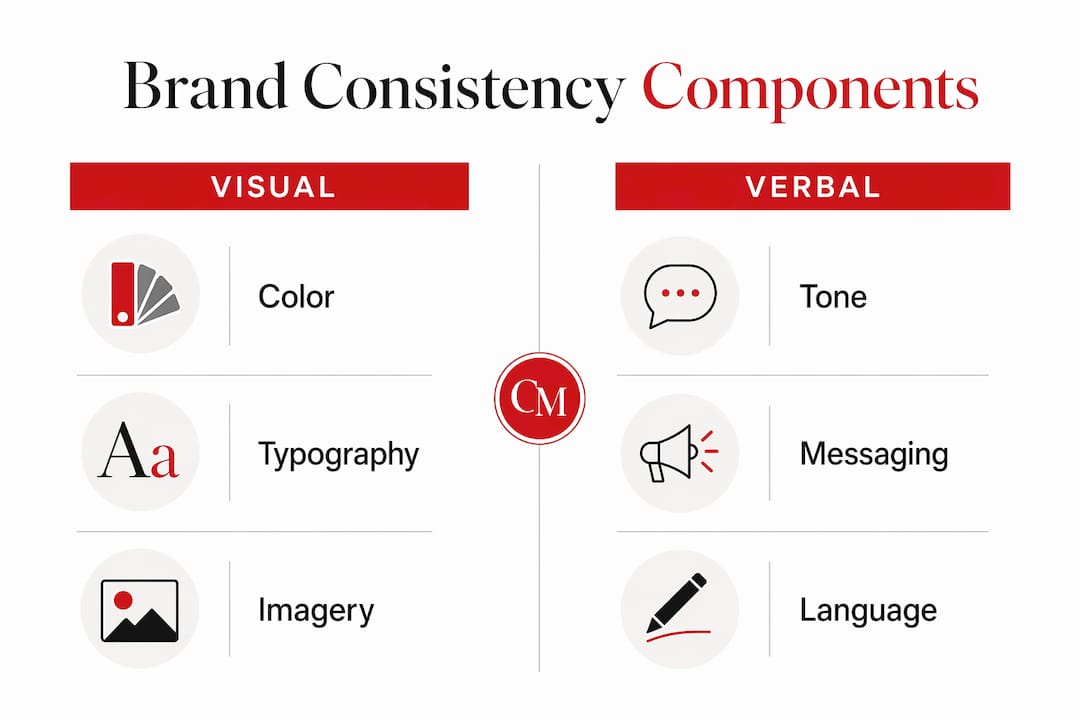
Brand consistency is not a single asset. It is the alignment of multiple elements working together across every team and channel.

The visual layer is the most recognized. Color alone increases brand recognition by up to 80% when applied consistently. Logos, typography, image style, and color palettes must follow documented standards that every designer, agency, and content creator can access and apply without interpretation.
The verbal layer is equally critical and far more often neglected. Tone of voice, messaging pillars, and the specific language a brand uses to describe its products must remain coherent whether the context is a luxury product launch, a customer service reply, or a paid ad. A brand that sounds authoritative on its website but casual and inconsistent on social media sends a mixed signal that erodes trust.
The experiential layer covers every interaction a customer has with the brand, from packaging to post-purchase email to in-store behavior. Adaptive consistency means presenting the same core values and message across formats that vary by platform and audience expectations. This is coherence, not rigid replication.
Key components to align across your organization:
- Logo usage rules and protected space guidelines
- Approved color palettes with exact hex, RGB, and CMYK values
- Typography standards for digital and print
- Tone of voice guidelines with examples for different contexts
- Core messaging pillars that every team references
- Visual content standards for photography and video
Pro Tip: Consistency is coherence, not rigidity. A luxury brand can adapt its Instagram caption style to feel native to the platform while still using the same vocabulary, values, and visual identity it uses everywhere else.
How do brands lose consistency, and how do you fix it?
Brand fragmentation is the most common and most costly consistency failure. It happens when marketing, sales, product, and support teams each develop their own interpretation of the brand. The result is a customer experience that feels disjointed, which increases operational costs through duplicated efforts and contradictory messaging.
The damage is not just internal. Customers who encounter conflicting brand signals lose confidence. A prospect who sees a polished luxury campaign and then receives a poorly formatted email from the sales team will question whether the brand is what it claims to be.
The fix requires three things working together:
- Clear, accessible guidelines. Brand guidelines must be a living document, not a PDF that lives in a shared drive no one opens. Store them in a central platform every team member can access in real time.
- Shared tools and templates. Give every team pre-approved assets, templates, and copy frameworks. Remove the need for improvisation by making the right choice the easiest choice.
- Onboarding and ongoing culture. New hires must understand brand standards from day one. Brands that invest in guidelines, tools, and a culture that respects the brand experience see compounding value and less friction across teams.
Pro Tip: Run a quarterly brand audit across your top five customer touchpoints. Compare tone, visuals, and messaging. Gaps you find in that audit are revenue leaks.
How does brand consistency affect AI-driven search and visibility?
AI-powered search engines and content recommendation systems categorize brands based on the signals they receive across the web. Consistent branding improves AI and search engine discovery by giving algorithms a clear, coherent picture of what a brand represents and which topics it owns.
When a brand uses different names, different descriptions, and different visual identities across platforms, algorithms struggle to categorize it accurately. The result is lower organic visibility, weaker content recommendations, and reduced discoverability in AI-driven search results. This is a growing problem as AI-generated search summaries increasingly favor brands with clear, consistent signals.
Consistent posting schedules and aligned social media strategy also build audience trust and improve engagement under AI-influenced content distribution. Platforms reward accounts that behave predictably and deliver content that matches audience expectations. Inconsistency in posting frequency, hashtag strategy, or content style signals low reliability to the algorithm.
The table below shows how consistency affects key digital performance areas:
| Digital channel | Impact of consistency | Impact of inconsistency |
|---|---|---|
| Organic search | Stronger topical authority and categorization | Diluted signals, lower rankings |
| Social media | Higher engagement and algorithmic reach | Reduced distribution and trust |
| AI search summaries | Accurate brand representation in results | Misclassification or omission |
| Email marketing | Higher open rates from recognized sender identity | Lower trust, higher unsubscribe rates |
For luxury and fashion brands, the stakes are especially high. Affluent consumers research extensively before purchasing. A brand that appears inconsistent across digital channels signals instability, which is the opposite of what a premium brand needs to communicate. Understanding brand consistency for luxury brands in the context of AI-driven visibility is now a core competency, not an optional upgrade.
Two-thirds of companies report that maintaining brand consistency contributes to at least a 10% lift in annual revenue by reducing the number of touchpoints needed before a customer converts. In an AI-driven environment where fewer touchpoints reach the customer organically, that efficiency gain is worth more than ever.
Key Takeaways
Brand consistency is the most direct path from recognition to revenue, and the brands that treat it as a cultural discipline rather than a design task will outperform those that do not.
| Point | Details |
|---|---|
| Revenue impact is measurable | Consistent brand presentation can increase revenue by up to 23% and reduces needed customer touchpoints. |
| Trust drives premium pricing | 87% of consumers pay more for trusted brands, making consistency a direct pricing lever. |
| Visual alignment is foundational | Consistent color use alone increases brand recognition by up to 80% across channels. |
| AI visibility depends on coherence | Inconsistent branding confuses algorithms and reduces organic discoverability in AI-driven search. |
| Culture sustains consistency | Guidelines and tools only work when the entire organization treats brand standards as non-negotiable. |
Brand consistency as a dynamic discipline, not a static checklist
After years of working with fashion and luxury brands across multiple markets, I have seen one pattern repeat itself more than any other. Teams invest heavily in creating beautiful brand guidelines, then treat those guidelines as a finished product. They file them away and move on. Six months later, the brand looks and sounds like three different companies depending on which channel you are looking at.
The brands I have seen maintain real consistency share one trait. They treat their brand identity as a living framework that requires active management. They review it, update it, and enforce it with the same discipline they apply to financial reporting. Consistency is not something you achieve once. It is something you practice every week.
The other misconception I encounter constantly is that consistency means sameness. It does not. A luxury brand can produce a playful short-form video for social media and a formal editorial campaign for print without losing coherence. What makes both feel like the same brand is the underlying values, the vocabulary, and the visual logic. Those do not change. The format adapts. That distinction matters enormously, especially in fashion, where creative expression is part of the brand’s value.
The brands that fragment are almost always the ones where different teams own different channels without a shared reference point. The fix is not more rules. It is a shared culture where every person who touches the brand understands what it stands for and why that matters to the customer.
— Corrado
How Corradomanenti supports luxury brands in building consistency
Luxury and fashion brands face a specific challenge. The standard advice on brand consistency rarely accounts for the complexity of managing a premium identity across editorial, digital, retail, and experiential channels simultaneously.
Corradomanenti works directly with fashion and luxury brand leaders to build consistency frameworks grounded in consumer psychology and real market behavior. The approach goes beyond visual guidelines to address messaging, team alignment, and the digital signals that determine how AI-driven platforms categorize and surface your brand. If you are ready to turn brand coherence into a measurable growth driver, the luxury brand growth tactics resource is a practical starting point. You can also explore the premium brand consistency tips developed specifically for high-end brands navigating multi-channel complexity.
FAQ
What is brand consistency?
Brand consistency is the practice of presenting a unified identity, message, and visual style across all customer touchpoints. It builds recognition, trust, and long-term loyalty.
Why is consistent branding important for revenue?
Consistent brand presentation can increase revenue by up to 23%, and two-thirds of companies report at least a 10% annual revenue lift from maintaining brand consistency.
How does brand consistency affect customer trust?
Repeated, coherent brand exposure builds familiarity, which reduces purchase hesitation. 87% of consumers are willing to pay more for products from brands they trust.
Why does brand consistency matter for AI search?
AI-driven search engines categorize brands based on the consistency of signals they receive across platforms. Inconsistent branding produces weaker categorization and lower organic visibility.
How do you maintain brand consistency across teams?
Maintain consistency by creating accessible brand guidelines, providing shared templates and approved assets, and building a team culture where brand standards are treated as non-negotiable from day one.