


TL;DR:
- Personalization in marketing tailors messages and experiences based on customer behavior and preferences. It significantly boosts revenue, customer retention, and marketing efficiency by creating relevant, seamless interactions. Effective personalization requires unified data, real-time adaptation, and focusing on high-intent moments for measurable results.
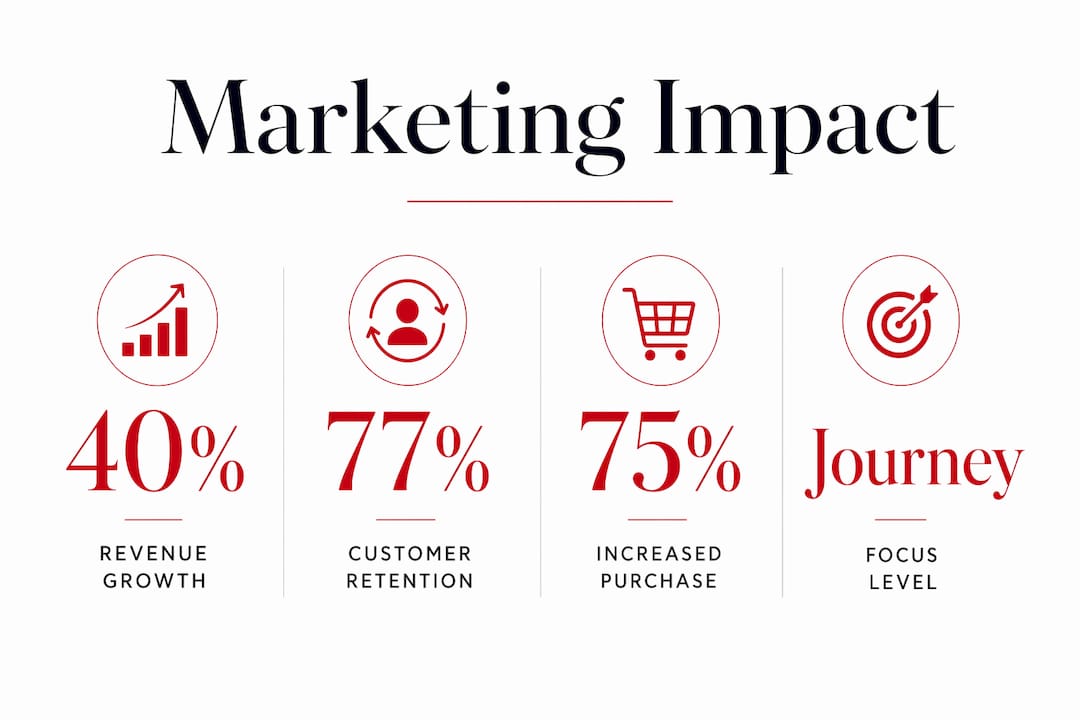
Personalization in marketing is the practice of tailoring messages, offers, and experiences to individual customers based on their unique preferences, behaviors, and context. 94% of marketing professionals rate it as important or critical, and nearly 75% of consumers are more likely to buy from brands that deliver personalized experiences. Those numbers explain why personalization has moved from a nice-to-have feature to a core discipline in modern marketing. The question is no longer whether to personalize. The question is how to do it well enough to matter.
Why personalization in marketing produces measurable business gains
The benefits of personalized marketing show up directly on the revenue line. Fast-growing companies generate up to 40% more revenue from personalization compared to slower-growing peers. That gap exists because tailored experiences reduce friction at every stage of the buying process, from awareness to purchase.
Retention is equally affected. 77% of business leaders acknowledge that personalization drives higher customer retention, because customers return to brands that anticipate their needs. Retention is cheaper than acquisition, so this benefit compounds over time.
The role of personalization in advertising also extends to media efficiency. Personalization improves marketing ROI by reducing wasted impressions and focusing spend on audiences most likely to convert. A brand running generic display ads pays for eyeballs that will never buy. A brand running behavior-triggered ads pays for intent.
The combined effect is significant:
- Revenue growth: Personalized product recommendations and dynamic pricing lift average order values.
- Reduced churn: Customers who feel understood stay longer and spend more over their lifetime.
- Lower cost per acquisition: Relevant messaging converts faster, which cuts the number of touchpoints needed to close a sale.
- Stronger brand recall: People remember messages that feel written for them, not broadcast at them.
Pro Tip: Track revenue lift and retention rate separately when measuring personalization programs. Combining them into a single ROI figure hides which lever is actually working.
How does true personalization go beyond basic customization?
Most marketers understand personalization in theory but execute it at the surface level. Inserting a customer’s first name into an email subject line is customization. Basic personalization like name insertion does not meet customer expectations. Customers expect recognition of their preferences, their current context, and where they are in their relationship with your brand.
The distinction matters because the two approaches produce very different results. Customization is static. It applies a single data point to a template. True personalization is dynamic. It reads behavioral signals, purchase history, browsing context, and lifecycle stage, then assembles an experience that fits that specific moment.
Here is how the gap between the two plays out in practice:
- Name insertion vs. behavioral triggers. A welcome email that says “Hi Sarah” is customization. A welcome email that surfaces the exact product category Sarah browsed before signing up is personalization.
- Segment-level targeting vs. individual-level relevance. Sending the same promotional offer to everyone in the “high-value customer” segment is still mass marketing. Sending an offer based on Sarah’s last purchase date, preferred channel, and price sensitivity is personalization.
- One-time data capture vs. continuous learning. Customization uses data collected at signup. Personalization updates its model every time a customer interacts with your brand.
- Single-channel execution vs. cross-channel coherence. A personalized email that contradicts what the customer sees on your website signals that your data is fragmented, not connected.
Disconnected data silos cause disjointed experiences that hurt personalization effectiveness. A customer who calls support after receiving a promotional email should not have to re-explain their situation. When marketing, sales, and service operate on separate data sets, that is exactly what happens.
Pro Tip: Audit your customer data architecture before launching a personalization program. If your CRM, email platform, and ad tech cannot share a unified customer ID, your personalization will feel fragmented no matter how good your creative is.
What strategies enable effective marketing personalization today?
The most effective personalization strategies for marketers in 2026 operate at the journey level, not the campaign level. Customer journey personalization uses AI to adapt interactions in real-time based on intent, sentiment, and context across all lifecycle stages. This is a fundamental shift from scheduling campaigns in advance to responding to behavior as it happens.

Journey-level personalization requires connecting data across marketing, sales, and service. Marketing personalization requires unified customer views built from integrated data across all departments. Without that integration, a customer who just purchased will still receive acquisition-stage messaging, which erodes trust rather than building it.
Starting with high-intent moments
Not every touchpoint deserves equal personalization investment. Starting with high-intent moments like onboarding helps prove ROI quickly and builds the case for broader investment. Onboarding is the moment when a customer’s attention is highest and their expectations are freshest. A personalized onboarding sequence that surfaces relevant features, content, or products based on how the customer arrived sets the tone for the entire relationship.
Other high-intent moments worth prioritizing include post-purchase follow-up, cart abandonment recovery, and re-engagement after a period of inactivity. Each of these moments carries a clear behavioral signal that makes personalization straightforward to execute and easy to measure.
Comparing personalization maturity levels
| Maturity level | Data used | Execution method | Typical outcome |
|---|---|---|---|
| Basic | Name, email, segment | Static template rules | Marginal lift in open rates |
| Intermediate | Purchase history, channel preference | Triggered automation | Improved conversion and retention |
| Advanced | Real-time behavior, intent signals, lifecycle stage | AI-driven orchestration | Revenue lift and reduced churn at scale |
Pro Tip: Do not try to reach the advanced level in one project. Start at intermediate, measure the revenue lift, and use that data to justify the investment in AI-driven orchestration.
How can marketers practically implement personalization for better ROI?
Implementation is where most personalization programs fail. The strategy looks clean on a slide deck, but execution breaks down when the underlying data infrastructure is not ready. The following practices separate programs that deliver ROI from those that stall.
- Build a unified customer profile first. Combine CRM data, behavioral data from your website and app, and transactional data into a single record per customer. Without this, every personalization effort operates on incomplete information.
- Segment by intent, not just demographics. A 35-year-old professional who browsed your premium tier three times this week is a different audience than a 35-year-old professional who has not visited in six months. Behavioral segmentation outperforms demographic segmentation for conversion.
- Monitor the right KPIs. Track engagement rate, retention rate, and revenue lift per segment. Vanity metrics like email open rates tell you very little about whether personalization is changing purchase behavior.
- Test continuously. Run A/B tests on personalization logic, not just creative. Test whether behavioral triggers outperform time-based triggers. Test whether lifecycle-stage messaging outperforms purchase-history messaging.
Personalization transforms transactional relationships into meaningful connections that build loyalty even against cheaper alternatives. That outcome does not happen from a single campaign. It accumulates through consistent, relevant interactions over time. The brands that win on personalization treat it as an ongoing practice, not a one-time project.
Pro Tip: Set a quarterly review cadence for your personalization rules. Customer behavior shifts, and rules built on last year’s data will eventually produce irrelevant experiences. Refresh your logic before it starts working against you.
For luxury brands specifically, the stakes are even higher. Personalization in luxury client retention is not a marketing tactic. It is a brand promise. Clients who spend at the premium level expect to be known, not just recognized.
Key Takeaways
Personalization in marketing drives revenue, retention, and loyalty when it operates at the journey level with unified customer data, not just at the campaign level with basic customization.
| Point | Details |
|---|---|
| Revenue impact is proven | Fast-growing companies generate up to 40% more revenue from personalization than slower-growing peers. |
| Retention depends on feeling understood | 77% of business leaders link personalization directly to higher customer retention rates. |
| Name insertion is not personalization | True personalization recognizes preferences, lifecycle stage, and context, not just a customer’s first name. |
| Data integration is non-negotiable | Disconnected silos produce fragmented experiences that undermine even well-designed personalization programs. |
| Start with high-intent moments | Onboarding, cart abandonment, and post-purchase follow-up deliver the fastest, most measurable ROI. |
Why I think most personalization programs underperform
I have worked with brands that had the right technology and the wrong mindset. They treated personalization as a feature to switch on, not a discipline to build. The result was a flood of “personalized” messages that felt anything but personal, because the data feeding them was siloed, stale, or misread.
The shift that actually changes outcomes is moving from campaign thinking to relationship thinking. When you ask “what should we send this segment this week,” you are still doing mass marketing with a thin layer of customization on top. When you ask “what does this customer need right now based on everything we know about them,” you are doing real personalization.
I have also seen brands resist starting small because they want to build the full AI-driven system before launching anything. That is the wrong sequence. Start with one high-intent moment, measure it rigorously, and let the results fund the next phase. The brands I have watched succeed at high-end marketing personalization all followed that path. They did not wait for perfect data. They built better data by acting on what they had.
The uncomfortable truth is that most personalization failures are not technology failures. They are organizational failures. Marketing, sales, and service teams protecting their own data sets is the single biggest obstacle I see. Fix the collaboration problem first. The technology will follow.
— Corrado
Personalization expertise for luxury and fashion brands
Brands in the fashion, luxury, and lifestyle sectors face a version of the personalization challenge that is more demanding than most. Their customers expect to be treated as individuals from the first interaction, and a single generic message can damage years of brand equity.
Corradomanenti works with premium brands to build personalization programs grounded in consumer psychology and real behavioral data. The approach connects fashion brand growth tactics with the kind of individual-level insight that turns first-time buyers into loyal clients. If you are ready to move beyond basic segmentation and build a personalization practice that reflects the quality of your brand, Corradomanenti’s consulting work is the place to start.
FAQ
What is personalization in marketing?
Personalization in marketing is the practice of tailoring messages, offers, and experiences to individual customers based on their behavior, preferences, and lifecycle stage. It goes well beyond inserting a customer’s name into a template.
Why is personalization crucial in marketing today?
Personalization directly affects purchase likelihood and revenue. Nearly 75% of consumers are more likely to buy from brands that deliver personalized experiences, and fast-growing companies generate up to 40% more revenue from personalization programs.
How does personalization improve customer retention?
77% of business leaders acknowledge that personalization drives higher retention because customers return to brands that consistently anticipate their needs. Retention built on relevance is more durable than retention built on discounts.
What is the difference between personalization and customization?
Customization applies a single static data point, like a name, to a template. Personalization dynamically adapts to a customer’s behavior, context, and lifecycle stage across every interaction and channel.
Where should marketers start with personalization?
Start with high-intent moments like onboarding or cart abandonment. These touchpoints carry clear behavioral signals, produce fast measurable results, and build the internal case for broader personalization investment.