


Luxury buyers operate on a different wavelength. They don’t just purchase products, they invest in identity, status, and emotional fulfillment. Understanding the intricate psychological drivers of luxury consumption separates successful campaigns from wasted budgets. This guide reveals evidence-based techniques to decode buyer motivations, build lasting commitment, and transform your luxury marketing strategy in 2026. You’ll discover how to leverage affective, calculative, and normative triggers that drive high-value consumer decisions and advocacy.
Table of Contents
- Understanding The Luxury Buyer Mindset: Foundations And Challenges
- Preparing Your Strategy: Identifying Psychological Triggers And Customer Commitment Types
- Executing Psychological Techniques To Influence Luxury Buyer Behavior
- Verifying Success: Measuring Outcomes And Refining Buyer Psychology Strategies
- Enhance Your Luxury Marketing With Expert Guidance
Key takeaways
| Point | Details |
|---|---|
| Biological and social factors drive luxury buying | Luxury consumption stems from complex interplay of neurological rewards, social positioning, and cultural influences that marketers must address holistically. |
| Three commitment types shape customer relationships | Affective emotional bonds, calculative cost-benefit analysis, and normative moral obligations each require distinct engagement strategies. |
| Novel predictors enhance traditional approaches | Four comprehensive dimensions including religious and cultural influences provide deeper insight into luxury purchase decisions than conventional methods. |
| Measurable outcomes guide strategy refinement | Tracking economic, social, and psychological metrics enables data-driven optimization of buyer psychology campaigns. |
Understanding the luxury buyer mindset: foundations and challenges
Your luxury marketing strategy needs a foundation built on genuine psychological insight. Luxury consumption is driven by biological, socio-psychological, and structural factors that create unique challenges for marketers seeking authentic engagement. The biological dimension involves neurological reward systems activated by exclusive ownership and sensory experiences. Socio-psychological drivers include identity construction, social comparison, and the pursuit of distinction within peer groups.
Historically, luxury served as a visible marker of social hierarchy and power. This legacy continues to shape modern consumption patterns, though contemporary buyers navigate additional tensions. They balance conspicuous display with understated sophistication, personal pleasure with social responsibility, and heritage appreciation with innovation desire. These contradictions make the role of consumer behavior in luxury far more complex than mass market dynamics.
The structural dimension encompasses economic accessibility, distribution exclusivity, and brand heritage narratives. Together, these three forces create a psychological landscape where rational decision-making intertwines with emotional yearning and social anxiety. Marketers who ignore this complexity risk campaigns that feel tone-deaf or manipulative.
Key challenges you’ll face include:
- Identifying which psychological driver dominates for specific customer segments
- Balancing exclusivity messaging with inclusive brand growth objectives
- Navigating cultural differences in luxury perception across global markets
- Measuring intangible emotional outcomes alongside traditional conversion metrics
Understanding these foundational elements allows you to analyze high-end consumer behavior luxury patterns with precision. The next step involves translating this knowledge into actionable strategy by identifying specific commitment types that influence purchase decisions and long-term loyalty. This preparation phase determines whether your campaigns resonate superficially or create genuine psychological bonds.
Preparing your strategy: identifying psychological triggers and customer commitment types
Effective luxury marketing targets three distinct commitment types that shape consumer relationships. Affective commitment is a key relationship enhancer in luxury brand consumption, representing emotional attachment and identification with brand values. Calculative commitment stems from perceived costs of switching brands versus benefits of staying loyal. Normative commitment involves moral or social obligation to maintain the relationship, often rooted in family tradition or cultural expectations.
Affective commitment drives the strongest advocacy behaviors and willingness to pay premium prices. Customers with high affective commitment view the brand as an extension of their identity. They experience genuine emotional satisfaction from ownership and actively recommend products to their social circles. This commitment type proves most valuable for long-term brand equity but requires consistent delivery of emotionally resonant experiences.
Calculative commitment appeals to pragmatic luxury buyers who evaluate quality, service, and exclusivity benefits. These customers remain loyal as long as the value equation favors your brand over competitors. While less emotionally invested, they provide stable revenue when you maintain superior offerings. Normative commitment often appears in heritage luxury categories where family traditions or cultural norms influence purchasing decisions.

To identify which commitment type dominates your target segments, analyze purchase motivations through customer interviews and behavioral data. Look for patterns in repeat purchase drivers, referral behaviors, and response to brand communications. Segment customers based on their primary commitment orientation to define customer loyalty luxury profiles accurately.
Prepare your strategy using these steps:
- Map your current customer base across the three commitment types using purchase history and engagement metrics
- Identify gaps where low commitment indicates vulnerability to competitor attraction
- Develop targeted messaging frameworks for each commitment type that speak to their specific motivations
- Create touchpoint experiences designed to strengthen the weakest commitment dimensions
- Establish baseline metrics for satisfaction, advocacy, and retention within each segment
Pro Tip: Don’t assume all luxury buyers share the same psychological profile. A first-time luxury purchaser seeking social validation operates differently from a seasoned collector driven by connoisseurship. Tailor your approach accordingly.
Once you’ve identified commitment types and prepared segmented strategies, you’re ready to execute specific psychological techniques. The psychology luxury branding engagement 2026 landscape demands precision in application. Your preparation work ensures these techniques land with maximum impact rather than generic appeals that fail to move the needle.
Executing psychological techniques to influence luxury buyer behavior
Executing buyer psychology techniques requires moving beyond traditional demographic targeting to comprehensive psychological modeling. A novel model identifies four luxury purchase predictors with comprehensive dimensions that outperform conventional approaches. These predictors include materialism with its success-oriented and happiness-seeking facets, susceptibility to normative influence spanning informational and normative dimensions, need for uniqueness covering creative choice and unpopular choice avoidance, and status consumption reflecting both internal satisfaction and external recognition.
Apply the materialism predictor by crafting narratives that connect product ownership to personal achievement and life satisfaction. Success-oriented messaging highlights how the luxury item represents career milestones or personal victories. Happiness-seeking approaches emphasize sensory pleasure, aesthetic appreciation, and the joy of ownership. Your campaigns should balance both facets rather than relying solely on status symbolism.
Leverage susceptibility to normative influence through strategic social proof and expert endorsements. Informational influence works when customers look to knowledgeable sources for quality validation. Feature master craftspeople, heritage stories, and technical specifications that educate while persuading. Normative influence activates when customers align with aspirational reference groups. Showcase brand ambassadors and customer communities that represent desired social identities.
The need for uniqueness predictor requires careful execution. Creative choice messaging celebrates individual expression and personalization options. Avoid suggesting the item is rare to the point of social isolation. Instead, position it as a distinctive choice that reflects personal taste within an appreciative community. Unpopular choice avoidance means customers still want validation that their unique selection has merit and recognition value.
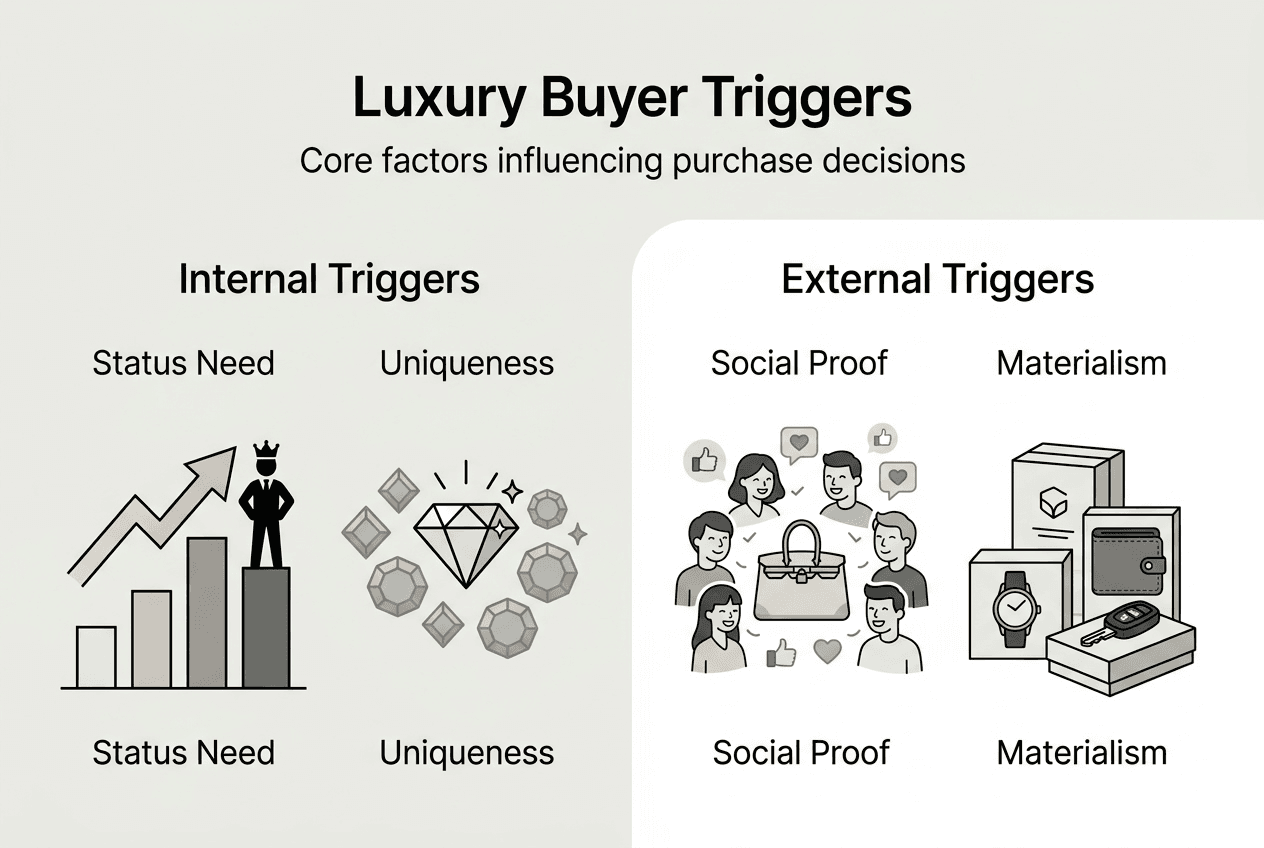
Status consumption techniques must address both internal and external validation needs. Internal satisfaction comes from self-perception as someone who appreciates quality and beauty. External recognition involves visible signals that communicate taste and success to others. Your execution should provide both private enjoyment and social currency.
| Approach | Traditional Method | Novel Psychological Method |
| — | — | |
| Targeting | Demographics and income | Commitment type and psychological predictors |
| Messaging | Product features and heritage | Emotional fulfillment and identity alignment |
| Metrics | Sales and reach | Advocacy levels and satisfaction depth |
| Personalization | Purchase history | Psychological profile and motivation mapping |
Cultural and religious dimensions add critical nuance to execution. Religion influences consumers’ judgments and decisions toward luxury through values around modesty, display, and moral consumption. Some religious frameworks view luxury as acceptable reward for hard work, while others emphasize restraint and charitable giving over personal indulgence. Understand these orientations within your target markets to avoid messaging that conflicts with deeply held beliefs.
Key execution tactics include:
- Develop multiple creative variants testing different psychological predictors to identify which resonates strongest
- Use A/B testing on commitment-type messaging to optimize conversion and advocacy outcomes
- Integrate cultural consultants when expanding to new geographic markets with distinct luxury perceptions
- Create experiential touchpoints that activate multiple senses and emotional responses simultaneously
- Monitor sentiment analysis to catch early signs of messaging misalignment with psychological expectations
Pro Tip: Layer psychological techniques rather than relying on single approaches. A campaign might combine materialism appeals with need for uniqueness while respecting cultural norms around display. This multidimensional strategy mirrors the complex psychology of actual luxury buyers.
Successful execution transforms your fashion brand growth tactics luxury market approach from guesswork to precision. You’re no longer broadcasting generic luxury messages but delivering psychologically targeted communications that speak directly to individual motivations. This level of sophistication separates market leaders from followers in the competitive luxury landscape. The final step involves verifying these techniques deliver measurable results and refining based on evidence.
Verifying success: measuring outcomes and refining buyer psychology strategies
Measuring buyer psychology campaign effectiveness requires tracking outcomes across multiple dimensions. Consumption yields economic, social, and psychological costs and benefits influencing satisfaction and advocacy in ways traditional metrics often miss. Economic outcomes include purchase frequency, average transaction value, and customer lifetime value. These provide baseline financial performance but tell an incomplete story.
Social outcomes measure how luxury consumption affects customer relationships and community belonging. Track referral rates, social media engagement quality, and participation in brand community events. High social value indicates customers view the brand as a vehicle for connection and status within desired groups. Low social metrics despite strong sales suggest transactional relationships vulnerable to competitor disruption.
Psychological outcomes capture satisfaction depth, emotional attachment, and identity alignment. Use post-purchase surveys measuring how ownership makes customers feel about themselves. Monitor unsolicited testimonials and user-generated content for authentic emotional expression. Declining psychological satisfaction often precedes churn even when economic metrics appear healthy.
| Metric Category | Key Indicators | Measurement Frequency | Target Benchmark |
| — | — | — | |
| Economic | Customer lifetime value, repeat purchase rate | Monthly | 40%+ repeat rate |
| Social | Referral conversion, community engagement | Quarterly | 25%+ referral participation |
| Psychological | Net Promoter Score, satisfaction depth | After each purchase | NPS above 50 |
| Commitment | Affective/calculative/normative scores | Biannually | Affective commitment trending up |
Track commitment type shifts over time to identify strategy effectiveness. Growing affective commitment indicates successful emotional bonding. Stable or increasing calculative commitment shows strong value delivery. Rising normative commitment suggests cultural embedding and tradition building. Declining commitment in any dimension signals need for intervention before it impacts retention.
Interpret advocacy changes by analyzing both quantity and quality. More referrals matter, but passionate advocacy from highly committed customers carries greater weight than transactional recommendations. Segment advocacy by commitment type to understand which psychological approaches drive genuine enthusiasm versus obligatory mentions.
Refine your strategies through systematic testing cycles:
- Review campaign performance data monthly against psychological outcome targets
- Conduct quarterly deep dives into commitment score changes and their correlation with specific initiatives
- Test new psychological approaches on small segments before broad rollout
- Gather qualitative feedback through customer interviews exploring emotional responses and decision drivers
- Adjust messaging, touchpoints, and personalization based on what strengthens desired commitment types
Common measurement pitfalls include overreliance on short-term sales spikes that mask eroding emotional connections. Avoid vanity metrics like social media followers that don’t correlate with actual commitment or advocacy. Don’t assume luxury buyers will complete lengthy surveys, keep feedback mechanisms brief and integrated into natural touchpoints.
Pro Tip: Create a psychological dashboard alongside your financial dashboard. Track the leading indicators of emotional commitment and satisfaction that predict future economic performance. This forward-looking approach prevents reactive firefighting when revenue already shows decline.
Your refinement process should balance data-driven optimization with creative experimentation. Numbers reveal what’s happening, but qualitative insight explains why. Combine analytics with ongoing conversations with high-value customers who represent your target psychological profiles. Their perspectives illuminate nuances that quantitative data alone misses.
Understanding luxury consumer expectations guide principles helps contextualize measurement results. When satisfaction scores dip, ask whether expectations shifted or delivery faltered. Luxury markets evolve as new generations bring different values and psychological needs. Your verification process must detect these shifts early enough to adapt strategies proactively.
The most sophisticated luxury marketers treat verification as continuous learning rather than periodic auditing. They build feedback loops connecting customer psychology insights directly to creative development, product innovation, and service enhancement. This integration ensures buyer psychology techniques remain fresh and relevant rather than becoming stale formulas that lose effectiveness over time.
Enhance your luxury marketing with expert guidance
Mastering buyer psychology techniques transforms luxury marketing from intuition-based guesswork to evidence-driven strategy. Corrado Manenti specializes in translating psychological insights into actionable campaigns that drive measurable results for fashion and luxury brands. His approach combines academic rigor in consumer psychology with practical experience in high-end marketing execution.
Whether you’re refining fashion brand growth tactics luxury market strategies or developing new approaches to analyze buyer behavior luxury brands, expert guidance accelerates your learning curve. Corrado’s consulting services provide customized frameworks for identifying commitment types, executing psychological techniques, and measuring outcomes specific to your brand context. Explore specialized resources on psychology in luxury branding 2026 to deepen your strategic capabilities and gain competitive advantage in the evolving luxury landscape.
Frequently asked questions
What are buyer psychology techniques?
Buyer psychology techniques are evidence-based methods for understanding and influencing consumer decision-making processes. In luxury marketing, these techniques address the complex emotional, social, and cultural factors that drive high-value purchases. They go beyond traditional demographic targeting to focus on psychological motivations, commitment types, and identity needs that shape luxury consumption behaviors.
How do affective, calculative, and normative commitments differ in luxury buying?
Affective commitment represents emotional attachment where customers view the brand as part of their identity. Affective commitment enhances relationships in luxury brands more powerfully than other types. Calculative commitment relies on rational cost-benefit analysis of staying loyal versus switching brands. Normative commitment involves moral or social obligation, often rooted in family tradition or cultural expectations around luxury consumption.
What role does culture or religion play in luxury buyer psychology?
Culture shapes fundamental values, aesthetic preferences, and social meanings attached to luxury consumption across different markets. Religion guides consumers’ judgments and decisions toward luxury through frameworks around modesty, display, and moral consumption. Some religious orientations view luxury as acceptable reward while others emphasize restraint. Marketers must understand these cultural and religious dimensions to avoid messaging that conflicts with deeply held beliefs and to create campaigns that resonate authentically.
How can marketers measure if buyer psychology strategies are working?
Track engagement quality, loyalty depth, and advocacy levels across economic, social, and psychological dimensions. Monitor customer satisfaction scores, Net Promoter Score, repeat purchase rates, and referral conversion alongside traditional sales metrics. Measure shifts in commitment types over time to identify whether strategies strengthen emotional bonds or rely primarily on transactional relationships. Use post-purchase surveys and qualitative interviews to capture psychological outcomes that predict future behavior and long-term brand equity.