

TL;DR:
- Luxury brands must pivot from traditional social media, focusing on personalized, AI-driven digital experiences.
- Building an interconnected, expert-supported technology ecosystem is essential for delivering relevance in a fragmented market.
Traditional digital campaigns are no longer enough. Luxury brands that built their online presence around social media reach and polished content are discovering a sobering reality: engagement is declining, audiences are fragmenting, and competitors are racing ahead with AI-powered experiences that create genuinely memorable consumer connections. The brands winning in this environment aren’t doing more of the same. They’re rebuilding their digital approach from the foundation up, guided by fresh data, smarter technology, and a much deeper understanding of where their consumers actually spend their attention.
Table of Contents
- Understand the new digital landscape for luxury brands
- Set up your digital foundation: tools, roles, and requirements
- Execute cutting-edge tactics: AI, personalization, and experiential design
- Measure, verify, and optimize your results
- A practical perspective: Why bold bets, not tweaks, win in luxury digital strategy
- Next steps: Partner with experts in luxury digital strategy
- Frequently asked questions
Key Takeaways
| Point | Details |
|---|---|
| Social engagement shift | Luxury brands should rebalance from declining social platforms to channels and services showing growth. |
| External expertise advantage | Luxury groups successfully leverage external partners and tech specialists to drive innovation. |
| AI-powered personalization wins | Artificial intelligence tools and personalized experiences dramatically boost revenue and engagement. |
| Measure and refine | Track KPIs and rapidly iterate to stay ahead of fast-changing luxury consumer expectations. |
| Bold strategy outperforms | Innovative, high-risk digital pilots create stronger brand differentiation than incremental changes. |
Understand the new digital landscape for luxury brands
To break through audience fatigue and declining engagement, you must first understand how the market has shifted and where the opportunities truly are.
The most important lesson from recent market data is this: the channels you relied on three years ago may be actively hurting your brand perception today. Social media engagement for luxury brands in China declined across Weibo, WeChat, and Douyin, with RED UGC mentions falling for three consecutive quarters. Yet at the same time, e-commerce showed real recovery, with 45% of luxury brands posting positive year-over-year growth on digital commerce channels. That’s not a contradiction. It’s a signal that luxury consumers are shifting how and where they engage, and your strategy needs to follow them precisely.
Regional differences matter enormously. Over 70% of luxury consumers in the US, China, and Europe still prefer in-store buying as their primary touchpoint, while India stands apart as a market where digital entry genuinely dominates consumer preference. Services represent the next major growth frontier, with digital ecosystems built around personalized styling, blockchain-verified provenance, and concierge-style digital access emerging as powerful differentiators.
Here’s a snapshot of where luxury digital engagement currently stands across key channels:
| Channel | Current trend | Growth opportunity |
|---|---|---|
| Social media (China) | Declining engagement | Low, focus on quality over volume |
| E-commerce platforms | Recovering strongly | High, 45% of brands positive YoY |
| Personalized digital services | Emerging | Very high, still early-stage |
| Blockchain provenance tools | Growing | High in trust-sensitive markets |
| Experiential digital events | Expanding | High, especially post-pandemic |
The strategic implication is clear. Brands need to stop treating digital as a single unified channel and start treating it as an ecosystem of distinct touchpoints, each requiring its own approach. Understanding digital strategy essentials for luxury means recognizing that reach is less valuable than relevance.
Key shifts reshaping luxury digital in 2025 and beyond:
- Personalization at scale is no longer optional. Consumers expect the digital experience to mirror the bespoke attention they receive in boutiques.
- Blockchain and provenance tech are becoming trust signals, especially in markets where counterfeit risk is high.
- Community-based content on niche platforms is outperforming broad reach campaigns on mainstream channels.
- Experiential digital marketing and luxury event innovation are growing as brands blend physical and digital moments to create premium touchpoints.
Pro Tip: Rather than defending your presence on legacy channels, map your brand’s engagement performance against channels that showed measurable positive growth last year. Reallocating even 20% of budget toward rising channels can produce disproportionate results.
Staying on top of 2025 digital marketing trends specific to luxury isn’t about chasing novelty. It’s about understanding which signals actually predict where your audience will be in the next 12 months, not where they were two years ago.
Set up your digital foundation: tools, roles, and requirements
Once you’re clear on the new market realities, build your foundation with the right people, processes, and technology to execute advanced digital strategies.

The luxury sector has a distinctive technology investment profile that sets it apart from other industries. Luxury groups spend an average of 3.1% of revenue on technology, ranging from 1.9% to 5.5% depending on brand size and strategic maturity. More revealing is where that spending goes: 68% of technology change investment flows to external providers, compared to just 44 to 61% in most other industries. This tells you that building everything in-house is rarely the winning model. Strategic partnerships and specialized external expertise are core to how luxury brands actually execute.
Here’s a practical comparison to guide your build vs. buy decisions:
| Capability | In-house team | External provider |
|---|---|---|
| Brand DNA and creative direction | Strong, essential to keep internal | Risky to outsource |
| AI personalization and MarTech | Expensive to build, slow to scale | Faster ROI, more specialized |
| Data infrastructure and CRM | Moderate internal capability needed | Best built with specialist partners |
| Campaign analytics and reporting | Easy to internalize over time | Initial setup benefits from external |
| Experiential and innovative event design | Creative brief internal, execution external | Strong partner ecosystem available |
The essential requirements for a strong luxury digital foundation include:
- Unified data integration: Your CRM, e-commerce platform, and marketing automation tools need to communicate in real time. Siloed data is the single biggest barrier to personalization at scale.
- Compliance readiness: Data privacy regulations differ by market. Luxury brands operating globally need legal and technical infrastructure that adapts to regional requirements without breaking the customer experience.
- Partner vetting criteria: When working with external providers, evaluate them on luxury sector experience specifically. A partner who excels in mass retail may not understand the behavioral nuances of high-net-worth consumers.
- Internal upskilling: Your teams need training not just on new tools but on how to use technology without compromising the premium feel of every consumer interaction.
- Brand governance protocols: As digital infrastructure scales, maintaining consistency in tone, visual identity, and messaging becomes harder. Build governance processes early.
Your digital strategy guide for luxury should treat the tech stack not as a set of isolated tools but as an interconnected system designed around a single goal: making every digital consumer touchpoint feel as considered and elevated as your finest in-store experience. And when building branding innovation into your foundation, the frameworks you establish now will determine how quickly and consistently you can move when opportunities arise.
Execute cutting-edge tactics: AI, personalization, and experiential design
With the groundwork set, this section walks you through executing the boldest, most effective digital tactics using proven tools and creative approaches.
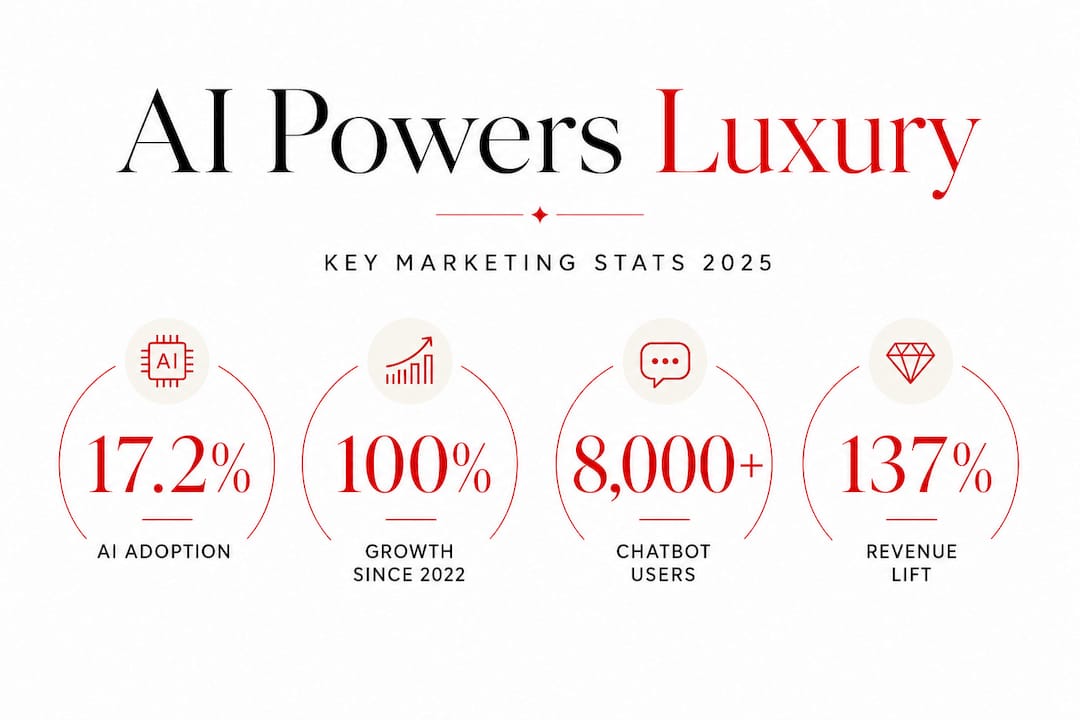
The numbers from real luxury brand deployments are striking. Marc Jacobs AI personalization delivered 9% of total online GMV, a 137% increase in average revenue per session, and contributed to 22% of Black Friday and Cyber Monday 2024 sales. These aren’t incremental gains. They represent a fundamental improvement in how the brand converts digital traffic into meaningful revenue. The mechanism is straightforward: AI analyzes individual browsing behavior, purchase history, and real-time signals to serve each visitor a uniquely tailored product selection and experience.
Here’s how to approach an AI personalization launch step by step:
- Define your use cases clearly. Start with the highest-traffic moments: homepage personalization, product recommendation engines, and abandoned cart sequences. Don’t try to personalize everything at once.
- Audit your data quality first. AI personalization is only as good as the data feeding it. Clean, unified customer data across your CRM and e-commerce platform is non-negotiable.
- Select a platform with luxury sector experience. Not all personalization tools understand the behavioral nuances of high-consideration purchases. Evaluate vendors on their luxury client case studies specifically.
- Run a controlled pilot tied to a campaign moment. Launch your first AI personalization campaign during a high-stakes window, a capsule drop, a seasonal editorial push, or a flagship product launch.
- Measure incrementally. Track revenue per session, conversion lift, and average order value in your pilot cohort against your control group. Real results should emerge within four to six weeks.
- Expand with confidence. Once your pilot validates the approach, scale to more pages, more segments, and more complex personalization scenarios.
The AI chatbot space is equally compelling. Tom Ford Beauty’s holiday AI chatbot engaged over 8,000 users and generated more than 2,000 product clicks during a single holiday campaign, outperforming traditional holiday marketing formats. The reason it worked is psychological: the chatbot replicated the advisory relationship consumers associate with in-store beauty consultants, removing friction and building genuine product affinity in a digital context.
The macro trend reinforces the urgency. Marketing AI now powers 17.2% of marketing efforts, up 100% since 2022, while generative AI is at 15.1%, up 116% year over year. Digital marketing spend overall has risen 7.3%. Brands that delay adoption aren’t holding steady. They’re falling behind a market that’s moving fast.
Beyond AI, luxury marketing trends increasingly point to the power of digital-physical fusion. Limited-access digital events tied to physical product moments, virtual try-on experiences that maintain premium visual quality, and influencer marketing for luxury through micro and macro voices who genuinely inhabit the brand world are all tactics that drive engagement when executed with craft and intentionality.
Pro Tip: The highest-impact moment to launch any AI-powered experience is during a concentrated campaign window with built-in urgency. Holidays, capsule drops, and fashion week activations compress the feedback loop dramatically and give you clean, fast data on what works.
Measure, verify, and optimize your results
After activating advanced digital measures, it’s critical to track what works, fix what doesn’t, and systematize best practices for ongoing success.
Measurement in luxury digital strategy is more nuanced than in mass-market retail. Your KPIs must reflect not just volume but quality of engagement, because a high-net-worth consumer who spends 12 minutes deeply exploring your new collection represents far more value than 10,000 passive impressions. Here’s how to structure your measurement framework:
- Establish baseline metrics before any campaign launches. You need a clean reference point. Record current session revenue, conversion rate, average order value, and engagement depth before activating AI tools or new personalization layers.
- Run structured A/B tests for every major tactic. Test AI personalization against your standard homepage. Test chatbot-assisted journeys against standard navigation. Let the data tell you what consumers prefer in your specific brand context.
- Track campaign ROI at the tactic level, not just at the campaign level. Understanding which specific AI recommendations drove conversions gives you the intelligence to refine and improve systematically.
- Set a monthly review cadence for optimization decisions. Luxury brand marketing moves quickly. Waiting for a quarterly review to make changes means losing ground in real time.
- Integrate sustainability metrics where relevant. 60% of fashion brands now use or test AI for demand forecasting, with half applying it to stock allocation to reduce waste. If your brand cares about sustainable positioning, AI-driven inventory accuracy is a metric worth tracking and communicating.
Here’s a summary of the core KPI framework for luxury digital strategy:
| KPI | What it measures | Why it matters for luxury |
|---|---|---|
| GMV contribution by tactic | Revenue attribution | Proves financial ROI of personalization |
| Revenue per session | Engagement quality | Captures high-value visitor behavior |
| Chatbot conversion rate | AI assistant effectiveness | Validates digital concierge model |
| Click-through rate on AI recommendations | Personalization relevance | Signals how well AI understands your audience |
| Inventory waste reduction | Forecasting accuracy | Links digital intelligence to operational efficiency |
| Engagement depth (time on site, pages) | Content and UX quality | Differentiates premium brands from commodity retailers |
For a deeper look at building the systems behind these metrics, the in-depth digital strategy resources available cover the full architecture from tracking setup to optimization cycles. Understanding luxury e-commerce insights specific to high-consideration purchase behavior can also sharpen how you interpret the data you collect.
A practical perspective: Why bold bets, not tweaks, win in luxury digital strategy
Here’s something the industry rarely says out loud: the majority of luxury brand digital strategies are built for defense, not distinction. They’re calibrated to avoid mistakes rather than to create moments. And in a market where consumer attention is scarce and loyalty is earned through memorable experiences, playing it safe is the most expensive choice you can make.
The brands that are generating real results with AI personalization, chatbot concierge design, and experiential digital campaigns didn’t get there by testing one small change per quarter. They ran genuine pilots. They accepted that some tests would fail. And they committed resources to move fast enough to learn before the competitive window closed.
The digital innovation insights that matter most in this space consistently point to the same pattern: first movers in personalization and service-layer digital experiences capture outsized market share before the category standardizes. Once your competitors fully deploy AI personalization and the experience becomes expected, the competitive advantage dissolves. The window for differentiation is now, before the technology becomes table stakes.
There’s also a psychological dimension that strategic consultants often understate. Luxury consumers don’t just buy products. They buy identities, experiences, and the feeling of being understood. When your AI delivers a product recommendation that feels personally curated, or your chatbot communicates with the warmth and knowledge of a genuine brand advisor, you’re not just optimizing a funnel. You’re deepening the psychological bond between your brand and your consumer. That bond is far harder for competitors to replicate than any technology stack.
The fashion innovation examples that will define the next era of luxury marketing come from brands willing to lead rather than follow. Incremental updates to existing campaigns won’t get you there. Bold, market-shaping experiments will.
Next steps: Partner with experts in luxury digital strategy
Knowing the strategy is one thing. Executing it at the standard your brand demands is another entirely.
Corrado Manenti works directly with luxury fashion and lifestyle brands to design, launch, and optimize digital strategies built on deep consumer psychology and real market intelligence. From luxury fashion brand growth tactics that translate engagement into revenue, to the behavioral frameworks behind luxury branding psychology that make campaigns genuinely resonant, the work is always grounded in what your specific audience responds to. If you’re ready to build a complete digital strategy that moves your brand forward with confidence, the right partnership starts with a conversation.
Frequently asked questions
What digital channels show the most growth for luxury brands in 2025?
While social engagement is declining in China, e-commerce channels rebounded with 45% of luxury brands posting positive year-over-year growth, making digital commerce the clearest opportunity for investment.
How much should luxury brands invest in new technology for digital strategy?
Luxury groups spend an average of 3.1% of revenue on technology, notably higher than most industries, with the majority of change investment directed toward specialized external providers.
Is artificial intelligence really driving results for luxury brands?
Absolutely. Marc Jacobs AI personalization delivered a 137% increase in average revenue per session, and Tom Ford Beauty’s chatbot engaged over 8,000 users with measurable product click results during a single holiday campaign.
How do luxury brands measure the impact of innovative digital strategies?
Brands use KPIs like session revenue lift, chatbot conversion rate, GMV contribution, and demand forecasting accuracy, with 60% of fashion brands already testing AI specifically to reduce inventory waste.
Which regions offer the biggest digital growth opportunity for luxury brands?
India currently leads in digital-first luxury consumer adoption, while over 70% of consumers in the US, China, and Europe still prefer in-store buying as their primary experience touchpoint.