


Most American consumers decide within seconds whether a fashion brand feels authentic or forgettable. In a world crowded with choices, establishing a memorable brand identity can make the difference between fleeting interest and lasting loyalty. By focusing on the core emotional story that sets your American fashion label apart, you can transform every encounter into a meaningful connection that inspires trust and engagement.
Table of Contents
- Step 1: Define Your Brand’s Unique Core Narrative
- Step 2: Identify Audience Emotional Drivers
- Step 3: Map Psychological Touchpoints Across Channels
- Step 4: Craft Compelling Visual and Verbal Narratives
- Step 5: Test and Refine Story Consistency
- Step 6: Monitor Impact and Brand Resonance
Quick Summary
| Key Point | Explanation |
|---|---|
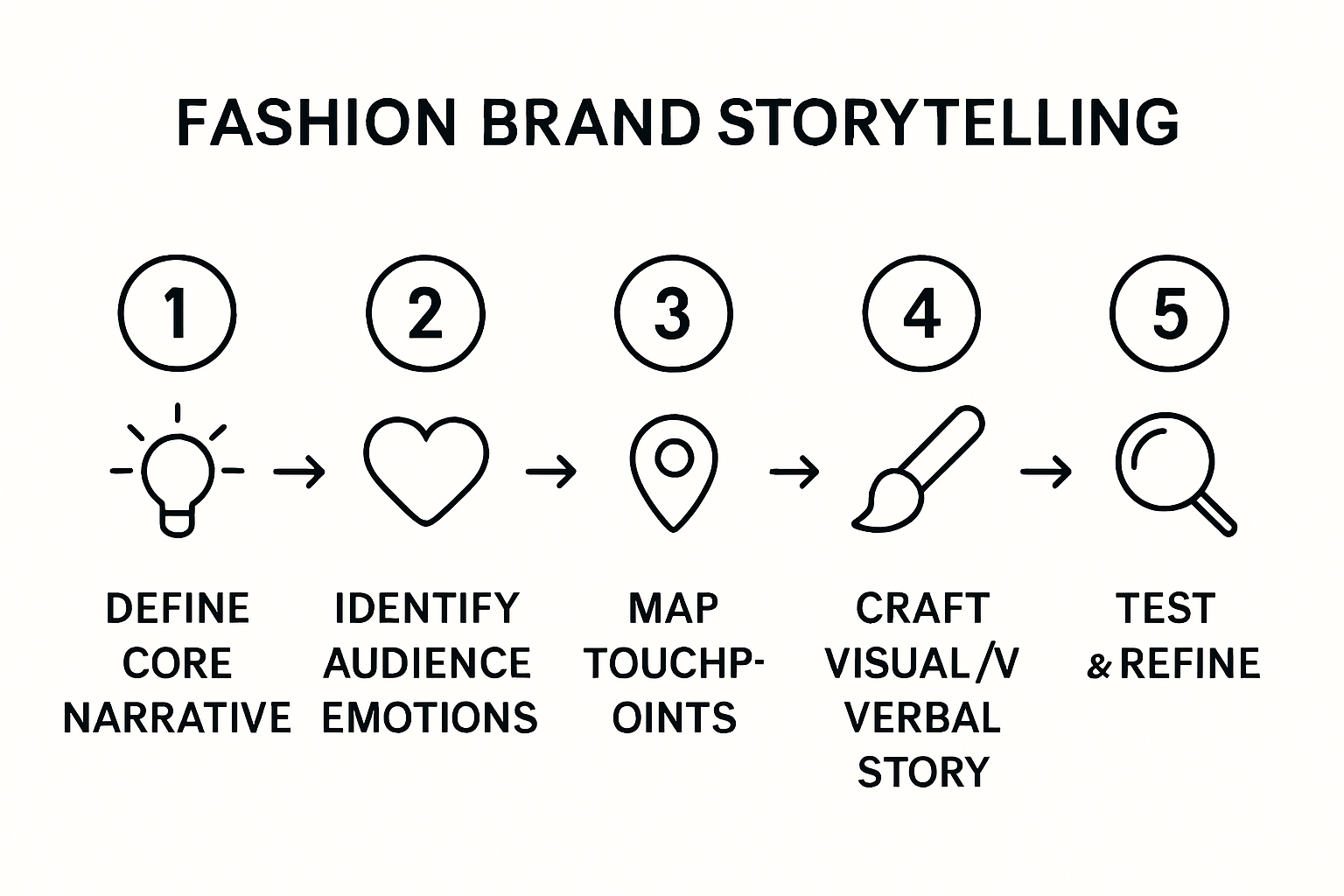
| 1. Define Your Core Narrative | Establish your brand’s emotional essence by exploring its genuine roots and the passion that drives your creative vision. |
| 2. Understand Audience Emotions | Conduct in-depth research to uncover the emotional motivations of your target audience for effective storytelling. |
| 3. Map Customer Touchpoints | Create a holistic journey map that identifies emotional responses at every potential customer interaction. |
| 4. Integrate Visual and Verbal Stories | Develop cohesive visual and verbal narratives that reflect your brand’s identity and engage the audience emotionally. |
| 5. Continuously Monitor and Adapt | Implement ongoing assessment of brand impact, recognizing that audience engagement and emotional resonance evolve over time. |
Step 1: Define Your Brand’s Unique Core Narrative
Crafting a compelling brand narrative requires strategic insight and deep understanding of your fashion brand’s fundamental essence. Your core narrative represents the emotional heartbeat that transforms your brand from a mere collection of products into a powerful storytelling experience that resonates with your target audience.
To define your unique narrative, start by exploring the authentic roots of your brand. What inspired its creation? What values drive your design philosophy? What makes your approach different from other fashion brands? Conducting an introspective analysis means digging beyond surface level aesthetics and uncovering the genuine passion that fuels your creative vision. Powerful fashion brand storytelling examples demonstrate that successful narratives emerge from genuine personal experiences and deeply held beliefs.
A powerful core narrative connects your brand’s history, current mission, and future aspirations into a seamless emotional journey. Think of it as creating a narrative arc that invites customers to become part of something larger than themselves. Your story should communicate not just what you create, but why you create it, transforming transactional interactions into meaningful connections that inspire loyalty and authentic engagement.
Pro tip: Authenticity is your greatest asset. Customers can instinctively detect manufactured stories, so ensure your narrative reflects genuine passion and real experiences. Your narrative should feel like an invitation into your world, not a marketing pitch.
Step 2: Identify Audience Emotional Drivers
Understanding the psychological landscape of your target audience is crucial for creating a brand narrative that truly resonates. By decoding the underlying emotional motivations that drive consumer behavior, you can craft a storytelling approach that speaks directly to their deepest desires and aspirations.
Affective disposition theory reveals that audiences form powerful emotional connections when narratives align with their inherent moral and psychological perspectives. This means your brand story must go beyond surface level descriptions and tap into the core emotional triggers that make your potential customers feel understood. Research suggests that different personality types respond uniquely to emotional arguments, indicating that a nuanced approach to emotional storytelling is essential.
To effectively identify your audience’s emotional drivers, conduct comprehensive research that goes beyond demographic data. Develop detailed customer personas that explore not just age and income, but deeper psychological profiles. What aspirations keep them awake at night? What transformative experiences are they seeking? What emotional voids are they hoping your brand might fill? By mapping these intricate emotional landscapes, you can create a narrative strategy that feels intensely personal and compelling.
Pro tip: Emotional authenticity trumps manufactured sentiment. Your audience can detect inauthentic attempts to manipulate their feelings, so ensure your emotional storytelling emerges from genuine understanding and respect for their experiences.
Step 3: Map Psychological Touchpoints Across Channels
Creating a comprehensive emotional mapping strategy requires an intricate understanding of how your audience experiences your brand across multiple communication channels. This process involves deliberately analyzing and connecting the psychological triggers that influence customer interactions at every potential touchpoint.
Recent research demonstrates the complexity of emotional recognition across different contexts. Advanced emotion mapping techniques reveal that emotional states are deeply contextual, requiring brands to develop nuanced approaches that capture the subtle psychological variations between digital and physical interactions. Innovative audience response tracking provides insights into how subtle cues like facial expressions and engagement patterns can illuminate the deeper emotional landscapes your brand navigates.

To effectively map psychological touchpoints, you must create a holistic journey map that tracks emotional responses across every brand interaction. This means examining how customers feel during website visits, social media engagements, physical store experiences, customer service interactions, and marketing communications. Pay attention to emotional transitions, identifying moments of potential connection, vulnerability, excitement, or hesitation. Your goal is to create a seamless emotional narrative that feels intuitive and authentic across all channels.
Pro tip: Emotional mapping is not a one time exercise. Continuously update your psychological touchpoint analysis by collecting qualitative feedback, monitoring audience reactions, and remaining adaptable to evolving customer expectations.
Step 4: Craft Compelling Visual and Verbal Narratives
Crafting a powerful brand narrative requires seamlessly integrating visual and verbal elements that communicate your brand’s unique essence. Your goal is to create a cohesive storytelling experience that resonates deeply with your audience, transforming abstract concepts into tangible emotional connections.
Effective narrative frameworks demonstrate that compelling storytelling emerges from a concise messaging platform that can be interpreted through multiple creative lenses. This means developing a core narrative that is flexible enough to translate across different visual and verbal mediums while maintaining a consistent emotional tone and core message.
To craft your narrative, start by identifying the fundamental visual and verbal archetypes that represent your brand’s personality. Your visual language should include consistent color palettes, photographic styles, graphic design elements, and imagery that evoke the emotional landscape of your brand. Verbal storytelling involves developing a distinctive voice characterized by specific linguistic patterns, emotional undertones, and communication rhythms that feel authentic and distinctive. The most powerful narratives create a sensory and emotional experience that transcends individual communication channels, making your brand feel like a living breathing entity with its own unique spirit.
Pro tip: Authenticity is your greatest creative asset. Your visual and verbal narratives should feel like natural extensions of your brand’s core identity rather than manufactured marketing constructs.
Step 5: Test and Refine Story Consistency
Ensuring the coherence and authenticity of your brand narrative requires systematic testing and continuous refinement. Your goal is to create a storytelling approach that remains true to your brand’s core identity while adapting to evolving audience expectations and market dynamics.
Effective brand narrative frameworks emphasize the importance of developing a messaging platform that can be consistently interpreted across multiple communication channels. This means implementing rigorous testing protocols that examine how your narrative resonates across different audience segments, media platforms, and emotional contexts.
To test story consistency, develop a comprehensive evaluation matrix that assesses your narrative from multiple perspectives. Conduct qualitative research through focus groups, in depth interviews, and audience feedback sessions to understand how your story is perceived. Create a scoring system that measures emotional alignment, brand authenticity, message clarity, and narrative coherence. Pay special attention to potential inconsistencies between visual and verbal storytelling elements. Track how your narrative performs across different touchpoints like social media, marketing materials, customer interactions, and brand experiences. The most sophisticated narrative strategies create a fluid yet recognizable emotional signature that feels both dynamic and fundamentally unchanging.
Pro tip: Story consistency is not about rigid repetition but about maintaining a core emotional truth. Your narrative should feel like a living breathing entity that can adapt and evolve while preserving its fundamental spirit.
Step 6: Monitor Impact and Brand Resonance
Tracking the emotional and psychological impact of your brand narrative requires sophisticated monitoring techniques that go beyond traditional marketing metrics. Your goal is to develop a comprehensive understanding of how your storytelling resonates with audiences across different touchpoints and emotional landscapes.
Advanced audience reaction tracking reveals that emotional engagement can be measured through nuanced indicators like facial expressions, digital interaction patterns, and subtle behavioral cues. Emotional response modeling demonstrates that brand resonance emerges from complex collective emotional dynamics that extend far beyond simple quantitative measurements.
To effectively monitor your brand impact, develop a multidimensional assessment framework that captures both quantitative and qualitative emotional signals. Implement sophisticated analytics tools that track engagement metrics like sentiment analysis, social media interactions, customer feedback loops, and psychological response patterns. Create a holistic scoring system that evaluates brand resonance across different dimensions emotional alignment, narrative consistency, audience perception, and transformative potential. The most effective monitoring strategies treat brand impact as a dynamic ecosystem of emotional connections rather than a static set of performance indicators.
Pro tip: Emotional monitoring is an ongoing conversation. Remain adaptable and open to emerging insights, recognizing that brand resonance is a living dialogue with your audience.
Unlock the Power of Your Fashion Brand’s Storytelling Today
Mastering the fashion brand storytelling workflow goes beyond crafting attractive content. This article highlights the challenges of creating an authentic core narrative that taps into your audience’s deepest emotions and maintaining story consistency across all channels. Are you struggling to connect psychologically with your customers or unsure how to translate your brand’s essence into compelling visual and verbal messages? Developing emotional touchpoints that truly resonate is critical to transforming followers into loyal advocates.
Elevate your brand with expert guidance from Corrado Manenti who combines psychology-driven marketing with luxury fashion consulting to help you craft stories that speak directly to your customers’ hearts. Explore strategic methods tailored for fashion brands within our Marketing Fashion category. Whether you are launching your first collection or refining an established image, discover how to integrate authentic emotional narratives and innovative digital strategies. Start now and see how Fashion Start up solutions can transform your storytelling approach. Visit Corrado Manenti to unlock your brand’s full potential and create lasting emotional connections that drive growth.
Frequently Asked Questions
What elements should I include in my brand’s core narrative?
Your brand’s core narrative should encompass its history, mission, and future aspirations. Start by exploring your brand’s authentic roots and values to create a storytelling experience that resonates with your target audience.
How can I identify the emotional drivers of my target audience?
To identify emotional drivers, conduct research that goes beyond basic demographics. Create detailed customer personas that delve into their aspirations, transformative experiences, and emotional voids to craft a narrative that genuinely connects with them.
What are the key steps to map psychological touchpoints across different channels?
Begin by creating a holistic journey map that tracks emotional responses across all brand interactions, such as websites, social media, and physical stores. Regularly assess how customers feel at each touchpoint to create a cohesive emotional narrative.
How do I ensure consistency in my visual and verbal storytelling?
Achieve consistency by developing a core narrative that can adapt across different mediums while maintaining the same emotional tone. Identify visual and verbal archetypes that represent your brand’s personality, ensuring they authentically reflect your brand’s core identity.
What methods can I use to test and refine my brand narrative?
Implement rigorous testing protocols, including qualitative research like focus groups and audience feedback sessions. Create a scoring system to assess emotional alignment, brand authenticity, and message clarity across multiple channels.
How can I monitor the impact and resonance of my brand narrative?
Develop a multidimensional framework that captures both quantitative and qualitative emotional signals. Consistently track engagement metrics and audience perceptions to evaluate brand resonance and adapt your storytelling approach as needed.
Recommended
- 7 Powerful Examples of Fashion Brand Storytelling to Inspire – Corrado Manenti
- 7 Powerful Examples of Fashion Brand Storytelling to Inspire – Corrado Manenti
- How to Enhance Brand Storytelling for Lasting Impact – Corrado Manenti
- Complete Guide to the Role of Brand Storytelling – Corrado Manenti
- 7 Essential Fashion Trends for Young Adults in 2025 – Maker of Jacket