
Standing out in the European luxury sector means knowing what truly drives your high-net-worth clients. Traditional demographics often miss the mark, leaving brands with generic messaging that fails to connect on an emotional level. By focusing on psychological profiling and mapping key touchpoints, you can craft experiences that resonate deeply, strengthen loyalty, and transform casual buyers into brand ambassadors.
Table of Contents
- Step 1: Define Luxury Client Profiles Using Psychology
- Step 2: Map Touchpoints To Craft Premium Brand Experience
- Step 3: Design Personalized Engagement Strategies
- Step 4: Implement Digital Innovations For Seamless Interaction
- Step 5: Verify And Refine The Luxury Customer Journey
Quick Summary
| Key Insight | Explanation |
|---|---|
| 1. Understand psychological motivations | Analyze emotional drivers and aspirations to create deeper luxury client profiles that resonate with their true desires. |
| 2. Map all client touchpoints | Systematically identify and enhance every interaction point to create a cohesive, premium brand experience that fosters loyalty. |
| 3. Personalize client engagement | Utilize data-driven insights and emotional intelligence to craft tailored experiences that make clients feel uniquely valued. |
| 4. Leverage digital innovations | Implement cutting-edge technologies to enhance brand interactions and create emotionally engaging experiences that resonate with clients. |
| 5. Continuously refine customer journeys | Regularly assess and optimize the luxury customer journey to meet evolving client expectations and improve overall satisfaction. |
Step 1: Define luxury client profiles using psychology
Understanding luxury clients requires a nuanced psychological approach that goes beyond traditional demographic segmentation. By leveraging psychological insights, brands can create more precise and emotionally resonant client profiles that capture the complex motivations driving high-end consumption.
The process of defining luxury client profiles involves several sophisticated psychological dimensions. Experimental research on luxury consumption reveals that luxury consumers are driven by multifaceted psychological factors:
- Social Status Motivation: Clients who view luxury purchases as symbolic representations of their social positioning
- Emotional Reinforcement: Consumers seeking self-concept validation through premium brand associations
- Experiential Fulfillment: Individuals prioritizing unique experiences and personal narrative construction
To effectively profile these clients, marketers must analyze several key psychological dimensions:
- Examine individual emotional drivers
- Map social aspiration patterns
- Understand personal value hierarchies
- Assess brand interaction preferences
The goal is not just categorization but deep comprehension of the underlying psychological mechanisms that transform a product from a mere object into a meaningful personal statement.

Here’s a quick comparison of psychological profiling versus traditional demographic segmentation in luxury marketing:
| Approach | Depth of Insight | Emotional Resonance | Business Impact |
|---|---|---|---|
| Psychological Profiling | Reveals motivations and aspirations | Drives stronger connections | Enables more accurate targeting |
| Demographic Segmentation | Identifies age and income groups | Often lacks emotional depth | Risk of generic marketing messages |
Luxury client psychology transcends traditional demographic boundaries – it’s about understanding emotional landscapes, not just statistical segments.
Pro Tip: Develop comprehensive psychological profiles by combining qualitative interviews with quantitative behavioral data to create multidimensional client representations.
Step 2: Map touchpoints to craft premium brand experience
Crafting a premium brand experience requires meticulous mapping of every client interaction point, transforming disconnected moments into a seamless, emotionally compelling journey. Strategic consumer touchpoint mapping enables brands to understand and optimize each critical interaction.
Designing a comprehensive touchpoint strategy involves multiple sophisticated dimensions:
- Digital Interactions: Website, mobile app, social media platforms
- Physical Encounters: Retail spaces, customer service interactions
- Communication Channels: Email, personalized messaging, direct communications
- Experiential Touchpoints: Events, product demonstrations, exclusive previews
Successful touchpoint mapping requires a systematic approach:
- Inventory existing client interaction points
- Analyze emotional impact of each touchpoint
- Identify gaps in current experience
- Design holistic connection strategies
- Implement consistent brand narrative
The objective transcends mere functional interactions – it’s about creating memorable emotional connections that elevate brand perception and client loyalty.
Premium brand experiences are not constructed through individual moments, but through an orchestrated symphony of perfectly aligned interactions.
Pro Tip: Create a visual touchpoint journey map that color codes emotional intensity and brand alignment for each client interaction.
Step 3: Design personalized engagement strategies
Crafting personalized engagement strategies requires a sophisticated understanding of individual client preferences and psychological motivations. Social media marketing research reveals that true personalization goes beyond surface-level customization, demanding deep empathy and nuanced communication approaches.
Effective personalization strategies encompass multiple critical dimensions:
- Data-Driven Insights: Leveraging advanced analytics to understand individual client behaviors
- Emotional Intelligence: Crafting communications that resonate with personal aspirations
- Contextual Relevance: Tailoring interactions to specific client life stages and preferences
- Multichannel Synchronization: Ensuring consistent messaging across digital and physical platforms
Designing these strategies involves a methodical approach:
- Collect comprehensive client data
- Develop detailed psychological profiles
- Create segmented communication frameworks
- Design individualized engagement pathways
- Implement adaptive communication protocols
The ultimate goal transcends transactional interactions – it’s about creating deeply personal brand relationships that make each client feel uniquely understood and valued.
Personalization in luxury marketing is not about selling a product, but about crafting an exclusive narrative that speaks directly to an individual’s deepest desires.
Pro Tip: Develop a dynamic client persona template that allows continuous refinement based on evolving interaction data and emerging behavioral patterns.
Step 4: Implement digital innovations for seamless interaction
Transforming luxury brand interactions requires strategic digital innovations that create immersive, emotionally resonant experiences. Luxury brand digital strategies demonstrate that seamless technological integration goes far beyond mere functionality – it’s about crafting extraordinary emotional connections.
Cutting-edge digital innovations for luxury brands encompass multiple transformative dimensions:
- Virtual Experience Technologies: Augmented reality try-on platforms
- Personalized Digital Interfaces: AI-powered recommendation systems
- Immersive Communication Channels: Live expert consultation platforms
- Hybrid Physical-Digital Interactions: Metaverse brand experiences
Implementing these innovative strategies requires a systematic approach:
- Assess current digital infrastructure
- Identify technological gaps
- Select user-centric innovation platforms
- Design integrated digital experiences
- Create seamless omnichannel interactions
The ultimate objective is creating technology-enhanced emotional connections that transcend traditional transactional boundaries.
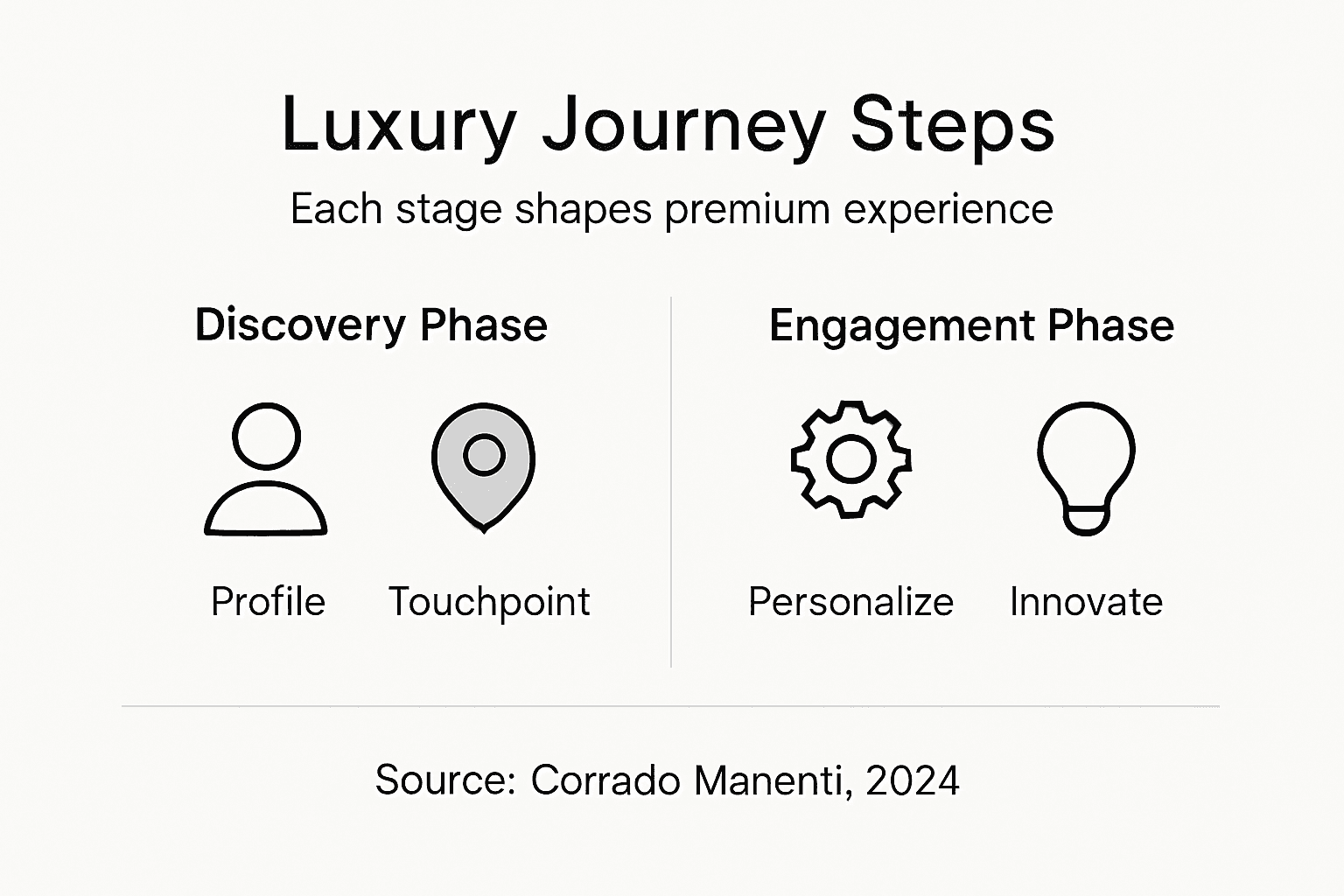
Below is a summary of key digital innovations shaping luxury brand experiences:
| Innovation Type | Typical Use | Expected Outcome |
|---|---|---|
| Augmented Reality Try-On | Interactive product previews | Enhanced engagement and personalization |
| AI Recommendation Systems | Tailored product suggestions | Increased client satisfaction |
| Live Consultation Platforms | Real-time expert support | Builds trust and loyalty |
| Metaverse Experiences | Hybrid online-offline events | Deepens brand immersion |
Digital innovation in luxury is not about technological complexity, but about creating intuitive, meaningful interactions that feel effortlessly human.
Pro Tip: Continuously prototype digital experiences with real users, treating each interaction as an opportunity to refine and personalize your technological approach.
Step 5: Verify and refine the luxury customer journey
Evaluating and optimizing the luxury customer journey demands continuous strategic assessment and precision-driven refinement. Systematic consumer motivation research emphasizes the critical importance of adaptable, iterative approaches that keep pace with rapidly evolving consumer expectations.
Effective journey verification involves multiple sophisticated methodological dimensions:
- Quantitative Performance Metrics: Measuring conversion rates and engagement levels
- Qualitative Customer Feedback: Capturing emotional responses and experience nuances
- Behavioral Analytics: Tracking interaction patterns and decision triggers
- Competitive Benchmarking: Comparing experiences against industry standards
The refinement process requires a structured approach:
- Collect comprehensive customer data
- Conduct in-depth experience mapping
- Identify friction points and emotional gaps
- Design targeted improvement strategies
- Implement iterative optimization protocols
The fundamental objective transcends mere incremental improvements – it’s about crafting dynamically responsive luxury experiences that anticipate and exceed client expectations.
Luxury customer journeys are living ecosystems, not static blueprints – they demand constant nurturing and intelligent adaptation.
Pro Tip: Develop a real-time feedback mechanism that allows immediate insights and micro-adjustments to your customer experience strategy.
Elevate Your Luxury Brand Experience with Psychology-Driven Marketing
Navigating the intricate luxury customer journey demands more than conventional marketing methods. The article highlights key challenges such as understanding emotional reinforcements, mapping experiential touchpoints, and creating personalized engagement strategies that truly resonate with high-end clients. If you are striving to transform these insights into a seamless, impactful brand experience that forges deep emotional connections, expert guidance is essential.
At Corrado Manenti, we specialize in blending advanced psychological profiling with luxury marketing precision to address exactly these challenges. Our Marketing Fashion services combine deep consumer psychology with meticulous attention to brand detail. We help you decode your clients’ motivations and strategically map every interaction to craft a premium, memorable experience.
Ready to transform your luxury brand’s customer journey and engage clients on a profound emotional level? Discover how innovative digital strategies and personalized marketing can keep your brand ahead in a competitive marketplace. Visit us today at Corrado Manenti to start crafting strategies that speak directly to your clients’ hearts.
For insights on the evolving influence of digital channels in luxury marketing, explore our Fashion VS Influencer category and stay at the forefront of industry trends.
Frequently Asked Questions
How can I define luxury client profiles for my brand?
To define luxury client profiles, focus on the psychological motivations behind their purchasing behavior. Analyze emotional drivers, social aspirations, and personal value hierarchies, then create profiles that capture these complexities. Begin by conducting qualitative interviews with your target consumers within 30 days to gain deeper insights.
What are the key touchpoints to consider when mapping the luxury customer journey?
Key touchpoints in the luxury customer journey include both digital interactions (like websites and social media) and physical encounters (such as retail spaces). Evaluate each touchpoint’s emotional impact and ensure they create a seamless brand experience. Start by conducting an inventory of existing interactions within the next two weeks to identify essential areas for improvement.
How can I tailor my engagement strategies for luxury clients?
Tailor your engagement strategies by leveraging data-driven insights and emotional intelligence to resonate with individual client aspirations. Ensure that your communications are contextually relevant and synchronized across various channels. Begin segmenting your client data now to design personalized engagement pathways within the next month.
What digital innovations should I implement for luxury brand interactions?
Consider implementing virtual experience technologies, AI-driven interfaces, and immersive communication channels to enhance interactions. Focus on creating seamless connections between physical and digital environments. Evaluate your current digital infrastructure within the next 30 days to identify gaps and optimal innovations to adopt.
How do I continuously verify and refine the luxury customer journey?
Continuously verify the luxury customer journey by collecting performance metrics, customer feedback, and behavioral analytics to identify any friction points. Implement iterative optimization protocols to enhance the overall experience. Establish a real-time feedback mechanism within the next six weeks to allow for immediate adjustments to your strategy.
Recommended
- Customer Journey in Luxury: Complete Guide – Corrado Manenti
- Blog – Corrado Manenti
- Customer Journey in Luxury: Complete Guide – Corrado Manenti
- How to Create Luxury Brand Experience for Premium Clients – Corrado Manenti
- How to Design a Luxury Pool for a Stunning Backyard Oasis
- Medically Guided Skincare Steps for Lasting Natural Results
- How to Create Streetwear Looks with Sustainable Style – MEXESS