

Most executives assume luxury pricing is justified by superior materials or engineering. That assumption is only partially true. Some of the world’s most profitable luxury brands command 500% higher prices without a proportionally superior product. The real engine behind premium positioning is consumer psychology: the way exclusivity, emotional resonance, and social signaling shape what buyers believe a product is worth. For executives in fashion, automotive, and hospitality, understanding this distinction is not academic. It is the difference between competing on price and owning a category.
Table of Contents
- What is premium positioning and why does it matter?
- The psychological levers behind premium positioning
- Tactics luxury brands use to justify premium pricing
- The risks and pitfalls of premium positioning
- How to apply premium positioning for long-term brand growth
- Elevate your luxury brand with expert positioning strategies
- Frequently asked questions
Key Takeaways
| Point | Details |
|---|---|
| Psychology drives value | Luxury brands profit from status, emotional connection, and exclusivity, not just quality. |
| Execution is key | Premium strategies like storytelling and no discounts build pricing power and loyalty. |
| Risks require focus | Overexposure or discounts can quickly erode exclusivity—strategic discipline is essential. |
| Specialist advantage | Brands with focused expertise and personalization outperform industry giants. |
What is premium positioning and why does it matter?
Premium positioning is the deliberate strategy of placing a brand at the top tier of perceived value within its market, independent of cost-to-produce ratios. It is not simply about charging more. It is about engineering a perception so powerful that price becomes a secondary consideration for the buyer. The premium positioning psychology behind this strategy draws on status theory, emotional attachment, and the Veblen effect, where higher prices actually increase desirability rather than suppress demand.
The Veblen effect is not a quirk. It is a documented behavioral pattern that luxury brands actively engineer. When a consumer pays more for a Hermès Birkin or a Rolls-Royce Phantom, the price itself becomes part of the product’s value. It signals membership in an exclusive group. That signal is worth more to the buyer than any incremental improvement in stitching or horsepower.
The financial impact is significant. Luxury brands achieve 20 to 35% profit margins, compared to 12 to 20% for premium brands and far less for mass-market players. That gap is not driven by production costs. It is driven by perception. Luxury brand positioning evidence consistently shows that emotional and symbolic value outweighs functional value in purchase decisions at the top of the market.
“The luxury consumer is not buying a product. They are buying a story, a status, and a feeling that no mass-market alternative can replicate.”
Why does this matter most in fashion, automotive, and hospitality? Because these are categories where exclusivity in fashion and its equivalents in other sectors directly translate to pricing power, repeat purchase, and brand loyalty that competitors cannot easily erode.
Key reasons premium positioning drives superior returns:
- Higher price tolerance among target buyers reduces margin pressure
- Emotional loyalty creates switching costs that are psychological, not contractual
- Status signaling amplifies word-of-mouth among aspirational consumers
- Premium perception insulates brands from commodity pricing wars
The psychological levers behind premium positioning
Understanding why premium positioning matters leads to the real secret: the psychological triggers that make luxury pricing work. Brands leverage exclusivity, scarcity, and the halo effect to build perceived value that far exceeds production reality. Each lever operates independently, but together they create a perception ecosystem that is extremely difficult for competitors to replicate.
Scarcity is perhaps the most powerful lever. When supply is deliberately constrained, demand intensifies. Waiting lists at Hermès are not a logistics failure. They are a marketing strategy. You can explore how scarcity drives exclusivity in practice to see how this plays out across categories.
The halo effect means that a high price signals superior quality, even when objective differences are minimal. Consumers assume that if a brand charges more, it must be better. This assumption is self-reinforcing: the more consistently a brand maintains premium pricing, the more credible the quality signal becomes.
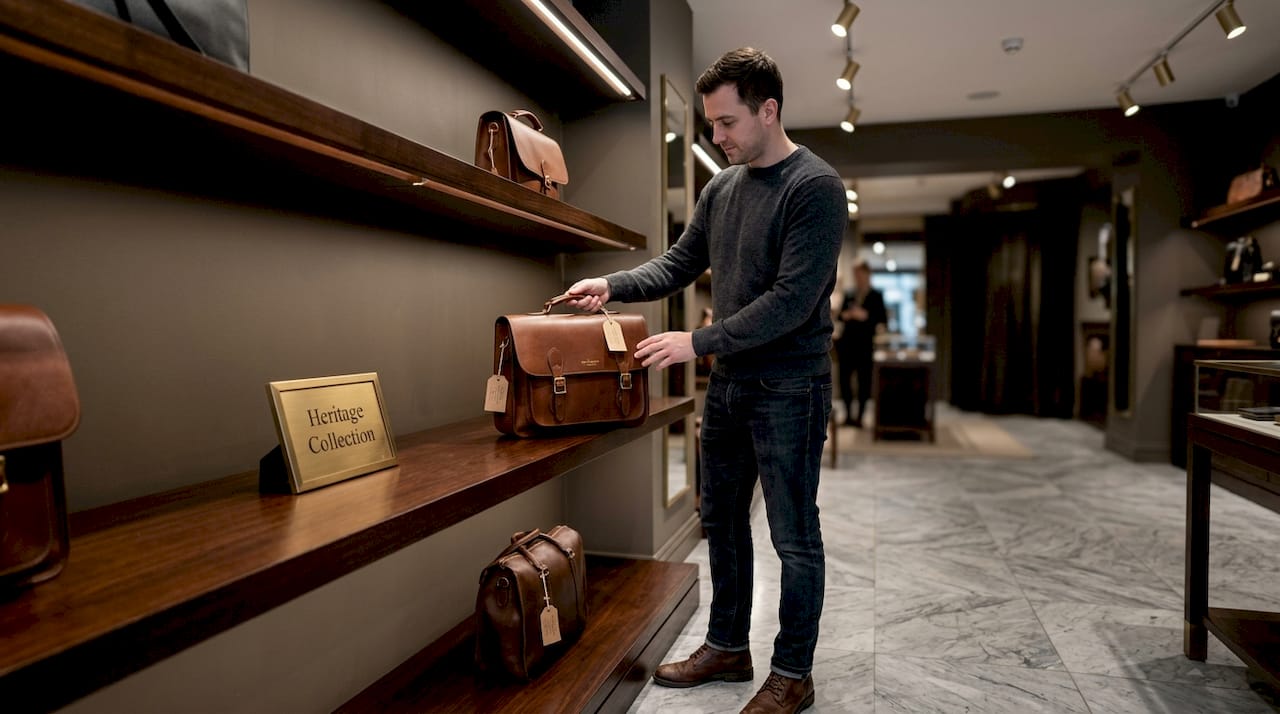
Emotional storytelling converts a product into a cultural artifact. Heritage narratives, founder mythology, and artisan craftsmanship stories all serve the same function: they give the buyer a reason to feel that their purchase is meaningful, not just transactional. The psychology in luxury branding that drives this is well-documented and highly actionable.
| Psychological lever | Mechanism | Brand example |
|---|---|---|
| Scarcity | Limits supply to amplify demand | Hermès Birkin waitlists |
| Halo effect | Price signals quality | Rolex pricing architecture |
| Emotional storytelling | Heritage builds meaning | Louis Vuitton founder narrative |
| No-discount policy | Protects prestige and margin | Chanel pricing discipline |
| Social signaling | Purchase signals status | Ferrari ownership community |
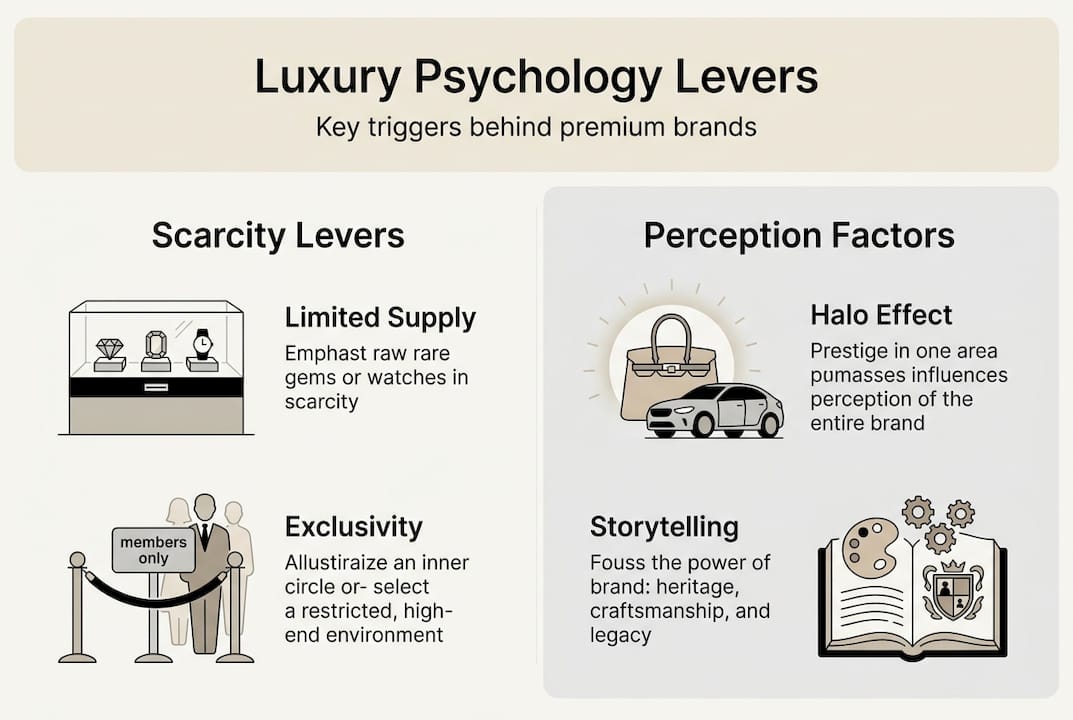
Prestige branding psychology research confirms that these levers work in concert. Removing any one of them weakens the overall system. A brand that tells a great heritage story but then discounts aggressively sends a contradictory signal that erodes trust.
Pro Tip: Never allow uncontrolled distribution. Every additional retail touchpoint that does not meet your brand’s experiential standard dilutes the exclusivity in luxury value you have spent years building. Distribution is a positioning decision, not just a logistics one.
Tactics luxury brands use to justify premium pricing
Once you understand the psychological foundations, you can see how tactical choices bring premium positioning to life. The most effective tactics are not accidental. They are deliberate, consistent, and often counterintuitive from a conventional marketing perspective.
Limited editions and bespoke services create urgency and personalization simultaneously. A limited-edition colorway at BMW M or a bespoke interior specification at Rolls-Royce does two things: it signals craftsmanship and it makes the buyer feel singular. That feeling of singularity is worth a significant price premium.
No-discount policies are non-negotiable for true luxury. No discounting, premium pricing as a status signal, storytelling, and personalized experiences are the core mechanics that separate luxury from aspirational premium. Aman Resorts, for example, never discounts. Their pricing is a statement: if you need a discount, this experience is not for you. That exclusion is itself a positioning tool.
“Discounting is not a sales strategy in luxury. It is a brand destruction strategy executed in slow motion.”
Look at BMW’s brand positioning as an instructive case. BMW straddles premium and near-luxury by leading with performance engineering as the core value proposition. This allows them to command prices above mass-market competitors while maintaining broader volume than ultra-luxury players. The risk, as we will discuss, is that this straddle position requires constant discipline.
| Tier | Pricing strategy | Distribution | Discount policy |
|---|---|---|---|
| Mass market | Competitive pricing | Wide, multi-channel | Frequent promotions |
| Premium | Value-based pricing | Selective channels | Rare, tactical only |
| Luxury | Prestige pricing | Exclusive, controlled | Never |
Numbered list of proven premium tactics:
- Launch limited editions with documented production numbers to create verifiable scarcity
- Invest in bespoke or personalization programs that make each purchase feel unique
- Train every customer-facing team member in the brand’s heritage narrative
- Control distribution ruthlessly: fewer doors, higher standards
- Price increases, not discounts, when demand softens, to protect the Veblen effect
Pro Tip: Study examples of premium branding across categories before assuming your sector’s conventions are fixed. The most innovative premium positioning often borrows from adjacent industries.
The risks of moving from mass to premium are real. Brands that attempt premiumization without changing their distribution, service model, and communication strategy typically fail to shift consumer perception, regardless of how much they raise prices.
The risks and pitfalls of premium positioning
Premium positioning brings great rewards, but there are real-market pitfalls for the incautious or the over-ambitious. The most common mistake is treating premium positioning as a pricing decision rather than a total brand experience decision.
Discounts erode exclusivity; overexpansion weakens brand prestige. This is not a theoretical warning. Brands that have entered outlet channels, run seasonal sales, or expanded into mass retail have consistently seen their premium perception decline, often irreversibly. The damage is asymmetric: it takes years to build premium equity and months to destroy it.
Overexposure is equally dangerous. When a luxury brand becomes too visible, too accessible, or too widely distributed, the exclusivity signal collapses. The buyer who paid a premium to feel singular now sees their purchase everywhere. That feeling of singularity, which justified the price, disappears.
“Exclusivity is not just about who can afford the product. It is about who feels chosen by the brand.”
Luxury growth slowed to 1 to 3% CAGR between 2024 and 2027 due to overexposure in several major categories, but specialist brands with tight distribution and strong heritage narratives continued to outperform. The data is clear: focus beats breadth in luxury.
Additional risks worth monitoring:
- Overpricing without delivering a commensurate experience alienates even loyal buyers
- Electric vehicle premiumization in automotive is creating new price elasticity challenges
- Aspirational buyers are more price-sensitive than core luxury consumers, making them unreliable anchors for premium strategy
- Brand loyalty from exclusivity erodes faster when brands chase volume over prestige
Premiumization scalability risks are particularly acute for brands attempting to move upmarket quickly. The behavioral science behind brand growth suggests that premium positioning requires sustained investment in perception, not just product, over multiple years before it becomes self-reinforcing.
How to apply premium positioning for long-term brand growth
To move from theory to competitive advantage, luxury teams must act strategically. The following framework is designed for executives who need to evaluate, refine, or rebuild their premium positioning in a disciplined way.
Brand equity drives purchase decisions at statistically significant levels (t-test p less than 0.05), and 70% of luxury loyalty is driven by emotional connection rather than functional attributes. This means your positioning work must prioritize emotional resonance as much as product quality.
Step-by-step framework for premium positioning:
- Audit your current positioning. Map where your brand sits on the mass-premium-luxury spectrum across each market you operate in. Be honest about gaps between your pricing and your perceived value.
- Identify your status signals. What does owning or experiencing your brand communicate about the buyer? If you cannot answer this clearly, your customers cannot either.
- Map the full customer journey. Every touchpoint, from the first digital impression to post-purchase communication, must reinforce the premium signal. One weak link breaks the chain.
- Implement a no-discount policy and monitor its impact. Track brand equity metrics, not just short-term revenue, for at least 12 months before evaluating results.
- Invest in heritage storytelling and specialist craftsmanship. These are not marketing expenses. They are brand equity investments with compounding returns.
- Personalize at scale. Use data to create personalized experiences that make each buyer feel recognized without making the brand feel mass-market.
Pro Tip: Balance exclusivity with targeted inclusivity for future market shifts. The next generation of luxury buyers values access to experiences and cultural belonging as much as product ownership. Explore lifestyle branding essentials to understand how to evolve your positioning without diluting it.
The brands that will lead their categories in the next decade are those that treat premium positioning as a living strategy, not a fixed price point. Continuous refinement, grounded in consumer psychology and executed with operational discipline, is what separates enduring luxury brands from those that fade.
Elevate your luxury brand with expert positioning strategies
Sustaining competitive advantage with premium positioning is a complex, ongoing journey. The psychological mechanics, tactical execution, and risk management covered here represent a starting point, not a complete playbook. Corrado Manenti works directly with luxury brand teams to translate these principles into actionable strategies tailored to your specific market, category, and consumer base.
Whether you need a full positioning audit, a refined fashion brand growth tactics strategy, or a deeper understanding of analyzing luxury buyer behavior, the resources and consulting frameworks available through Corrado Manenti are built specifically for executives operating at the premium and luxury tier. The psychology branding guide is a strong starting point for teams ready to move from intuition to evidence-based positioning. Reach out for a customized audit and strategic repositioning engagement.
Frequently asked questions
Can premium positioning work for brands outside fashion, auto, and hospitality?
Premium positioning applies wherever perception of exclusivity and quality impacts price, which means virtually any category can leverage it. Execution must be adapted to the specific category’s consumer psychology and competitive dynamics.
How do discounts impact premium or luxury brands?
Discounts erode exclusivity and can permanently damage brand equity and loyalty in luxury markets. Even a single high-profile discount event can reset consumer price expectations in ways that take years to reverse.
What’s the main risk of premiumization?
Luxury overexpansion weakens exclusivity, and specialists consistently outperform brands that pursue broad distribution. The main risk is becoming too visible and too accessible, which collapses the exclusivity signal that justifies premium pricing.
How do you measure the success of premium positioning?
Brand equity drives purchase decisions and luxury brands with strong positioning earn measurably higher loyalty rates and pricing power versus competitors. Key metrics include profit margin relative to category average, brand equity scores, loyalty rates, and price premium sustainability over time.
Is it possible to recover premium status after eroding it?
Rebuilding luxury positioning requires restoring exclusivity and perceived value through strict rebranding and renewed distribution discipline. Recovery is possible but demands patience, consistency, and a willingness to sacrifice short-term volume for long-term brand equity.