TL;DR:
- Luxury brands keep their most personal service moments offline to preserve exclusivity and emotional connection.
- A high-end customer experience involves emotional personalization, authenticity, anticipation, and sensory consistency.
- Successful luxury CX balances tradition and innovation by using digital tools to enhance human interactions, not replace them.
Many luxury brands are doing something that might surprise you. While their clients scroll Instagram, book appointments through apps, and research purchases online, these same brands deliberately keep their most important service moments entirely offline, unhurried, and deeply personal. Luxury can remain rooted in experience-preserving practices even while consumers use digital channels. That apparent contradiction is not a failure to adapt. It is a deliberate strategy grounded in psychology, brand positioning, and a sophisticated understanding of what affluent clients actually want. This article clarifies what high-end customer experience really means, why the tradition versus digital debate is largely a false one, and how you can apply both psychological insight and innovative tactics to create client moments that generate lasting loyalty.
Table of Contents
- What defines a high-end customer experience?
- Tradition versus digital: Balancing legacy and innovation
- Psychological insights: What luxury consumers desire most
- Innovative strategies for redefining high-end customer experience
- Why redefining luxury CX requires nuance, not extremes
- Enhance your luxury brand’s customer experience
- Frequently asked questions
Key Takeaways
| Point | Details |
|---|---|
| Hybrid luxury CX | High-end customer experience now blends tradition with digital personalization to maximize satisfaction. |
| Psychological drivers matter | Recognition, certainty, belonging, and surprise are essential for luxury consumer loyalty. |
| Sector-specific strategies | Fashion, hospitality, and automotive brands must tailor their approach based on unique sector expectations. |
| Balance legacy and innovation | Preserving exclusivity while innovating touchpoints is key for luxury brand differentiation. |
| Invest in actionable resources | Executives can leverage expert guides and checklists to advance luxury customer experience initiatives. |
What defines a high-end customer experience?
Before you can elevate it, you need to define it clearly. High-end customer experience is not simply excellent service. It is a curated emotional journey that makes a client feel recognized, valued, and irreplaceable. That distinction matters enormously in practice.
The foundational elements that separate luxury from premium or mass-market are not difficult to name, but they are surprisingly difficult to execute consistently:
- Personal attention: Clients are addressed by name, their preferences are remembered across every interaction, and nothing feels scripted.
- Authenticity: The story behind the product or service feels real. Clients sense when heritage is performed versus lived.
- Exclusivity: Access, timing, inventory, and even information are curated so that clients feel they belong to a world most people cannot enter.
- Anticipation: The best luxury experiences create a sense of pleasurable waiting, where the buildup is part of the reward.
- Emotional resonance: Clients leave feeling something specific, whether pride, serenity, excitement, or belonging.
These elements work because they trigger well-documented psychological responses. Perceived value, for instance, is shaped not just by price or quality but by context, scarcity, and the social meaning attached to an object or experience. Anticipation activates reward circuits in the brain before a purchase even happens, which is why the pre-purchase rituals at brands like Hermès or Rolls-Royce are as deliberate as the delivery itself.
Compare this with mass-market service design. In mass-market contexts, the goal is speed, consistency, and frictionless transactions. In luxury, friction is sometimes desirable. Waiting for a bespoke garment, going through a multi-step consultation, or receiving a handwritten note after purchase are all forms of productive friction. They signal investment, care, and exclusivity.
“Luxury brands maintain legacy service models rather than fully replatforming CX around new digital touchpoints.”
That quote reflects a pattern many executives get wrong. The assumption that modernizing customer experience means digitalizing it entirely can actively damage a luxury brand’s perceived value. Clients who spend significant sums expect human judgment, not algorithmic efficiency.
One of the most effective ways to build this type of experience is through personalizing luxury marketing so that every touchpoint, digital or not, feels curated for the individual rather than broadcast to a demographic.
Tradition versus digital: Balancing legacy and innovation
Having defined what luxury customer experience actually means, you can now look at the tension that many executives wrestle with daily: how do you integrate digital capabilities without diluting the exclusivity and warmth that your brand has spent decades building?
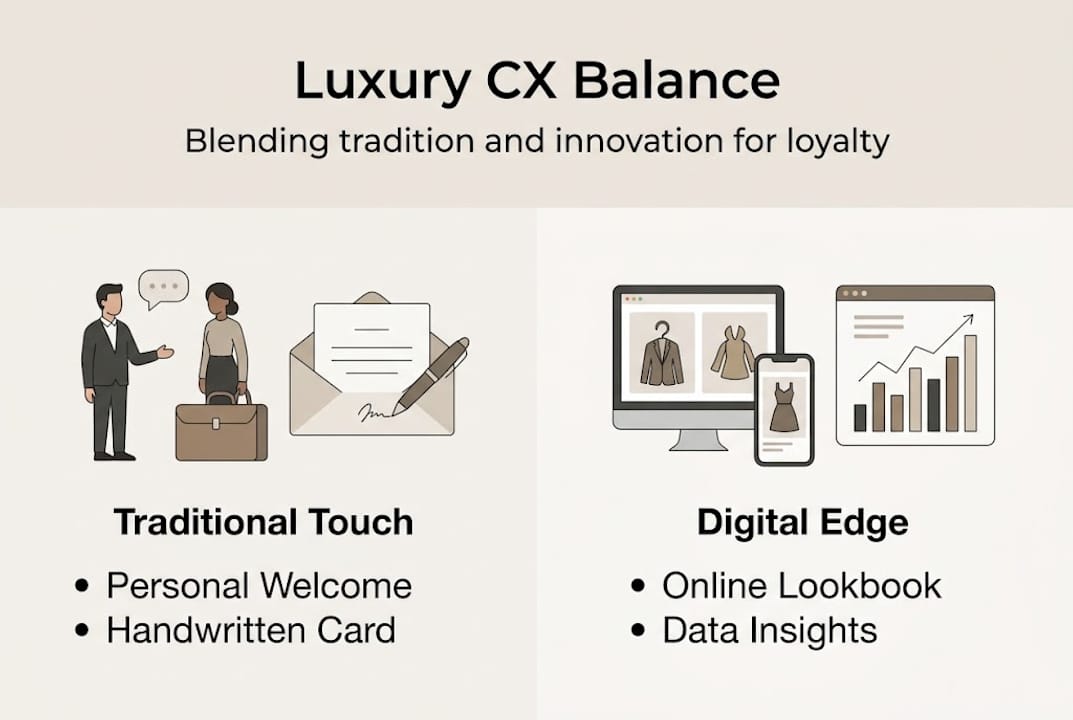
The honest answer is that you do not need to choose one over the other. What you need is clarity on which moments demand human presence and which can be enhanced by technology without losing their emotional weight.
| Touchpoint | Traditional luxury approach | Digital enhancement opportunity |
|---|---|---|
| First contact | In-store greeting, personal referral | AI-assisted CRM triggering personalized welcome emails |
| Product discovery | Private showroom, stylist consultation | Curated digital lookbooks, virtual previews |
| Purchase | Hand-signed certificates, elegant packaging | Digital authentication, NFT ownership records |
| Post-purchase | Handwritten thank-you notes, follow-up calls | Personalized digital loyalty programs, early access alerts |
| Feedback | Private conversation with client advisor | Discreet in-app satisfaction prompts |
Sector examples reveal how different the balance looks depending on your market. In fashion, brands like Chanel deliberately limit e-commerce access to protect exclusivity, while using digital channels for storytelling and brand world-building. In hospitality, Four Seasons has invested heavily in its app for service requests, but ensures that human staff acknowledge every digital request personally within minutes. In automotive, Ferrari uses digital configurators to let clients co-design their vehicles, but the final handover remains an intimate, ceremony-style event at the factory.
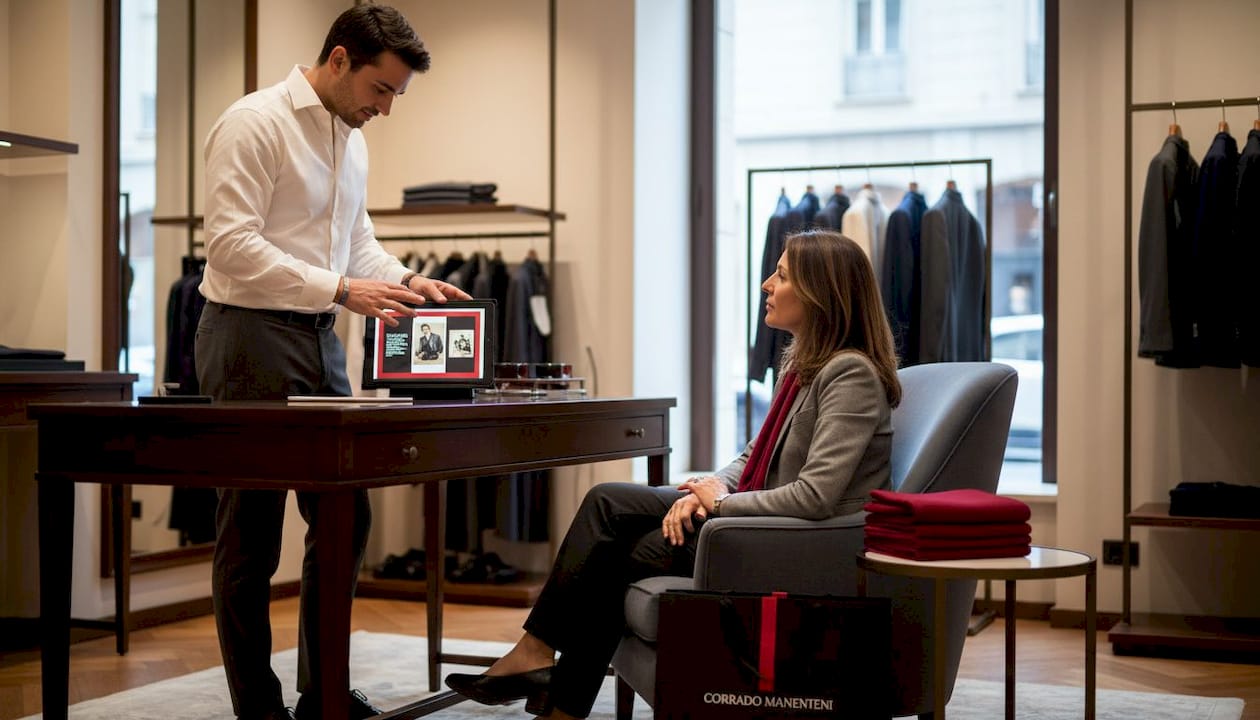
Some luxury brands maintain legacy service models even as consumers engage digitally. The key insight here is sequence. Digital tools can accelerate awareness, deepen research, and extend the relationship after purchase. The peak emotional moments, however, almost always benefit from human presence and craft.
You can explore deeper frameworks for this balance through luxury digital innovation and digital innovation strategies tailored specifically for premium sectors.
Pro Tip: Before deploying any digital tool in your customer journey, ask yourself one question: does this make the client feel more or less like an individual? If the technology makes the interaction feel more generic, it has no place in a luxury touchpoint, regardless of how sophisticated it is.
The statistic worth noting here is that, according to Bain and Company’s luxury research, over 70% of luxury purchases are influenced by at least one digital interaction before a client enters a store. Yet the moment of purchase itself remains largely offline for the highest-spending segment. Digital influences; human experience closes.
Psychological insights: What luxury consumers desire most
Moving from channel choices to underlying motivations reveals something that many brands either overlook or underestimate. Luxury customers are not primarily buying products. They are buying feelings, identities, and social signals. When you understand which psychological needs drive your clients, your entire approach to customer experience sharpens.
The core psychological needs in luxury are these:
- Recognition: Being known, remembered, and treated as an individual rather than a transaction.
- Certainty: Confidence that the brand will deliver consistently on its promise, every time, across every market.
- Belonging: Access to a community or world that reflects and elevates one’s self-image.
- Surprise: Delight through the unexpected, an upgrade, a personal gesture, a piece of knowledge they did not anticipate receiving.
These four drivers are not equally important across sectors. The table below reflects general patterns observed across luxury categories:
| Psychological need | Fashion | Hospitality | Automotive |
|---|---|---|---|
| Recognition | Very high | Very high | High |
| Certainty | High | Very high | Very high |
| Belonging | Very high | High | High |
| Surprise | High | Very high | Moderate |
In fashion, belonging and recognition dominate because wearing a luxury brand is a social act. Clients want to feel part of a world, and they want that world to acknowledge them. In hospitality, certainty and surprise compete for top position because guests pay for reliable excellence but remember the unexpected gesture. In automotive, certainty is paramount because a client investing hundreds of thousands in a vehicle needs to trust the brand unconditionally.
Consumers expect luxury brands to deliver authenticity and emotional resonance, not just technological convenience. This expectation directly challenges many digital-first strategies. When a chatbot handles a complaint that affects a client’s sense of recognition, the brand pays a price that no discount or apology can fully recover.
The opportunity in luxury personalization impact lies in using data intelligently to inform human decisions, not to replace them. A client advisor who knows from a CRM that a client recently purchased a watch for his wife’s birthday can mention it naturally during the next visit. That moment of recognition costs nothing to execute but creates an emotional imprint that competitors cannot copy easily.
For broader strategies around enhancing brand perception, the research consistently points back to the same truth: emotional experiences are remembered longer and more vividly than rational ones, and in luxury, memory is the product.
Pro Tip: Map your current client journey against these four psychological needs. Identify where recognition fails, where certainty breaks down, where belonging feels thin, and where surprise is completely absent. Even one strong improvement in each area creates measurable gains in repeat purchase rates and client advocacy.
Innovative strategies for redefining high-end customer experience
Theory becomes useful only when it drives action. Here are five concrete strategies that luxury executives can apply now, each grounded in the psychological insights above and relevant across fashion, hospitality, and automotive.
-
Build a memory architecture into your client journey. Every touchpoint should be designed with the question: what will this person remember in six months? In fashion, this might mean presenting a garment with a short story about its artisan. In automotive, it means engineering the delivery day as a cinematic event, not an administrative handover. In hospitality, it means creating a singular, unexpected moment every stay that the guest did not see coming.
-
Use data to humanize, not automate. Luxury brands redefining experiences use both legacy and digital approaches to increase engagement and loyalty. The smartest application of client data is not to generate automated messages but to prepare human advisors to have better, more personal conversations. CRM systems should be tools for advisors, not substitutes for them.
-
Create access-based rewards rather than points-based ones. Points systems are mass-market in their psychology. High-spending clients are not motivated by accumulating points toward a discount. They are motivated by access: an invitation to a private preview, a conversation with the creative director, a factory visit before a model launches. Design your loyalty offer around exclusivity of experience, not reduction in price.
-
Invest in sensory consistency across all channels. Luxury is experienced through multiple senses simultaneously, and this extends to digital. Your tone of voice in email, the quality of imagery in digital catalogs, the sound design on your app, and the weight of your packaging must all tell the same brand story. Inconsistency at any sensory level creates doubt, and doubt is fatal in luxury.
-
Establish real-time feedback loops with your highest-value clients. Not through surveys, which feel transactional, but through structured conversations with client advisors who then log insights that refine the overall experience. A good digital strategy for luxury brands includes a mechanism for capturing qualitative client sentiment and feeding it back into CX design quickly. Understanding luxury consumer behavior at this depth gives you a competitive edge that market research alone cannot provide.
The engagement boost from personalization at scale is significant. McKinsey research shows that personalization at the right moments can drive revenue increases of 10 to 15 percent for luxury brands that execute it with precision. The caveat is that personalization must feel earned and organic rather than data-driven and transactional.
Why redefining luxury CX requires nuance, not extremes
Here is the uncomfortable reality that many luxury executives are not hearing clearly enough: the pressure to digitalize everything is often coming from inside the organization, not from your most valuable clients.
Boards see digital adoption rates and assume the entire customer experience must follow. But some luxury brands maintain legacy models rather than fully replatforming CX around new digital touchpoints, and their client satisfaction scores are no lower for it. In many cases, they are higher.
The brands that get this right are the ones that resist both extremes. They do not cling to tradition out of nostalgia, and they do not chase digital innovation out of anxiety. They ask a more precise question: at what moment in this client’s journey does technology serve the human connection, and at what moment does it replace it?
The answer to that question should guide every CX investment decision you make. Reviewing your CX personalization lessons through this lens will reveal that your most powerful differentiator is not your tech stack. It is the quality of the human judgment that your technology makes possible.
Enhance your luxury brand’s customer experience
If this article has clarified one thing, it is that high-end customer experience is a craft that requires psychological depth, strategic clarity, and the courage to resist easy answers.
Corrado Manenti works with fashion, hospitality, and automotive brands to build exactly this kind of clarity. Whether you are reassessing your CX strategy from the ground up or looking to sharpen specific touchpoints, the resources available cover everything from luxury brand growth tactics to the granular science of analyzing luxury buyer behavior. If your brand is ready to move from general principles to specific, psychologically grounded action, this is where that work begins.
Frequently asked questions
What makes a luxury customer experience different from mass-market?
Luxury customer experience is defined by exclusivity, personalization, and emotional resonance, supported by tradition and meticulous attention to detail. Unlike mass-market service, which optimizes for speed and consistency, luxury maintains legacy service models centered on individual recognition.
How can digital channels elevate high-end customer experience without losing exclusivity?
Digital tools support luxury CX best when they enhance personalization and inform human decision-making rather than replace personal service. Legacy service models can coexist with digital engagement when each channel is assigned the right role in the journey.
What psychological drivers matter most in luxury customer engagement?
Recognition, certainty, belonging, and surprise are the four core drivers behind high-end satisfaction and loyalty. Brands that consistently address all four deliver authenticity and emotional resonance that goes far beyond product quality.
What are three practical ways to innovate luxury customer experience?
Executives should blend tradition with digital personalization to inform human conversations, design access-based loyalty rewards that reinforce exclusivity, and build memory-making moments into every key journey stage that clients will recall and recount.
Are all luxury brands expected to digitalize their customer experience?
No. Many luxury brands selectively adopt digital while retaining their legacy approaches to protect tradition and exclusivity. Experience-preserving practices remain central for the highest-spending client segments, even as digital touchpoints grow in influence at earlier journey stages.