
TL;DR:
- Affordable luxury marketing positions premium products at accessible prices without sacrificing brand prestige or discounts.
- It relies on proof signals, scarcity, and storytelling to build desire while protecting margins.
Affordable luxury marketing is defined as the practice of positioning premium products at accessible price points without sacrificing brand prestige or resorting to discounts. The challenge for brand managers is real: affluent consumers demand proof of quality, exclusivity, and story, yet budgets rarely allow for mass-market spending. This guide covers the core tactics that deliver on all three. From Model-to-Consumer (M2C) pricing structures and proof signals to digital demand capture and experiential exclusivity, these are the methods that build desire and protect margin simultaneously. Every tactic here is grounded in how luxury consumers actually make decisions, not how brands wish they would.
What are the core prerequisites for affordable luxury marketing tactics?
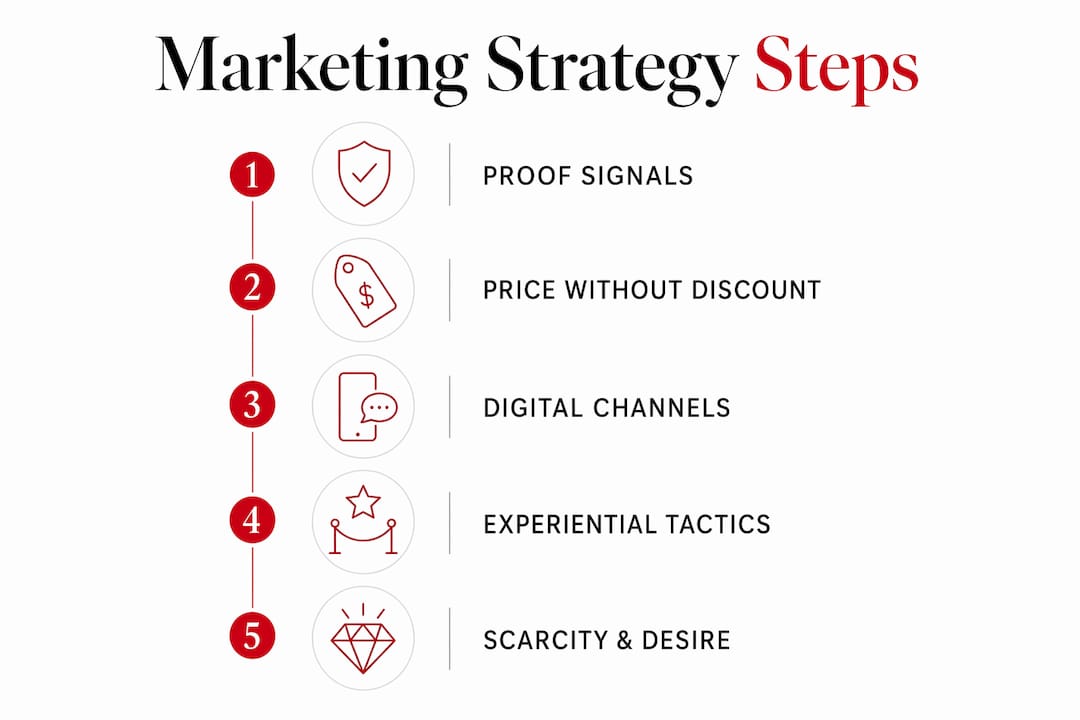
The foundation of any cost-effective luxury strategy is credible proof. Stacking multiple proof signals on product pages, including material sourcing, provenance, performance guarantees, and ethical production, reduces perceived risk and justifies premium pricing. Without these signals, even the most polished campaign falls flat because affluent consumers are trained to detect shortcuts.

Your digital infrastructure must match your brand promise. A slow, cluttered website signals low quality faster than any ad campaign can correct. Brand managers should audit product feeds, page load times, and mobile experience before spending a dollar on paid media. The website is the first proof signal most prospects encounter.
Audience segmentation is the next prerequisite most brands skip. Luxury consumers are not a monolith. The aspirational buyer who stretches for an entry-level piece behaves very differently from the established collector who buys on heritage alone. Knowing which segment you are addressing determines everything from copy tone to channel selection.
- Proof signals: List materials, certifications, country of origin, and artisan credentials directly on product pages.
- Digital readiness: Audit site speed, mobile UX, and product feed accuracy before launching any paid campaign.
- Audience segmentation: Define at least two distinct buyer profiles with separate messaging frameworks.
- Price-to-story alignment: Every price point needs a corresponding narrative that explains why the product is worth it.
Pro Tip: Run a five-second test with someone outside your team. Show them your product page for five seconds, then ask what makes the product worth its price. If they cannot answer, your proof signals need work.
A step-by-step fashion marketing guide from Corradomanenti covers how to build this foundation systematically, including how to sequence brand story elements for maximum credibility.
How can luxury brands price without discounting?
Discounting is the fastest way to destroy luxury equity. Luxury brands must avoid discounting and instead build desire through scarcity, newness, and story. Once a brand trains its audience to wait for a sale, the full price becomes the ceiling, not the floor.
The M2C model offers a structural alternative. Brands using M2C structures bypass wholesale markups entirely, enabling price points that feel disruptive without requiring a markdown. A cashmere piece at $50 lands as a pattern interrupt, not a discount signal, because the brand controls the full margin and the full narrative. That margin control is what funds the storytelling, packaging, and service that make the price feel earned.
Premiumization is the other lever. Shifting consumer mix toward premium tiers delivers 8–15 points higher gross margin per unit compared to pushing core price-point sales. Anchoring the most premium product first in any merchandising sequence pulls the entire perceived value of the range upward.
- Anchor with your highest-tier product first. Display it prominently before any entry-level option. This sets the reference price that makes everything else feel accessible, not cheap.
- Use limited editions instead of markdowns. A capsule collection creates urgency through scarcity. It moves inventory without signaling that the brand needs to discount.
- Bundle services, not prices. Offer personalized monogramming, extended warranties, or exclusive packaging as value-adds. The price stays fixed; the perceived value increases.
- Control distribution tightly. Selling through too many channels dilutes exclusivity. Fewer, more curated touchpoints reinforce the sense that buying is a privilege.
- Communicate newness regularly. Frequent product drops keep the audience engaged without requiring price reductions to generate interest.
Pro Tip: When launching a new product, seed it with your highest-value existing customers first. Their early adoption becomes social proof that the product is desirable, not discounted.
Which digital channels build desire and capture demand for luxury brands?
Effective digital marketing for luxury goods requires separating channels into two distinct roles: those that build desire and those that capture demand. Mixing the two in a single campaign dilutes both functions. Upper-funnel channels create aspiration; lower-funnel channels convert it.
YouTube and TikTok are the primary desire-building platforms for luxury in 2026. Long-form brand films on YouTube establish heritage and craft. TikTok rewards authenticity over polish, which is a genuine advantage for brands with a real story to tell. Creator content that captures genuine consumer excitement outperforms scripted brand ads on both reach and engagement. One brand recorded 366% year-over-year EMV growth on Instagram and 437% growth on TikTok by leaning into authentic creator content rather than traditional advertising. Those numbers reflect what happens when real enthusiasm replaces manufactured polish.
For customer loyalty and relationship depth, email and SMS remain underrated. Luxury brands that treat these channels as VIP communication tools, not broadcast lists, see higher repeat purchase rates and stronger lifetime value.
| Channel | Primary role | Content type |
|---|---|---|
| YouTube | Desire building | Brand films, craft documentaries |
| TikTok | Discovery and desire | Authentic creator content |
| Social proof and aspiration | Editorial imagery, Reels | |
| Google Search | Demand capture | Branded and category search ads |
| Performance Max | Demand capture | Brand-safe placements across Google network |
| Email and SMS | Retention and loyalty | VIP access, early drops, personalized offers |
Brand-safe placement controls are non-negotiable on programmatic channels. A luxury product appearing next to low-quality content undoes months of brand-building in seconds. Set exclusion lists aggressively and review placements monthly.
What experiential and promotional tactics enhance perceived value?
Luxury marketing works by restricting access and slowing the purchase process. The goal is to make buying feel like a privilege, not a transaction. Experiential tactics are the most direct way to create that feeling at scale.
Invitation-only events are the clearest signal of exclusivity a brand can send. Whether physical or digital, the act of selecting who receives an invitation communicates that not everyone qualifies. Capsule collections with creative collaborators, artists, or cultural figures add a layer of cultural relevance that pure product marketing cannot replicate. These collaborations also generate press and creator content organically, which extends reach without paid media spend.
Exclusive limited-edition launches, invite-only events, and personalized luxury gift wrapping all boost brand perception without requiring a price reduction. The key is that each tactic must feel genuinely scarce, not artificially so. Consumers recognize manufactured urgency immediately, and it reads as desperation rather than desirability.
- Invite-only product previews: Give top-tier customers early access before any public launch. This rewards loyalty and generates word-of-mouth before the product is widely available.
- Capsule collaborations: Partner with artists, designers, or cultural figures for limited runs. The collaboration itself becomes the story.
- Personalized packaging: Offer monogramming, custom gift wrapping, or handwritten notes at no extra charge. The cost is low; the perceived value is high.
- Exclusive digital content: Gate behind-the-scenes content, making it available only to registered customers or subscribers. This turns content into a loyalty mechanism.
- Luxury subscription access: Offer a members-only tier with early access to drops, styling consultations, or private events. Membership reinforces belonging, which is the core emotional driver of luxury purchase.
The experiential branding advantages that Corradomanenti documents show that brands investing in these moments consistently outperform those relying on paid media alone for brand perception scores.
Key Takeaways
Affordable luxury marketing succeeds when brands build desire through proof signals, scarcity, and channel discipline rather than discounting or mass-market tactics.
| Point | Details |
|---|---|
| Proof signals are foundational | Stack material, provenance, and ethics claims on every product page to justify premium pricing. |
| M2C pricing enables accessible luxury | Bypassing wholesale markups lets brands offer competitive prices without eroding brand equity. |
| Separate desire from demand channels | Use YouTube and TikTok to build aspiration; use search and Performance Max to convert it. |
| Scarcity beats discounting | Limited editions and invite-only events create urgency without training buyers to wait for sales. |
| Experiential tactics multiply perceived value | Personalized packaging, exclusive events, and capsule collaborations build emotional connection at low cost. |
Why I think most luxury brands are solving the wrong problem
Most brand managers I work with arrive focused on reach. They want more impressions, more followers, more traffic. The real problem is almost always desire, not awareness. Their audience knows the brand exists. They just do not feel compelled to buy at full price.
The uncomfortable truth is that luxury brands build prestige through restriction, not expansion. Every time a brand chases volume with a broader campaign or a promotional offer, it signals to its best customers that the brand is available to everyone. That signal is fatal to luxury positioning. The brands I have seen recover from discount dependency all did the same thing: they stopped measuring success by sales volume and started measuring it by brand lift and customer lifetime value.
The other mistake I see constantly is treating digital channels as interchangeable. A brand that runs the same creative on TikTok and Google Search is wasting budget on both. TikTok rewards raw authenticity. Search rewards clarity and intent matching. These are fundamentally different psychological states, and they require fundamentally different content. Brands that understand this separation, and build content specifically for each role, consistently outperform those that repurpose assets across channels.
My advice: audit your last three campaigns and ask honestly whether they built desire or just chased it. If the answer is the latter, the exclusivity in branding framework is where to start rebuilding.
— Corrado
How Corradomanenti supports luxury brands in growing without discounting
Corradomanenti works with fashion and luxury brands that want to grow their market presence without compromising their positioning. The approach combines psychology-driven consumer analysis with channel-specific content strategy, giving brand managers a clear picture of where desire is being built and where it is leaking.
For brand managers ready to move beyond generic digital tactics, Corradomanenti offers tailored consulting on luxury brand growth tactics that cover pricing architecture, proof signal development, and experiential campaign design. The work is grounded in buyer behavior analysis specific to the luxury sector, not adapted from mass-market frameworks. If your brand is ready to build real desire, the conversation starts at corradomanenti.it.
FAQ
What is affordable luxury marketing?
Affordable luxury marketing is the practice of positioning premium products at accessible price points while maintaining brand prestige through proof signals, scarcity, and storytelling rather than discounts.
How do luxury brands avoid discounting while staying competitive?
Luxury brands use M2C pricing structures, limited-edition launches, and bundled services like personalized packaging to create perceived value without reducing the listed price.
Which digital channels work best for luxury brand marketing?
YouTube and TikTok build brand desire through storytelling and authentic creator content, while Google Search and Performance Max campaigns capture qualified demand from consumers already in a buying mindset.
How do proof signals affect luxury pricing?
Stacking proof signals such as material sourcing, provenance, and ethical production on product pages reduces perceived risk and gives consumers a concrete reason to accept a premium price point.
What experiential tactics build luxury brand perception affordably?
Invite-only events, capsule collaborations, personalized packaging, and exclusive digital content all reinforce exclusivity and emotional connection without requiring significant media spend.