


Luxury positioning for a small business is not a rebrand. It’s a structural transformation that touches pricing psychology, visual identity, client selection, and the way you communicate. The small business luxury positioning roadmap has four core phases: diagnosing and shedding mid-market conditioning, building a visual identity that signals premium without a premium budget, deploying psychology-driven marketing principles, and executing a step-by-step implementation plan. Each phase depends on the one before it. Skip the diagnosis and the visual work looks like costume jewelry. Nail all four and a small business can compete on desirability rather than price.
The key components of a complete luxury positioning strategy include:
- Mindset recalibration: Unlearning discounting, justifying, and mass-audience habits
- Visual coherence: Integrating aesthetics with brand narrative from day one
- Psychology-driven messaging: Applying the “never explain, never justify” principle
- Structural scarcity: Curating demand rather than chasing volume
- Affluent consumer targeting: Understanding how high-net-worth buyers actually decide
- Pricing alignment: Setting prices that reflect perceived value, not cost-plus math
- Ongoing adaptation: Measuring response and adjusting positioning over time
Corradomanenti’s methodology, grounded in applied consumer psychology and luxury sector experience, structures this roadmap into workflows that small business owners can follow without a Fortune 500 budget.
How to diagnose mid-market conditioning before repositioning your brand
Most luxury pivots fail before they start. The product improves, the logo gets a refresh, prices go up, and then nothing changes because the owner still thinks and sells like a mid-market operator. Luxury consumers notice immediately. They read the residual signals: the eagerness to close, the willingness to negotiate, the instinct to say yes to every inquiry.
The Luxury Academy’s diagnostic tool uses 56 scenario-based questions to surface exactly where mid-market conditioning is still running the show. It covers seven dimensions of readiness:
- Client relationship model: Depth versus breadth, intimacy versus volume
- Value and pricing psychology: Whether you justify, compare, or discount instinctively
- Quality orientation: Whether your standards hold under pressure or bend when no one is watching
- Exclusivity comfort: Whether you can say no to a willing buyer without flinching
- Strategic patience: Whether you can tolerate a revenue dip during the transition period
- Personal brand and presentation: In a small business, you are the brand
- Luxury consumer psychology: Whether you understand how affluent buyers actually decide, not just that they have more money
The hardest dimension for most owners is strategic patience. Revenue often drops before it recovers during a luxury transition. Repositioning failure most commonly traces back not to a weak product but to an owner who couldn’t wait long enough for the new positioning to take hold.
Pro Tip: Before changing a single visual or raising a single price, take a scenario-based assessment. Your instincts in realistic business situations reveal far more about your readiness than any knowledge test.
How to build a luxury visual identity on a limited budget
Visual strategy is not decoration. It is brand foundation. Every visual choice either reinforces or undermines the positioning, and treating them as separate decisions is one of the most expensive mistakes a small business can make.
The good news: a limited budget does not prevent a luxury aesthetic. A bootstrapped skincare startup built a complete luxury brand identity that impressed seasoned cosmetics industry veterans by using public domain fine art imagery, specifically classical sculptures and Renaissance paintings, as its primary visual language. No expensive photography. No custom illustration. The Venus de Milo communicated sophistication, premium positioning, and timeless quality instantly, and it cost nothing in licensing fees.
The principles behind that approach apply to any category:
- Integrate visual and strategic decisions from the start. Never commission a logo before the positioning is defined.
- Use classical or fine art imagery to signal sophistication without expensive shoots.
- Maintain absolute consistency across every touchpoint: packaging, website, social media, and client communications.
- Align the visual style tightly with the brand narrative. If the story is about mastery and restraint, the visuals must say the same thing.
A startup achieved a high-end luxury identity within 2 weeks using strategic positioning and resource-conscious visuals, successfully entering the high-end spa market on a bootstrap budget.
Corradomanenti’s approach to visual storytelling for luxury brands follows this same logic: the visual system must be a direct expression of the brand’s positioning claim, not an afterthought applied once the strategy is written. When both are built together, even a small business can produce a brand that looks like a six-figure investment.

Why “never explain, never justify” is the most powerful rule in luxury marketing
Luxury brands do not argue their case. BrandStruck’s analysis of how luxury brands grow identifies “never explain, never justify” as a foundational rule: campaigns are built on atmosphere rather than argument, minimal copy rather than feature lists, evocative visuals rather than rational reassurances. Chanel does not explain why the 2.55 bag costs what it costs. Rolex does not break down what goes into the watch. The opacity is intentional.
For a small business, this principle has direct operational implications:
- Stop justifying your price. A price explained is a price that sounds uncertain.
- Build atmosphere through visuals and minimal copy, not through benefit bullets.
- Curate who you work with. Scarcity is a structural necessity, not a tactic. Limiting access makes the brand feel selective and intentional.
- Eliminate weak-fit inquiries early. A refined inquiry form, a response process that feels personal, and messaging that filters for fit all protect the brand’s standards.
- Build credibility through presence, not endorsements. Affluent consumers evaluate consistency, presentation, and communication quality far more than celebrity associations.
Scarcity deserves its own emphasis. Luxury brands grow by maintaining distance, not by seeking mass-market appeal. For a small business, limited availability is not a weakness to hide. It is the advantage. A private house with standards feels more desirable than a brand trying to reach everyone.
Pro Tip: Replace your generic contact form with a curated inquiry process. Ask qualifying questions. The friction itself signals that your brand has standards worth protecting.
Corradomanenti’s psychology-driven methodology goes deeper than messaging tactics. Understanding why affluent consumers buy requires recognizing that they are not mid-market clients with larger wallets. Their decision process is driven by identity, belonging, and symbolic value, not by price-to-performance ratios.
Implementing your luxury positioning strategy step by step
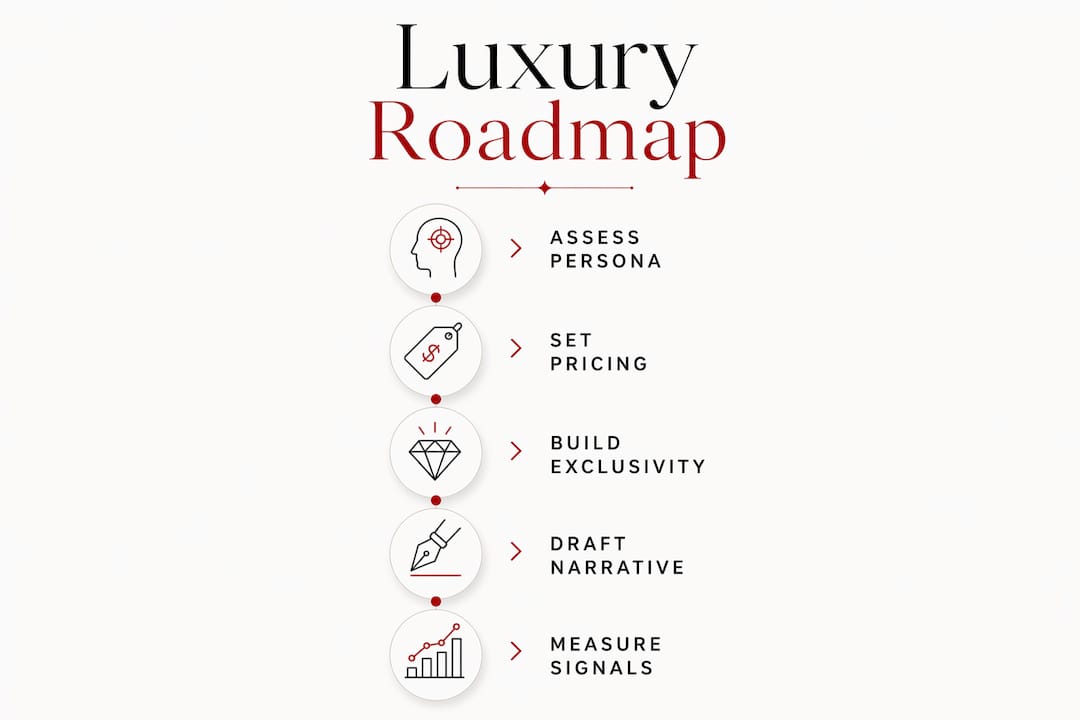
Execution is where most roadmaps collapse. The steps below reflect the sequence that Corradomanenti’s luxury brand positioning workflow follows for small businesses moving from mid-market to high-end positioning.
Step 1: Define your affluent consumer persona with precision. High-net-worth individuals are not a monolith. A client shopping for a bespoke service in New York differs fundamentally from one in a secondary market. Map their values, their reference points, their existing luxury relationships, and what belonging means to them in your category.
Step 2: Set pricing that reflects perceived value, not cost. Luxury pricing communicates exceptional quality, exclusivity, and belonging. It is not a barrier. It is a signal. Price too low and the affluent consumer reads it as a quality problem, not a bargain.
Step 3: Build your digital presence around exclusivity, not reach. Social media for a luxury brand functions like a gallery wall: curated, mostly one-directional, and never reactive. No giveaways, no polls, no “we heard you” posts. The feed should feel like a broadcast from an arbiter of taste, not a brand desperate for engagement. Digital tools including AI-powered personalization now allow small brands to create immersive, tailored experiences without diluting exclusivity.
Step 4: Craft a brand narrative that evokes, not explains. Luxury needs stories built on heritage, craft, purpose, and aspiration, not feature lists. Every piece of content should expand the brand’s world, not just describe its products. The luxury segmentation guide for 2026 reinforces that precise audience segmentation is what makes these narratives land with the right people.
Step 5: Measure through quality signals, not volume metrics. Track inquiry quality, client retention depth, and whether the brand is attracting the right conversations. If you are fielding price objections regularly, the positioning has not landed yet. Adjust the visual language, the messaging tone, or the access structure before raising prices further.
The full luxury branding checklist from Corradomanenti covers each of these steps with specific decision points for small business owners who are executing this transition without a large team.
Key Takeaways
A successful small business luxury positioning roadmap requires shedding mid-market conditioning first, then building visual identity and psychology-driven messaging as one integrated system, not as sequential afterthoughts.
| Point | Details |
|---|---|
| Diagnose before repositioning | Use scenario-based assessments across seven readiness dimensions to identify mid-market habits before changing anything visible. |
| Visual and strategy are one system | Every visual choice reinforces or undermines positioning; build them together from day one, even on a bootstrap budget. |
| Never explain, never justify | Luxury brands build atmosphere through minimal copy and evocative visuals, not through price justification or benefit lists. |
| Scarcity is structural, not tactical | Limiting access, using waitlists, and curating inquiries signals that the brand has standards, not that it lacks capacity. |
| Measure quality, not volume | Track inquiry fit and client retention depth; regular price objections signal that positioning has not yet landed. |