

TL;DR:
- A psychology-based, tiered gifting approach that emphasizes research and narrative design enhances client relationships for luxury brands.
- Investing in recipient research and personalized storytelling proves more effective than spectacle or price alone in driving retention and engagement.
A psychology-first, tiered gifting program that invests in recipient research and narrative design — not spectacle — delivers the highest retention and relationship depth for luxury and fashion brand clients. Corrado Manenti’s methodology, grounded in behavioral research on personalization and trust-building, makes this the recommended approach:
- Who to prioritize: Tier 1 (strategic VIPs and C-suite), Tier 2 (growth accounts and active teams), Tier 3 (new relationships and re-engagement targets)
- What to prioritize: recipient research first, then narrative design, then execution and presentation
- The one outcome to track: relationship movement — renewal rate, booked meetings, or reply rate within 30 days of delivery
Table of Contents
- What’s the right luxury gift strategy for key clients?
- When should you send an experience versus a physical luxury object?
- How do you make a luxury gift feel genuinely personal?
- How much should you budget, and what KPIs prove it worked?
- The operational checklist every gifting program needs
- What gifting mistakes actively damage client relationships?
- Three ready-to-use templates for your gifting program
- How do cultural background and personal preferences shape gifting choices?
- How do you protect privacy when gifting high-profile clients?
- When should you work with an external vendor or consultant?
- Key Takeaways
- Why psychology is the only real differentiator in luxury gifting
- Work with Corradomanenti on your gifting program
- Useful sources
What’s the right luxury gift strategy for key clients?
Client segmentation is the foundation. Without it, gifting becomes a budget exercise rather than a relationship tool. Map every key account across two axes: business value (revenue, strategic importance, referral potential) and relationship stage (new, active, deepening, at-risk). The intersection tells you both the gift tier and the objective.
| Tier | Account Type | Primary Objective | Budget Band (Per Unit) |
|---|---|---|---|
| Tier 1 | Strategic VIPs, C-suite, top revenue accounts | Retention, renewal, deepening | $200+ |
| Tier 2 | Growth accounts, active project teams, collaboration partners | Expansion, milestone recognition | $150–$200 |
| Tier 3 | New clients, re-engagement targets, referral prospects | Engagement, first impression | $75–$150 |
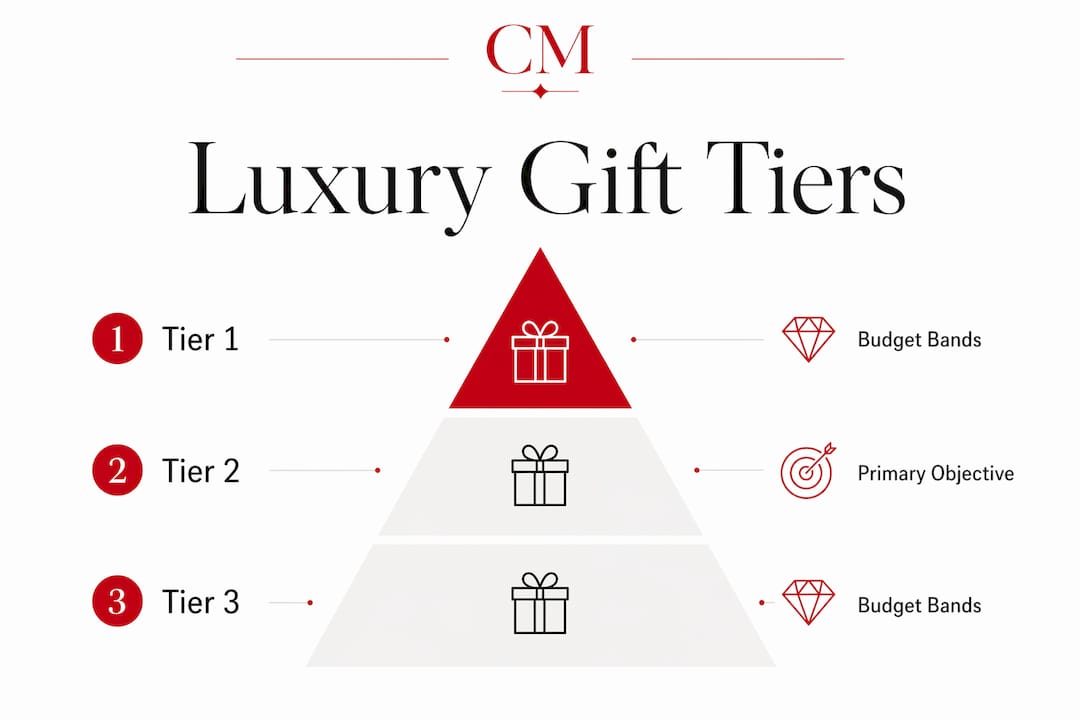
These tiered budget ranges reflect practitioner consensus for U.S. luxury programs. Tier 1 sends justify higher spend because the relationship ROI is measurable: a retained strategic account typically generates returns well above the gifting cost. Tier 3 gifts should still feel considered — a consistent tiered structure prevents visible quality drop-off that signals to mid-tier clients they are undervalued.
Move an account up a tier when it crosses a revenue threshold, a contract renewal, or a referral event. Approvals for Tier 1 sends should require sign-off from the account lead and a senior marketing manager — both to protect budget and to catch personalization errors before production.
When should you send an experience versus a physical luxury object?
The short answer: choose experience-adjacent gifts for emotional bonding and objects for daily brand presence. Use hybrid packages for high-impact milestones where both matter.
| Gift Type | Memorability | On-Brand Signal | Logistics | Privacy | Longevity |
|---|---|---|---|---|---|
| Experience | Very high | Strong, if curated | Complex | High risk | Fades without follow-up |
| Physical object | Moderate–high | Consistent | Manageable | Low risk | High (daily use) |
| Hybrid | Highest | Strongest | Most complex | Moderate | High |
Experience-adjacent gifts tied to shared memory or industry context outperform generic luxury items for established relationships. For fashion and luxury clients specifically:
- Private atelier or showroom appointment: ideal for Tier 1 buyers or press contacts; signals access and exclusivity
- Co-branded performance outerwear or accessories: strong for Tier 2 teams; generates repeated brand presence in daily use
- Curated lifestyle boxes (premium drinkware, artisanal goods, branded stationery): reliable for Tier 3 and re-engagement sends where personalization depth is limited
- Experiential production partnerships (curated client dinners, private previews): for milestone moments, working with a creative production partner like U LA LA can turn a gift into a full brand experience
Sustainable, well-made items raise program effectiveness because recipients keep and use them longer, which extends brand presence well past the delivery date.
How do you make a luxury gift feel genuinely personal?
Personalization is research-driven narrative design. The creative direction should emerge from what you learn about the recipient, not from browsing a catalog.
“Personalized gifts generate a measurable bonding response when recipients perceive genuine understanding — the psychological lift comes from the research, not the price tag. A $150 gift built on 60 minutes of recipient research will outperform a $500 catalog send almost every time.” — SalesRelief on deep personalization
Scale research intensity to recipient value:
- Tier 3 / minimum viable: 30–45 minutes — scan LinkedIn, recent press mentions, company news
- Tier 2 / standard: 60–90 minutes — add public speaking topics, team priorities, recent wins
- Tier 1 / C-suite deep: 2–4 hours — map career milestones, personal interests, cultural context, shared history with your brand
Once the research is done, build a one-paragraph narrative brief: what does this person care about, what moment in your relationship does the gift reference, and what should they feel when they open it? That brief drives every creative decision, from the item to the packaging insert. Subtle co-branding (debossed initials, tonal embroidery, laser engraving) and a handwritten note that references a specific shared moment are the two details that most reliably signal genuine attention. Luxury customer experience psychology confirms that perceived understanding, not price, drives the trust response.
How much should you budget, and what KPIs prove it worked?
Start with per-unit ranges anchored to the tier table above, then build program-level costs by multiplying unit cost by send volume and adding packaging, personalization, and fulfillment.
| Line Item | Tier 1 | Tier 2 | Tier 3 |
|---|---|---|---|
| Custom packaging | $30–$60 | — | — |
| Fulfillment / shipping | — | $15–$25 | $10–$15 |
| Total per unit | $200+ | $150–$200 | $75–$150 |
KPIs by measurement window:
- Short-term (0–30 days): reply rate to follow-up outreach, booked meetings, open rate on post-gift email
- Medium-term (30–90 days): renewal rate, NPS lift, referral introductions
- Attribution: run a matched control group — accounts that received gifts versus comparable accounts that did not — and measure renewal and meeting rates across both groups over one quarter
The operational checklist every gifting program needs
Packaging and delivery are part of the product. A gift that arrives late, in a damaged box, or with the wrong name on the insert destroys the luxury signal regardless of what is inside. Packaging integrity — material quality, finish consistency, and assembly — is often what determines whether a recipient registers the send as luxury at all.

Production timeline for custom luxury work:
Brief → recipient research → sample approval → artwork sign-off → production (allow 3–6 weeks for custom finishes) → quality control → fulfillment → delivery confirmation
Pre-send checklist:
- Confirm recipient names, titles, and delivery addresses (direct-to-recipient vs. office delivery)
- Artwork and personalization proofed by one designated approver
- Packaging inspected for finish consistency across all units
- Customs documentation prepared for any international sends
- Privacy protocol confirmed: no public announcement of individual gifts without recipient consent
- Fulfillment partner briefed on handling standards and delivery windows
U.S. tax note: Under IRS rules, business gifts are generally deductible up to $25 per recipient per year. Gifts above that threshold are not deductible as business gifts, though they may qualify under other categories. Confirm current rules with a qualified tax advisor for your specific situation.
Pro Tip: Order 10–15% above your confirmed send quantity for custom luxury programs. MOQ minimums on premium packaging often make small reorders prohibitively expensive, and having buffer stock protects against last-minute additions or damaged units.
What gifting mistakes actively damage client relationships?
The biggest errors are rushed sends, generic items, and heavy-handed branding. Hurried, generic gifting signals inattention and actively reduces perceived partnership value in high-stakes relationships.
- Spectacle over strategy: a visually impressive gift with no personal relevance reads as a budget flex, not a relationship investment. Fix: brief the creative against a specific recipient insight, not a price point.
- Oversized logos on personal items: a branded jacket with a large chest logo turns a gift into merchandise. Fix: use debossing, tonal embroidery, or a small interior label instead.
- Inconsistent packaging across recipients: if Tier 1 and Tier 2 sends arrive in the same box, the tier signal collapses. Fix: enforce distinct packaging standards per tier.
- Late delivery: missing a milestone date (contract anniversary, product launch, holiday window) signals the gift was an afterthought. Fix: build a 3-week buffer into every production timeline.
- Poor recipient research: sending a wellness box to someone who has publicly stated they dislike that category. Fix: minimum 30 minutes of research per recipient before any item is selected.
- Neglecting mid-tier accounts: concentrating all creative effort on Tier 1 while sending generic items to Tier 2 creates visible inconsistency. Fix: apply the tiered structure consistently so quality drop-off is never obvious.
Three ready-to-use templates for your gifting program
Templates reduce execution risk by forcing research-backed constraints before any vendor is briefed.
| Scenario | Objective | Creative Direction | Measurement | Follow-Up Script |
|---|---|---|---|---|
| Tier 1 renewal kit | Reinforce partnership ahead of contract renewal | Custom outerwear or leather accessory, debossed initials, handwritten note referencing a shared project win | Renewal signed within 60 days | “I wanted to make sure this arrived before our renewal conversation — [specific reference to project]. Looking forward to the next chapter.” |
| Post-pitch VIP prospect send | Convert a high-value prospect after a strong meeting | Curated lifestyle box (premium drinkware + artisanal item) tied to a detail from the pitch conversation | Meeting booked within 30 days | “Thought of you when I saw this — it reminded me of what you said about [specific topic from meeting]. Would love to continue the conversation.” |
| Tier 2 team appreciation | Recognize a project team after a major deliverable | Co-branded performance apparel or premium desk set, consistent packaging, team-addressed note | NPS score or reply rate within 30 days | “The whole team made this one feel easy. This is a small thank-you for the work — we’re already looking forward to the next one.” |
How do cultural background and personal preferences shape gifting choices?
Cultural context changes what a gift signals. In Japanese business culture, presentation and wrapping carry as much meaning as the item itself — a carelessly packaged gift can read as disrespectful regardless of its value. In many Middle Eastern contexts, alcohol-based gifts are inappropriate. German and Northern European clients often respond better to functional, high-quality objects than to overtly personal or sentimental gestures.
For U.S.-based luxury clients, the relevant variables tend to be personal rather than broadly cultural: dietary restrictions (for food and beverage gifts), lifestyle signals (fitness-oriented vs. home-focused), and professional identity (a creative director and a CFO at the same company may want entirely different things). The 60–90 minute research investment surfaces these details before they become mistakes.
Personal preference data should live in your CRM, updated after every meaningful client interaction. Flag dietary restrictions, known interests, and any previous gifts received. A client who received a premium whiskey set last year should not receive another one this year — variety signals ongoing attention.
How do you protect privacy when gifting high-profile clients?
High-profile recipients — executives, public figures, senior buyers at major fashion houses — often have gatekeepers, PR teams, and personal policies about receiving gifts. Sending directly to a home address without prior consent is a significant misstep. Always route Tier 1 sends through a confirmed business address or a named assistant unless the recipient has explicitly provided a personal address.
Never publicize individual gifts on brand social media or in press materials without written consent. The gift is a private signal of relationship value; turning it into a marketing asset without permission inverts the dynamic and can damage trust. For experience-based gifts (private dinners, atelier appointments), confirm attendance directly with the recipient or their assistant before any vendor is booked. Discretion is itself a luxury signal.
When should you work with an external vendor or consultant?
Bring in an external partner when internal capacity, vendor relationships, or creative expertise cannot meet the program’s quality standard. The threshold is usually one of three conditions: the send volume exceeds what the account team can research and brief individually, the creative requirement (custom manufacturing, experiential production) is outside in-house capability, or the program needs an independent audit to identify why response rates are low.
A good gifting consultant or creative production partner should be able to deliver: a recipient research template, a narrative brief format, a vetted vendor shortlist with MOQ and lead time data, and a fulfillment checklist. For experiential components, partners like U LA LA’s event production team can handle the logistics of curated client events that function as experience-adjacent gifts at scale.
When briefing any vendor, provide the tier structure, per-unit budget, packaging standards, personalization requirements, and delivery windows in writing before any samples are produced. Verbal briefs produce inconsistent results at the quality level luxury programs require.
Key Takeaways
A psychology-first, tiered gifting program that invests in recipient research and narrative design — not price or spectacle — produces the highest relationship movement and retention rates for luxury and fashion brand clients.
| Point | Details |
|---|---|
| Research before item selection | Invest 30–45 minutes minimum per recipient; 2–4 hours for C-suite targets to build a narrative brief. |
| Tier budgets by relationship value | Tier 1: $200+ per unit; Tier 2: $150–$200; Tier 3: $75–$150, with consistent packaging standards at every level. |
| Packaging is part of the product | Finish quality and assembly integrity determine whether a gift registers as luxury more than item price alone. |
| Track relationship movement | Measure reply rate and booked meetings within 30 days; renewal rate and NPS lift within 90 days. |
| Corradomanenti’s recommended next step | Run a 10-account pilot using the research-first approach with a matched control group to measure relationship movement before scaling. |
Why psychology is the only real differentiator in luxury gifting
Most gifting programs fail not because of budget, but because they skip the research and go straight to the catalog. The item becomes the strategy, which means the strategy is whoever had the best product photo that week.
What actually moves a high-value client relationship is the moment they open something and think: they paid attention. That response is not about price. Behavioral research is clear that personalized gifts generate a bonding response when the recipient perceives genuine understanding. The oxytocin effect is real, and it is triggered by evidence of attention, not by the weight of the box.
The practical implication is uncomfortable for teams under time pressure: you cannot shortcut the research phase. A 45-minute investment per recipient is the minimum viable threshold for a gift that does psychological work. Below that, you are sending a nice object, not a relationship signal.
The other thing most guides miss is that luxury gifting is a brand act, not just a relationship act. Every send communicates your judgment. A generic gift from a luxury brand tells the recipient that the brand’s standards stop at the product. A considered, discreetly branded, research-backed send tells them the brand’s standards extend to how it treats people. That is the signal worth investing in.
Work with Corradomanenti on your gifting program
Luxury gifting programs that actually move relationships require the same psychology-first discipline as any high-end brand strategy. Corradomanenti offers discrete consulting, campaign design, and turnkey vendor brief creation for fashion and luxury brands that want to build or audit a gifting program.
What Corradomanenti delivers: recipient research templates, narrative brief formats, vendor briefing documents, tier structure design, and fulfillment checklists calibrated to U.S. luxury program standards. The methodology draws directly from psychology-driven marketing principles applied to high-value client relationships.
To start, reach out through corradomanenti.it to discuss a pilot program or a program audit. A 10-account pilot with a control group is the fastest way to validate the approach against your existing gifting spend.
Useful sources
| Source | What it supports |
|---|---|
| SalesRelief: Research-Driven Executive Gifting | Research investment levels (30 min–4 hrs), personalization response rates, oxytocin/bonding psychology |
| Cyan Group: Luxury Corporate Gifts That Land | Packaging standards, subtle branding guidance, sustainable sourcing, perceived value signals |
| SOBO Concepts: What Gets Remembered | Experience-adjacent gifting, tier budget ranges ($75–$150 / $150+), spectacle vs. strategy |
| CustomMark: Corporate Gifting Playbook | Tiered structure rationale, budget bands by account type, brand consistency rules |
| Teak & Twine: Luxury Corporate Gift Ideas | Executive gifting examples, packaging execution, personalization tactics |
| Corradomanenti: Psychology-Driven Marketing | Methodology foundation: behavioral psychology applied to luxury client engagement |