

Standing out in the crowded world of luxury fashion means more than offering beautiful products or a storied heritage. Today’s European marketing managers face the challenge of claiming a distinctive space in the minds of affluent customers, where exclusivity and psychological value matter most. This guide explores the core principles of high-end brand positioning, revealing how psychology-driven strategies and organizational alignment create lasting prestige and customer loyalty.
Table of Contents
- Core Principles Of High-End Brand Positioning
- Psychological Drivers In Luxury Branding
- Types And Methods Of Premium Positioning
- Key Characteristics Of High-End Brands
- Risks, Pitfalls, And How To Avoid Them
Key Takeaways
| Point | Details |
|---|---|
| Unique Mental Space | High-end brands must establish a distinct position that resonates with customers, creating perceived value and exclusivity. |
| Credibility and Consistency | Every aspect of the brand experience must align with the positioning statement to build trust and enhance brand loyalty. |
| Focus on Target Segment | Successful luxury brands define and serve a specific niche rather than broad markets, ensuring tailored communication and service. |
| Monitor Market Dynamics | Brands must continuously evaluate their positioning against competitors and evolving consumer preferences to remain relevant. |
Core Principles of High-End Brand Positioning
High-end brand positioning isn’t about flashy marketing or premium price tags alone. It’s about occupying a unique mental space in your customers’ minds where they see genuine value and exclusivity.
When you position a luxury brand effectively, you’re answering one critical question: why should affluent consumers choose you over competitors? Strategically crafting a unique proposition that resonates with your target audience creates the psychological foundation for loyalty and premium pricing power.
Distinctiveness as Your Competitive Anchor
Your brand must occupy a specific, defensible position that competitors cannot easily replicate. This isn’t about being different for the sake of it—it’s about being meaningfully different in ways your audience cares about.
Consider what makes your European luxury brand distinct:
- Exclusive heritage or craftsmanship tradition
- Specific customer experience or service philosophy
- Particular lifestyle association or values alignment
- Unique product features or quality standards
When Hermès positions itself around artisanal craftsmanship, or when Brunello Cucinelli emphasizes humanistic capitalism, they’re claiming specific mental real estate. Competitors can’t occupy that same space without diluting their own positioning.
Distinctiveness without credibility is just noise. Your unique positioning only works if customers believe you actually deliver on your promise.
Credibility and Consistency: Building Belief
Credibility comes from aligning your entire organization behind your positioning statement. It’s not enough to say you’re exclusive—every touchpoint must reinforce this claim.
Consistency across these channels builds credibility:
- Customer service interactions and response times
- Visual identity, packaging, and retail environments
- Product quality standards and materials
- Communication tone and media selection
- Pricing strategy and distribution selectivity
When your brand says something, people must believe it because every interaction confirms it. This is where psychology enters the picture—consistent messaging reduces cognitive dissonance and builds trust.
Competitive Niche Focus
High-end positioning requires you to own a specific customer segment and market niche, not chase everyone with money. The most successful luxury brands are brutally selective about who they serve.
This means:
- Defining your ideal customer with precision (not just “wealthy people”)
- Understanding their specific needs, aspirations, and pain points
- Communicating only to this segment through appropriate channels
- Turning away customers who don’t fit your positioning
Simplifying your value proposition makes this easier. When you try to appeal to multiple niches, your message becomes diluted and loses power.
Alignment Across All Functions
Examples of premium positioning show that successful luxury brands align product development, pricing, distribution, hiring, and customer service around their positioning.
Every department must understand and reinforce the brand positioning:
- Product teams ensure quality and exclusivity standards
- Pricing teams maintain price positioning relative to competitors
- Sales teams enforce distribution selectivity
- HR teams hire staff who embody brand values
Misalignment happens when different departments optimize locally without considering brand positioning. A customer service failure can destroy years of positioning work.
Positioning isn’t a marketing document—it’s an organizational operating system. Every decision should reinforce your unique position.
Pro tip: Audit your entire organization quarterly to identify misalignments between what you claim in your positioning and what customers actually experience across touchpoints.
Psychological Drivers in Luxury Branding
Luxury purchases aren’t rational decisions driven by product quality alone. Customers buying high-end brands are satisfying deep psychological needs—status, identity, belonging, and emotional fulfillment.
Understanding what motivates your customers psychologically is the difference between creating a brand people need and creating one they’re emotionally attached to. Psychological factors influence luxury consumption in ways that traditional marketing often overlooks.
To better understand luxury customers, below is a summary of their key psychological motivators:
| Psychological Driver | How It Influences Purchase | Impact on Brand Relationship |
|---|---|---|
| Status/Social Signaling | Demonstrates success | Fosters exclusivity and prestige |
| Identity/Self-Expression | Reinforces personal values | Strengthens emotional connection |
| Emotional Attachment | Provides pleasure and reward | Generates long-term loyalty |
| Exclusivity/Control | Offers insider access | Increases perceived brand value |
Status and Social Signaling
Status seeking is one of the most powerful drivers in luxury consumption. Your customers aren’t just buying a product—they’re buying a signal to themselves and their social circles.
When someone purchases a luxury item, they’re communicating:
- Affluence and financial success
- Refined taste and cultural sophistication
- Membership in an exclusive social group
- Achievement and personal accomplishment
This isn’t shallow. Status signaling fulfills legitimate psychological needs. It helps people confirm their identity, build confidence, and feel connected to communities they aspire to join.
Status isn’t the villain in luxury branding—it’s the oxygen. Deny your customers the status benefit, and you’ve stripped away half your brand’s psychological power.
Self-Expression and Identity Construction
Luxury brands are identity tools for your customers. Through their purchases, they’re answering the question: “Who am I?”
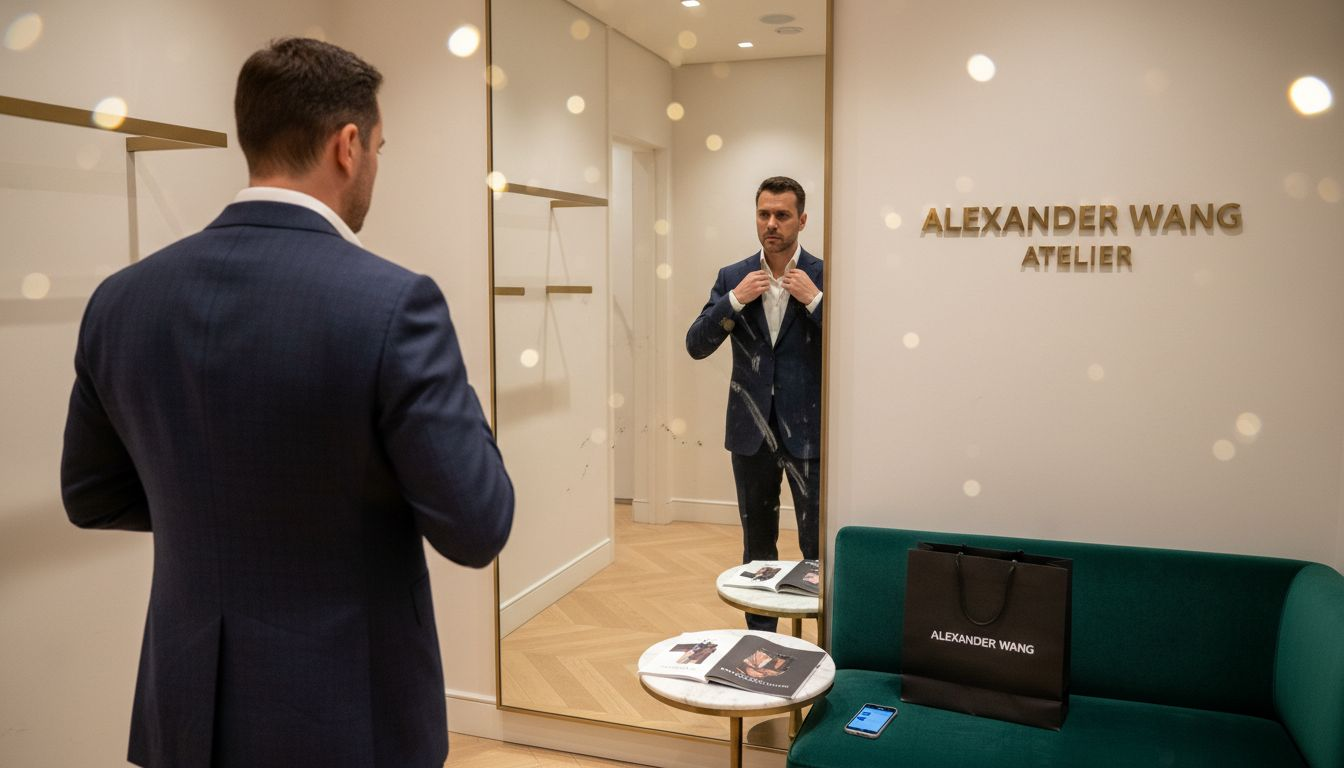
When a customer chooses your brand over competitors, they’re selecting the identity narrative your brand represents. A Hermès customer isn’t just buying a bag—they’re choosing to express themselves as someone who values heritage and artisanal quality.
This self-expression operates at multiple levels:
- Personal identity: Confirming how they see themselves
- Social identity: How they want others to perceive them
- Aspirational identity: Who they’re becoming or want to become
Premium branding examples demonstrate how successful luxury brands align their positioning with the identity their customers want to express.
Emotional Attachment and Hedonistic Satisfaction
Emotional connection transforms a transaction into a relationship. Luxury customers crave emotional satisfaction—the feeling of joy, pleasure, and fulfillment that comes from owning something beautiful.
Hedonistic benefits matter profoundly in luxury markets. Your customers want to:
- Experience sensory pleasure (touch, sight, smell, sound)
- Feel authentic enjoyment and happiness
- Create meaningful memories and experiences
- Reward themselves emotionally
This is why unboxing experiences, product design, and even the sound of opening a luxury item matter. You’re not just selling function—you’re selling psychological and sensory gratification.
Exclusivity and Perceived Control
Exclusivity triggers deep psychological responses. When something is rare, limited, or difficult to access, it becomes more psychologically valuable.
Your customers want to feel they have intimate knowledge of your brand—that they’ve discovered something special few others possess. This perceived control and insider status strengthens emotional investment.
Limited editions, invitation-only events, and selective distribution aren’t just marketing tactics. They’re psychological levers that increase desire and perceived value.
Scarcity creates psychological weight. Make your brand accessible to everyone, and you’ve eliminated the exclusivity driver that sustains premium pricing.
Pro tip: Map your specific customer’s psychological drivers through one-on-one interviews and behavioral observation, then ensure every brand touchpoint reinforces the identity and status benefits they seek.
Types and Methods of Premium Positioning
Not all premium positioning strategies are created equal. Different luxury brands use different approaches depending on their market, customer base, and competitive landscape.
Understanding the main positioning types helps you choose the right strategy for your brand. Positioning strategies leverage unique strengths and market opportunities to occupy distinctive spaces in consumer minds.
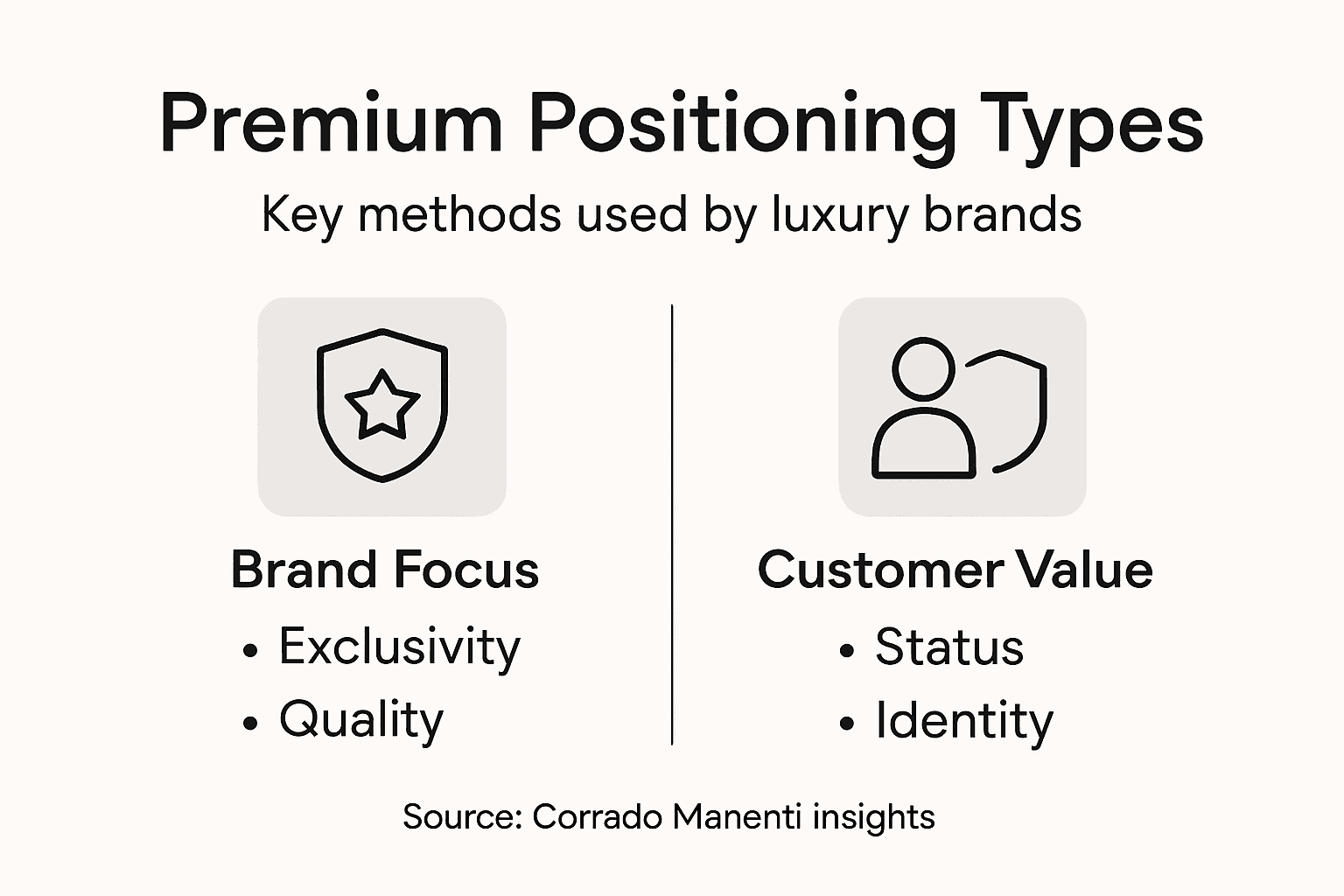
Here’s a comparison of premium positioning methods and their strategic value:
| Positioning Method | Main Focus | Strategic Benefit | Typical Business Impact |
|---|---|---|---|
| Competition-Based | Differentiation from rivals | Highlights unique advantages | Drives customer comparison |
| Perception-Based | Mental territory ownership | Builds emotional association | Encourages brand loyalty |
| Differentiation-Based | Unique offerings | Emphasizes specific attributes | Justifies premium pricing |
| Mind-Based | Distinct psychological space | Creates deep emotional bond | Enhances customer advocacy |
Competition-Based Positioning
Competition-based positioning means you define your brand relative to competitors. You’re answering: “What makes us different from them?”
This approach works when:
- Your market has established competitors with clear positioning
- You have demonstrable advantages over rivals
- Customers actively compare brands when making decisions
- Price or feature differentiation matters
For example, a luxury Italian leather brand might position itself against French competitors by emphasizing heritage, artisanal methods, and regional authenticity. You’re directly contrasting your strengths against their weaknesses.
This method requires constant competitive monitoring. As competitors evolve, your positioning must adapt to maintain relevance.
Perception-Based Positioning
Perception-based positioning focuses on occupying a specific mental territory regardless of what competitors do. You’re building an image and emotional association independent of competitive comparison.
Instead of saying “we’re better than them,” you’re saying “we own this feeling or identity.” A brand might position itself as the ultimate expression of minimalist luxury or as the guardian of traditional craftsmanship.
This approach is powerful because:
- You control the narrative rather than reacting to competitors
- Emotional associations are harder for competitors to copy
- You can command premium pricing through perception alone
- Brand loyalty becomes based on identity, not comparison
Perception-based positioning is about owning mental real estate, not winning battles. Your customer chooses you because of who they become when they wear your brand, not because your features beat someone else’s.
Differentiation-Based Positioning
Differentiation positioning emphasizes what makes your offering uniquely valuable. You highlight specific attributes, benefits, or experiences competitors cannot replicate.
Differentiation dimensions for luxury brands include:
- Heritage and storytelling
- Exclusive materials or manufacturing processes
- Personalization and customization services
- Experiential retail or customer relationships
- Sustainability and ethical practices
- Limited availability and scarcity
The strength of differentiation positioning lies in its specificity. You’re not vaguely “premium”—you’re concretely different in ways customers value.
Mind-Based Positioning
Mind-based positioning is about occupying a distinctive place in consumer psychology. You’re positioning in how people think, not in the marketplace.
This might mean:
- Being the “innovative” luxury brand when others are traditional
- Being the “accessible” luxury option
- Being the “rebellious” or “disruptive” luxury player
- Being the “sustainable” or “conscious” luxury choice
Building brand loyalty in luxury requires mind-based positioning that creates emotional investment beyond transactional relationships.
Choosing Your Positioning Method
The most successful luxury brands often blend multiple approaches. They compete on specific attributes while owning emotional territory that feels unique to their customers.
Your positioning method should align with:
- Your authentic brand strengths
- Your target customer’s decision criteria
- Your competitive context
- Your long-term brand vision
Pro tip: Test your positioning by asking 10 target customers to describe your brand versus competitors using only 3-5 words—their natural language reveals whether your positioning is actually landing or remaining invisible.
Key Characteristics of High-End Brands
High-end brands share common traits that distinguish them from mainstream competitors. Understanding these characteristics helps you identify what makes a brand genuinely luxury versus simply expensive.
High-end brands are characterized by exclusivity, superior craftsmanship, and heritage, serving as status symbols for affluent consumers seeking quality and prestige. These aren’t random features—they’re the foundation of luxury brand success.
Exclusivity and Rarity
Exclusivity is the oxygen of luxury branding. Your brand must be rare, difficult to access, and not available to everyone with money.
Exclusivity operates on multiple levels:
- Limited production quantities and scarcity
- Selective distribution through specific retailers
- High price barriers that naturally limit the customer base
- Membership or invitation-only access
- Waiting lists and allocation systems
When a product becomes too accessible, it loses its luxury status. This is why luxury brands fiercely protect their distribution channels and maintain strict pricing discipline across markets.
Superior Craftsmanship and Quality
Craftsmanship isn’t negotiable in high-end brands. Your customers can feel the difference in materials, construction, and attention to detail.
This means:
- Premium materials sourced from the finest suppliers
- Exceptional manufacturing processes and techniques
- Rigorous quality control standards
- Skilled artisans and technical expertise
- Investment in durability and longevity
Luxury customers aren’t just buying a product—they’re buying evidence of care, skill, and uncompromising standards. A poorly made luxury item is a contradiction in terms.
Quality is non-negotiable because it’s the only thing that justifies premium pricing when customers actually use your product. Your brand’s reputation depends on delivering excellence at every touchpoint.
Heritage and Authenticity
Heritage gives your brand a story and emotional weight. Consumers connect with brands that have deep roots, historical significance, and authentic origins.
Heritage communicates:
- Longevity and staying power in competitive markets
- Accumulated knowledge and expertise over decades
- Cultural or regional authenticity
- Family legacy or founding story
- Evolution while maintaining core values
Exclusivity in branding strengthens luxury value when combined with authentic heritage that customers believe and respect.
Exceptional Customer Experience
High-end brands obsess over customer experience at every interaction. From discovery through post-purchase, every moment matters.
This includes:
- Personalized service and attention
- Expert product knowledge and consultation
- Exceptional after-sales support and warranties
- Exclusive events and VIP experiences
- Responsive and attentive communication
A single poor customer service interaction can damage years of brand building. Your sales associates, customer service teams, and delivery personnel are brand ambassadors.
Compelling Brand Identity and Story
High-end brands don’t just make products—they craft compelling narratives that customers want to be part of.
Your brand identity should include:
- Clear brand values and philosophy
- Distinctive visual identity and aesthetic
- Founder or brand story that resonates
- Consistent messaging across all channels
- Authentic emotional connection with customers
When customers understand and believe your story, they become brand advocates rather than transactional buyers.
Pro tip: Document your brand’s core values, heritage story, and brand promise, then audit every customer touchpoint to ensure alignment—even small inconsistencies erode the luxury perception you’ve built.
Risks, Pitfalls, and How to Avoid Them
Brand positioning is powerful, but it’s also fragile. One misstep can confuse customers, dilute your equity, or damage years of careful positioning work.
Understanding common pitfalls helps you protect your brand investment. Brand positioning faces risks including market saturation and misalignment between identity and consumer perception, requiring continuous alignment and differentiation.
The Overextension Trap
Overextension happens when you try to be everything to everyone. You launch sub-brands, enter new markets, or introduce product lines that contradict your core positioning.
This destroys positioning because:
- Your message becomes diluted and confusing
- Customers struggle to understand what you actually stand for
- Premium positioning weakens when you chase volume
- Brand equity spreads thin across too many categories
Luxury brands that attempted mass-market expansion often saw significant brand damage. When you’re positioned as exclusive, becoming accessible is repositioning—and customers notice.
The Authenticity Disconnect
Authenticity gaps emerge when your marketing claims diverge from actual customer experience. You promise heritage craftsmanship but outsource production to low-cost regions. You claim sustainability but use questionable materials.
This happens because:
- Marketing teams oversell while operations lag behind
- Cost pressures force compromises on quality standards
- Brand messaging doesn’t align with actual practices
- Customers discover inconsistencies through social media
When authenticity gaps surface, they destroy trust faster than anything else. One viral post showing your “handmade” bag being mass-produced eliminates your positioning overnight.
Authenticity is non-negotiable in luxury positioning. Your brand promise must match your actual delivery, or positioning becomes liability instead of asset.
Neglecting Competitive Defense
Weak positioning defense allows competitors to copy your space or make you irrelevant. You establish a position but fail to continuously defend it against imitation.
Common defense failures:
- Ignoring competitor moves and market shifts
- Allowing others to own your positioning space
- Failing to evolve while maintaining core values
- Losing distinctiveness through superficial differentiation
- Stopping communication and reminder efforts
Positioning requires active defense. Your competitors are trying to steal your mental real estate. Constant monitoring, innovation, and communication keep your position protected.
The Consistency Collapse
Inconsistent messaging confuses customers about who you are. Your retail experience contradicts your digital brand. Sales teams pitch different value propositions than your advertising.
This happens when:
- Different departments operate without positioning alignment
- Brand guidelines exist but aren’t enforced
- Customer touchpoints evolve independently
- Visual identity and messaging drift over time
Consistency across all channels is mandatory for positioning to work. Creating unique and favorable positions requires clarity and consistency in messaging, visual identity, and customer experience.
Ignoring Market Evolution
Static positioning fails when consumer values shift. You maintain yesterday’s positioning instead of adapting to today’s consumer priorities.
This creates vulnerability when:
- Generational preferences change (sustainability, ethics, transparency)
- Technology reshapes how customers interact with brands
- Social movements demand brand responsiveness
- Competitor innovations make your positioning feel dated
Dynamic adaptation doesn’t mean abandoning your position—it means evolving how you express core values to remain relevant.
Pro tip: Conduct quarterly positioning audits comparing your stated positioning against actual customer perceptions, competitor moves, and market shifts—then address gaps before they become crises.
Elevate Your Luxury Brand with Psychology-Driven Positioning
The challenge high-end brands face today is not just being different but becoming distinctively memorable in their customer’s mind. Your brand must deliver consistent exclusivity, emotional attachment, and authentic identity to win loyalty and premium pricing as highlighted in “High-End Brand Positioning: Psychology and Impact.” If you struggle with aligning these psychological drivers and organizational consistency, you are not alone.
At Corrado Manenti, we specialize in turning these complex challenges into your strongest competitive advantages. Through Psychology-Driven Marketing, we analyze why your customers behave the way they do—going beyond surface preferences to design campaigns that foster deep emotional bonds while protecting your brand’s exclusivity. Our Fashion and Luxury Consulting ensures that every detail from craftsmanship storytelling to customer experience reflects authentic luxury positioning.
Take control of your brand’s mental space now by partnering with an expert who understands both the nuances of luxury markets and the power of psychological insights. Visit https://corradomanenti.it to discover how to transform your brand into the unique, credible, and emotionally compelling luxury it deserves to be.
Frequently Asked Questions
What are the core principles of high-end brand positioning?
The core principles include occupying a unique mental space in the customers’ minds, creating a distinctive and defensible position that highlights genuine value and exclusivity. Effective positioning answers why affluent consumers should choose your brand over competitors.
How does consistency impact luxury brand credibility?
Consistency across all customer touchpoints reinforces a brand’s credibility. When visual identity, product quality, service interactions, and communication align with the brand’s positioning, customers are more likely to trust that the brand delivers on its promises.
Why is understanding psychological drivers important in luxury branding?
Understanding psychological drivers, such as status, self-expression, and emotional attachment, allows brands to better connect with customers. This deep understanding helps create a brand that resonates on an emotional level, leading to loyalty and advocacy.
What common pitfalls should luxury brands avoid in their positioning?
Common pitfalls include overextension, authenticity disconnect, weak competitive defense, inconsistency in messaging, and neglecting market evolution. Brands should continuously monitor their positioning and align their offerings with customer expectations to avoid these risks.