


Luxury fashion houses face a constant challenge: deeply understanding what truly motivates premium buyers. Every data point matters when exclusivity and emotional resonance drive customer loyalty. By leveraging advanced psychological profiling and integrating comprehensive digital data collection, you unlock the power of precise buyer personas. This approach reveals why your consumers make purchasing decisions, offering actionable insights to elevate engagement strategies for the most discerning clientele.
Table of Contents
- Step 1: Define Buyer Personas Using Psychological Profiling
- Step 2: Gather Data Through Targeted Digital Channels
- Step 3: Interpret Purchase Motivations With Behavioral Analytics
- Step 4: Segment Audiences Based on Actionable Insights
- Step 5: Validate Findings By Testing Engagement Strategies
Quick Summary
| Key Point | Explanation |
|---|---|
| 1. Develop nuanced buyer personas | Create detailed profiles to understand luxury consumers beyond basic demographics and capture their motivations. |
| 2. Implement comprehensive data collection | Utilize multiple digital channels to gather rich behavioral data that informs consumer insights and marketing strategies. |
| 3. Employ behavioral analytics | Use advanced techniques to decode emotional and rational drivers behind luxury purchase decisions for deeper understanding. |
| 4. Segment audiences effectively | Analyze complex psychological and behavioral characteristics for precise audience segmentation and targeted marketing. |
| 5. Validate marketing strategies through testing | Use controlled experiments to confirm the effectiveness of consumer insights and refine engagement approaches. |
Step 1: Define buyer personas using psychological profiling
Creating precise buyer personas is a critical strategy for luxury brands seeking to understand their target audience at a deeper psychological level. By developing nuanced profiles that go beyond basic demographics, you can craft marketing strategies that truly resonate with your high-end consumers.
To build comprehensive buyer personas, begin by collecting rich customer behavioral data through multiple channels. This means integrating insights from:
- Digital interaction tracking
- Purchase history analysis
- Social media engagement metrics
- Customer survey responses
- Direct interview feedback
The goal is to construct multidimensional profiles that reveal not just who your customers are, but why they make specific purchasing decisions. Psychological profiling allows you to map out complex motivational structures, understanding the deeper emotional drivers behind luxury consumption.
Effective buyer personas transform generic market research into targeted, psychologically informed marketing strategies.
Focus on capturing psychographic dimensions such as lifestyle preferences, aspirational values, personal motivations, and emotional triggers. These elements reveal far more about potential buyers than traditional demographic segmentation.

Here’s a summary of psychological profiling dimensions relevant for luxury buyer personas:
| Dimension | Description | Business Impact |
|---|---|---|
| Lifestyle Preferences | Choices reflecting daily habits and tastes | Targeted product and content design |
| Aspirational Values | Desired status and long-term goals | Positioning for exclusivity and prestige |
| Emotional Triggers | Feelings that prompt purchase decisions | Creation of compelling brand stories |
| Personal Motivations | Deep personal reasons driving interest | Tailored messaging and engagement |
Pro tip: Always validate your buyer personas through ongoing research and periodic recalibration to ensure they remain accurate and relevant to your evolving luxury market segment.
Step 2: Gather data through targeted digital channels
Successfully capturing insights about luxury brand consumers requires a strategic approach to data collection across multiple digital platforms. Understanding how to effectively harvest and analyze digital data will transform your marketing intelligence and consumer understanding.
Begin by implementing comprehensive digital data collection methods that provide rich, multidimensional consumer insights. Your data gathering strategy should encompass:
- Social media platform analytics
- Website behavior tracking
- Email engagement metrics
- Customer interaction logs
- Digital survey responses
- Mobile app usage patterns
Each digital channel offers unique perspectives into consumer behavior. Advanced tracking technologies enable you to map intricate consumer journeys, revealing motivations and preferences that traditional research methods might miss.
Digital data collection represents the cornerstone of modern luxury brand consumer intelligence.
Focus on collecting qualitative and quantitative data that provide holistic insights. Integrate advanced tracking tools that capture nuanced behavioral signals, such as time spent on specific product pages, interaction frequency, and emotional engagement indicators.
Pro tip: Invest in robust data privacy protocols and transparent consent mechanisms to ensure ethical data collection while maintaining consumer trust.
Step 3: Interpret purchase motivations with behavioral analytics
Delving into the psychological landscape of luxury consumer behavior requires sophisticated analytical techniques that go beyond surface-level demographic insights. Consumer purchase intention modeling offers a nuanced approach to understanding the complex emotional and rational drivers behind luxury purchasing decisions.
To effectively decode consumer motivations, luxury brands must examine multiple dimensions of behavioral data:
- Emotional response tracking
- Time-based purchase patterns
- Context of interaction
- Psychological trigger points
- Aspirational value assessments
- Decision-making hesitation indicators
Advanced analytics transform raw data into meaningful insights by identifying underlying psychological patterns. These insights reveal not just what consumers buy, but why they make specific purchasing choices.
Behavioral analytics decode the intricate emotional landscape that drives luxury consumer decisions.
Successful interpretation requires connecting quantitative metrics with qualitative emotional signals. Track indicators like engagement duration, revisit frequency, and comparative product exploration to understand the deeper narrative behind each consumer interaction.
Pro tip: Develop a holistic analytics framework that balances statistical rigor with empathetic interpretation, allowing you to see beyond numbers and understand the human story.
Step 4: Segment audiences based on actionable insights
Transforming raw customer data into meaningful audience segments requires a strategic approach that goes beyond traditional demographic categorization. Algorithmic customer segmentation methodologies provide luxury brands with sophisticated techniques for identifying high-value consumer groups.
Effective audience segmentation involves analyzing multiple behavioral dimensions:
- Purchase frequency and value
- Engagement intensity
- Emotional response patterns
- Brand loyalty indicators
- Lifestyle preferences
- Digital interaction metrics
Advanced segmentation techniques enable you to create nuanced audience profiles that reveal deeper insights into consumer motivations. By understanding the unique characteristics of each segment, you can develop highly targeted marketing strategies.
Precision in audience segmentation transforms generic marketing into personalized consumer experiences.
Luxury brands must move beyond surface-level demographics to construct segments that reflect complex psychological and behavioral characteristics. Utilize machine learning algorithms and predictive analytics to continuously refine and update your audience understanding.
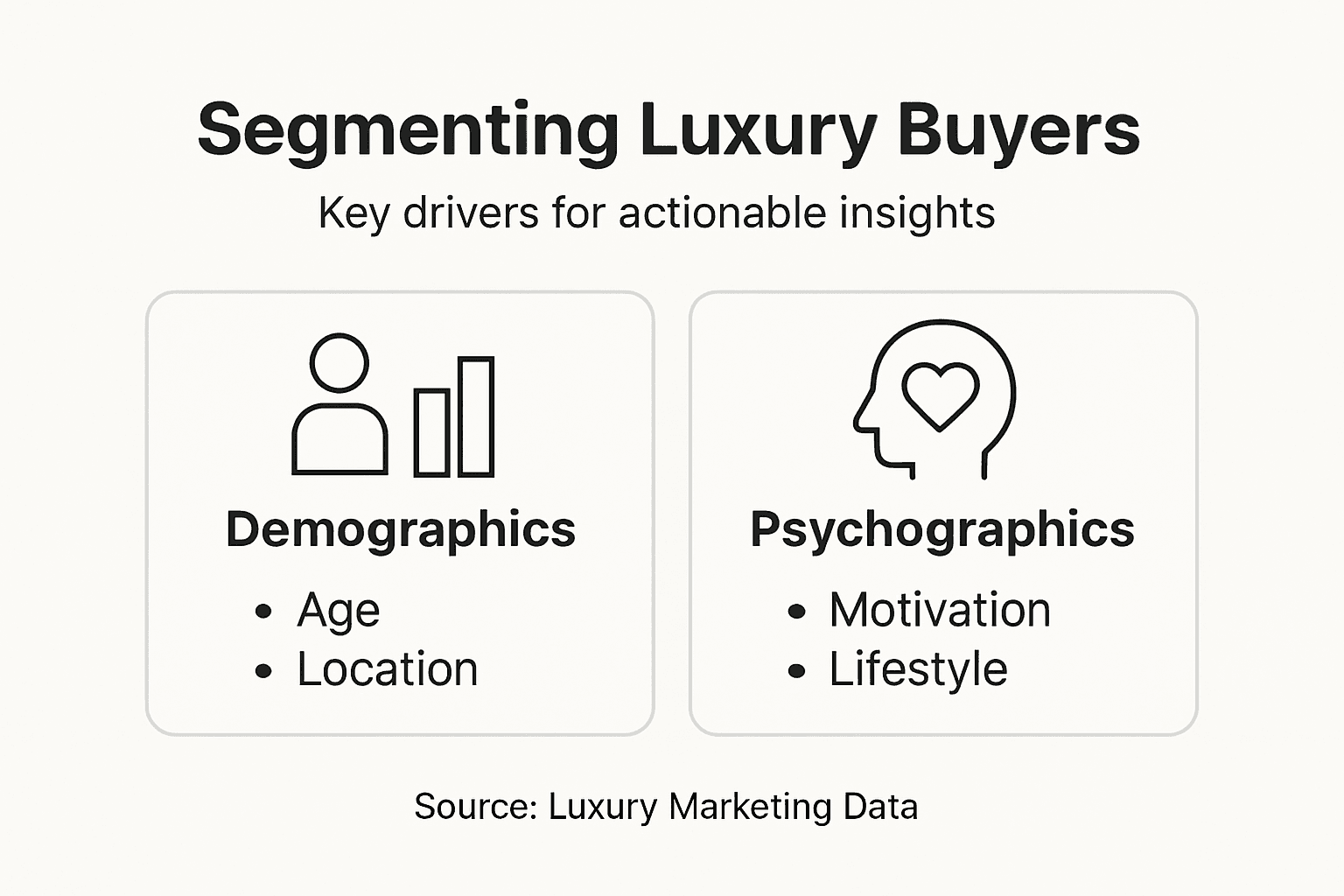
Compare key audience segmentation approaches for luxury brands:
| Segmentation Method | Data Used | Level of Precision | Ideal Use Case |
|---|---|---|---|
| Demographic Segmentation | Age, income, gender | Basic | Broad campaigns |
| Behavioral Segmentation | Actions, interactions | Moderate to advanced | Retention and loyalty efforts |
| Psychographic Segmentation | Values, motivations | Very high | Personalized experiences |
Pro tip: Implement a dynamic segmentation model that adapts in real-time, allowing your marketing strategies to evolve alongside changing consumer behaviors.
Step 5: Validate findings by testing engagement strategies
Confirming the effectiveness of your consumer insights requires a systematic approach to engagement strategy validation. Luxury brands must move beyond theoretical analysis to empirically test their marketing hypotheses through controlled experimental methods.
Design your engagement validation process using multiple strategic approaches:
- A/B testing of marketing messaging
- Controlled campaign variations
- Targeted segment response tracking
- Conversion rate analysis
- Emotional response measurement
- Longitudinal engagement studies
Experimental validation techniques allow you to transform theoretical consumer insights into actionable marketing strategies. By rigorously testing your segmentation hypotheses, you can refine your understanding of customer behavior with statistical precision.
Validated engagement strategies bridge the gap between consumer research and marketing performance.
Successful validation requires creating controlled experimental environments that isolate specific behavioral variables. Utilize advanced analytics tools to measure nuanced responses and track incremental changes in customer interaction patterns.
Pro tip: Implement a continuous learning framework that treats each marketing campaign as a research opportunity, systematically documenting insights and iteratively improving your engagement approach.
Unlock the True Potential of Your Luxury Brand with Psychology-Driven Marketing
Understanding buyer behavior is the key challenge luxury brands face when striving to create meaningful consumer connections. This article highlights how psychological profiling, behavioral analytics, and dynamic audience segmentation reveal the deep emotional triggers and personal motivations behind your customers’ purchase decisions. However, translating this complex data into actionable marketing strategies requires expert guidance that combines academic insight and real-world luxury experience.
At Corrado Manenti, we specialize in integrating psychology and marketing to craft campaigns that not only attract but truly resonate with your target audience. Our approach addresses the pain points of fluctuating engagement and unclear customer motivations by offering:
- In-depth analysis of consumer psychology tailored for luxury and fashion brands
- Meticulous branding and experiential marketing consistent with your premium image
- Cutting-edge digital strategies that keep your brand ahead of evolving market trends
Ready to convert buyer behavior insights into impactful marketing tactics that drive results? Visit Corrado Manenti today to discover how a psychology-driven strategy can elevate your luxury brand presence and create an emotional connection that lasts. Don’t wait—unlock your brand’s full potential now.
Frequently Asked Questions
What are the key dimensions to consider when analyzing buyer behavior for luxury brands?
Understanding buyer behavior for luxury brands requires focusing on several key dimensions, including lifestyle preferences, aspirational values, emotional triggers, and personal motivations. Start by collecting data on these dimensions to develop nuanced buyer personas that reflect the deeper reasons behind consumer purchasing decisions.
How can I gather actionable data about luxury brand consumers?
To gather actionable data, implement comprehensive digital data collection methods across various platforms, such as social media analytics and website behavior tracking. Begin by analyzing interactions and engagement metrics, which can provide rich insights into consumer preferences within 30 days.
What methods should I use to interpret consumer purchase motivations?
You can interpret consumer purchase motivations by employing behavioral analytics that examine emotional responses and purchasing patterns. Start by tracking emotional engagement and purchase hesitation indicators to uncover the underlying reasons why customers choose luxury items.
How can I effectively segment audiences based on buyer behavior insights?
Effective audience segmentation can be achieved by analyzing factors like purchase frequency, emotional response patterns, and brand loyalty indicators. Begin by utilizing algorithmic customer segmentation techniques to create detailed profiles that can guide your marketing strategies and improve targeting accuracy.
What is the importance of testing engagement strategies in buyer behavior analysis?
Testing engagement strategies is crucial as it helps validate your consumer insights and evaluates marketing effectiveness. Use controlled experimental methods, such as A/B testing, to refine your strategies, aiming for measurable improvements in engagement rates within a few campaign cycles.
Recommended
- Consumer Behavior Analysis: Complete Guide for Luxury Brands – Corrado Manenti
- Optimizing Consumer Behavior Analysis Workflow for Luxury Brands – Corrado Manenti
- Consumer Behavior Analysis: Complete Guide for Luxury Brands – Corrado Manenti
- How to Analyze Consumer Behavior for Luxury Brands – Corrado Manenti
- Lus Hair Care: Transforming Hair Through AI Insights | MyHair