

TL;DR:
- Digital storytelling in fashion involves creating immersive visual narratives that enhance brand identity and foster consumer engagement across digital platforms. Effective arcs are typically structured over two to three weeks, utilizing platform-native formats like Reels, with a focus on emotional credibility through protagonists, tension, and proof. Brands succeed by integrating creators as narrative engines, leveraging AI for rapid testing, and measuring performance phase-by-phase to optimize storytelling impact.
Digital storytelling in fashion is the deliberate craft of building immersive, visually driven narratives across digital platforms that amplify brand identity and deepen consumer connection from teasers to behind-the-scenes reveals. This guide to digital storytelling in fashion covers the full workflow: how to structure narrative arcs, which platform formats perform best in 2026, how to build emotional credibility, and how to measure what actually works. Brands like Louis Vuitton have already moved beyond product photography into phygital storytelling that blends physical and digital experiences to engage younger audiences. Tools like Superdirector, Instagram Reels, and Meta’s native video formats are the infrastructure. Your narrative strategy is the engine.
What is a guide to digital storytelling in fashion?
Digital storytelling in fashion is a structured, multi-format narrative process. It combines visual design, platform-native content, and brand world-building to move audiences from awareness to emotional investment. The distinction from traditional content marketing is intentionality: every asset, from a three-second fabric close-up to a 60-second runway-to-street video, serves a defined role in a larger story arc.
The most effective fashion storytelling does not treat “theme” as narrative. Emotional resonance grows from immersive cohesion achieved through visual and storytelling craft, not from a mood board alone. A collection built around “freedom” needs to express that through drape, lighting, movement, and character, not just a caption. This is the gap most fashion brands fail to close.
Luxury storytelling takes this further. Luxury brand storytelling equals world-building, offering audiences a cultural space to engage beyond product features. Louis Vuitton does not sell bags in its digital content. It sells belonging to a specific cultural moment. That distinction is what separates brands that generate reach from brands that generate loyalty.
For fashion marketers and brand strategists, the practical implication is clear: digital storytelling requires a content architecture, not just a posting schedule. You need a defined narrative spine, platform-specific formats, and a feedback loop that tells you what is resonating and why.
How to structure a digital storytelling arc for a fashion collection
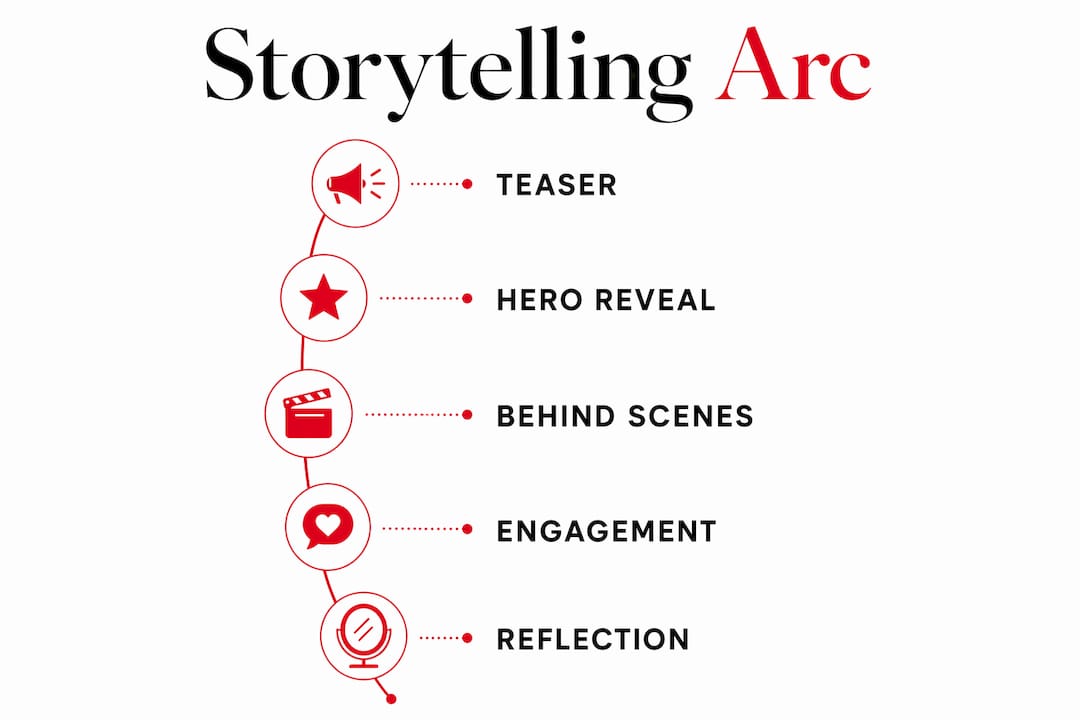
A fashion storytelling arc works best as a short narrative spanning two to three weeks, built in three phases: teaser, hero reveal, and behind-the-scenes. Each phase serves a distinct psychological function. Teasers create anticipation. The hero reveal delivers the payoff. Behind-the-scenes content builds trust and extends the emotional life of the collection after the launch peak.
Superdirector specifies that choreography for transitions and shot framing must be pre-planned to avoid arbitrary edits, which directly boosts watch time and engagement. This is not a creative preference. It is a production discipline. Brands that plan shot lists in advance reduce costly reshoots and maintain narrative causality across the arc.
Here is a practical three-phase workflow for a collection launch:
- Week one (teaser phase): Post two to three short clips featuring fabric textures, silhouette shadows, or partial reveals. Keep each under ten seconds. The goal is curiosity, not information.
- Week two (hero reveal): Release the primary lookbook video or Reels series. Use outfit swap transitions, runway-to-street archetypes, or model-in-context storytelling. This is your highest-production asset.
- Week three (depth phase): Publish behind-the-scenes content, designer commentary, and creator-led interpretations. This phase extends engagement and feeds the algorithm with fresh signals after the launch spike.
Scheduling matters as much as content. Distribution windows for fashion content on Instagram and TikTok favor Tuesday through Friday, with peak engagement between 11 a.m. and 2 p.m. in your primary audience’s time zone. Plan your arc around these windows, not around your internal production calendar.
Pro Tip: Pre-plan your match cuts and reveal transitions in your shot list before filming. Separating movement-driven transitions from static visuals is the single most effective way to maximize watch time without increasing production budget.
What digital storytelling techniques resonate best on social platforms in 2026
Platform-native storytelling is not about repurposing content. It is about engineering content for the specific behavioral context of each platform. On Instagram Reels, 7 to 15 second videos with fast hooks within the first 1.5 seconds outperform longer, more polished formats. Near-static images underperform regardless of production quality. Motion is the minimum requirement.
The three creative archetypes that consistently drive performance on Reels are:
- Pattern interrupt: An unexpected visual or audio shift in the first second that stops the scroll. Examples include a sudden color change, a model breaking the fourth wall, or a sound that contrasts with the visual.
- Demonstration: Showing the product in use, in context, or in transformation. Outfit swaps, fabric drape reveals, and styling sequences all fall into this category.
- Social proof: Real reactions, creator testimonials, or community content that signals external validation. This archetype performs particularly well for new collections entering a skeptical audience.
Multi-format consistency is the distribution strategy that ties these archetypes together. Posting five to seven times weekly across formats drives measurable engagement and sales, with Reels carrying dynamic styling content, carousels serving lookbook and educational roles, and Stories handling real-time interaction and limited-time offers.
For production efficiency, AI-generated UGC matched or outperformed real-creator UGC on Instagram Reels in 60% of tests, and it accelerates iteration speed significantly. This means fashion brands can test multiple narrative angles in the time it previously took to produce one polished asset. The strategic implication: volume and iteration are now competitive advantages, not just creative luxuries.
Pro Tip: Use AI-generated UGC for rapid testing of hooks and archetypes, then invest production resources into the formats and narratives that your data confirms are working. Test fast, then polish what wins.
The Instagram Reels algorithm in 2026 ranks content primarily on watch-completion rate, DM shares, and creative reuse through remixes. Likes and comments are secondary signals. This means your storytelling goal is not applause. It is compulsion: content that people finish, share privately, and want to recreate.
How to create emotionally compelling, credible fashion narratives
Emotional credibility in fashion storytelling comes from three structural elements: a protagonist, a tension, and proof. Aspirational imagery alone does not build trust. Stories with clear protagonists, tension, and measurable proof elevate credibility far more than abstract brand claims. A campaign that shows a designer solving a specific construction challenge, or a model navigating a real environment in the collection, gives the audience something to believe in.
World-building is the long-game version of this principle. Louis Vuitton’s digital content does not describe its brand values. It constructs a world where those values are self-evident through casting, location, color palette, and narrative arc. Every asset reinforces the same cultural identity. This is what luxury storytelling achieves at scale: a coherent universe the audience wants to inhabit.
“Narrative credibility demands conflict and proof. Numbers or testimonials transform stories into measurable, impactful messages.” — Andi Cross
Creators are now the most effective vehicle for participatory narrative. The 247 brand launch documented by The Drum is a precise example: the creator became the story through a 3,800-kilometer run that transformed digital hype into real-world community content. The brand did not broadcast a message. It created an ecosystem where the creator’s journey was the campaign. This model, where creators serve as narrative engines rather than distribution channels, is the direction fashion storytelling is moving.
Visual craft choices carry narrative weight that copy cannot replicate. Weight, drape, lighting, and hidden visual messages communicate emotional tone before the viewer reads a single word. A story bible and mood map, tools used in film production, give fashion campaigns the same directorial coherence. When your lighting tells the same story as your casting and your music, you have achieved the immersive cohesion that separates memorable campaigns from forgettable ones.
For practical execution, explore fashion brand storytelling examples that demonstrate how leading brands apply these principles across different collection types and audience segments.
How to measure and optimize digital storytelling impact
Data-driven storytelling starts with framing. Narrative framing and visual rhetoric guide audiences to interpret data emotionally and causally, preventing cognitive overload. The same principle applies when you are reading your own performance data: the lens you choose determines what you see and what decisions you make.
The metrics that matter most for fashion storytelling on Instagram Reels in 2026 are:
- Watch-completion rate: The percentage of viewers who watch your Reel to the end. This is the primary algorithmic signal and the clearest indicator of narrative pull.
- DM shares: When someone shares your content privately, it signals genuine emotional resonance, not passive consumption.
- Remixes and creative reuse: The number of creators who build on your content. This is the participation metric that indicates your narrative has become a cultural reference point.
- Saves versus profile visits: Saves indicate content people want to return to. Profile visits indicate content that made them want to know more about the brand. Both are stronger intent signals than likes.
A weekly cluster analysis of your content calendar tells you whether your archetype balance is working. If demonstration posts consistently outperform social proof posts in watch-completion but underperform in DM shares, your narrative is informing but not connecting emotionally. Adjust the archetype mix accordingly.
The connection between storytelling and measurable outcomes becomes clearest when you track narrative phases separately. Teaser content should be measured on profile visit rate and story swipe-ups. Hero reveal content should be measured on watch-completion and saves. Behind-the-scenes content should be measured on DM shares and comments. Each phase has a different job, and each needs a different success metric.
Key takeaways
Effective digital storytelling in fashion requires a structured narrative arc, platform-native formats, emotional credibility built through protagonists and proof, and a measurement framework that tracks each phase of the story separately.
| Point | Details |
|---|---|
| Plan a phased arc | Structure collection launches across two to three weeks with teasers, hero reveals, and behind-the-scenes content. |
| Engineer for native platforms | Use 7 to 15 second Reels with hooks in the first 1.5 seconds; motion and audio are non-negotiable for algorithmic reach. |
| Build world, not just theme | Emotional resonance comes from immersive visual cohesion, not from a mood board or caption alone. |
| Use creators as narrative engines | Participatory creator campaigns outperform broadcast campaigns by turning the creator’s journey into the brand story. |
| Measure by phase, not by post | Track watch-completion for hero reveals, DM shares for depth content, and profile visits for teasers separately. |
Why most fashion brands are telling stories wrong
The tension I see most often in fashion storytelling is between artistic identity and platform energy. Brands invest in beautiful, high-production content and then wonder why it underperforms against a creator’s phone-shot Reel. The answer is not that quality does not matter. It is that quality without native motion and a fast hook is invisible on these platforms.
What I have found actually works is planning a spine arc, the two to three week narrative structure described above, while leaving deliberate room for creator spontaneity within that structure. The spine gives you coherence. The spontaneity gives you authenticity. Neither works without the other.
AI tools have changed the production calculus entirely. Brands that use AI-generated UGC for rapid iteration can now test five narrative angles in the time it previously took to produce one polished asset. But the risk is real: volume without taste produces noise, not stories. The human editorial judgment, knowing which hook feels true to the brand and which feels desperate, is still the irreplaceable variable.
The shift from polished broadcast to participatory community narrative is not a trend. It is a structural change in how audiences relate to brands. The brands that will win are the ones that build ecosystems where their audience wants to create content alongside them, not just consume it. That requires a different kind of storytelling confidence: less control, more conviction.
— Corrado
How Corradomanenti helps luxury fashion brands master digital storytelling
Fashion brands that understand the theory of digital storytelling often struggle with the execution at scale. Corradomanenti works directly with luxury and premium fashion brands to build the narrative architecture, platform tactics, and measurement frameworks that turn creative vision into measurable growth.
The approach combines buyer behavior analysis with experiential branding and platform-specific storytelling strategy, drawing on the same psychology-driven methodology that informs every Corradomanenti engagement. If you are building a collection launch, repositioning a brand narrative, or scaling content production without losing creative integrity, the luxury fashion growth tactics resource is the right starting point. For brands that want to go deeper on audience psychology, the buyer behavior analysis framework explains exactly how consumer decision-making shapes which stories convert and which ones disappear.
FAQ
What is digital storytelling in fashion?
Digital storytelling in fashion is the structured practice of creating immersive, visually driven narratives across digital platforms to communicate brand identity and build audience connection. It integrates video arcs, creator content, and platform-native formats into a coherent brand narrative.
How long should a fashion brand storytelling arc be?
A fashion storytelling arc works best across two to three weeks, structured as teasers, a hero reveal, and behind-the-scenes depth content. Each phase serves a distinct psychological function and requires separate performance metrics.
What metrics matter most for fashion storytelling on Instagram Reels?
Watch-completion rate, DM shares, and creative remixes are the leading algorithmic signals for Reels in 2026, outperforming likes and comments as indicators of genuine narrative impact.
How do creators fit into a fashion brand narrative strategy?
Creators function as narrative engines, not just distribution channels. Campaigns that make the creator’s journey the story, as demonstrated by the 247 brand launch, generate participatory community content that broadcast campaigns cannot replicate.
How can AI tools improve fashion storytelling without losing brand identity?
AI-generated UGC enables rapid testing of hooks and narrative archetypes at scale. The strategic approach is to use AI for iteration speed and volume, then apply human editorial judgment to identify which outputs align with the brand’s visual and emotional identity before investing in full production.