


TL;DR:
- Applying behavioral science in e-commerce improves conversion rates by leveraging principles like social proof, loss aversion, and anchoring. Honest use of these triggers builds trust, emotional connection, and reduces decision fatigue, leading to better long-term brand loyalty. Manipulative tactics damage credibility, while genuine signals and simplified choices foster sustainable growth.
Psychology principles for e-commerce are direct applications of behavioral science that shape how customers decide, hesitate, and ultimately buy online. Concepts like Cialdini’s principles of persuasion, loss aversion, and the anchoring effect are not abstract theory. They are conversion tools. Applying these principles increases conversion rates by 15–40% compared to design and copy built on guesswork. Every element of your store, from product images to pricing layout to urgency messaging, either works with consumer psychology or against it. The marketers who understand this distinction consistently outperform those who don’t.
What are the most powerful psychology principles for e-commerce?
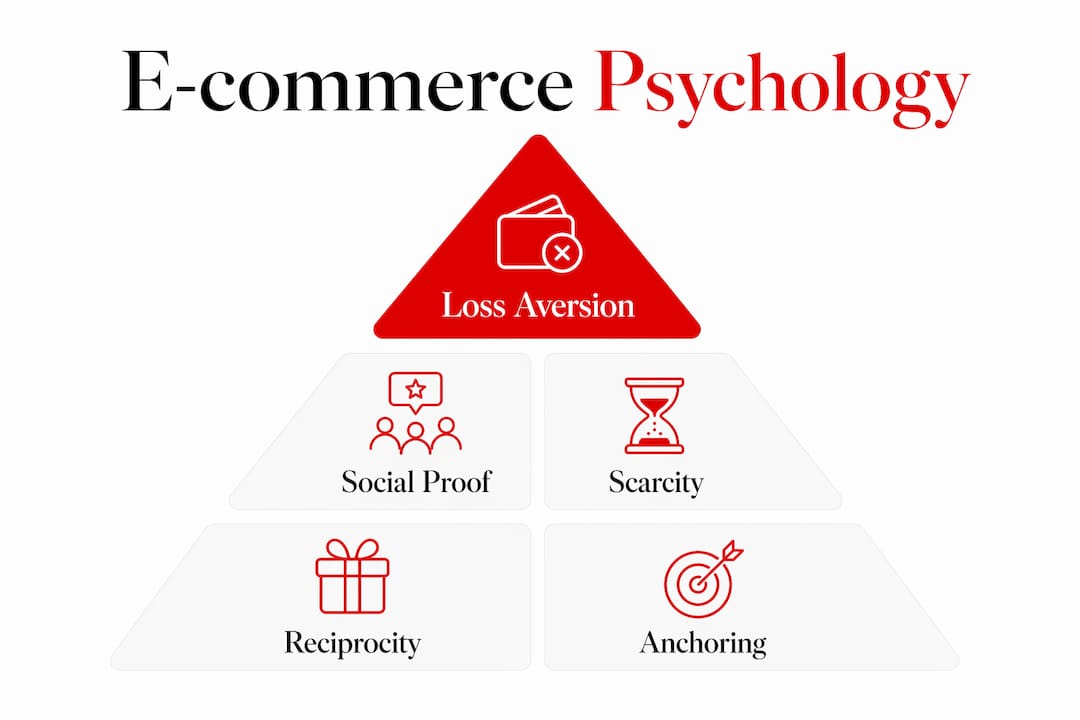
The five principles with the strongest, most documented impact on online sales are social proof, scarcity, reciprocity, loss aversion, and anchoring. Each one targets a different layer of how customers process decisions subconsciously.

Social proof is the fastest trust signal available. Specific social proof, such as showing exact purchaser counts or verified review totals, delivers a 15–34% conversion uplift. Vague claims like “thousands of happy customers” produce almost no measurable effect. Specificity is what triggers the cognitive shortcut.
Loss aversion is the strongest motivator of the five. Loss-framed messaging converts 18–35% better than gain-framed equivalents. “Don’t miss your 20% discount” outperforms “Save 20% today” because the brain weights potential losses roughly 2.5 times more heavily than equivalent gains. Reframing your copy around what customers stand to lose is one of the highest-return changes you can make.
Anchoring works by setting a reference point before revealing the actual price. Showing a crossed-out original price next to a sale price raises willingness to pay because the first number becomes the mental benchmark. The discount feels real and significant, even when the math is modest.
| Principle | Core mechanism | Behavioral effect | Conversion lift range |
|---|---|---|---|
| Social proof | Conformity bias | Reduces purchase uncertainty | 15–34% |
| Loss aversion | Risk sensitivity | Increases urgency to act | 18–35% |
| Scarcity / urgency | Fear of missing out | Accelerates decision-making | Up to 22% |
| Anchoring | Reference point bias | Raises perceived value | Varies by price gap |
| Reciprocity | Obligation response | Increases engagement and loyalty | Context-dependent |
- Display exact review counts and purchaser numbers, not rounded estimates.
- Frame limited-time offers around what customers lose, not what they gain.
- Always show the original price before the discounted price, never after.
- Use reciprocity through free content, samples, or early access before asking for a sale.
Pro Tip: Test loss-framed copy against gain-framed copy in a single A/B test on your highest-traffic product page. The result will tell you more about your specific audience than any general benchmark.
How do emotional and visual marketing strategies leverage psychology?
Emotion drives purchase decisions faster and more reliably than rational argument. Inspirational advertising generates a 1,891% ROI compared to standard informational ads. That figure is not a rounding error. It reflects a fundamental truth about consumer behavior psychology: customers buy feelings first and justify with facts second.
Not all positive emotions perform equally. Research from the University of Sydney shows that inspiration specifically drives higher financial motivation than generic positivity or happiness. A product page that makes a customer feel inspired to become a better version of themselves converts at a different level than one that simply makes them feel good. This distinction matters enormously for emotional brand connections in premium and lifestyle categories.
Color and visual design are the first psychological triggers in marketing that customers encounter. 90% of initial product opinions form within 90 seconds, based almost entirely on color and visual cues. That means your color palette, image quality, and layout are doing the heaviest persuasion work before a single word is read.
| Visual or emotional cue | Psychological mechanism | Documented effect |
|---|---|---|
| Inspirational imagery | Aspiration and identity alignment | Up to 1,891% ROI vs. informational ads |
| Color and visual design | Subconscious brand perception | 90% of opinion formed in 90 seconds |
| Haptic language in copy | Mental touch simulation | Part of 28–34% subconscious conversion lift |
| Product image orientation | Proto-ownership simulation | Increases purchase intent |
- Use imagery that shows the customer’s aspirational self, not just the product.
- Choose brand colors that align with the emotional state you want to trigger, not just aesthetic preference.
- Write product descriptions using tactile, sensory language to activate mental simulation.
- Prioritize high-resolution, lifestyle-context photography over plain white-background shots.
Pro Tip: Run your homepage hero image through a five-second test with real users. Ask what emotion they felt, not what they saw. If the answer doesn’t match your brand intent, the image is working against you.
What common psychological pitfalls should e-commerce marketers avoid?
The most damaging mistake in applied consumer behavior psychology is using psychological triggers dishonestly. Fake scarcity and pressure tactics erode brand trust the moment customers detect them. And customers detect them quickly. A countdown timer that resets on page reload, or a “only 3 left” message that never changes, signals manipulation rather than urgency.
The paradox of choice is the second major pitfall. Presenting too many options increases cognitive load and actually reduces sales. Reducing product options by 60% can increase sales by up to 14%. More choice feels generous to the marketer but feels exhausting to the customer. Decision fatigue is real, and it ends in abandoned carts.
Urgency must be genuine and consistent across the entire site. A flash sale that appears on every visit, or a “limited time” offer that runs for three months, trains customers to ignore urgency signals entirely. When real scarcity exists, customers won’t believe it.
- Never use countdown timers that reset or inventory counts that don’t reflect real stock.
- Limit primary product category pages to the most relevant options, not every variant.
- Apply urgency messaging only when the scarcity or deadline is factually accurate.
- Audit your site for inconsistency: urgency signals that contradict each other destroy credibility.
- Build trust online as the foundation before applying any persuasion technique.
Pro Tip: Before publishing any urgency element, ask: “Would I feel manipulated if I saw this as a customer?” If the answer is yes, redesign it. Ethical persuasion reduces hesitation. Manipulation creates it.
How can psychology principles improve e-commerce UX design?
E-commerce UX design principles that incorporate behavioral science produce measurable conversion gains without changing a single word of copy. The layout, image orientation, and choice architecture of your store all send subconscious signals that either build or break purchase intent.
Above-the-fold imagery sets the evaluation frame for the entire page. A customer who sees an aspirational lifestyle image before scrolling enters a different mental state than one who sees a product spec sheet. This is mindset priming: the first visual cue determines how all subsequent information gets processed.
Product image orientation is a specific, underused tactic. Orienting product images toward the customer’s dominant hand activates a mental touch simulation called proto-ownership. The brain begins to simulate holding the product, which increases purchase intent measurably. For most Western audiences, that means orienting handles, grips, or product faces to the right.
Subconscious design cues like haptic language and image orientation are processed roughly 3,000 times faster than rational thought, with a potential 28–34% conversion lift. That speed advantage is why UX psychology works even when customers are not aware of it.
- Audit your hero images for emotional priming. Replace product-only shots with lifestyle imagery that reflects your customer’s aspirational identity.
- Review product image orientation across your catalog. Reorient images so the product faces or handles point toward the right side of the screen.
- Simplify your navigation and category structure. Remove low-performing product variants to reduce cognitive load.
- Add trust signals, such as verified reviews, security badges, and clear return policies, near every call-to-action button.
- Use psychology-driven sales steps to map the full customer journey from first impression to checkout confirmation.
- Write product descriptions with tactile and sensory language to reinforce mental simulation.
- Place your strongest social proof element directly above the add-to-cart button, not buried in a reviews tab.
Pro Tip: Treat your checkout page as a psychology exercise, not a form. Every extra field, unexpected cost, or missing trust signal is a friction point that activates loss aversion in the wrong direction.
Key Takeaways
Applying psychology principles for e-commerce requires combining honest persuasion techniques, emotionally resonant design, and simplified choice architecture to consistently convert more customers without sacrificing trust.
| Point | Details |
|---|---|
| Loss aversion outperforms gain framing | Loss-framed messaging converts 18–35% better; reframe copy around what customers stand to lose. |
| Specific social proof drives trust | Showing exact purchaser counts or review totals delivers up to 34% conversion uplift. |
| Emotional inspiration beats information | Inspirational advertising generates up to 1,891% ROI compared to standard informational campaigns. |
| Simplified choice increases sales | Cutting product options by 60% can lift sales by up to 14% by reducing cognitive overload. |
| Fake scarcity destroys credibility | Customers detect synthetic urgency quickly; only use scarcity tactics anchored in real inventory or deadlines. |
Why I think most e-commerce psychology advice misses the point
Most articles on psychological triggers in marketing treat customers like targets. The framing is always about what you can do to the customer to extract a purchase. That framing is both ethically wrong and commercially shortsighted.
My background is in psychology and applied marketing for luxury and lifestyle brands. What I’ve learned from that work is that the most effective use of behavioral science is not manipulation. It’s friction removal. Customers already want to buy. They hesitate because of uncertainty, cognitive overload, or a lack of trust. Psychology principles work best when they address those specific barriers honestly.
Emotional branding done well doesn’t trick anyone. It creates a genuine connection between a customer’s identity and a brand’s values. That connection produces loyalty and lifetime value, not just a single transaction. The brands I’ve worked with that see the strongest long-term results are the ones that use psychology to serve the customer, not to pressure them.
The uncomfortable truth is that short-term conversion gains from manipulative tactics come at the cost of long-term brand equity. A customer who feels tricked doesn’t come back. A customer who feels understood does. Build your psychology strategy around that distinction, and the conversion numbers will follow.
— Corrado
How Corradomanenti applies behavioral science to luxury e-commerce
Corradomanenti’s approach to psychology in luxury branding combines academic grounding in behavioral science with direct experience in fashion and lifestyle marketing. The result is a consulting methodology that goes beyond surface-level tactics to address why customers behave the way they do at every stage of the buying process.
For e-commerce brands in the fashion, luxury, and lifestyle sectors, Corradomanenti builds strategies that apply principles like loss aversion, emotional priming, and social proof in ways that reinforce brand identity rather than undermine it. If you want to apply consumer behavior insights to your store with precision and integrity, Corradomanenti’s consulting services are built for exactly that challenge.
FAQ
What are the most effective psychology principles for e-commerce?
Loss aversion, social proof, and anchoring consistently produce the highest measurable conversion lifts. Loss-framed messaging converts 18–35% better than gain-framed equivalents, and specific social proof delivers up to 34% uplift.
How does color psychology affect online buying decisions?
Customers form 90% of their initial product opinion within 90 seconds, based primarily on color and visual design. Color choice directly shapes brand perception and purchase intent before any copy is read.
Is urgency marketing ethical in e-commerce?
Urgency is ethical when it reflects genuine scarcity or a real deadline. Fake countdown timers and fabricated stock limits erode trust and reduce long-term brand value once customers detect the deception.
How does simplifying product choices increase sales?
Reducing product options by 60% can increase sales by up to 14% by lowering cognitive overload. Fewer choices reduce decision fatigue and make it easier for customers to commit to a purchase.
What is the role of emotional advertising in e-commerce conversion?
Inspirational emotional advertising generates up to 1,891% ROI compared to informational ads. Inspiration specifically, not generic positivity, drives the strongest financial motivation in online shoppers.