

TL;DR:
- Investing in digital trends in 2025 can significantly boost a luxury brand’s profitability and market valuation.
- AI and digital personalization foster emotional engagement, vital for differentiating brands in a crowded market.
Investing in digital trends in 2025 is the single most consequential decision a fashion or luxury brand leader can make right now. 56% of CEOs report increased profits directly linked to their digital investments, and companies that align technology with strategy earn a 14% market-cap premium over peers who do not. AI now supports 70% of digital marketing strategies across the industry. For luxury brands, where perception and differentiation are everything, the question is no longer why invest in digital trends 2025. The question is how fast you can move without losing the brand equity you have spent years building.
Why invest in digital trends 2025: the profitability case for luxury brands
Digital investment drives measurable profit, not just brand awareness. The CEO data above is not aspirational. It reflects a structural shift in how luxury consumers discover, evaluate, and purchase. Brands that sit out this shift lose ground to those that do not.
The 14% market-cap premium for digitally aligned firms is the clearest signal available. That premium compounds over time. A brand that earns it in 2025 enters 2026 with a higher valuation base, lower cost of capital, and more room to invest again.
“AI shifts the role of technology from efficiency tool to value creator. The brands winning in luxury are using AI to build emotional connections, not just cut costs.”
GenAI technologies make this shift faster and cheaper than most leaders expect. GenAI-driven agents reduce modernization timelines by 50% and delivery costs by 40%. A technology overhaul that once took three years now completes in roughly 18 months. That speed matters in fashion, where seasonal relevance is everything.
The practical steps for capturing this profitability advantage follow a clear sequence:
- Audit your current digital touchpoints against revenue contribution. Identify which channels drive actual conversion, not just traffic.
- Assign a specific profit target to each planned digital investment before committing budget. No target, no investment.
- Pilot AI-driven personalization in one customer segment first. Measure emotional engagement metrics, not just click rates.
- Scale what works within a single fiscal quarter. Luxury brands that wait for perfect data miss the window.
Pro Tip: Tie every digital initiative to a named business outcome before launch. “Increase brand awareness” is not a business outcome. “Increase repeat purchase rate among top-tier clients by 15% in Q3” is.
What are the top digital trends reshaping luxury marketing in 2025?
The digital video advertising market reached $140.18 billion in 2025. That figure tells you where consumer attention lives. Luxury brands that still allocate the majority of their budgets to static print or traditional display are funding yesterday’s reach.
Four trends define the current landscape for fashion and luxury marketing leaders:
- AI-driven personalization: AI now enables deeper, emotional and personalized customer connections beyond automation. For luxury, this means AI that surfaces the right product to the right client at the right emotional moment, not just the right demographic.
- Answer Engine Optimization (AEO): AI-native search became a mainstream discovery channel in 2025. Brands that built content for traditional SEO alone are now invisible in AI-generated answers. AEO requires structured, entity-rich content that AI systems can cite directly.
- Digital video and immersive content: Short-form video, shoppable content, and virtual try-on experiences are the primary formats driving luxury discovery among younger high-net-worth consumers.
- Brand-building through content and community: Brands investing in content, PR, and community see compounding returns that performance marketing alone cannot replicate. Community builds trust. Trust drives the repeat purchase rates that define luxury profitability.
| Digital Trend | Primary Benefit for Luxury Brands | Adoption Priority |
|---|---|---|
| AI-driven personalization | Emotional engagement at scale | High |
| Answer Engine Optimization | Visibility in AI-generated search results | High |
| Digital video advertising | Reach among high-net-worth younger consumers | High |
| Immersive and virtual experiences | Brand differentiation and trial reduction | Medium |
| Community and content marketing | Long-term loyalty and acquisition cost reduction | Medium |
The PwC insight on digital innovation and human experience captures the central paradox of 2025: the more technology permeates the market, the more consumers crave human, immersive, real-world experiences. Luxury brands that use AI to amplify human connection, rather than replace it, win. Those that use it only to cut costs lose the intangible that justifies their price point.

For a broader view of how these forces are reshaping the sector, the 2025 luxury digital takeaways from Luxury Intel offer useful market-level context on where advertising investment is shifting.
How do you avoid the digital investment traps that kill ROI?
Nearly 50% of digital initiatives fail to progress beyond the pilot phase due to poor governance and a lack of cost ownership. That statistic is the most important number in this article for any leader who has watched a promising digital project quietly disappear after six months.
The failure pattern is consistent. A team launches a pilot with enthusiasm and no named owner for the budget or the outcome. The pilot produces interesting data but no clear decision. The project enters a review cycle. Eighteen months later, a competitor has already scaled what you were still testing.
Avoiding this requires discipline, not more technology:
- Name an owner. Every digital initiative needs one person accountable for both the budget and the business outcome. Committees do not scale digital projects. People do.
- Set a kill date. Define in advance the conditions under which you will stop a pilot. This forces honest evaluation and frees budget for what works.
- Build data literacy across your team. Workforce upskilling in digital literacy is the most overlooked investment in digital transformation. A team that does not trust or understand the tools will not use them effectively.
- Govern costs weekly, not quarterly. Digital projects that lack weekly cost review drift. Quarterly reviews catch problems too late to correct without significant write-offs.
Pro Tip: Before approving any digital pilot, require the project lead to write one sentence stating the specific business outcome, the measurement method, and the decision date. If they cannot write that sentence, the project is not ready to fund.
Sustainable digital advantage comes from building what investors now call a “model-driven competitive moat.” Savvy investors distinguish companies with true AI-driven advantages from those using third-party tools without margin upside. For luxury brands, this means owning your customer data, your content infrastructure, and your personalization logic rather than renting them from platforms.
How to strategically integrate digital investments in luxury fashion marketing
Every technology initiative must connect to a specific business outcome before it receives budget. This is not a preference. It is the single factor that separates brands that build lasting digital advantage from those that accumulate expensive experiments.
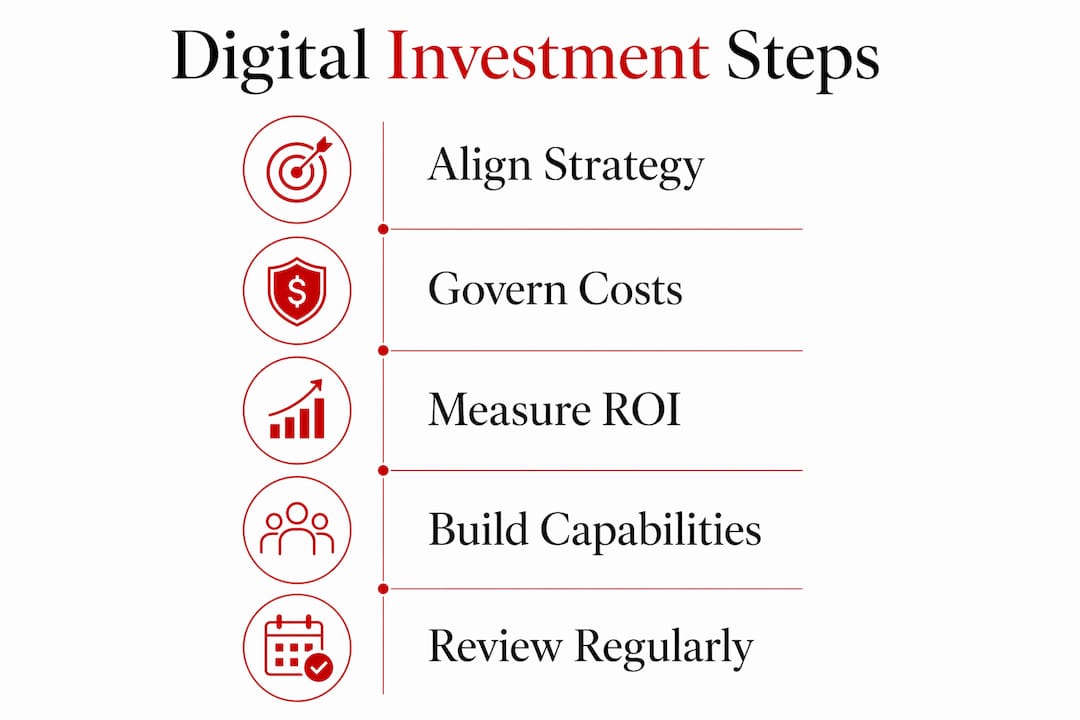
The integration sequence that works for luxury brands follows four steps:
- Define the business goal first. Increased client retention, higher average order value, faster new-market entry. The technology choice follows the goal, not the reverse.
- Balance efficiency with emotional experience. AI can reduce campaign production costs significantly. Redirect those savings into higher-quality creative, not into margin. Luxury clients notice the difference between a brand that feels richer and one that feels cheaper.
- Use partnerships to accelerate safely. Collaborating with specialized digital partners, including consultants with deep luxury sector knowledge, reduces the risk of costly missteps. The luxury brand digital strategy framework developed by Corradomanenti addresses exactly this integration challenge.
- Measure and iterate every 90 days. Digital investments that go unmeasured for a full year are not investments. They are expenses. Set a 90-day review cadence and adjust allocation based on what the data shows.
| Integration approach | Best for | Risk level |
|---|---|---|
| Build in-house AI capability | Brands with large data assets and technical teams | High |
| Partner with specialized consultants | Brands seeking speed and sector expertise | Low to medium |
| License third-party platforms | Brands testing new channels before committing | Medium |
| Hybrid model | Brands scaling proven pilots | Low |
Brands that align digital trends with luxury brand strategy consistently outperform those that treat technology as a standalone function. The integration of psychology, brand storytelling, and digital channels is where the real competitive advantage lives.
Key Takeaways
Fashion and luxury brands that tie every digital investment to a named business outcome, govern costs with discipline, and use AI to deepen human connection will outperform peers on both profitability and market valuation by the end of 2025.
| Point | Details |
|---|---|
| Profitability is proven | 56% of CEOs report higher profits from digital investment; aligned firms earn a 14% market-cap premium. |
| AI amplifies human connection | Use AI to personalize emotional experiences, not just reduce production costs. |
| AEO replaces traditional SEO | Optimize content for AI-native search engines to maintain luxury brand visibility. |
| Governance prevents failure | Nearly 50% of digital projects stall at pilot; name one owner and set a kill date for every initiative. |
| Measure every 90 days | Digital investments without a quarterly review cycle become unmanaged expenses. |
What I have learned about digital investment in luxury fashion
The brands I watch most closely are not the ones spending the most on technology. They are the ones spending with the most clarity. The difference between a digital investment that builds lasting advantage and one that drains budget quietly is almost always governance, not the technology itself.
The hardest conversation I have with luxury brand leaders is this: your brand story is not a reason to delay digital investment. It is the reason to invest more carefully. The emotional resonance that defines a luxury brand is exactly what AI-driven personalization can amplify, but only if the underlying data and content infrastructure are built with the same attention to detail you apply to your product.
Brands that delay because they fear digital will dilute their identity are making a false choice. The real risk is not dilution. The risk is invisibility. When your client searches for your category in an AI-powered interface and your brand does not appear, no amount of heritage protects your revenue. The luxury brands that need digital strategy now are not the ones without a story. They are the ones whose story is not yet structured for the channels where their clients are looking.
Digital investment is a long-term discipline. It rewards consistency, clear ownership, and the willingness to kill what is not working before it consumes the budget that should fund what does.
— Corrado
How Corradomanenti supports luxury brands in digital growth
Fashion and luxury brands face a specific challenge that generic digital agencies rarely understand: technology must serve the brand, not the other way around.
Corradomanenti works with fashion and luxury leaders to build digital marketing strategies grounded in consumer psychology and brand differentiation. From fashion brand growth tactics tailored to the luxury market to deep buyer behavior analysis that reveals why your clients buy, the approach connects technology investment to measurable brand outcomes. If you are ready to move beyond pilots and build a digital presence that matches the quality of your product, the expertise is here to support that work.
FAQ
Why should luxury brands invest in digital trends in 2025?
Digital investment directly increases profitability. 56% of CEOs report higher profits from digital initiatives, and strategically aligned brands earn a 14% market-cap premium over peers.
What is Answer Engine Optimization and why does it matter?
Answer Engine Optimization (AEO) is the practice of structuring content so AI-powered search tools can cite it directly. Brands that ignore AEO lose visibility in the AI-generated results where luxury consumers now search.
How do you avoid wasting budget on failed digital projects?
Assign one named owner to every initiative, set a defined decision date, and require a specific measurable outcome before funding. Nearly 50% of digital projects fail because they lack these basic governance conditions.
What role does AI play in luxury brand marketing?
AI enables personalized, emotionally resonant customer experiences at scale. The most effective luxury applications use AI to deepen client relationships, not simply automate campaign production.
How often should luxury brands review their digital investments?
A 90-day review cycle is the standard that prevents digital spending from drifting into unmanaged expense. Quarterly measurement forces honest evaluation and keeps budget aligned with what actually performs.