


TL;DR:
- Luxury brand validation involves testing high-fidelity prototypes and legitimacy signals with affluent consumers to assess market fit. Clear presentation, verifiable sustainability, and emotional loyalty measurement are essential for converting interest into purchase intent scores above 50%. Landing page tests and nuanced human insights help refine concepts before full market launch.
Luxury brand concept validation is the process of testing a brand idea against real affluent consumers to measure purchase intent, emotional resonance, and market fit before committing to full production. The standard industry term is concept testing, and it applies directly to luxury with one critical difference: the bar for fidelity, presentation, and proof is far higher than in mass-market categories. Entrepreneurs who skip this step risk building a brand on assumptions rather than evidence. The frameworks below give you a repeatable process to validate luxury brand concepts with confidence, from survey design to landing page benchmarks to legitimacy signals that today’s high-net-worth buyers demand.
How to validate a luxury brand concept: prerequisites and tools
The single biggest mistake in luxury concept testing is presenting an unfinished idea. High-fidelity prototypes and polished mockups are non-negotiable. A rough sketch or a vague mood board signals amateur execution, and affluent consumers will judge your brand by the quality of the test itself.
Before you run a single survey or ad, prepare these foundational assets:
- Finished-product mockups. Packaging, materials, and visual identity must reflect the final product at full quality.
- Clear pricing. State your actual price point. Vague pricing produces vague feedback.
- Precise messaging. Write the exact copy you plan to use on your website and in ads. Do not test placeholder text.
- Audience targeting criteria. Define your tester profile by income bracket, purchase history with luxury goods, and relevant lifestyle behaviors.
| Asset | Minimum standard for luxury testing |
|---|---|
| Product mockup | Photorealistic render or physical prototype |
| Packaging | Final materials, typography, and finish |
| Pricing | Exact retail price, not a range |
| Survey audience | Screened for luxury purchase history |
| Messaging | Final headline and one-sentence brand promise |
Pro Tip: Never test a concept with friends or colleagues who know you. Their responses are socially biased. Use a screened panel of strangers who match your actual buyer profile.
Digital tools like QR codes and NFC chips can also serve a dual purpose at this stage. They authenticate your prototype as a finished product and signal to testers that your brand takes provenance seriously, which matters to the buyers you are targeting.

How to design concept testing surveys for luxury buyers
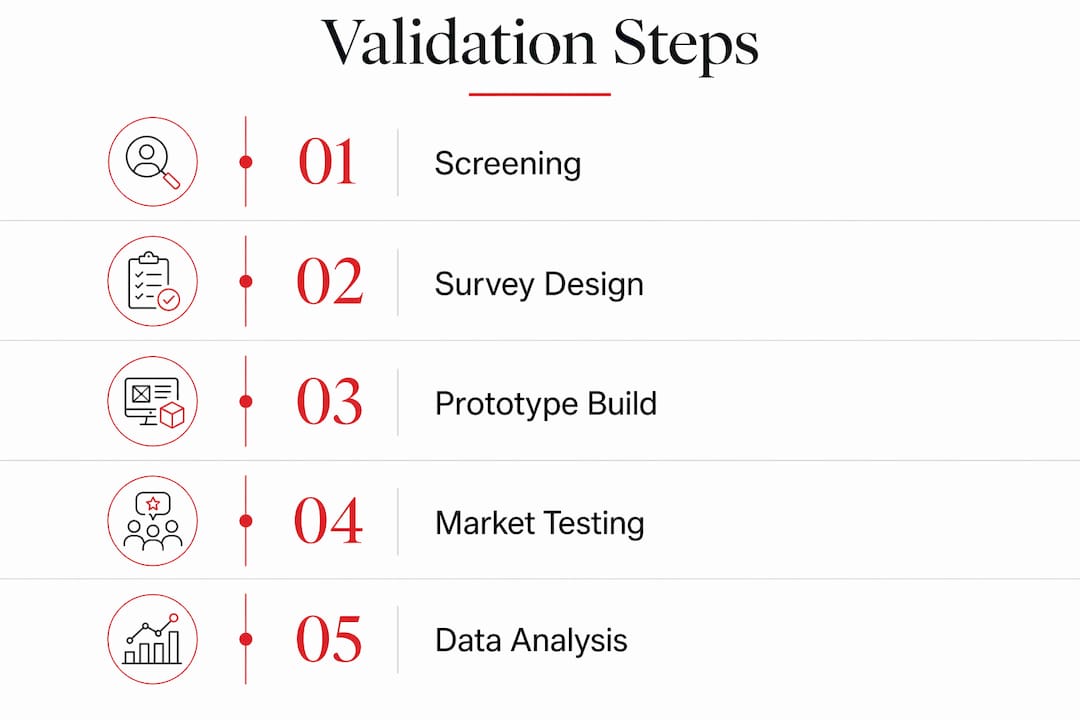
Survey design for luxury brand concept testing requires a different structure than general consumer research. Screening questions that qualify participants by demographics, purchase behavior, and luxury category familiarity are the first filter. Without them, your data reflects the wrong audience.
Structuring the questionnaire
A balanced questionnaire uses roughly 70% closed questions and 30% open-ended questions. Closed questions give you quantifiable scores. Open-ended questions give you the language and reasoning behind those scores.
Build your survey around these five question categories:
- Appeal. “How visually appealing is this concept to you?” Use a 5-point Likert scale.
- Clarity. “How clearly does this concept communicate what it offers?” Same scale.
- Relevance. “How relevant is this concept to your lifestyle and values?”
- Uniqueness. “How different is this from other luxury brands you know?”
- Purchase intent. “How likely are you to purchase this at the stated price?” This is your North Star metric.
Interpreting your scores
Purchase intent thresholds define your next move. Under 30% intent means the concept needs major revision. Above 50% signals strong market fit. The range between 30% and 50% calls for targeted refinement, usually in messaging or price positioning.
Add a willingness-to-pay question after the purchase intent question. Ask respondents to name the price they would expect to pay, then compare it to your stated price. A large gap between the two tells you whether your pricing is misaligned or your value communication is weak.
Pro Tip: Include one open-ended question that asks: “What would need to change for you to consider purchasing this?” The answers to that single question often contain more refinement guidance than all your Likert scores combined.
What advanced validation methods should luxury brands use?
Luxury brand validation has moved beyond surveys and focus groups. Younger high-net-worth consumers now treat sustainability, repairability, and verifiable provenance as economic behaviors, not lifestyle preferences. Aspirational storytelling no longer closes the gap. Proof does.
The advanced validation layer addresses legitimacy, authentication, and emotional loyalty. These are the factors that separate a concept with strong survey scores from one that actually converts and retains buyers.
Legitimacy and provenance signals
Embedding QR codes or NFC chips in product prototypes gives testers instant access to provenance data. This deters counterfeiting perceptions and demonstrates supply chain transparency. Digital Product Passports, which record material origin, production location, and repair history on a blockchain, are becoming a standard expectation in high-end fashion and accessories. Testing your concept with these elements present tells you whether your target buyers respond to them as a purchase driver.
Sustainable luxury practices now function as a baseline requirement, not a differentiator. If your concept cannot demonstrate verifiable sustainability claims during testing, expect lower purchase intent scores from buyers under 45.
“Luxury customers today demand traceable and verifiable proof of sustainability and provenance. They no longer accept vague marketing. Operational transparency has become a core validation requirement, not a brand story add-on.”
Measuring emotional loyalty
37% of luxury customers say brands struggle to sustain emotional resonance and lasting loyalty. That statistic points to a gap between initial appeal and long-term retention. Your concept test should include questions that measure the emotional dimension: Does this brand feel like it belongs in your life? Would you recommend it without being asked?
Relational artisans, brand personnel trained in deep client listening, detect weak signals that surveys miss. They notice hesitation, word choice, and the gap between what a respondent says and what they mean. Building this human layer into your validation process catches problems before they show up in sales data. For more on building this kind of emotional connection, the emotional branding guide from Corradomanenti covers the loyalty mechanics in depth.
How to run landing page tests for luxury market interest
A landing page test converts your concept into a financial signal. The page must look and read like a finished product launch, not a preview. Coming-soon pages feel cheap in luxury contexts and suppress conversion rates artificially.
Build your test landing page with these steps:
- Write the final headline and subheadline. Use the exact messaging from your concept survey.
- Show the product at full quality. Use your photorealistic mockup or prototype photography.
- State the price clearly. Do not hide it below the fold.
- Include a single call to action. “Reserve your piece” or “Request early access” works for luxury. Avoid generic e-commerce language.
- Drive cold traffic. Run a $50 targeted ad campaign on Facebook or Google to audiences who match your buyer profile but have no prior relationship with your brand.
| Conversion rate | Interpretation | Next step |
|---|---|---|
| Above 5% | Strong market interest | Proceed to production planning |
| 2%–5% | Messaging needs refinement | Rewrite headline and value proposition |
| Under 2% | Concept or positioning issue | Revisit core concept before further spend |
Pro Tip: For physical luxury goods priced above $1,000, do not pre-sell on the landing page. Collect expressions of interest instead. Pre-selling a product that does not yet exist can damage trust with exactly the buyers you need most.
Authenticity in branding is the reason cold-traffic landing page tests work. A stranger with no prior brand exposure who still clicks and converts is giving you the most honest signal available.
How to analyze concept test results and refine your brand
Purchase intent is the primary metric. Cross-reference it with everything else, but do not let secondary scores override a low intent number. A concept that scores high on appeal and low on purchase intent has a pricing or relevance problem, not a visual problem.
Use this framework to interpret your combined data:
- High intent + positive open-ended feedback. Proceed. Refine messaging based on the exact language respondents used.
- High intent + negative open-ended feedback. Investigate the gap. Respondents may be buying despite a concern, which becomes a retention risk later.
- Low intent + specific open-ended feedback. Refine. The feedback tells you what to fix.
- Low intent + no open-ended feedback. Abandon or fundamentally rethink the concept. Silence is not neutral in luxury research.
Segment your results by age, income bracket, and prior luxury purchase behavior. A concept that scores 60% purchase intent among buyers over 50 but 20% among buyers under 35 is not a broadly viable luxury concept. It is a niche concept, and your positioning, channels, and pricing should reflect that reality.
Use validation data to update your brand positioning before launch. The language your respondents used in open-ended answers is often better copy than anything a creative team produces in isolation.
Key Takeaways
Validating a luxury brand concept requires measurable purchase intent above 50%, high-fidelity presentation, and verifiable legitimacy signals including provenance and sustainability proof.
| Point | Details |
|---|---|
| Purchase intent threshold | Above 50% signals strong market fit; under 30% requires major concept revision. |
| Fidelity is non-negotiable | Present finished-quality mockups and final pricing to avoid false negative signals. |
| Legitimacy now drives conversion | Verifiable sustainability and provenance claims directly raise purchase intent among buyers under 45. |
| Landing page benchmarks | A conversion rate above 5% on cold traffic confirms market readiness to proceed. |
| Emotional loyalty matters | Measure belonging and recommendation intent, not just initial appeal, to predict long-term brand health. |
What I have learned from validating luxury concepts in the real world
The most common error I see from luxury entrepreneurs is confusing positive reactions with purchase intent. People will tell you a concept is beautiful, original, and exciting. Then they will not buy it. That gap is not a mystery. It is what happens when you test aspiration without testing conviction.
The second error is presenting concepts too early. A rough prototype in a luxury context does not read as “work in progress.” It reads as “this brand does not understand its own category.” The authenticity standards that luxury buyers apply to finished products, they apply equally to how you present ideas to them.
What actually works is leading with proof. Show the material. Show the price. Show the provenance. Then ask if they would buy. The brands I have worked with that skip this discipline spend twice as much fixing positioning problems post-launch that a two-week validation sprint would have caught.
The legitimacy shift in luxury is real and accelerating. Sustainability credentials and traceable supply chains are no longer brand stories. They are purchase criteria. Entrepreneurs who build these elements into their concept from day one, and test them explicitly, gain a measurable advantage over those who treat them as marketing add-ons.
Finally, do not underestimate the human signal. Surveys give you numbers. Relational artisans, or simply trained listeners in your team, give you the nuance behind those numbers. The best validation processes I have run combine both.
— Corrado
How Corradomanenti supports luxury brand concept validation
Corradomanenti works with luxury entrepreneurs and brand leaders who need more than a survey template. The work combines buyer behavior analysis with psychology-driven positioning to identify exactly where a concept resonates and where it loses affluent buyers before they commit.
Every engagement starts with the data: purchase intent scores, emotional resonance gaps, and legitimacy signals specific to your category and price point. From there, Corradomanenti builds a refinement plan grounded in real consumer psychology, not guesswork. If you are preparing a luxury concept for market and want a validation process built for the standards your buyers actually hold, the luxury market growth tactics page is the right starting point.
FAQ
What is luxury brand concept validation?
Luxury brand concept validation is the process of testing a brand idea with screened affluent consumers to measure purchase intent, emotional resonance, and market fit before production begins.
What purchase intent score indicates a strong luxury concept?
A purchase intent score above 50% indicates strong market fit. Scores below 30% signal the concept needs major revision before further investment.
How much does a landing page validation test cost?
A $50 targeted ad campaign driving cold traffic to a finished-product landing page is sufficient to gather meaningful conversion data on a luxury concept.
Why does sustainability matter in luxury brand concept testing?
Younger high-net-worth buyers treat verifiable sustainability and provenance as purchase criteria, not brand stories. Concepts that cannot demonstrate these claims score lower on purchase intent with buyers under 45.
What is the difference between appeal and purchase intent in concept testing?
Appeal measures how attractive a concept looks or feels. Purchase intent measures whether a respondent would actually pay the stated price. High appeal with low purchase intent points to a pricing or relevance problem, not a design problem.