
Luxury brand managers often assume that exclusivity alone sustains customer relationships, yet retention improvements by 2% can cut costs equivalent to 10% while loyalty members contribute substantially more revenue. The reality is that loyalty in luxury markets operates on fundamentally different principles than mass-market retention. Emotional bonds, symbolic value, and experiential depth drive lasting commitment far more than transactional rewards. Understanding these unique dynamics allows you to cultivate relationships that protect brand equity, amplify advocacy, and generate disproportionate financial returns in an increasingly competitive premium landscape.
Table of Contents
- Key takeaways
- Understanding the financial impact of loyalty in luxury
- The psychology behind luxury consumer loyalty
- Navigating risks and nuances of luxury loyalty programs
- Strategies to cultivate lasting loyalty in luxury markets
- Enhance your luxury brand loyalty with expert tactics
- Frequently asked questions
Key Takeaways
| Point | Details |
|---|---|
| Cost savings from retention | In luxury, small retention gains dramatically reduce acquisition costs and increase repeat purchases. |
| Emotional bonds drive loyalty | Emotional bonds and experiential depth predict long term loyalty more than transactional rewards. |
| Single bad experience impact | A single service failure can swiftly sever loyalty in luxury due to exceptionally high expectations. |
| Loyalty fuels revenue and advocacy | Loyal customers generate more revenue and become brand ambassadors who reinforce brand equity. |
Understanding the financial impact of loyalty in luxury
The business case for loyalty in luxury markets rests on compelling financial evidence. Research shows that retention improvements by 2% can cut costs equivalent to 10%, a dramatic multiplier effect that stems from reduced acquisition spending and increased purchase frequency. Loyalty members contribute 12-18% more revenue than non-members, reflecting both higher transaction values and greater purchase consistency. Perhaps most striking, 59% of US consumers remain loyal for life once they commit to a luxury brand, creating annuity-like revenue streams that stabilize long-term performance.
These numbers matter because luxury brands face unique cost structures. Acquiring a new luxury customer requires significant investment in brand building, personalized outreach, and trust development. Retaining an existing customer eliminates most of these costs while leveraging established emotional connections. The economics shift dramatically in favor of retention.
Yet financial incentives alone prove insufficient in luxury contexts. Defining customer loyalty luxury requires understanding that retention protects brand equity beyond immediate revenue. Loyal customers become brand ambassadors, generating word-of-mouth endorsements that carry more weight than paid advertising. They provide feedback that shapes product development and service refinement. They forgive minor missteps that would cause mass-market customers to defect.
The flip side carries equal weight. Negative experiences trigger rapid customer loss in luxury sectors because expectations run exceptionally high. A single service failure or quality lapse can sever relationships that took years to build. This asymmetry means that loyalty strategies must focus as much on preventing defection as on encouraging repeat purchases.
“Retention improvements by 2% can cut costs equivalent to 10%. Loyalty members contribute 12-18% more revenue. 59% of US consumers are loyal for life once committed.” — Luxury brand customer retention statistics
Consider these financial realities:
- Acquisition costs in luxury markets often exceed five times retention costs
- Loyal customers purchase 67% more frequently than new customers
- Referrals from loyal customers convert at rates 3-5 times higher than cold prospects
- Lifetime value of loyal luxury customers can exceed $100,000 in categories like fashion and hospitality
These metrics demonstrate why loyalty deserves strategic investment rather than tactical attention. The financial returns compound over time as loyal cohorts deepen their engagement and expand their share of wallet within your brand ecosystem.
The psychology behind luxury consumer loyalty
Luxury loyalty operates on emotional rather than rational foundations. Research reveals that affective commitment drives satisfaction and advocacy far more powerfully than calculative commitment based on switching costs or rewards. Affective commitment reflects genuine emotional attachment to the brand, creating intrinsic motivation to maintain the relationship. This psychological bond makes customers resistant to competitive offers and willing to pay premium prices.
Service quality emerges as a critical antecedent to affective commitment in luxury contexts. Exceptional service creates positive emotions that strengthen brand attachment. Conversely, perceived costs of leaving influence loyalty by making customers recognize the unique value they would forfeit by switching. These lost benefit costs include personalized relationships with staff, accumulated status, and the symbolic meaning embedded in the brand relationship.

Luxury value itself comprises three interrelated dimensions. Functional value delivers tangible utility and quality. Hedonic value provides emotional pleasure, sensory delight, and experiential richness. Symbolic value communicates identity, status, and social positioning. Luxury value includes functional, hedonic, and symbolic dimensions that collectively influence repurchase intentions and loyalty strength.
Brand attachment acts as a psychological glue connecting customers to luxury brands. Studies in luxury hospitality show that luxury value, emotions, and brand attachment drive repurchase intentions, with attachment mediating the relationship between value perceptions and loyalty behaviors. Customers with strong brand attachment view the brand as an extension of their identity, making loyalty deeply personal rather than transactional.
Understanding luxury customer loyalty psychology reveals why traditional marketing approaches often fail in premium markets. Luxury consumers seek brands that reflect their aspirations and values, not just products that solve problems. They want relationships that acknowledge their individuality and status, not mass-market treatment disguised with premium pricing.
Key psychological drivers include:
- Self-congruence between brand image and customer identity
- Emotional resonance through storytelling and heritage
- Social validation from brand associations and community
- Sensory pleasure from product quality and service excellence
- Trust built through consistent delivery of exceptional experiences
Pro Tip: Focus on strengthening emotional bonds through exceptional service and meaningful brand storytelling. Invest in training that helps staff recognize and respond to individual customer preferences, creating personalized interactions that build affective commitment. Document customer histories to enable continuity across touchpoints, demonstrating that you value the relationship beyond individual transactions.
These psychological insights explain why loyalty in luxury requires fundamentally different strategies than mass-market retention. You cannot buy loyalty with points or discounts. You must earn it through consistent delivery of experiences that resonate emotionally and reinforce symbolic value.
Navigating risks and nuances of luxury loyalty programs
Traditional loyalty programs carry significant risks in luxury contexts. Transactional reward programs risk cheapening luxury brands by introducing discount-driven thinking that contradicts the exclusivity and premium positioning central to luxury value propositions. When customers begin calculating points and comparing reward values, they shift from emotional to transactional mindsets that erode brand mystique.
Ultra-wealthy consumers demonstrate particularly strong resistance to points-based programs. Research shows that ultra-wealthy consumers prefer experiential and interpersonal loyalty over quantifiable rewards. They value access to exclusive experiences, personalized service from familiar staff, and recognition of their individual preferences. Points feel pedestrian and impersonal, suggesting the brand views them as interchangeable rather than unique.
The table below contrasts transactional and experiential approaches to luxury loyalty:
| Approach | Mechanism | Brand Impact | Customer Perception |
|---|---|---|---|
| Transactional | Points, discounts, tier status based on spend | Risks cheapening brand, introduces price sensitivity | Calculative, comparison-driven |
| Experiential | Exclusive access, personalized service, bespoke experiences | Reinforces exclusivity, strengthens emotional bonds | Emotional, identity-driven |
| Hybrid | Limited rewards combined with experience-based benefits | Moderate risk if experiences dominate | Mixed, depends on balance |
This comparison reveals why many luxury brands avoid formal loyalty programs entirely, preferring informal recognition systems that maintain flexibility and personalization. The most successful luxury loyalty initiatives feel invisible, operating through discreet gestures and personalized touches rather than explicit program mechanics.
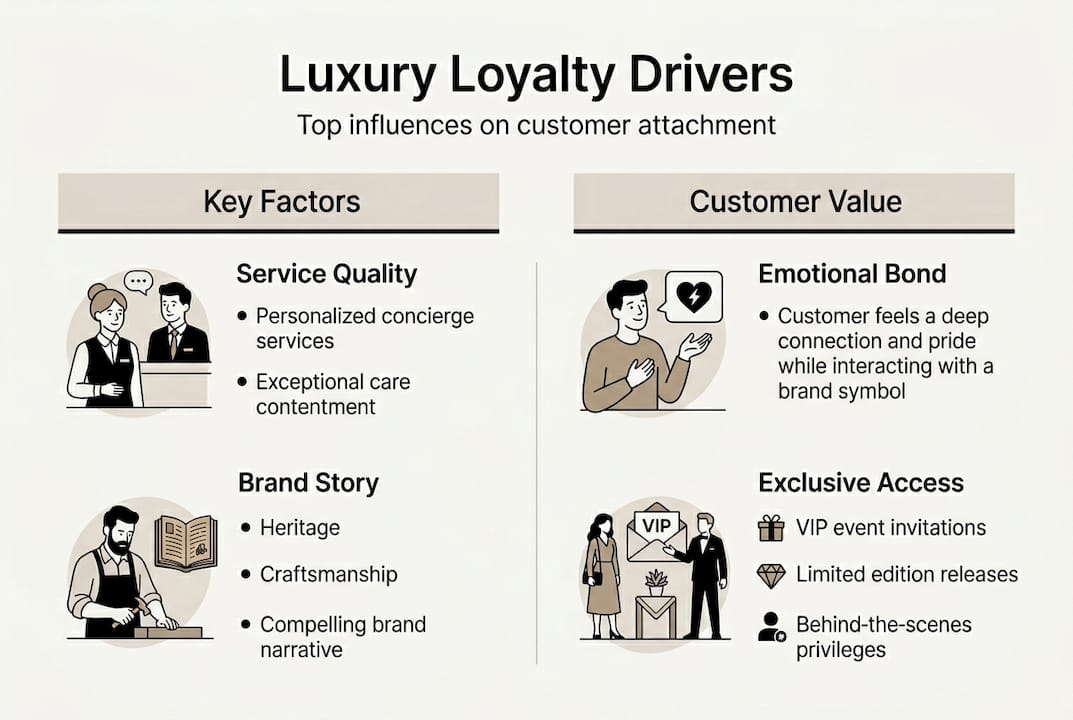
Consider how luxury client retention steps emphasize relationship building over program structure. Top luxury brands maintain detailed preference profiles that enable staff to anticipate needs and personalize interactions without customers requesting special treatment. They create invitation-only events that provide social currency and community connection. They assign relationship managers who develop genuine personal connections with high-value customers.
Pro Tip: Tailor loyalty initiatives to emphasize exclusivity, personalized interactions, and experience-based rewards. Avoid visible point systems or tier structures that commoditize relationships. Instead, create mechanisms for recognizing and rewarding loyalty through surprise-and-delight moments, priority access, and personalized experiences that feel organic rather than programmatic. Train staff to use customer data to personalize service naturally, not to reference program status explicitly.
The nuance lies in recognizing that loyalty programs can work in luxury contexts when designed around experiences rather than transactions. Private shopping appointments, advance access to new collections, invitations to brand events, and personalized styling services all reinforce luxury positioning while rewarding loyalty. These benefits feel like privileges earned through the relationship rather than rewards calculated from spending.
Successful luxury loyalty strategies also acknowledge different customer segments. Some luxury consumers appreciate subtle recognition and exclusive access. Others prefer complete discretion with no visible program elements. The most sophisticated approaches offer multiple pathways to express and reward loyalty, allowing customers to self-select their preferred engagement style.
Strategies to cultivate lasting loyalty in luxury markets
Building durable loyalty in luxury markets requires systematic approaches grounded in psychological insights and operational excellence. Service quality is a key antecedent to loyalty in luxury industries, influencing affective commitment through consistent delivery of exceptional experiences. The following numbered strategies provide a framework for luxury brand managers:
- Establish service excellence as non-negotiable foundation through rigorous training and quality standards
- Create detailed customer preference profiles that enable personalized interactions across all touchpoints
- Design exclusive experiences that provide social currency and reinforce brand community
- Build emotional connections through storytelling that links brand heritage to customer aspirations
- Implement discreet recognition systems that acknowledge loyalty without commoditizing relationships
- Develop relationship management protocols that ensure continuity and deepen personal connections
- Measure loyalty through behavioral indicators and emotional attachment rather than transaction frequency alone
These strategies work synergistically to create loyalty ecosystems that feel natural rather than manufactured. The key lies in integration, ensuring that every customer touchpoint reinforces the emotional bonds and symbolic value that drive luxury loyalty.
The data table below shows loyalty drivers prioritized by luxury consumers:
| Driver | Importance Score | Impact on Repurchase | Impact on Advocacy |
|---|---|---|---|
| Service quality | 9.2/10 | Very High | High |
| Exclusivity | 8.8/10 | High | Very High |
| Symbolic value | 8.5/10 | High | Very High |
| Personalization | 8.3/10 | Very High | Moderate |
| Brand heritage | 7.9/10 | Moderate | High |
| Product quality | 9.4/10 | Very High | Moderate |
These priorities reveal that product quality serves as table stakes, expected but insufficient alone. Service quality and personalization drive repurchase behavior most directly, while exclusivity and symbolic value generate advocacy and word-of-mouth.
Operationalizing these insights requires investment in systems and training that enable consistent execution. Customer relationship management platforms must capture preference data and make it accessible to frontline staff. Training programs must develop emotional intelligence and cultural awareness alongside technical skills. Incentive structures must reward relationship building and customer satisfaction rather than short-term sales metrics alone.
Building community represents another powerful loyalty strategy. Luxury consumers seek connection with like-minded individuals who share their values and aspirations. Brand-sponsored events, online communities, and collaborative experiences create social bonds that extend beyond individual customer-brand relationships. These communities generate network effects that make loyalty self-reinforcing as customers develop friendships and shared experiences within the brand ecosystem.
Advocacy naturally emerges from strong loyalty when customers feel genuine enthusiasm for the brand. The most effective advocacy programs in luxury contexts feel organic rather than incentivized. Customers share their experiences because they want to, not because they receive referral bonuses. Your role involves making it easy and socially rewarding to advocate by creating shareable moments, facilitating introductions, and acknowledging advocacy gracefully.
Pro Tip: Invest in continuous training to maintain superior service that reinforces emotional commitment. Service excellence degrades quickly without ongoing reinforcement. Schedule quarterly training sessions that refresh core skills, introduce new techniques, and share best practices from top performers. Create mentorship programs that pair experienced relationship managers with newer staff. Celebrate service excellence publicly to reinforce its importance and motivate consistent delivery.
The strategic imperative centers on viewing loyalty as a long-term relationship rather than a series of transactions. Every interaction either strengthens or weakens the emotional bonds that sustain loyalty. Consistency matters enormously because luxury customers notice and remember lapses. Building loyalty requires patience and sustained investment, but the financial and strategic returns justify the commitment.
Enhance your luxury brand loyalty with expert tactics
Applying these loyalty principles requires both strategic vision and tactical expertise. Corrado Manenti specializes in helping luxury brands optimize buyer loyalty and engagement through psychology-driven marketing strategies tailored to premium markets. His approach combines academic insights into consumer psychology with practical experience in fashion, luxury, and lifestyle sectors.
Explore detailed frameworks for fashion brand growth tactics luxury market that translate loyalty insights into actionable initiatives. Learn systematic approaches to how to analyze buyer behavior luxury brands using psychological segmentation and behavioral data. Discover how psychology luxury branding engagement creates emotional connections that drive sustained loyalty and advocacy. These resources provide the strategic depth and tactical specificity needed to implement loyalty strategies that protect brand equity while generating measurable financial returns in competitive luxury markets.
Frequently asked questions
What is unique about loyalty in luxury markets?
Luxury loyalty operates primarily through emotional and symbolic value rather than transactional rewards. High-end consumers seek brands that reflect their identity and provide experiences that reinforce status and belonging. Exceptional service quality, exclusivity, and personalized attention drive loyalty more effectively than points or discounts. The psychological bonds formed through these elements create intrinsic motivation to maintain relationships even when competitors offer attractive alternatives.
How much does improving retention impact luxury brand profits?
Small retention increases generate dramatic profit improvements in luxury brands. Retention improvements by 2% can cut costs equivalent to 10% through reduced acquisition spending and increased efficiency. Loyal members contribute 12-18% more revenue than non-members, compounding over time as relationships deepen. The lifetime value of retained luxury customers often exceeds acquisition costs by factors of five to ten, making retention investment highly profitable. These financial returns justify prioritizing loyalty strategies in resource allocation decisions.
Are traditional loyalty programs effective for luxury brands?
Traditional point-based programs often harm luxury brand positioning by introducing transactional thinking that contradicts exclusivity. Transactional programs risk cheapening brands because they make customers calculate value rather than experience emotional connection. Ultra-wealthy consumers particularly prefer experiential loyalty built through personalized service, exclusive access, and relationship depth. Successful luxury loyalty initiatives emphasize experiences and recognition over quantifiable rewards, maintaining brand mystique while acknowledging customer value.
What role does service quality play in luxury loyalty?
Service quality acts as a foundational driver of affective commitment in luxury markets. Exceptional service creates positive emotions that strengthen brand attachment and generate intrinsic motivation to maintain relationships. Consistent service excellence builds trust and demonstrates respect for customer expectations, both critical in high-stakes luxury contexts. Poor service triggers rapid defection because luxury customers hold elevated standards and view service lapses as fundamental breaches of the brand promise. Investing in service training and quality systems directly impacts loyalty strength and duration.
How can luxury brands measure loyalty effectively?
Luxury brands should measure loyalty through behavioral indicators and emotional attachment rather than transaction frequency alone. Track repeat purchase rates, customer lifetime value, referral generation, and share of wallet within relevant categories. Assess emotional attachment through surveys measuring brand connection, willingness to recommend, and resistance to competitive offers. Monitor service quality scores and customer satisfaction across touchpoints. Combine quantitative metrics with qualitative feedback to understand the depth and durability of customer relationships, recognizing that true luxury loyalty reflects emotional bonds that transcend individual transactions.