


The single most effective move for an emerging luxury brand is to build an identity so culturally specific that established houses cannot copy it without losing their own. Heritage cannot be invented, but relevance can be earned. The brands winning right now against legacy giants are doing three things well: they demonstrate craft in ways that are verifiable, they create access that feels earned rather than purchased, and they build digital trust that turns a first-time buyer into a long-term client.
Your 30/90/12-month starter plan:
- Month 1–30 (product proof): Develop one signature SKU with documented material sourcing, visible craft details, and a provenance story. No hero product, no brand.
- Month 3–90 (flagship experience): Design one high-touch retail or appointment moment that converts at a premium price point. Measure appointment-to-purchase rate from day one.
- Month 6–12 (digital trust): Implement a CRM workflow for early-access cohorts and add provenance pages to your hero SKU. Track repeat purchase rate among early-access members and full-price sell-through weekly.
Signals to watch immediately: conversion rate by acquisition cohort, repeat purchase rate among early-access members, and full-price sell-through percentage. If any of these stall in month two, the identity or the product story is not landing, not the price.
Pro Tip: Don’t wait until you have a full collection to start measuring. One SKU, one cohort, and one CRM sequence will tell you more in 60 days than a year of brand planning without data.
Table of Contents
- What are the real competitive threats you’re up against?
- How do you build believable prestige without fabricating heritage?
- How do you make your product the proof point, not just the promise?
- How should you price and create scarcity that feels earned?
- Where should you sell, and what does selective distribution actually mean?
- Which digital tools actually move the needle for a premium brand?
- How do you turn events and service into brand-building assets?
- What kinds of partnerships actually build cultural legitimacy?
- What does a realistic U.S. market launch actually cost?
- Which KPIs actually tell you if your luxury brand is gaining traction?
- Corrado Manenti’s 12-month implementation checklist
- Key Takeaways
- The mistakes I see most often, and what to do instead
- Corradomanenti can help you build this from the ground up
- Useful sources and further reading
What are the real competitive threats you’re up against?
Established luxury houses carry advantages that took decades to build: deep supply chains, global clienteling networks, heritage narratives, and the kind of scale that lets them absorb a bad season. But those same strengths have created blind spots. Ubiquity has eroded exclusivity for several megabrands. Pricing scrutiny is sharper than ever, and lookalikes expose misalignment between price and demonstrable value, making replication commercially viable wherever “the look” is the primary value.
Challenger brands are often perceived as more exclusive by certain U.S. cohorts precisely because they feel culturally specific and less saturated than megabrands. When a client says “not everyone has this,” that is a competitive advantage the old guard cannot easily reclaim.
The threats you need to map are not just the incumbents:
- Fast-fashion lookalikes and dupes: Social media has accelerated the dupe cycle to weeks. If your value proposition is purely aesthetic, it will be copied. Craft evidence and provenance are your defense.
- Pre-owned and resale channels: The luxury resale market is growing four times faster than the primary luxury market. This reshapes client expectations around value retention and authenticity.
- Pricing skepticism: Clients increasingly demand justification for price. Arbitrary markup claims without visible craft or service rationale invite skepticism, not aspiration.
- Social media dupes culture: Influencer-driven dupe content reaches the same audiences you are targeting. The antidote is not louder marketing; it is deeper proof.
| Threat | Why it matters | Tactical response |
|---|---|---|
| Fast-fashion lookalikes | Erodes perceived uniqueness | Document and display craft evidence; add provenance pages |
| Resale market growth | Shifts value conversation to longevity | Design for repairability; communicate resale value |
| Pricing skepticism | Undermines willingness to pay | Justify price through material sourcing and service narrative |
| Social media dupes | Reaches your target cohort | Build community identity that dupes cannot replicate |
| Megabrand ubiquity | Creates opening for niche challengers | Own a specific cultural code; avoid broad positioning |
How do you build believable prestige without fabricating heritage?
Emotional connection now outranks craftsmanship and heritage as the top driver of luxury desirability in the U.S. That single finding should reorder your priorities. You do not need a 150-year founding story. You need an identity that makes a specific person feel seen.
The most durable luxury brands are not the oldest ones. They are the ones whose identity is so precise that the right client recognizes themselves in it immediately.
Core identity framework — build these four elements before anything else:
- Purpose: What does your brand believe that the category does not? State it in one sentence, not a paragraph.
- Cultural code: Which subculture, aesthetic movement, or value system does your brand belong to? Be specific. “Quiet luxury” is a starting point, not a destination.
- Visual and verbal system: Typography, color, photography style, and tone of voice must be consistent across every touchpoint. Premium visual cues include matte finishes, serif or geometric type, natural light photography, and copy that never shouts.
- Customer archetype: Name the person you are designing for. Not a demographic, a character. What do they read, where do they travel, what do they already own?
Checklist for a defensible origin story:
- Is the founding story true and verifiable? If a craft lineage is claimed, can you name the artisan or the region?
- Does the production choice (small-batch, made-to-order, specific material) reflect the stated values?
- Can a journalist fact-check your heritage claims without finding a contradiction?
- Is the story specific enough to be memorable and broad enough to grow into?
Proven marketing frameworks adapted with cultural precision work as well in luxury as in any other category. You do not need a proprietary “luxury law.” You need rigorous execution of positioning fundamentals. For naming and verbal identity, luxury brand naming examples show how the right name carries the entire identity system before a single product is seen.

How do you make your product the proof point, not just the promise?
Craft is only a differentiator when it is visible and verifiable. A claim of “handcrafted” without documentation is marketing copy. A photograph of the artisan’s hands, a named supplier, and a numbered production run is evidence.
Design principles that protect value:
- Limited editions with numbered certificates and documented production counts
- Material provenance: name the tannery, the mill, the farm. Specificity signals authenticity.
- Visible craft details: hand-stitching, raw edges, tool marks, and natural variation that mass production cannot replicate
- Repairability: a product designed to be repaired communicates confidence in its own quality and extends client lifetime value
Product playbook for year one:
- Start with one hero SKU. Not a collection. One item that demonstrates everything your brand believes.
- Run a small-batch sample of 50–150 units. Use this to test quality KPIs: material consistency, finish durability, and client feedback on perceived value.
- Set quality KPIs before production: acceptable defect rate, finish standard, and weight/hand-feel benchmarks.
- Document the making process with photography and short video. This content becomes your provenance page, your CRM content, and your press kit.
- Establish artisan partnerships in writing. Exclusivity clauses and minimum quality standards protect both parties.
Pro Tip: Film the production process before you launch, not after. Provenance content shot at the source is irreplaceable once production scales. A 10-minute raw video of your maker at work is worth more than a polished campaign.
Craft evidence and heritage documentation are among the most underused tools for increasing perceived prestige. The brands that document their making process from day one build an asset that compounds over time.
How should you price and create scarcity that feels earned?
Price is a signal before it is a transaction. Set it too low and you invite skepticism; set it arbitrarily high and you invite the exact scrutiny you are trying to avoid. The framework that works for emerging luxury brands has three layers.
Pricing framework:
- Cost floor: Full landed cost including materials, labor, duties, and packaging. Never price below this.
- Target margin: For luxury DTC, gross margins of 65–75% are standard at scale. Early-stage brands often run lower while building volume, but the architecture should point toward that range.
- Perceived-value uplift: This is where story and service add price. A documented artisan process, a named material source, and a high-touch purchase experience each justify a premium above the cost-plus number. Quantify what each element adds before you set the final price.
Scarcity mechanics that work:
- Early access for founding members or CRM subscribers, not for everyone
- Private previews before public release, by invitation only
- Small-batch numbered runs with a clear production count stated upfront
- Made-to-order options that extend wait time intentionally
- Earned-access loyalty programs that reward purchase history, not just spend
According to BoF research, U.S. luxury clients favor early access and loyalty rewards as exclusivity drivers. Artificial supply constraints without a credible reason behind them read as manipulation, not prestige.
Dos and don’ts:
- Do state production counts and stick to them. A numbered run of 200 that becomes 400 destroys trust permanently.
- Do document what justifies the price: material cost, labor hours, artisan credentials.
- Don’t use countdown timers or “only 3 left” tactics. These are fast-fashion mechanics that signal the opposite of luxury.
- Don’t discount. If inventory moves slowly, restrict future production rather than reduce price.
Pro Tip: Price architecture is a long-term decision. Set your launch price at the level you intend to hold for three years. Raising price later is possible; recovering from a discount is not.
Where should you sell, and what does selective distribution actually mean?
Distribution is positioning. Where your product appears tells clients as much about your brand as the product itself. For an emerging luxury brand in the U.S., the default answer is DTC first, selective wholesale second, and never broad wholesale.
DTC vs. selective wholesale tradeoffs:
- DTC gives you full margin, client data, and control over the purchase experience. The cost is customer acquisition, which is high for luxury.
- Selective wholesale with the right partner (a specialty retailer with aligned clientele and service standards) provides credibility and discovery. The cost is margin and data access.
- Broad wholesale destroys positioning. One wrong retail partner can take years to recover from.
Year 1–3 channel guidance:
- Year 1: DTC only. Build the CRM, learn the client, and control every touchpoint. Use appointment-only retail or pop-ups in high-affinity markets (New York, Los Angeles, Miami, Chicago).
- Year 2: Add one or two selective wholesale partners. Criteria: they must carry brands at or above your price point, share client data under a formal agreement, and maintain your service standards in-store.
- Year 3: Consider a permanent flagship or showroom if the economics support it. A flagship is a brand asset, not just a sales channel.
Partner selection criteria:
- Pricing alignment: do they discount? If yes, walk away.
- Service standards: do their staff receive training on the brands they carry?
- Client data access: will they share purchase data under a data-sharing agreement?
- Brand adjacency: who else is on the shelf next to you?
| Channel | Margin retained | Client data | Brand control | Best for |
|---|---|---|---|---|
| DTC e-commerce | High | Full | Full | Year 1 foundation |
| Appointment retail / pop-up | High | Full | Full | Early VIP acquisition |
| Selective wholesale | Medium | Partial | Partial | Year 2 credibility |
| Broad wholesale | Low | None | Low | Avoid |
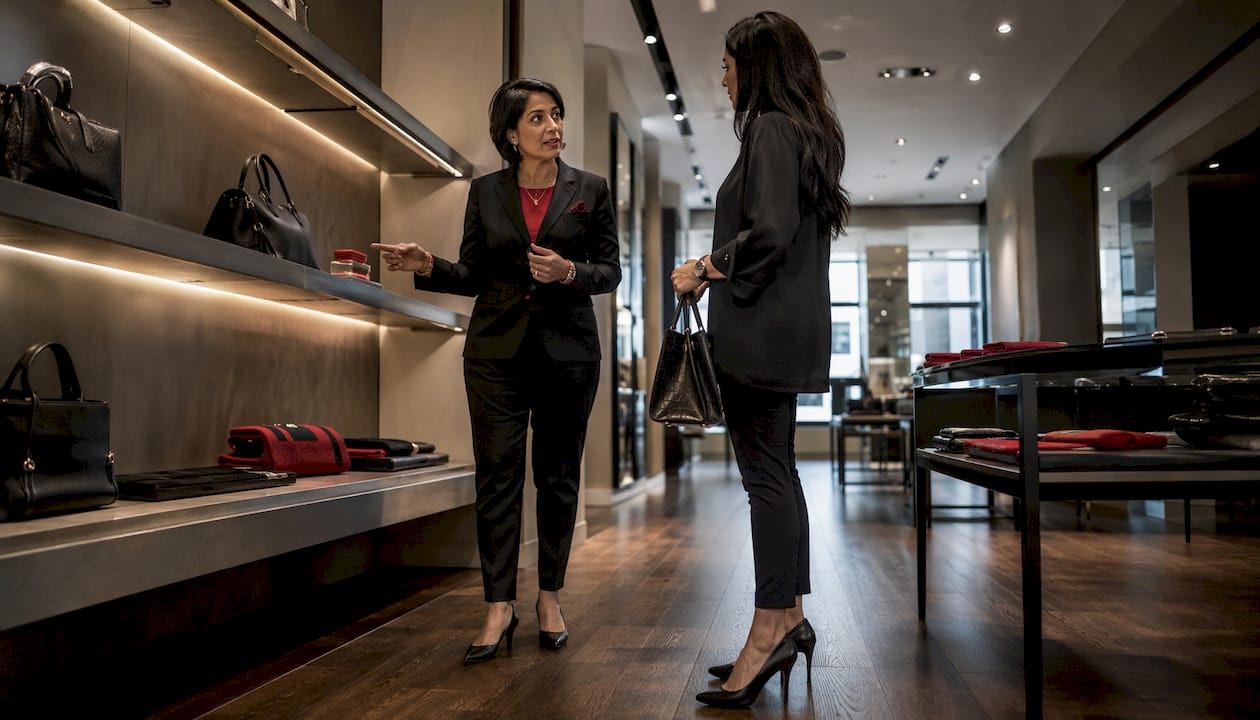
Pro Tip: An appointment-only model in year one is not a limitation. It is a positioning statement. “We see clients by appointment” signals that your time and your product are both scarce.
Which digital tools actually move the needle for a premium brand?
The temptation is to treat digital as a broadcast channel. For luxury, it is a relationship channel. The brands that win online are not the ones with the most followers; they are the ones with the deepest client data and the most consistent content quality.
Channel priorities:
- CRM and clienteling first. Every other channel feeds this. Your CRM is the only digital asset you own outright.
- Owned content: Long-form provenance stories, maker profiles, and material explainers on your own site. This content ranks, converts, and builds trust simultaneously.
- High-quality e-commerce: Slow load times and generic product pages are brand damage. Photography, copy, and UX must match the product quality.
- Selective social presence: One or two platforms, done exceptionally well. Depth over breadth. Instagram and Pinterest for visual luxury; LinkedIn for B2B credibility if relevant.
- Resale partnership management: Monitor secondary market prices. A strong resale value is a marketing asset.
Technology use cases worth investing in:
- Digital Product Passports: Early pilots show provenance tools increase conversion among younger clients when integrated into the purchase journey. A QR code on the product linking to a provenance page is a minimum viable version.
- AI for personalization: Use AI to identify which content resonates with which cohort, not to automate client communication. A personalized CRM sequence written by a human, triggered by AI-identified behavior, outperforms a fully automated flow.
- Data foundation: Collect first-party data from day one. Email, purchase history, and preference data are the inputs for every high-touch CRM workflow.
AI-driven brand strategy frameworks can accelerate discovery and reduce time-to-first-sale when combined with strong creative direction. The key word is “combined.” Data without creative identity produces efficient mediocrity.
Immediate ROI actions:
- Implement a CRM welcome sequence for early-access cohort members within 30 days of launch
- Add provenance pages to your hero SKU before the first press outreach
- Set up UTM tracking on every channel from day one so you know which source produces your best clients, not just your most clients
For a deeper look at luxury digital strategy implementation, the channel-priority framework applies whether you are pre-launch or scaling past your first 1,000 clients.
How do you turn events and service into brand-building assets?
An event is not a marketing expense. Done right, it is a client acquisition and retention tool with a measurable return. The mistake most emerging brands make is treating events as awareness plays rather than conversion moments.
Event playbook:
- Private previews: Invite your top 50 CRM contacts before any public release. Measure attendance-to-purchase rate. If it is below 40%, the event format or the invite list needs work.
- Curated cultural programs: Partner with a gallery, a chef, or a musician whose audience overlaps with your client archetype. The cultural association transfers to your brand.
- Membership series: A quarterly event for founding members creates a recurring reason to engage that is not transactional. Measure repeat attendance and revenue per attendee across three events before deciding whether to scale.
Service metrics to track from day one:
- Appointment-to-purchase conversion rate (target: 50%+ for appointment-only retail)
- NPS among VIP clients (surveyed after purchase, not at point of sale)
- Repeat visit frequency within 12 months
- Revenue per client across the first two years
Scaling without losing the feel:
- Cap event attendance. A private preview with 200 people is not private.
- Use membership tiers to manage access. Not every client needs the same experience.
- Localize curation. A New York client and a Los Angeles client have different cultural references. The event format can be the same; the content should not be.
Experiential marketing for luxury brands works best when the experience itself is the product, not a wrapper around it. The client should leave having experienced the brand’s values, not just seen its products.
What kinds of partnerships actually build cultural legitimacy?
A collaboration is only as good as the cultural credibility it transfers. The wrong partner dilutes your positioning faster than any bad product decision. The right one gives you access to a community you could not reach alone.
Partnership types that matter:
- Craft partners: An artisan, a mill, or a maker whose name carries weight in your category. The partnership must be real and documented, not a licensing arrangement dressed up as craft.
- Cultural institutions: Museums, galleries, and independent publications whose audience overlaps with your client archetype. A co-curated exhibition or a limited editorial placement carries more weight than a paid ad.
- Micro-influencers and ambassadors: Challenger brands perceived as more exclusive often use culturally specific micro-influencers rather than celebrities. An ambassador with 15,000 highly engaged followers in your exact niche outperforms a celebrity with 2 million general followers.
Deal checklist before signing any partnership:
- Creative control: who approves final assets? You must retain veto rights on anything carrying your brand name.
- Distribution rules: where can co-branded product be sold? Ensure it cannot appear in channels that would damage your positioning.
- Co-branding limits: how prominently does each brand appear? Parity is usually wrong; the stronger brand should lead.
- Data-sharing terms: what client data does each party receive from the collaboration?
- Exit terms: what happens to co-branded inventory if the partnership ends?
Collaboration formats and timing:
- Capsule collections: Best in year 2 or 3, after your core identity is established. A capsule before you have a clear identity confuses the market.
- Co-curated events: Can happen in year 1 if the partner’s audience is exactly right. Low risk, high cultural return.
- Artisan residency: A maker-in-residence program creates content, product, and press simultaneously. Plan for a 3–6 month commitment.
What does a realistic U.S. market launch actually cost?
The honest answer is that a credible luxury brand launch in the U.S. requires more capital than most founders expect and less than most agencies will tell you to spend. The cost is not in the product; it is in the positioning infrastructure.
Suggested timeline:
- Pre-launch (months 0–3): Brand identity finalized, hero SKU in production, CRM platform selected, provenance pages drafted, press list built. No public announcement.
- Soft launch (months 3–9): Private preview for founding cohort, DTC site live, first press outreach, CRM sequences active, appointment retail in one market.
- Scale (months 9–36): Second SKU introduced, first selective wholesale partner added, one cultural partnership activated, CRM cohort data used to refine pricing and product.
Cost buckets for a U.S. market launch:
| Cost bucket | Year 0–1 range | Notes |
|---|---|---|
| Product development and sampling | $15,000 | Hero SKU, materials, artisan fees, photography |
| Small-batch manufacturing (first run) | — | Limited units depending on category |
| DTC e-commerce build | — | Custom Shopify or similar; excludes ongoing maintenance |
| Flagship / pop-up retail | — | Per activation; appointment-only lowers cost |
| Marketing and PR | — | Includes press, micro-influencer fees, content production |
| CRM platform and setup | — | Annual platform cost plus initial workflow build |
| Staffing (part-time or fractional) | — | Founder plus fractional head of clienteling |
Break-even signposts:
- At a typical luxury gross margin, you need several hundred thousand dollars in net revenue to cover a lean year-one operating structure.
- A founding cohort in the low hundreds with a strong average order value can support this.
- A healthy repeat purchase rate among early-access members indicates positive unit economics.
Key deliverables per phase:
- Pre-launch: brand book, hero SKU samples, CRM platform live, provenance page drafted
- Soft launch: DTC site, first 50 client relationships, press coverage in one relevant publication
- Scale: second SKU, one wholesale partner, one cultural event, CRM cohort data driving product decisions
Which KPIs actually tell you if your luxury brand is gaining traction?
Vanity metrics are a luxury brand’s worst enemy. Follower counts and impressions tell you nothing about whether your positioning is working. These are the numbers that matter.
Primary KPIs:
- Full-price sell-through rate: The single most important signal. If you are discounting to move inventory, the positioning is wrong.
- Repeat purchase rate among early-access cohort: Measures whether your best clients are returning. Track this within 12 months.
- Average order value (AOV): Track this by acquisition channel. If one channel produces lower AOV, it is attracting the wrong client.
- Customer lifetime value (CLV) by membership tier: Segment your CRM and calculate CLV separately for founding members, early-access clients, and general purchasers.
Supporting metrics:
- Appointment-to-purchase conversion rate (target: 50%+ for appointment retail)
- NPS among VIP clients, surveyed 30 days post-purchase
- Provenance page views as a share of product page views (a proxy for how many clients are engaging with your craft story)
- CRM email open and click rates by cohort
Experiment guidelines for scarcity mechanics:
- Test one scarcity mechanic at a time. Early access vs. numbered run vs. made-to-order are three different signals; running them simultaneously makes attribution impossible.
- Use a minimum cohort of 100 clients per test to get directional data.
- Set a guardrail: if full-price sell-through drops below 80% during a test, pause and diagnose before continuing.
- Measure the effect on repeat purchase rate, not just conversion. A scarcity mechanic that drives one-time purchases but kills retention is net negative.
Corrado Manenti’s 12-month implementation checklist
This is the sequence that separates brands that launch with momentum from those that spend 18 months in pre-launch limbo.
Monthly sprint breakdown:
- Months 1–2 (Founder): Finalize brand identity framework. Write the origin story. Select hero SKU and begin artisan partnership conversations.
- Month 3 (Founder + Head of Product): Commission sample run. Set quality KPIs. Begin provenance documentation and photography.
- Month 4 (Founder + External PR Lead): Build press list of 30–50 relevant journalists and editors. Draft brand narrative for press kit. Identify one cultural partnership candidate.
- Month 5 (Head of Clienteling): Select and configure CRM platform. Build early-access cohort recruitment sequence. Define founding member criteria.
- Month 6 (All): Soft launch to founding cohort. Private preview event. DTC site live. First CRM sequences active.
- Months 7–9 (Head of Clienteling + PR Lead): First press outreach. Activate micro-influencer ambassador. Measure appointment-to-purchase and repeat purchase rate.
- Months 10–12 (Founder + Head of Product): Introduce second SKU based on cohort feedback. Evaluate first wholesale partner candidate. Activate cultural partnership.
Practical checklist items:
- Signature SKU with documented provenance: complete before any press outreach
- CRM platform live with early-access sequence: complete before soft launch
- Appointment-only retail plan for one U.S. market: complete by month 6
- One high-impact cultural partnership activated: complete by month 10
- Pricing governance document: who approves any price change, and what triggers a review
Pro Tip: Write your early-access cohort recruitment script before you need it. The script should explain what founding membership means, what access it provides, and what it does not. Clarity here prevents the expectation mismatches that damage early client relationships.
Fashion brand growth tactics for the luxury segment follow a consistent pattern: the brands that execute the first 90 days with discipline rarely need to course-correct in year two.
Key Takeaways
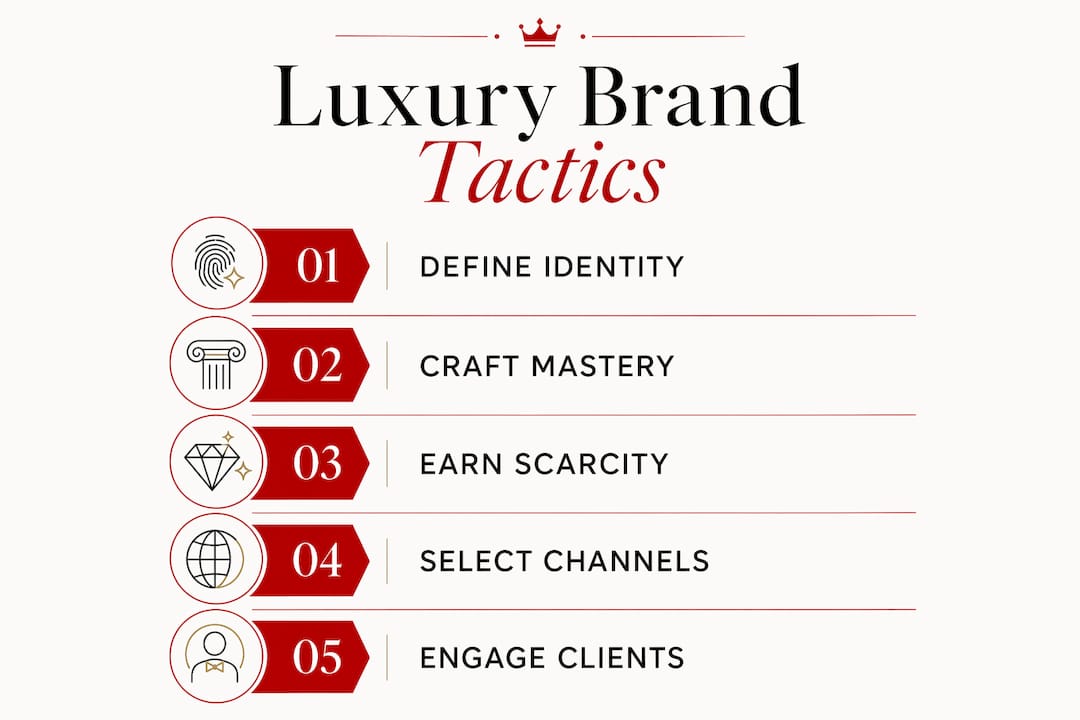
Competing with established luxury brands comes down to identity precision, verifiable craft, earned access, and disciplined distribution, executed in that order.
| Point | Details |
|---|---|
| Identity before everything | Define purpose, cultural code, and customer archetype before spending on product or marketing. |
| Craft must be verifiable | Document material sourcing, artisan partnerships, and production counts before launch. |
| Earned access beats artificial scarcity | Early-access CRM programs and private previews outperform countdown timers and arbitrary supply limits. |
| Distribution is positioning | DTC first, selective wholesale in year 2; broad wholesale damages positioning permanently. |
| Corradomanenti’s approach | Psychology-driven strategy and clienteling design help emerging luxury brands build identity and CRM infrastructure from day one. |
The mistakes I see most often, and what to do instead
The most common error I see from founders entering the luxury market is confusing aspiration with identity. They spend heavily on photography and packaging before they have answered the one question that matters: why would a specific person choose this brand over everything else available to them? Without that answer, the beautiful packaging is just expensive noise.
The second mistake is chasing scale before the positioning is proven. A challenger brand that expands distribution before its founding cohort is deeply loyal is borrowing against a reputation it has not yet earned. IMD’s analysis of winning luxury houses is direct on this: the brands that will remain relevant are those that pair historic luxury codes with transparency and organizational agility, not those that simply grow faster.
The third mistake is poor partner selection. A wholesale partner, a collaborator, or an ambassador who does not share your pricing discipline or your service standards will cost you more in brand equity than they generate in revenue. The right partner is one whose existing clients you would be proud to call your own.
What actually works is simpler than most founders want to hear: one product done exceptionally well, one cohort of clients treated better than they expect, and one clear reason why your brand exists that no established house can claim. Build those three things before you build anything else. The psychology of luxury buyer behavior consistently shows that clients who feel genuinely understood by a brand spend more, return more often, and refer more reliably than clients acquired through broad awareness campaigns.
Earned exclusivity is not a tactic. It is a governance principle. Every decision about pricing, distribution, partnerships, and events should pass one test: does this make our best clients feel more valued, or less?
Corradomanenti can help you build this from the ground up
Most luxury brand consultants hand you a strategy deck and leave you to execute it alone. Corradomanenti works differently: the engagement starts with a diagnostic session that maps your current identity gaps, product proof points, and CRM infrastructure against the framework in this guide, then delivers a prioritized 90-day action plan you can execute immediately.
The core services relevant to this playbook are psychology-driven marketing strategy, CRM and clienteling design, and experiential marketing architecture. Each engagement is built around your specific brand, your target cohort, and your U.S. market entry timeline, not a generic luxury template.
The first session covers your brand identity framework, your hero SKU positioning, and your early-access cohort strategy. You leave with a written brief and a prioritized task list, not a presentation. To book a diagnostic session or learn more about how the methodology applies to your brand, visit Corradomanenti’s fashion brand growth guide and submit an inquiry directly from the page.
Useful sources and further reading
- Business of Fashion: State of Luxury Report — The most current data on U.S. luxury client motivations, including the finding that emotional connection now outranks heritage as a desirability driver.
- BoF: The Rise of Challenger Brands as Beacons of Exclusivity — Specific analysis of how challenger brands are winning on perceived exclusivity in certain U.S. cohorts; essential reading for positioning strategy.
- IMD: Luxury Trends 2026 — Creating Relevance — IMD’s framework for how winning houses combine historic luxury codes with transparency, sustainability, and agility.
- The Fashion Law: The Luxury Reckoning — How Dupes Became the Logical Outcome — Sharp analysis of why the dupe economy is a structural problem for brands whose value is primarily aesthetic; useful for crafting your provenance defense.
- Glion: Luxury Brand Management — Accessible overview of scarcity mechanics, lifecycle planning, and the resale market’s impact on primary luxury; good reference for distribution and pricing sections.
- MarketingWeek: You Don’t Need a Bespoke Luxury Strategy to Succeed — A useful counterpoint to the “luxury is different” orthodoxy; argues that rigorous execution of standard brand-building patterns works in premium categories.
- LinkedIn: Strategies for Startups to Compete With Larger Companies — Practical niche-targeting and differentiation frameworks applicable to emerging luxury brands competing against established houses.
- Corradomanenti: Psychology-Driven Marketing Guide — Foundational resource on applying consumer psychology to luxury brand strategy; the methodology behind the approach described in this guide.