


TL;DR:
- Aspiration marketing connects a brand’s message with consumers’ ideal selves to foster emotional engagement and drive purchases. It relies on benign envy and social comparison to position products as vehicles for identity transformation, targeting both immediate and future audiences. Modern luxury branding emphasizes cultural resonance, authenticity, and specificity to build lasting desire and avoid brand dilution.
Aspiration marketing is defined as the practice of aligning a brand’s message and imagery with consumers’ ideal self-concepts to drive emotional engagement and purchasing decisions. In the luxury sector, this is not a soft branding exercise. It is the primary mechanism by which brands like Louis Vuitton, Rolex, and Chanel convert desire into revenue. The psychological engine behind it draws on René Girard’s theory of Mimetic Desire, which holds that humans want what they see others wanting, and on neuromarketing research showing that identity-based purchasing activates deeper emotional commitment than feature-based buying. Understanding what is aspiration marketing, and how it works at the psychological level, separates brands that generate cultural gravity from those that simply sell products.
What is aspiration marketing and how does it work psychologically
Aspiration marketing works by targeting the gap between who a consumer is today and who they want to become. The product is not sold as an object. It is sold as a vehicle for identity transformation. When Hermès positions a Birkin bag not through product specifications but through imagery of a certain kind of life, it is selling membership in an aspirational identity, not leather goods.

The psychological mechanism most central to this approach is benign envy, a motivating form of envy that increases purchase intention without triggering resentment. Malicious envy, by contrast, causes consumers to reject the brand rather than aspire toward it. The distinction matters enormously in casting, storytelling, and visual tone. A model who appears warm and attainable triggers benign envy. A model who appears cold and untouchable triggers malicious envy and drives consumers away.
Social comparison theory, developed by psychologist Leon Festinger, explains the second layer. Consumers constantly benchmark their current self against reference groups they admire. Aspiration marketing inserts the brand into that comparison as the solution. The Halo Effect amplifies this further: when attractive, admired figures are associated with a product, their positive traits transfer to the brand in the consumer’s perception, independent of any product feature.
“Aspiration marketing does not sell products. It sells the person you could become if you owned them.”
The loyalty loop in aspiration marketing is manufactured through what practitioners call perpetual lack. The brand consistently signals that there is always a next level of belonging to reach, whether through limited editions, tiered membership, or seasonal narrative shifts. This keeps even existing customers in a state of motivated desire rather than satisfied completion.
Pro Tip: When auditing your brand’s creative output, ask whether your imagery triggers admiration or alienation. If your models and settings feel inaccessible rather than aspirationally attainable, you are likely generating malicious envy and suppressing purchase intent.
Who are the two audiences aspiration marketing must serve
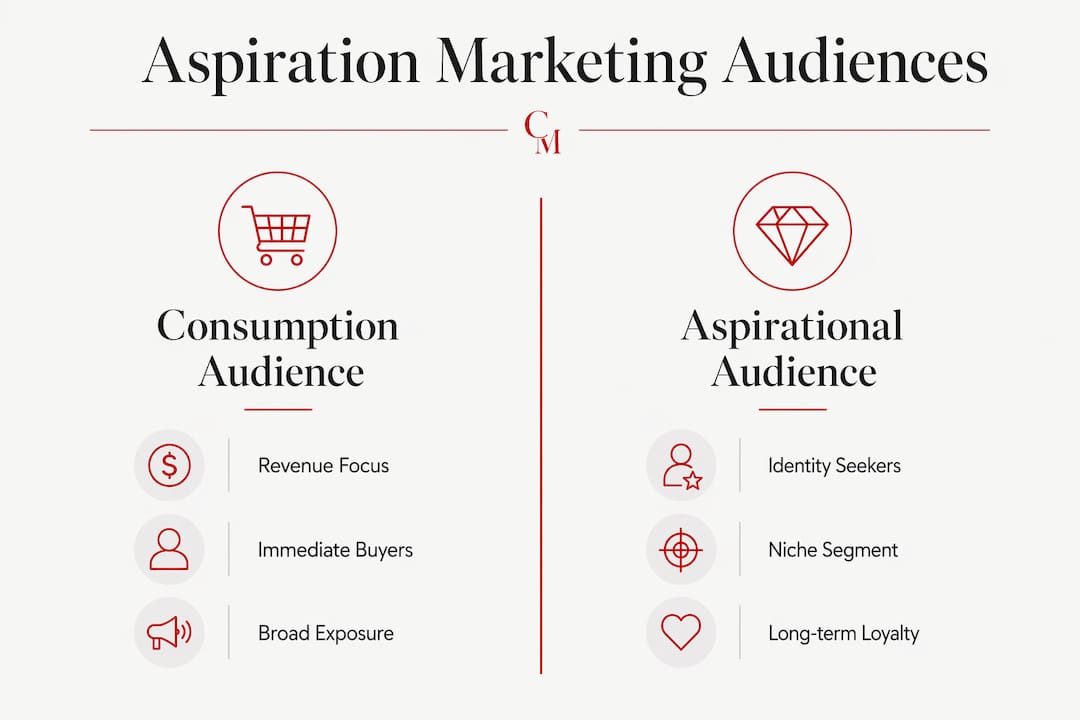
Every luxury brand operates with two distinct audience segments simultaneously, and confusing them is one of the most expensive strategic errors in the sector. The consumption audience consists of consumers who can currently afford the product and represent immediate revenue. The aspirational audience consists of consumers who desire the product but cannot yet afford it, and they represent future revenue, cultural reach, and brand prestige.
Target audiences in aspirational brand strategies typically range from 30% to 60% of the total exposure audience. This means the majority of people who see a luxury brand’s campaign will never buy the product, and that is by design. The aspirational audience amplifies cultural cachet, drives social proof, and creates the perception of desirability that justifies premium pricing for the consumption audience.
| Audience type | Primary role | Strategic risk |
|---|---|---|
| Consumption audience | Immediate revenue and brand sustenance | Alienation if brand chases aspirational reach too aggressively |
| Aspirational audience | Cultural positioning and long-term brand equity | Brand dilution if messaging becomes too accessible |
Premium pricing in aspirational brands is directly linked to keeping the target audience small relative to total exposure. Scarcity of access, real or perceived, is what makes the product worth wanting. This is why luxury brands resist discounting even under revenue pressure. A price reduction does not just affect margin. It collapses the aspirational architecture the brand has spent years building.
The risk of overindexing on the aspirational audience is brand dilution. When a brand becomes too accessible in its messaging or distribution, the consumption audience begins to feel that their purchase no longer signals what it once did. Managing both segments requires precise calibration of channel, tone, and product tier.
Pro Tip: Map your brand’s communication touchpoints against audience segment. Mass social media channels naturally skew toward the aspirational audience. Private events, editorial placements, and concierge experiences serve the consumption audience. Both are necessary, but they require different creative briefs.
How modern aspiration marketing has shifted toward cultural resonance
The aspiration marketing of 2026 looks different from the elite exclusivity model of the early 2000s. The shift is documented and measurable: 68% of consumers now prefer brands that actively reflect their personal values and sense of style. This moves the aspirational ideal away from a fixed image of wealth and status toward something more personal, editorial, and culturally specific.
Luxury brands that still rely solely on heritage imagery and elite signaling are losing ground to brands that understand cultural subcultures and identity tribes. A brand that speaks to a specific aesthetic community, whether that is quiet luxury, sustainable craftsmanship, or urban artisanal culture, generates stronger aspiration than one broadcasting generic prestige. The aspiration is now about belonging to a specific kind of person, not just a specific income bracket.
Sustainability has entered the aspiration marketing equation as both an opportunity and a minefield. Sustainability-linked aspirational claims can drive rapid adoption, but they risk being perceived as greenwashing without verifiable proof points. Consumers in the luxury sector are particularly sensitive to this. They have the resources to research claims and the social capital to publicly reject brands they perceive as dishonest.
The practical implication is that aspirational marketing is evolving from broadcasting elite symbols toward curated storytelling that invites consumer participation and identity alignment. Brands like Bottega Veneta have demonstrated this by withdrawing from conventional social media to create scarcity of access to brand narrative itself, making the brand’s world feel more exclusive precisely by being harder to reach.
Authenticity is no longer optional. Luxury consumers in 2026 punish brands that overpromise and underdeliver on aspirational identity. The gap between what a brand claims to represent and what it actually delivers in product, experience, and values is what practitioners call the authenticity gap. Closing it requires not just better messaging but substantive alignment between brand promise and brand reality.
How to apply aspiration marketing strategies for luxury brand positioning
Effective aspiration marketing in the luxury sector requires a specific narrative architecture. The most persuasive structure blends deficiency marketing with aspirational vision, positioning the consumer’s current state as incomplete and the brand as the path to a more realized self. This is not manipulation. It is empathy applied to brand storytelling.
The framework works in practice through these steps:
- Define the Current Ineffective Self. Identify the specific frustration, limitation, or identity gap your target consumer feels. This requires genuine research into consumer ambitions, not demographic data alone. Emotional triggers are more specific than age brackets.
- Define the Future Heroic Self. Articulate the identity the consumer aspires to inhabit. This should be specific enough to feel personal and attainable enough to feel possible. Vague idealization produces weak aspiration.
- Position the brand as the transformation vehicle. Every visual, verbal, and experiential brand element should reinforce the journey from current self to future self. The product is the mechanism, not the destination.
- Calibrate casting with precision. Luxury brand strategists use highly calibrated casting to sustain benign envy, selecting models who appear warm, approachable, and whose lifestyles feel attainable rather than alienating.
- Maintain coherence across every touchpoint. Aspirational messaging collapses when the in-store experience, customer service, or packaging contradicts the brand world built in advertising. Coherence is the structural requirement for aspiration to function.
Pro Tip: Before finalizing any campaign creative, test it against one question: does this make the viewer feel that the aspired identity is within reach, or does it make them feel excluded? The former builds desire. The latter builds resentment.
The data table below illustrates how aspiration marketing elements map to psychological outcomes:
| Brand element | Psychological mechanism | Consumer outcome |
|---|---|---|
| Aspirational casting | Benign envy activation | Increased purchase intention |
| Narrative identity arc | Identity alignment | Emotional brand attachment |
| Premium pricing and scarcity | Conspicuous consumption signal | Perceived exclusivity and status |
| Values and sustainability messaging | Personal values alignment | Long-term loyalty and advocacy |
For deeper context on how luxury brands shape desire through aspirational branding, the mechanics of positioning and desire engineering are worth examining in detail.
Key takeaways
Aspiration marketing succeeds in luxury when it connects brand identity to the consumer’s future self through psychologically calibrated storytelling, precise audience segmentation, and authentic values alignment.
| Point | Details |
|---|---|
| Core definition | Aspiration marketing sells identity transformation, not product features. |
| Psychological engine | Benign envy and the Halo Effect are the primary drivers of purchase intention. |
| Audience segmentation | Managing consumption and aspirational audiences simultaneously is required for sustained brand equity. |
| Modern shift | 68% of consumers prefer brands aligned with personal values, moving aspiration beyond elite exclusivity. |
| Authenticity requirement | Brands that fail to deliver on aspirational promises face consumer backlash and brand dilution. |
Why I think most luxury brands are using aspiration marketing wrong
After working with luxury and fashion brands across multiple markets, the pattern I see most often is not a failure of creativity. It is a failure of specificity. Brands invest heavily in aspirational imagery that is technically beautiful but emotionally generic. The models are attractive, the settings are expensive, and the message is completely forgettable because it could belong to any brand in the category.
The brands that get this right are the ones willing to commit to a specific cultural identity rather than a broad aspirational archetype. That specificity is what makes aspiration feel personal rather than distant. When a consumer sees a campaign and thinks “that is exactly the kind of person I want to be,” the brand has done its job. When they think “that is a beautiful image,” it has not.
The AI-generated imagery question is becoming impossible to ignore. Brands are using it to reduce production costs, which is understandable. But ethical aspirational marketing in 2026 requires transparency about AI use, particularly in luxury, where authenticity is the foundation of the entire value proposition. A consumer who discovers that the aspirational world they were sold was entirely synthetic will not just feel deceived. They will feel that the brand’s promise of authenticity was itself a lie.
My prediction is that the next phase of aspiration marketing in luxury will be subculture-specific rather than category-wide. Brands that identify and speak directly to specific identity communities, with genuine cultural fluency rather than trend-chasing, will generate the kind of aspiration that converts and retains. Broad prestige signaling is becoming a commodity. Cultural specificity is the new scarcity.
— Corrado
Apply aspiration marketing to your luxury brand strategy
Understanding the psychology behind aspiration marketing is the foundation. Translating it into a brand strategy that drives measurable growth in the luxury sector requires a different level of precision. Corradomanenti specializes in exactly this intersection, combining consumer psychology with fashion brand growth tactics built specifically for high-end markets. If you want to understand not just what your consumers think but why they buy, the work starts with a deeper analysis of their aspirational drivers. Explore how buyer behavior analysis can sharpen your brand positioning and make your aspiration marketing work harder.
FAQ
What is the aspiration marketing definition in simple terms?
Aspiration marketing is the practice of connecting a brand’s messaging to consumers’ ideal future selves rather than their current reality. It sells identity and transformation, not product features.
How does aspiration marketing differ from aspirational branding?
Aspiration marketing refers to the campaign-level tactics used to trigger desire and identity alignment. Aspirational branding is the broader, longer-term positioning strategy that makes a brand an object of desire across all touchpoints and over time.
What are the main benefits of aspiration marketing for luxury brands?
The primary benefits are stronger emotional engagement, higher perceived brand value, and the ability to command premium pricing. Brands that successfully trigger benign envy see measurable increases in purchase intention and long-term loyalty.
What is the biggest risk in aspiration-based advertising?
The authenticity gap is the most damaging risk. Luxury consumers punish brands that fail to deliver substantively on aspirational promises, and the reputational damage is difficult to reverse once trust is broken.
How large is the aspirational audience compared to the consumption audience?
Aspirational product target audiences typically range from 30% to 60% of the total exposure audience. The majority of people who see a luxury campaign will never purchase the product, which is a deliberate structural feature of the strategy, not a failure of reach.