


TL;DR:
- Premium pricing signals exclusivity and value by aligning brand, product, and experience.
- It relies on perceived quality, scarcity, and emotional worth, not just product specs or discounts.
Premium pricing is deliberately setting a significantly higher price to signal superior value, exclusivity, and identity to buyers who pay for prestige rather than function alone. It works when the brand, product, and experience all reinforce the same story. When any of those three breaks down, the price becomes indefensible.

This strategy is the default engine behind brands like Hermès, Rolex, and Tiffany & Co. — and the reason emotional brand enhancement drives willingness to pay more reliably than product specs ever could.
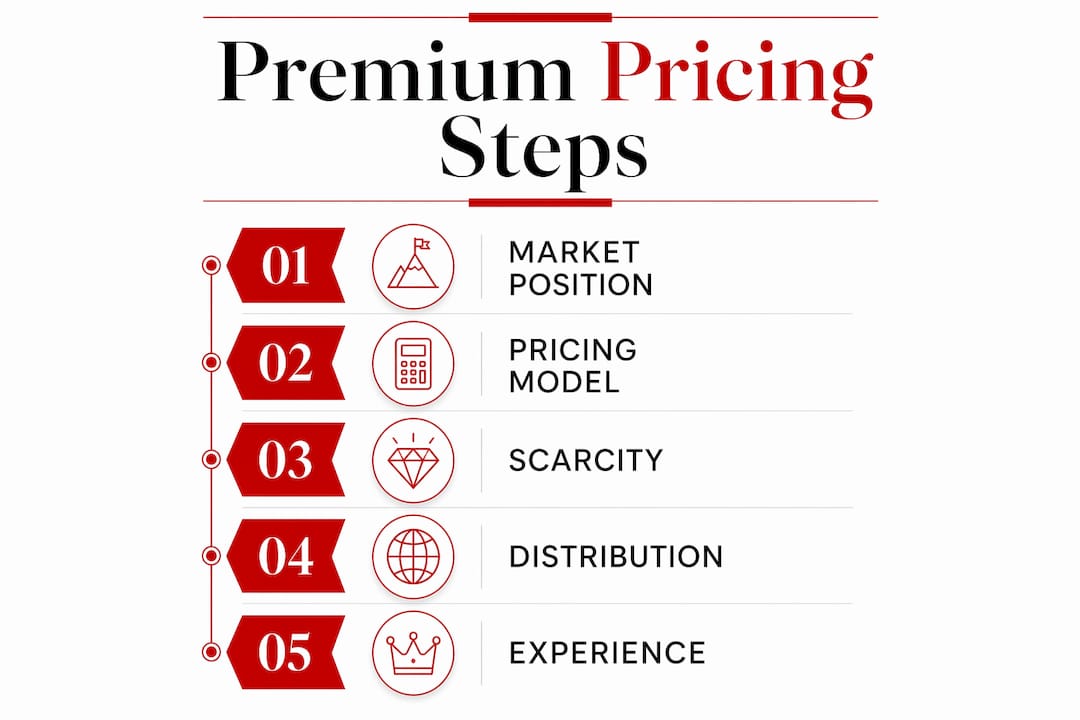
Three things make premium pricing work:
- Perceived quality and craftsmanship — buyers must believe the product is categorically better, even when they cannot objectively test it.
- Exclusivity and scarcity signaling — limited access reinforces the idea that not everyone can or should own this.
- Emotional and social value — the purchase says something about who the buyer is, not just what they bought.
One warning worth stating plainly: broad distribution or mass-market moves dilute prestige faster than almost any other mistake. Premium pricing is not a margin lever you pull in isolation. It is a system.
Table of Contents
- How consumer psychology makes a higher price feel worth it
- What your brand must have before premium pricing holds
- Which premium pricing tactics actually work for luxury brands
- How to implement premium pricing: a step-by-step timeline
- How to measure whether your premium pricing is working
- Common ways premium pricing fails — and how to prevent it
- How Hermès, Rolex, and Tiffany & Co. make premium pricing stick
- Key Takeaways
- Why most brands get premium pricing backwards
- Corradomanenti can help you build and protect your premium position
- Useful sources
How consumer psychology makes a higher price feel worth it
The price-quality heuristic is the foundation. When buyers lack the expertise to evaluate a product objectively, price becomes the proxy for quality. A $650 candle and a $12 candle may share similar ingredients, but the $650 version signals something the buyer wants to believe: that they have taste, access, and discernment.
Beyond that heuristic, three psychological levers do most of the work. Status signaling lets buyers communicate social position through ownership. Identity expression lets them align a purchase with who they want to be. Scarcity signaling creates urgency and perceived rarity that makes ownership feel earned rather than merely purchased. Anchoring ties it together: when a brand shows an ultra-premium option first, the standard premium tier suddenly feels reasonable by comparison.
“Consumers are willing to pay more for certain goods and not for others. To the marketer, it means creating a brand equity or value for which the consumer is willing to pay extra — and luxury is the main factor differentiating a brand in a product category.”
— Wikipedia, Premium pricing
The fragility here is real. The moment supporting signals weaken — a discount on a third-party site, a product quality complaint that goes viral, a celebrity pairing that feels off-brand — the psychological scaffolding collapses. Prestige is not a feature; it is a perception maintained by every touchpoint simultaneously.
What your brand must have before premium pricing holds
Not every brand can sustain a premium price. Before you move on tactics, run through this checklist honestly.
- Brand positioning clarity. Buyers must understand immediately what the brand stands for and who it is for. Ambiguity reads as uncertainty, and uncertainty kills willingness to pay.
- Demonstrable product superiority or differentiated craftsmanship. This does not have to mean the highest-spec materials — it means a proof point the buyer can feel, see, or tell a story about. Authenticity in branding is what makes that proof point believable.
- Controlled distribution. Selling through every available channel destroys scarcity. Selective retail, direct-to-consumer, and curated wholesale are the levers that preserve it.
- Premium service and fulfillment. Packaging, retail ambiance, and white-glove service are not optional extras — they are structural pillars that must align with the price.
- Defensible storytelling and heritage. A brand with no story is just an expensive product. Heritage, founder narrative, or a clear craft philosophy gives buyers a reason to repeat the purchase and tell others about it.
Pro Tip: Run a simple price-signal test before committing to a full launch. Show a small segment of your core buyers two versions of the same product page — one with the premium price, one at market average — and measure which generates more inquiry and fewer “is this worth it?” questions. If the premium page creates more friction, your supporting signals are not yet strong enough.
Which premium pricing tactics actually work for luxury brands
The tactic you choose should match where your brand sits in the market.
| Tactic | Best for | When to use |
|---|---|---|
| Prestige pricing (single high price) | Heritage boutique brands | Strong brand equity, controlled distribution |
| Good-better-best (tiered) | Aspirational designer labels | Capturing multiple segments without diluting the top tier |
| Price anchoring / decoy | Any premium brand launching new SKUs | Repositioning perceived value before a price increase |
| Limited editions / drops | Fashion and lifestyle brands | Creating urgency and scarcity without permanent price changes |
| Bespoke / personalized pricing | Ultra-luxury and made-to-order | Removing price from the conversation entirely |
A tiered structure with a clear premium anchor preserves brand leadership while giving aspirational buyers an entry point. The key discipline: the entry tier must never feel like a discount version of the brand. It should feel like the beginning of a relationship.
Anchoring and decoy options are among the most repeatable tactics available. The anchor does not need to sell frequently. Its job is to make the intended premium tier feel comparatively reasonable. A $4,500 handbag on the same shelf as a $12,000 one suddenly reads as accessible.
Limited editions and drops work because they manufacture scarcity on a schedule. The buyer knows the window is real, which compresses the decision cycle and removes price sensitivity from the equation.
How to implement premium pricing: a step-by-step timeline
Months 0–3: Research and price discovery
- Map your current price perception among core buyers through surveys and purchase-behavior analysis.
- Identify the ceiling price your positioning can support without triggering resistance.
- Audit competitor positioning to locate the white space your brand can own.
Months 3–6: Pilot and messaging
- Develop value messaging and storytelling that explains the price without justifying it defensively. The power of storytelling is what converts skeptics into believers.
- Design a test assortment — one or two SKUs at the new price point — and launch in a controlled channel.
- Set distribution rules: which retailers, which geographies, which online channels are in or out.
Months 6–12: Scale and service alignment
- Roll out the full assortment based on pilot data.
- Align post-purchase experience: packaging, delivery, customer service response times, and returns policy must all match the price.
- Train retail staff and wholesale partners on the brand story and price rationale.
Budget buckets to plan for: brand creative and photography, experiential retail or pop-up investment, sampling and warranty programs, and paid and earned communications.
How to measure whether your premium pricing is working
Track these KPIs from day one of the pilot:
- Price elasticity: Run regional or A/B price tests and measure volume response. Inelastic demand (small volume drop for a meaningful price increase) confirms the premium is holding.
- Average order value (AOV): Rising AOV without promotional pressure is a strong signal.
- Gross margin per SKU: Premium pricing should widen margin, not just revenue. If margin is flat, cost structure is absorbing the gain.
- Customer lifetime value (CLTV): Premium buyers who return are the proof the strategy is working. One-time buyers at a high price are not a premium customer base.
- Repurchase rate: A drop here is the earliest warning sign. It usually means the experience did not match the price expectation.
- Brand-lift metrics: Track consideration, preference, and net promoter score among your target segment quarterly.
- Distribution metrics: Monitor the number of active retail doors and the percentage of sales through controlled channels. Overexposure shows up here first.
When repurchase rates fall or channel overexposure appears, pause distribution expansion before touching the price. Pulling back is easier than rebuilding prestige after a discount.
Common ways premium pricing fails — and how to prevent it
| Failure mode | Why it happens | Mitigation |
|---|---|---|
| Distribution overreach | Chasing volume by adding channels | Hard cap on retail doors; audit annually |
| Weak aftercare | Post-purchase experience does not match price | Invest in packaging, service, and follow-up |
| Inconsistent messaging | Brand story varies by channel or market | Single brand bible; quarterly channel audits |
| Competitive parity | A rival matches perceived value or innovates | Continuous differentiation investment is non-negotiable |
| Price dilution via promotions | Discounts on third-party sites | Strict MAP policies; authorized-reseller agreements |
Maintaining premium status is not a one-time achievement. It requires ongoing reinvestment in product, experience, and storytelling. If a crisis hits — a quality issue, a brand misstep, or a competitor breakthrough — the fastest recovery tools are a pullback of distribution, a limited re-issue with elevated specs, and an exclusive drop that resets scarcity signals.
How Hermès, Rolex, and Tiffany & Co. make premium pricing stick
Hermès operates on controlled scarcity taken to its logical extreme. Birkin bags are not available for direct purchase online; buyers must build a purchase history in-store first. The price is almost secondary to the access. Copyable takeaway: make the buying process itself feel exclusive, not just the product.
Rolex uses prestige pricing combined with a heritage narrative so consistent it has become self-reinforcing. The brand rarely discounts, rarely extends into new categories, and invests heavily in prestige pricing mechanics that keep secondary-market prices above retail. Copyable takeaway: secondary-market price health is a leading indicator of primary-market prestige — track it.
Tiffany & Co. anchors its entire identity to a single visual cue (the blue box) and a clear emotional promise (the gift of significance). The packaging is inseparable from the price justification. Copyable takeaway: identify one sensory or visual element that can carry the brand’s emotional promise at every touchpoint, then protect it obsessively.
Louis Vuitton in the fashion category demonstrates how a good-better-best structure can coexist with ultra-premium positioning when the tiers are clearly differentiated by material, craftsmanship, and access — not just price. Gucci has used limited-edition collaborations to reset cultural relevance without permanently altering its core price architecture.
Key Takeaways
Premium pricing works when price, product quality, distribution control, and experiential reinforcement all tell the same story simultaneously.
| Point | Details |
|---|---|
| Psychology drives willingness to pay | Buyers pay for prestige, identity, and social signaling — not function alone. |
| Prerequisites come before tactics | Positioning clarity, controlled distribution, and defensible storytelling must be in place first. |
| Anchoring reshapes perceived value | A high-price anchor makes the intended premium tier feel reasonable without needing to sell often. |
| Repurchase rate is the earliest warning | A drop in repeat purchases signals the experience did not match the price — act before touching the price itself. |
| Corradomanenti applies psychology to pricing | Corrado Manenti’s consulting integrates consumer psychology and luxury brand expertise to build and sustain premium positioning. |
Why most brands get premium pricing backwards
The conventional wisdom says: build a great product, then charge more for it. That sequence is wrong for luxury and fashion brands, and the evidence from every durable prestige brand confirms it.
Hermès did not become Hermès because it made excellent leather goods. It became Hermès because it built a system of signals — scarcity, access, ritual, heritage — that made the leather goods feel like the physical proof of something larger. The product followed the positioning, not the other way around.
What most brand managers underestimate is how much of premium pricing is a promise made before the product is ever touched. The store environment, the website load time, the way a sales associate answers the phone — these are pricing decisions as much as the number on the tag. A brand that charges $800 for a jacket but ships it in a poly mailer has broken its own promise.
The other thing practitioners consistently miss: the distinction between premium and luxury matters tactically. Premium pricing can be justified by superior function — better materials, longer warranty, measurable performance. Luxury pricing is justified by heritage, exclusivity, and aspiration. Trying to claim both without the proof points for each is where dilution begins. Choose your lane, then build every signal around it.
Corradomanenti can help you build and protect your premium position
Brands that charge premium prices and keep them do one thing differently: they treat pricing as a brand decision, not a finance decision. Corradomanenti works with fashion, luxury, and lifestyle brands in the United States to build the psychological and operational infrastructure that makes a premium price believable and defensible.
The consulting scope covers price discovery and consumer psychology research, value messaging and brand storytelling, pilot assortment design, distribution governance, and post-launch measurement. A first engagement typically delivers a clear pricing architecture and a 90-day implementation roadmap — concrete enough to act on immediately.
If you are deciding whether to move to a single-tier premium model or a good-better-best structure, that conversation starts with understanding your buyer’s identity drivers, not your cost sheet. Explore luxury brand growth tactics and reach out to start a discovery conversation.
Useful sources
| Source | What it covers |
|---|---|
| Wikipedia: Premium pricing | Foundational definition, psychological mechanics, and market conditions for prestige pricing |
| NielsenIQ: Premium pricing insights | Emotional and social brand value as the primary willingness-to-pay driver |
| AccountingTools: Premium pricing strategy | Distribution risk, margin trade-offs, and the role of warranties and service in justifying premiums |
| Paddle: Premium pricing blog | Tiered pricing structures and good-better-best anchoring for brand leaders |
| Getzendo: Premium pricing tactics | Anchoring, decoy pricing, and experiential reinforcement as executional steps |
| EconomicsHelp: Premium pricing overview | Competitive vulnerability and the ongoing investment required to sustain a premium position |
| Pricefy: Premium pricing explained | The functional vs. emotional distinction between premium and luxury positioning |
| Corradomanenti: Prestige pricing for luxury brands | Practitioner guidance on prestige pricing mechanics and distribution control |
| Corradomanenti: Emotional branding guide | Translating emotional brand value into higher willingness to pay for luxury buyers |