


TL;DR:
- Prestige pricing sets prices above market norms to signal quality and exclusivity, aiming for margin expansion. It relies on a full ecosystem of brand equity, product differentiation, scarcity, and controlled distribution to maintain its effectiveness. Without a strong narrative and consistent experience, high prices can undermine brand perception and sales.
Prestige pricing is the deliberate practice of setting prices significantly above market averages to signal superior quality, exclusivity, and status — and it works best when a brand has the equity, product differentiation, and distribution control to back that signal up. This is not a tactic for every product or every market. It is a strategic choice for brands whose buyers treat price as proof of worth.
TL;DR — what you need to know:
- Prestige pricing targets price-insensitive buyers who use price as a quality cue
- The goal is margin expansion and brand positioning, not volume growth
- It requires a full ecosystem: packaging, service, scarcity, and controlled distribution must all validate the price
- Without brand equity and narrative architecture, raising prices alone will backfire
Table of Contents
- What is prestige pricing, and what does it actually mean?
- Why prestige pricing works: the psychology behind the price tag
- Real brands that show prestige pricing in action
- Which brands and products are actually suited to prestige pricing?
- How to implement prestige pricing step by step
- What are the real risks of prestige pricing?
- How do you measure whether prestige pricing is working?
- How does prestige pricing compare to other pricing strategies?
- Psychology-driven checklist before you commit to prestige pricing
- Key Takeaways
- Why most brands get prestige pricing wrong
- Work with a consultant who understands the psychology of premium pricing
- Useful sources
What is prestige pricing, and what does it actually mean?
Prestige pricing — also called premium pricing or image pricing — sets prices well above the market norm to communicate that a product occupies a different category entirely. The price is not a reflection of production cost. It is a signal. Monash University’s marketing dictionary defines it as a strategy “in which prices are set at a high level, recognising that lower prices will inhibit sales rather than encourage them.”
That last part is the counterintuitive core of the whole approach. For certain products and certain buyers, a lower price does not attract more customers. It raises doubt.
The mechanics differ sharply from cost-plus or competitive pricing:
- Cost-plus pricing adds a margin to production cost. Prestige pricing ignores cost as the anchor and builds price around perceived value and brand position instead.
- Competitive pricing matches or undercuts rivals. Prestige pricing deliberately avoids that race.
- Price as a signal: the elevated price itself communicates quality, craftsmanship, or exclusivity — often before the buyer has evaluated the product at all.
For a deeper look at how luxury pricing models differ across brand tiers, Corradomanenti’s dedicated guide covers the distinctions in detail.
Why prestige pricing works: the psychology behind the price tag
The behavioral science here is well-established. Consumers use price as a mental shortcut to infer quality when product information is costly or difficult to evaluate — a phenomenon known as the price-quality heuristic. When you cannot easily assess whether one watch movement is superior to another, price becomes the proxy. A $12,000 watch reads as categorically different from a $1,200 one, regardless of what either buyer knows about horology.
Three psychological mechanisms drive this:
- Price-quality heuristic: buyers assume higher price equals higher quality, especially in categories where quality is hard to verify before purchase.
- Signaling theory: a high price signals to others that the buyer has the means and taste to afford it — the purchase becomes a social statement.
- Veblen effects: named after economist Thorstein Veblen, this describes goods where demand actually increases as price rises, because the high price is the point. The Monash University marketing dictionary cross-references prestige pricing directly with the Veblen effect for this reason.
Academic literature also classifies prestige pricing alongside skim pricing — a strategy that intentionally targets less price-sensitive consumers to maximize early margins before a broader market opens up. The two are not identical, but they share the same segmentation logic: find the buyers for whom price is not the primary objection, and price for them.
Understanding psychological pricing strategies in depth is worth the time for any brand manager considering this route — the heuristics that support prestige pricing can also be undermined by the wrong promotional choices.
Real brands that show prestige pricing in action
Prestige pricing examples span industries, but a few cases illustrate the mechanics better than any textbook definition.
Apple prices its flagship iPhone models at a significant premium over Android competitors with comparable hardware specifications. The price signal works because Apple controls the full ecosystem — hardware, software, retail environment, and post-purchase service. Buyers are not just paying for a phone. They are paying for membership in a perceived category of people who use Apple products. The price is part of that identity signal.

Hermès and the Birkin bag are the canonical prestige pricing case study. A standard Birkin starts above $10,000 at retail and routinely sells for multiples of that on the secondary market. Hermès controls supply so tightly that NPR’s Planet Money documented the near-impossibility of simply walking into a store and buying one. Scarcity is not a side effect — it is the product. The craftsmanship narrative (each bag hand-stitched by a single artisan) validates the price, but the controlled distribution creates the desire.
Nike’s premium lines — Air Jordan, Nike x collaborations, and limited-run Dunks — use scarcity and cultural narrative rather than materials cost to justify prices that far exceed the brand’s standard retail. A pair of Air Jordans retails at a price point that signals status within specific communities, and the resale market amplifies that signal. Nike’s broader catalog runs on competitive pricing; the premium lines operate on entirely different logic. The role of exclusivity in fashion is central to why this works.
Luxury car makers — Porsche, Ferrari, Bentley — price flagships at levels that bear no proportional relationship to manufacturing cost. Ferrari deliberately caps annual production to maintain scarcity. Porsche uses trim-level anchoring: the base 911 makes the Turbo S feel aspirational, and the Turbo S makes the base 911 feel attainable. Both are prestige-priced relative to the broader automotive market.
The common thread across all four: none of these brands compete on price. They compete on what the price means.
Which brands and products are actually suited to prestige pricing?
Not every brand can or should attempt this. The prerequisites are specific, and skipping any one of them tends to produce the worst outcome: a high price that buyers simply ignore.
Suitability criteria:
- Strong brand equity — buyers must already associate the brand with quality or status before the price can reinforce that perception.
- Differentiated product value — the product must offer something genuinely hard to replicate, whether that is craftsmanship, technology, heritage, or cultural cachet.
- Limited or controlled supply — scarcity, whether natural or manufactured, supports the exclusivity signal. Exclusivity in branding is not just a marketing concept; it is a supply-chain decision.
- Status-seeking buyer segments — the target cohort must include buyers for whom the social signal of the purchase matters, not just the functional utility.
- Controlled distribution channels — flagship retail, direct-to-consumer, invitation-only drops, or carefully curated wholesale partners. Mass-market distribution undercuts the signal.
Quick decision checklist — run through these before committing:
- Does your brand have a clear, defensible quality or heritage narrative?
- Can you genuinely limit supply or access without losing critical revenue?
- Is your packaging, service, and in-store (or digital) experience already at the level the price implies?
- Do your target buyers make purchases partly for social visibility or self-expression?
- Can you maintain price discipline — no flash sales, no heavy discounting — for at least 12–18 months?
- Do you have the margin structure to absorb lower volume without financial pressure to discount?
If you answered no to more than two of these, prestige pricing will likely damage rather than build brand equity. The luxury branding success framework is worth reviewing before making that call.
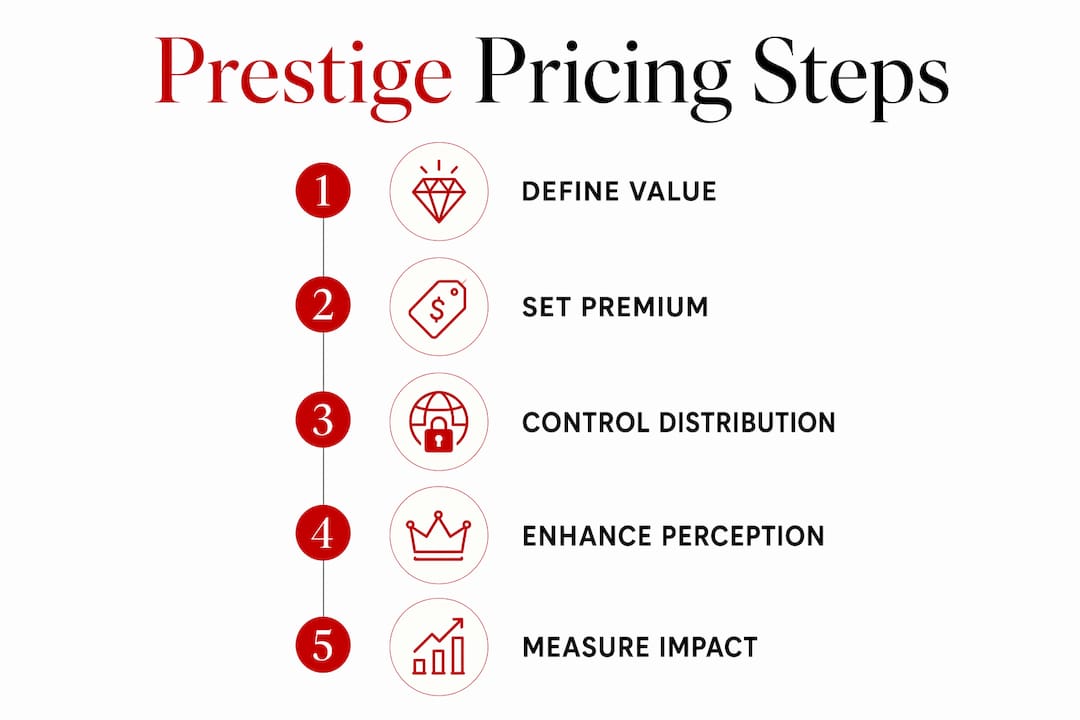
How to implement prestige pricing step by step
Implementation is where most brands stumble. The price itself is the easy part. The hard part is building the ecosystem that makes the price believable.
-
Segment your market precisely. Identify the cohort of buyers for whom status, quality signaling, or exclusivity genuinely drives purchase decisions. This is not your entire customer base — it is a defined subset. Use CRM data, purchase history, and cohort analysis to find them.
-
Set the price anchor deliberately. Your flagship price anchors perception for everything else you sell. Price it too low and you undermine the whole brand. Price it without supporting evidence and buyers will not accept it. The anchor should feel aspirational but not arbitrary.
-
Design a tier structure. A single prestige price point is fragile. A tiered structure — entry prestige, core prestige, ultra-premium — gives buyers a ladder to climb and makes the top tier feel even more exclusive by contrast.
-
Build scarcity into the product design. Limited editions, numbered runs, seasonal drops, and waitlists all reinforce the exclusivity signal. This is not manipulation — it is scarcity and craft working together to create genuine perceived value.
-
Control your distribution channels. Every channel decision is a brand decision. Selling through a discount retailer, even once, sends a signal that contradicts the price. Flagship stores, direct e-commerce with premium UX, and curated wholesale partners are the right channels.
-
Align packaging, service, and post-purchase experience. The price sets an expectation. Every touchpoint after the purchase either confirms or destroys it. Unboxing experience, customer service response time, and even the language used in follow-up emails all carry weight.
-
Establish strict promotional rules. No flash sales. No coupon codes. No “limited time” discounts. If you need to move inventory, do it through private client events or trade-in programs — never through public discounting that signals desperation.
Pro Tip: Before launching at the prestige price point, run A/B price anchoring tests in low-risk digital channels — paid social or email segments — to estimate elasticity among your premium cohort. This gives you real data before you commit the full brand to a price position.
Pro Tip: Write a service script for every customer-facing team member. The verbal experience of buying a prestige product must match the visual and tactile experience. A premium price paired with a generic customer service interaction breaks the spell immediately.

What are the real risks of prestige pricing?
Prestige pricing risks are real and worth taking seriously before committing. The strategy accepts a deliberate trade-off: lower volume in exchange for higher margins and stronger brand positioning. That trade-off only works if the brand can sustain it.
Primary risks:
- Alienating mass-market buyers. Once you price for prestige, you are explicitly excluding a large portion of potential customers. That is the point — but it requires a clear-eyed view of whether your premium cohort is large enough to sustain the business.
- Failing to meet elevated expectations. A prestige price creates a prestige expectation. If the product, packaging, or service falls short, the disappointment is proportionally larger than it would be at a lower price point.
- Margin vs. volume pressure. If sales volume drops faster than margin per unit rises, the strategy is failing. This is the most common execution failure.
- Brand reputation damage from execution slips. A single viral customer service failure, a quality defect, or a public discounting event can undo years of positioning work.
Red-flag signals to watch:
- Increased return rates among premium cohort buyers
- Negative social proof appearing in review platforms or social media
- Sales drop across multiple consecutive periods without a market-wide explanation
- Unauthorized discounting appearing in secondary channels
Mitigations:
- Stage the price increase over 2–3 product cycles rather than jumping to the target price immediately
- Align quality control and service standards before raising prices, not after
- Build a contingency pricing plan: know in advance what you will do if volume drops below a defined threshold
- Monitor secondary market pricing — if your product is being discounted there, your primary price signal is already compromised
How do you measure whether prestige pricing is working?
The right metrics for prestige pricing are different from standard volume-based KPIs. You are not optimizing for units sold. You are optimizing for margin quality, brand perception, and the long-term value of your premium buyer cohort.
Primary KPIs to track:
- Margin per unit — the most direct measure of whether the price elevation is translating to profit
- Contribution margin — margin per unit scaled across the actual volume sold
- Price elasticity estimates — how much does demand change when you adjust price? A low elasticity reading among your premium cohort is a positive signal
- Average order value (AOV) — are premium buyers purchasing more per transaction over time?
- Customer acquisition cost (CAC) for premium cohorts — what does it cost to acquire a buyer who actually pays the prestige price?
- Customer lifetime value (LTV) — premium buyers who are genuinely brand-loyal generate disproportionate LTV; track this cohort separately
- Return and complaint rates — elevated returns or complaints among premium buyers signal a gap between price expectation and product reality
How to run elasticity tests: start with small price variations in digital channels — paid search, email segments, or direct-to-consumer landing pages — before rolling out across retail or wholesale. A simple A/B test comparing two price points for the same product, held for 4–6 weeks, gives you a directional elasticity estimate. A positive signal is when the higher-priced variant converts at a rate close to the lower-priced one. A negative signal is a sharp conversion drop that is not offset by the margin gain.
Data sources: point-of-sale systems, CRM cohort analysis, Google Analytics 4 e-commerce tracking, and post-purchase surveys. Review these monthly during the first year of implementation, then quarterly once the strategy stabilizes. Understanding buyer behavior at the cohort level is what separates brands that sustain prestige pricing from those that quietly abandon it after 18 months.
How does prestige pricing compare to other pricing strategies?
| Pricing strategy | Best for | Primary goal | Typical tactics | Key trade-offs | Common KPIs |
|---|---|---|---|---|---|
| Prestige / image pricing | Luxury, premium, heritage brands | Margin and brand positioning | Scarcity, tier anchoring, controlled distribution | Lower volume, high execution risk | Margin per unit, LTV, AOV |
| Cost-plus pricing | Commodity and manufactured goods | Cost recovery and predictable margin | Fixed markup over production cost | Ignores market perception and competitive dynamics | Gross margin, break-even |
| Competitive / market pricing | High-volume, price-sensitive categories | Market share retention | Price matching, promotional cycles | Margin compression, race to the bottom | Market share, units sold |
| Penetration pricing | New market entry, subscription products | Volume and user acquisition | Below-market launch price, freemium | Difficult to raise prices later without churn | CAC, conversion rate |
| Value-based pricing | B2B, SaaS, professional services | Capture willingness-to-pay | Buyer research, segmented tiers | Requires deep buyer insight to execute | Revenue per customer, NPS |
The most effective brands rarely use a single approach across their entire catalog. Many run prestige pricing for flagship or hero SKUs while using value-based or competitive pricing for broader mid-tier lines. This protects overall category share without diluting the premium signal at the top. The key rule: never let the mid-tier pricing logic bleed into the flagship’s positioning. Separate them by channel, by product name, and by the entire surrounding experience.
Psychology-driven checklist before you commit to prestige pricing
This checklist draws on practitioner experience and behavioral research. Run through it before finalizing your pricing strategy — not after launch.
Brand narrative and proof points:
- [ ] You have a documented brand story that explains why the product is worth the price (heritage, craft, innovation, or cultural authority)
- [ ] The product has at least one verifiable proof point that a buyer can cite to justify the purchase to themselves or others
- [ ] Your brand’s visual identity — logo, typography, color palette — reads as premium without explanation
Service and packaging:
- [ ] Packaging matches or exceeds the price expectation at every tier
- [ ] Customer service scripts are written for a prestige context (language, response time, resolution approach)
- [ ] Post-purchase experience is mapped: what does the buyer see, receive, and feel in the 72 hours after purchase?
Scarcity and distribution controls:
- [ ] Supply limits are defined and enforced — not just aspirational
- [ ] Distribution partners are vetted and contractually bound to pricing and presentation standards
- [ ] You have a clear policy for what happens when unauthorized discounting appears in secondary channels
Price communications:
- [ ] Price is presented without apology — no “only $X” framing, no comparison to cheaper alternatives
- [ ] Promotional communications never lead with price; they lead with product story or exclusivity
Pro Tip: Map the post-purchase experience as carefully as the purchase funnel. The moment a prestige buyer receives their order is when the price is either validated or questioned. A premium unboxing experience, a handwritten note, or a personalized follow-up call does more for long-term retention than any loyalty points program.
Key Takeaways
Prestige pricing works when price, brand equity, product quality, and distribution control all reinforce the same signal — and fails when any one of those elements is missing.
| Point | Details |
|---|---|
| Price is a signal, not a cost calculation | Prestige pricing sets prices to communicate quality and exclusivity, not to recover production costs. |
| Psychology drives acceptance | The price-quality heuristic and Veblen effects explain why higher prices increase desirability among status-sensitive buyers. |
| Execution requires a full ecosystem | Packaging, service, scarcity, and distribution must all validate the price — raising the number alone will fail. |
| Measure margin quality, not volume | Track margin per unit, LTV of premium cohorts, AOV, and price elasticity — not units sold. |
| Corradomanenti applies this framework | Corradomanenti’s psychology-driven consulting practice helps luxury and fashion brands build the narrative architecture that makes prestige pricing hold. |
Why most brands get prestige pricing wrong
The most common mistake is treating prestige pricing as a revenue lever you pull when margins are under pressure. That is exactly backwards. By the time you need the margin, it is too late to build the brand equity that makes the price believable.
The brands that sustain prestige pricing over years — not just quarters — treat price as the last decision, not the first. They build the product, the story, the service, and the distribution first. Then they set a price that reflects all of it. When a client comes to me asking whether they can raise prices, my first question is always about the ecosystem: does the packaging, the service, the channel mix, and the brand narrative already feel like they belong at the higher price point? If the answer is no, raising the price will just make the gap more visible.
The psychology research backs this up. Consumers are not fooled by a high price alone. They are persuaded by a coherent system of signals that all point in the same direction. A prestige price paired with inconsistent service, mass-market distribution, or a weak brand story does not create luxury perception. It creates confusion — and confused buyers do not pay premium prices.
Work with a consultant who understands the psychology of premium pricing
Prestige pricing is one of the highest-leverage decisions a brand can make, and one of the easiest to execute badly. Corradomanenti brings together a background in consumer psychology and hands-on luxury marketing experience to help brands build the full system that makes premium pricing hold: from brand narrative and product positioning to channel controls and measurement frameworks.
Whether you are repositioning an existing brand or launching a new premium line, the work starts with understanding why your buyers buy, what signals they respond to, and where your current brand experience falls short of the price you want to charge. Corradomanenti’s psychology-driven marketing approach is built specifically for luxury, fashion, and lifestyle brands that want to compete on perception, not price. For brands in the fashion and lifestyle space, the luxury brand growth resource is a practical starting point. Book a strategy session to get a clear-eyed diagnostic of where your pricing and brand positioning stand today.
Useful sources
- Prestige Pricing — Monash University Marketing Dictionary: The academic definition, including the key insight that lower prices can inhibit rather than encourage sales for prestige goods.
- Veblen Effect — Monash University Marketing Dictionary: Explains the economic concept behind goods where demand rises with price — directly relevant to luxury pricing strategy.
- Prestige Pricing — MBASkool: Concise business-school definition covering the core mechanics of image pricing.
- Prestige Pricing Guide — Shopify: Practitioner-oriented guide with brand examples including Hermès and Apple; useful for implementation context.
- Prestige Pricing — Salesforce: Covers risks, KPIs, and the narrative architecture required to sustain a prestige price position.
- Crash Course on Prestige Pricing — HubSpot: Accessible explainer on the price-quality heuristic and how to test elasticity in practice.
- Premium Pricing — Wikipedia: Academic classification of premium/prestige pricing alongside skim pricing; useful for understanding the theoretical framework.
- Bagging a Birkin — NPR Planet Money: Reported piece on Hermès’ distribution control and why scarcity is central to the Birkin’s pricing strategy.
- Why Luxury Perfumes Cost So Much — Parfumla: Breaks down the real cost drivers and marketing decisions behind premium fragrance pricing — a useful category-specific example.