


TL;DR:
- Subtle marketing integrates brand messages naturally into consumer experiences through value-driven communication, building trust and preference without overt selling. It relies on psychological mechanisms like exposure, social proof, and loss aversion, combined with transparent strategies that emphasize authenticity and ethical influence. This approach requires intentional design, behavioral tracking, and careful measurement, making it a sustainable strategy for luxury and lifestyle brands aiming for long-term engagement.
Subtle marketing is defined as a strategy that integrates brand messaging naturally into consumer experiences, influencing preference through value-first communication rather than direct sales pressure. Unlike loud, interruptive advertising, this approach works by embedding brand presence into daily life so that marketing feels self-generated to the consumer. The psychological mechanisms driving it include the mere exposure effect, social proof, and loss aversion. These operate before conscious awareness, which is precisely what makes subtle marketing so effective for luxury, fashion, and lifestyle brands where trust and emotional resonance are non-negotiable. Corradomanenti has built an entire consulting practice around this principle.
What is subtle marketing and how does it work?
Subtle marketing is a deliberate, directional strategy that uses intentional message design and timing to shape consumer perception without overt persuasion. It leads with helpful content, emphasizes benefits over brand claims, and uses curiosity rather than hard calls-to-action. The goal is to be noticed without triggering the consumer’s resistance to being sold.

The behavioral science behind this is well-documented. Three core mechanisms explain why subtle approaches outperform aggressive ones in building lasting preference.
| Mechanism | How it works in subtle marketing |
|---|---|
| Mere exposure effect | Repeated, low-pressure brand contact builds familiarity, which the brain interprets as preference |
| Social proof | Integrated user signals (reviews, UGC, ambassador behavior) shape decisions without explicit endorsement |
| Loss aversion | Scarcity cues and “limited availability” framing create urgency without hard-sell pressure |
Beyond these three, digital algorithms play a structural role. When a consumer repeatedly encounters a brand through relevant content, retargeting, or editorial placement, the algorithm reinforces that exposure loop. The result is a perception-before-need effect where the consumer feels they discovered the brand independently. That perceived autonomy is the engine of subtle marketing’s conversion power.
Key behavioral signals that subtle marketing activates:
- Scroll depth and time on page increasing as brand familiarity grows
- Micro-conversions like wishlist saves and email sign-ups before any purchase intent
- Organic brand searches triggered by ambient exposure rather than paid clicks
- Word-of-mouth referrals that feel spontaneous but trace back to seeded content
What distinguishes subtle marketing from stealth and invisible marketing?
These three terms are often used interchangeably, but they describe meaningfully different practices with different ethical profiles.
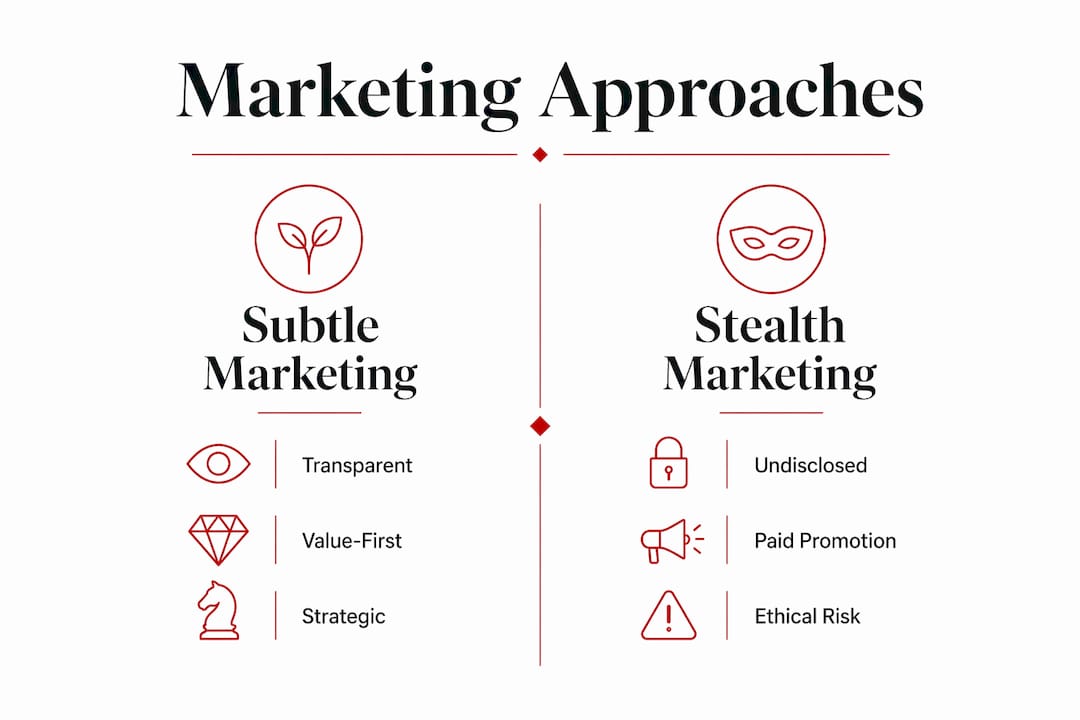
Stealth marketing involves undisclosed promotion. A brand pays an influencer or actor to recommend a product without revealing the commercial relationship. Only 4% of respondents trust marketers to act with integrity in stealth marketing contexts. That number alone should end the debate about whether stealth tactics are worth the risk.
Invisible marketing sits closer to subtle marketing. It relies on word-of-mouth ambassadorial behavior and curiosity-generating brand presence rather than paid ads. The distinction is that invisible marketing can sometimes lack the intentional conversion architecture that subtle marketing builds in.
Subtle marketing is the most strategically complete of the three. It maintains full transparency, discloses sponsorships where required, and relies on understated creativity to earn attention. The brand is visible. The selling is not.
| Approach | Transparency | Primary mechanism | Ethical risk |
|---|---|---|---|
| Stealth marketing | Hidden | Undisclosed promotion | High |
| Invisible marketing | Partial | Ambient brand presence | Low to medium |
| Subtle marketing | Full | Value-first, psychological nudging | Minimal |
The risk most marketers overlook is over-subtlety. A campaign so understated that consumers never connect the experience to the brand produces engagement without attribution. That is a measurement failure, not a creative success. Subtle marketing still requires clear, gentle conversion pathways: email captures, wishlist features, and soft CTAs that guide without pushing.
Pro Tip: Never confuse restraint with vagueness. Every subtle campaign needs a conversion rail, even if it is as low-commitment as “Save for later” or “See how it fits.” The subtlety is in the tone, not the absence of direction.
What are practical strategies and examples of subtle marketing?
Applying subtle marketing requires shifting from broadcast thinking to participation thinking. The brand does not announce itself. It creates conditions where consumers want to engage.
-
Experience-first engagement. Pop-up installations, ambient retail environments, and interactive digital experiences let consumers encounter the brand through participation rather than persuasion. Experiential marketing for luxury brands consistently demonstrates that immersive brand contact produces deeper emotional memory than any display ad.
-
Micro-narratives and soft CTAs. Instead of “Buy now,” subtle campaigns use micro-CTAs that lower commitment anxiety: “Discover the collection,” “See how others wear it,” or “Add to your wishlist.” These phrases reduce the psychological cost of engagement and keep the consumer moving through the funnel without feeling pushed.
-
Authentic customer stories and user-generated content. A customer photographing a product in their own environment carries more persuasive weight than a polished brand shoot. Brands like Glossier built their entire early growth strategy on seeding UGC rather than running traditional advertising. The brand becomes a backdrop to the customer’s story, not the other way around.
-
Behavioral depth metrics over vanity metrics. Subtle marketing does not optimize for impressions. It tracks scroll depth, time on page, and micro-conversions to understand whether the content is producing quality attention or shallow curiosity. A reader who spends four minutes on a brand editorial and then saves a product is a far stronger signal than ten thousand ad impressions.
-
Scarcity and social proof as ambient cues. Rather than a countdown timer screaming “Only 2 left!”, subtle marketing embeds scarcity naturally: “This piece is part of a limited run of 50.” The information is present. The pressure is not. Social proof follows the same logic. Displaying “47 people saved this item this week” is a factual statement that activates loss aversion without a single exclamation mark.
Pro Tip: In luxury contexts, the most effective subtle marketing often involves no product imagery at all in the first touchpoint. Lead with a story, a texture, a feeling. The product arrives as a natural conclusion, not an opening pitch.
What challenges and pitfalls should marketers avoid?
Subtle marketing fails in predictable ways. Knowing these failure modes in advance is the difference between a campaign that compounds over time and one that simply disappears.
-
Over-subtlety causing message loss. When the brand signal is too faint, consumers enjoy the content but never connect it to the brand. This is common in editorial-style campaigns where the product placement is so restrained that it reads as editorial rather than branded content. The fix is consistent brand cues: a recurring visual motif, a signature tone, a recognizable color palette.
-
Tone mismatch and cultural insensitivity. Subtle marketing depends on emotional resonance. A campaign calibrated for a Western European audience may read as cold or confusing in a market where directness signals respect. Cultural research before execution is not optional.
-
Misattributing social resonance as conversion. High engagement on a subtle campaign does not automatically mean the brand is winning. Shares, saves, and comments are leading indicators, not revenue. Tracking the full behavioral path from first exposure to purchase is the only way to validate that subtlety is working.
-
Neglecting conversion architecture. Successful subtle campaigns still plan email captures, wishlist features, and retargeting sequences. The subtlety is in the surface experience. The conversion infrastructure runs underneath it.
“Ethical subtle marketing maintains transparency with clear sponsorship disclosure and relies on understated, value-driven creativity to earn consumer trust over time.” Source: HubSpot
The ethical dimension matters more than most marketers acknowledge. Consumers in 2026 are sophisticated. They recognize when a brand is being genuine and when it is performing authenticity. The psychological triggers behind luxury engagement only activate when the consumer trusts the source. Deception, even subtle deception, destroys that trust permanently.
Key takeaways
Subtle marketing works because it aligns brand presence with consumer psychology, creating preference before conscious need through transparency, emotional resonance, and deliberate conversion architecture.
| Point | Details |
|---|---|
| Core definition | Subtle marketing is transparent, value-first influence that shapes preference without overt selling pressure. |
| Psychological foundation | Mere exposure effect, social proof, and loss aversion operate before conscious awareness to build brand preference. |
| Ethical boundary | Unlike stealth marketing, subtle marketing discloses sponsorships and relies on creativity rather than deception. |
| Conversion architecture | Every subtle campaign needs soft CTAs and behavioral tracking to turn engagement into measurable outcomes. |
| Measurement standard | Track scroll depth, time on page, and micro-conversions rather than impressions or last-click attribution. |
Why subtle marketing is the only strategy worth mastering right now
I have worked with fashion and luxury brands long enough to watch the full cycle of aggressive digital advertising play out. Brands spent years chasing impressions, click-through rates, and reach metrics. Then consumer trust collapsed, ad blockers became standard, and the brands that had quietly built emotional equity through subtle, experience-driven communication were the ones still standing.
What I find most interesting is that subtle marketing is not a soft strategy. It is actually harder to execute than a direct-response campaign. You cannot hide behind a loud headline or a discount offer. You have to earn attention through genuine value, and you have to trust that the psychological compounding will produce results on a longer timeline than a flash sale.
The brands I work with that resist this approach usually have the same objection: “How do we know it’s working?” That question reveals the real problem. They are still measuring marketing like it is 2015. Subtle marketing requires a different measurement vocabulary: brand search volume growth, qualitative sentiment shifts, repeat visit rates, and the ratio of organic to paid acquisition over time.
The future of this discipline sits at the intersection of psychological precision and digital personalization. Algorithms now allow brands to deliver the right subtle cue to the right person at the right moment of receptivity. That is not passive. That is the most sophisticated form of marketing that has ever existed. The brands that understand this early will not need to shout. Their consumers will do it for them.
— Corrado
How Corradomanenti applies subtle marketing to luxury brand growth
If you are a fashion or luxury brand looking to move beyond interruptive advertising, the principles in this article are the foundation. But principles without execution frameworks produce nothing.
Corradomanenti’s approach combines behavioral psychology with luxury market expertise to design campaigns that influence without pressure and convert without coercion. The luxury brand growth tactics developed through this practice give brands a structured path from ambient awareness to loyal customer relationships. For brands in fashion, hospitality, or lifestyle sectors, understanding how social proof and influencer signals integrate into subtle campaigns is the next practical step. Explore the full framework to see how psychological precision translates into market results.
FAQ
What is the definition of subtle marketing?
Subtle marketing is a strategy that integrates brand messaging into consumer experiences through value-first, non-intrusive communication rather than direct sales pressure. It uses psychological mechanisms like the mere exposure effect and social proof to shape preference before a conscious purchase need is recognized.
How does subtle marketing differ from stealth marketing?
Stealth marketing uses undisclosed promotion, such as paid endorsements without disclosure, which carries significant ethical and legal risk. Subtle marketing is fully transparent and relies on understated creativity and relevance to earn consumer attention.
What are the best examples of subtle marketing in practice?
Experience-first pop-up installations, user-generated content campaigns, micro-CTA copy like “Save for later,” and editorial-style brand storytelling are all proven subtle marketing formats. Luxury brands frequently use ambient retail environments and limited-run product framing to activate loss aversion without aggressive urgency tactics.
How do you measure subtle marketing effectiveness?
Effective measurement tracks behavioral depth metrics including scroll depth, time on page, wishlist saves, and organic brand search volume rather than impressions or click-through rates. These signals reveal whether subtle cues are producing genuine brand affinity or only surface-level curiosity.
Is subtle marketing suitable for small businesses?
Subtle marketing is accessible at any budget because it prioritizes authentic storytelling and customer-generated content over paid media volume. Small businesses can apply it through consistent brand voice, community-driven content, and soft conversion pathways that reduce purchase anxiety.