

TL;DR:
- Trend forecasting involves predicting consumer behavior through the analysis of data, cultural indicators, and market research. It guides creative design and marketing strategies, boosting adaptability and revenue for fashion brands. Effective forecasting is an ongoing organizational discipline that detects early signals and builds flexible scenarios to stay ahead of trends.
Trend forecasting is defined as the systematic process of predicting future consumer behavior and market demand by analyzing historical data, cultural indicators, and market research. The practice covers two distinct time horizons: short-term forecasting spanning 6 months to 1 year, and long-term foresight extending across multiple years. For marketing professionals and fashion enthusiasts, understanding this discipline is the difference between leading a market and reacting to one. This guide breaks down the definition, methods, and real business value of trend forecasting in the fashion industry.
What is trend forecasting and how does it work in fashion?
Trend forecasting systematically analyzes historical sales data, market research, and cultural indicators to predict consumer behavior. Short-term forecasts guide seasonal decisions like color palettes and silhouettes. Long-term forecasts shape brand positioning and product development pipelines years in advance.
The process starts with data collection across multiple channels. Fashion forecasters pull from retail sales figures, social media engagement metrics, runway coverage, street style photography, and macroeconomic signals. No single data source tells the full story. The real skill lies in reading all of them together.
A critical concept in fashion forecasting is the “weak signal.” Weak signals are early, low-visibility cultural shifts that precede mainstream adoption. A niche subculture embracing a specific fabric or silhouette on social media today may represent a mainstream trend 18 months from now. Proactive forecasters detect these signals well before they reach mass awareness, while reactive brands miss the window entirely.
Forecasting inputs divide into two categories: quantitative and qualitative. Quantitative inputs include sales velocity, search volume data, and consumer surveys. Qualitative inputs include ethnographic observation, cultural analysis, and editorial interpretation. Both are necessary. Quantitative data tells you what is happening. Qualitative analysis tells you why.
- Sales data and retail analytics: Identifies which categories are accelerating or declining across price points.
- Social media monitoring: Tracks emerging aesthetics, hashtag growth, and influencer adoption curves.
- Cultural and environmental signals: Includes political movements, sustainability pressures, and generational value shifts.
- Runway and trade show analysis: Captures early designer intent before products reach retail floors.
- Consumer behavior research: Surveys, focus groups, and ethnographic studies reveal the motivations behind purchasing decisions.
Pro Tip: Separate observation from interpretation at every stage. Write down what you actually see in the data before drawing conclusions. Forecasters who skip this step conflate their assumptions with evidence and end up in analysis paralysis, unable to act on any signal.
What is the role of trend forecasting for fashion brands and marketers?
Trend forecasting serves a dual function in fashion. It guides creative decisions around colors, fabrics, and silhouettes, and it shapes the marketing strategy that brings those decisions to market. These two functions are inseparable in practice.

Fashion forecasting simultaneously guides creative design and shapes consumer preferences, particularly among Gen Z and Millennials. This matters because these two cohorts respond to cultural alignment, not just product features. A brand that forecasts correctly can position a collection to feel culturally relevant before the trend peaks. A brand that misses the forecast launches into a saturated or declining market.
The business case for forecasting is concrete. Companies using structured forecasting methods achieve greater adaptability and can boost sales by 25% during key periods through optimized marketing. A 15–20% forecasted sales increase can translate into 25% more revenue in Q4 when marketing spend is timed correctly. That gap between forecast and actual result represents the compounding value of acting early.
Marketing teams use forecasts to time product launches, allocate promotional budgets, and sequence campaign messaging. A forecast that identifies a rising interest in quiet luxury, for example, tells a marketing team to shift messaging toward craftsmanship and restraint six months before competitors recognize the shift. The forecast becomes a competitive advantage, not just a planning tool.
The trend adoption process for luxury consumers follows a different curve than mass market adoption. Luxury buyers often lead trends rather than follow them, which means luxury brand forecasters must work further ahead and with greater cultural sensitivity than their mass market counterparts.
Key business benefits of accurate trend forecasting include:
- Reduced inventory risk through better demand planning
- Higher campaign relevance and engagement rates
- Stronger collection coherence across design and marketing
- Earlier identification of declining trends before overinvestment
- Better alignment between brand identity and consumer expectations
How does trend forecasting differ from trend analysis and foresight?
These three terms are frequently confused, and conflating them causes real strategic errors. Each concept operates at a different time horizon and serves a different organizational purpose.
A trend is simply an observable pattern of change. It describes what is already happening in the market. Trend analysis is the retrospective practice of identifying and measuring those patterns in historical data. Neither term involves prediction.
Trend forecasting differs from trend analysis and foresight by scope and time horizon. Forecasting is a short-term predictive practice, typically covering 6 months to 2 years. Foresight, sometimes called “prospective” in academic literature, is a longer-term strategic discipline that explores multiple possible futures over a 5 to 10 year horizon. The Futures Studies Research Journal recommends maintaining a clear lexicon across all three concepts to prevent tactical and strategic decisions from becoming misaligned.
The practical consequence of confusion is significant. A brand that treats a foresight scenario as a near-term forecast will over-invest in a direction that may not materialize for a decade. A brand that treats a trend observation as a forecast will react to the past rather than prepare for the future.
| Concept | Definition | Time horizon | Primary use |
|---|---|---|---|
| Trend | Observable pattern of change | Present | Market monitoring |
| Trend forecasting | Short-term predictive practice | 6 months to 2 years | Collection and campaign planning |
| Foresight | Long-term strategic exploration | 5 to 10+ years | Brand positioning and innovation |
Understanding where each concept applies keeps marketing teams from making short-term decisions with long-term tools, and vice versa. The clearest sign of a mature forecasting function is an organization that uses all three deliberately and separately.
How to forecast trends effectively: a practical framework
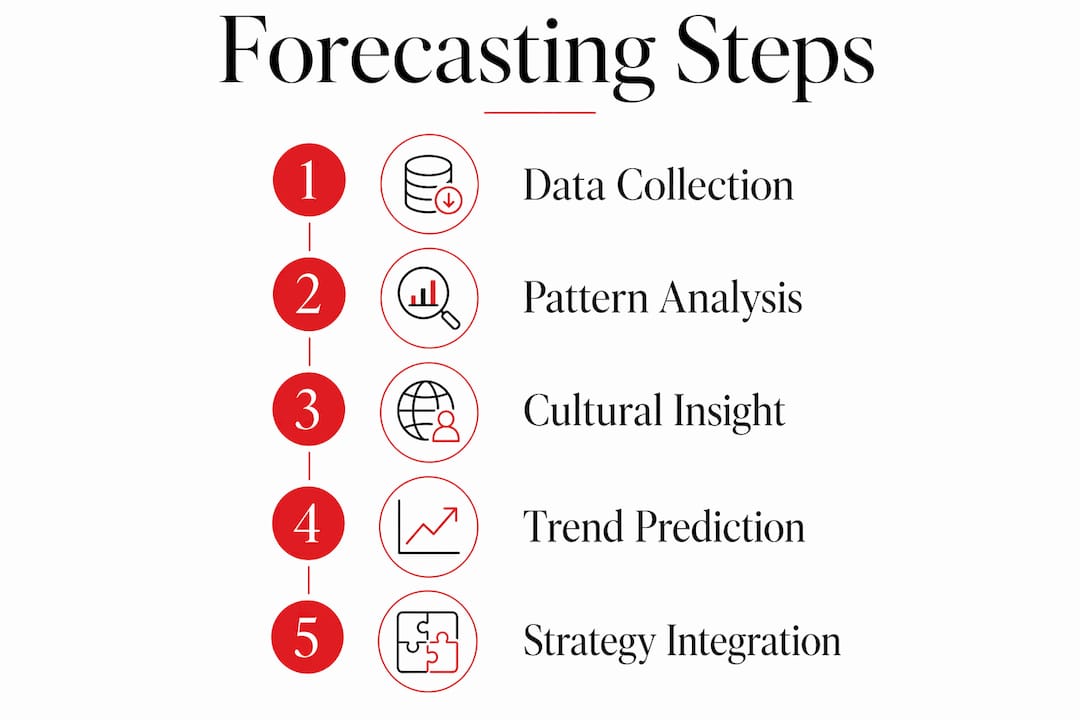
Effective forecasting is a repeatable process, not an act of intuition. A five-step forecasting framework includes detecting weak signals, forming hypotheses, running scenario planning, and building organizational agility rather than chasing perfect accuracy. The goal is a directional framework, not a guaranteed prediction.
- Detect weak signals. Monitor fringe communities, emerging designers, and cultural movements before they reach mainstream media. Set up regular scanning routines across social platforms, trade publications, and cultural events.
- Form hypotheses. Translate each signal into a testable prediction. “Consumers in the 25–35 age bracket will increase spending on heritage craftsmanship by Q3” is a hypothesis. “Heritage is trending” is not.
- Test against data. Cross-reference your hypotheses with sales data, search trends, and consumer research. Discard hypotheses that lack supporting evidence. Strengthen those that do.
- Build scenarios. Develop two or three plausible futures based on your strongest hypotheses. Scenario planning prevents over-commitment to a single forecast and keeps the organization flexible.
- Act and adapt. Treat the forecast as a living document. Forecasting is about building organizational muscle to act on emerging trends, not achieving a perfect prediction. Revisit and revise as new signals emerge.
Best forecasters treat predictions as directional frameworks, preserving brand creativity rather than rigidly following forecasts. This is especially true in luxury fashion, where brand identity must remain consistent even as market signals shift. A forecast that forces a brand to abandon its core aesthetic in pursuit of a trend does more damage than no forecast at all.
Pro Tip: Build a “signal log” inside your team. Every week, each team member submits one cultural observation with a brief interpretation. Over time, this log becomes a proprietary early-warning system that no external trend agency can replicate.
Integrating forecasts with your marketing pipeline requires a clear handoff process. The forecast should inform the creative brief, the campaign calendar, and the media budget simultaneously. When these three elements align around the same directional insight, the result is a campaign that feels both timely and coherent. For brands tracking retail display trends, the same principle applies: forecasting informs how and where products are presented, not just what products are made.
Key Takeaways
Trend forecasting is the most direct path from market intelligence to revenue, and brands that treat it as a discipline rather than a guessing game consistently outperform those that react to trends after they peak.
| Point | Details |
|---|---|
| Definition of trend forecasting | A systematic, data-driven process predicting consumer behavior across 6-month to multi-year horizons. |
| Forecasting vs. trend analysis | Trend analysis describes the past; forecasting predicts the near future; foresight explores long-term scenarios. |
| Business impact | Structured forecasting can boost sales by 25% during key periods through better-timed marketing. |
| Creative balance | Forecasts should guide, not dictate, creative decisions to preserve brand identity and design integrity. |
| Organizational practice | Building a repeatable signal-detection routine matters more than achieving perfect forecast accuracy. |
Why forecasting is a discipline, not a talent
I’ve worked with fashion and luxury brands long enough to see the same mistake repeat itself. A team spots a trend late, rushes a response, and then attributes the poor result to bad luck or a fickle market. The real problem is almost always structural. There was no forecasting process in place, only a habit of watching what competitors did and reacting.
The shift I’ve seen in the best-performing brands is not about hiring a better trend analyst. It’s about treating forecasting as an ongoing organizational practice. The brands that consistently get it right have built internal routines: weekly signal reviews, hypothesis logs, and quarterly scenario sessions. They don’t rely on a single annual trend report from an external agency. They build their own reading of the market, informed by external data but shaped by their own brand perspective.
AI is changing the speed at which signals can be detected and aggregated. Platforms can now surface emerging aesthetics across millions of social posts in hours rather than weeks. That’s genuinely useful. But the interpretive layer, the judgment about which signals matter for a specific brand’s identity and consumer base, still requires human expertise. Technology accelerates the observation phase. It does not replace the interpretation phase.
The brands I respect most treat forecasting as a form of consumer behavior analysis. They ask not just what consumers are buying, but why the cultural conditions exist that make those purchases feel necessary or desirable. That question is where forecasting becomes genuinely powerful.
— Corrado
How Corradomanenti supports fashion brands with trend forecasting
Corradomanenti works with fashion and luxury brands that need more than a trend report. The work starts with understanding consumer psychology and the cultural signals that drive purchasing behavior in high-end markets.
The consulting approach covers buyer behavior analysis, collection positioning, and campaign timing, all grounded in a forecasting methodology built for luxury contexts. For brands ready to move from reactive to proactive, the fashion brand growth tactics resource covers the full process of aligning forecasting with marketing execution. If your brand is building or refining its forecasting practice, the fashion marketing strategy checklist provides a structured starting point for 2026 planning.
FAQ
What is the definition of trend forecasting?
Trend forecasting is the systematic process of predicting future consumer behavior and market demand by analyzing historical data, cultural signals, and market research. It covers both short-term horizons of 6 months to 1 year and long-term multi-year foresight.
How does trend forecasting differ from trend analysis?
Trend analysis identifies and measures patterns that have already occurred in historical data. Trend forecasting uses those patterns, along with cultural signals, to predict what will happen next.
What are the main methods used in fashion forecasting?
Fashion forecasters use a combination of sales data analysis, social media monitoring, runway observation, consumer surveys, and cultural research. Effective forecasting blends quantitative data with qualitative interpretation.
Why is trend forecasting important for luxury brands?
Luxury consumers often lead trends rather than follow them, which means luxury brands must forecast further ahead and with greater cultural precision than mass market brands. Missing a forecast in luxury can mean launching into a declining trend at premium price points.
How often should a brand update its trend forecasts?
Forecasts should be treated as living documents and reviewed at least quarterly. Separating signal observation from interpretation on a regular basis prevents analysis paralysis and keeps the forecasting process agile as new cultural signals emerge.