


TL;DR:
- People-centric marketing places customer needs and experiences at the core of every decision and strategy. It increases profitability, retention, and conversions by building authentic, emotional relationships. Implementing it involves empathetic research, authentic messaging, transparency, and consistent brand storytelling.
People-centric marketing is defined as a strategy that places customers’ needs, desires, and lived experiences at the center of every marketing decision. The advantages of people-centric marketing are measurable and significant: companies using customer-centric strategies are 60% more profitable than those that do not. The same research shows that 80% of customers are more likely to buy when brands deliver personalized experiences. For marketing professionals and business leaders, these numbers signal a clear direction. Human-centric marketing, the recognized industry term for this approach, is not a soft philosophy. It is a revenue driver.
What are the key benefits of adopting people-centric marketing strategies?
The benefits of customer-focused marketing show up across every metric that matters: profitability, retention, and brand equity. When you build campaigns around genuine customer understanding, the results compound over time.

The most direct advantage is financial. Customer-centric strategies produce 60% higher profitability compared to product-first or process-first models. That gap exists because customers who feel understood spend more, return more often, and refer others.
Retention is the second major gain. Prioritizing long-term relationships reduces refund requests and increases revenue predictability. Customers who arrive well-informed and aligned with your brand’s values are far less likely to feel disappointed after purchase. That alignment is only possible when your marketing reflects their actual reality, not a polished fiction.
Personalization drives the third advantage. Tailored messaging consistently produces higher engagement, better conversion rates, and stronger sales. The mechanism is simple: people respond to content that feels written for them, not broadcast at them.
The core benefits of human-centric marketing include:
- Higher profitability: 60% more profitable than non-customer-centric models
- Stronger retention: informed customers arrive aligned, reducing churn and refunds
- Better conversions: personalized experiences increase purchase likelihood by 80%
- Brand advocacy: loyal customers become active promoters, reducing acquisition costs
- Improved brand reputation: consistent, authentic messaging builds long-term trust
Pro Tip: Map your customer’s emotional journey before writing a single word of copy. Understanding what your customer fears, wants, and values at each stage produces messaging that converts without pressure.
How does people-centric marketing differ from traditional marketing?
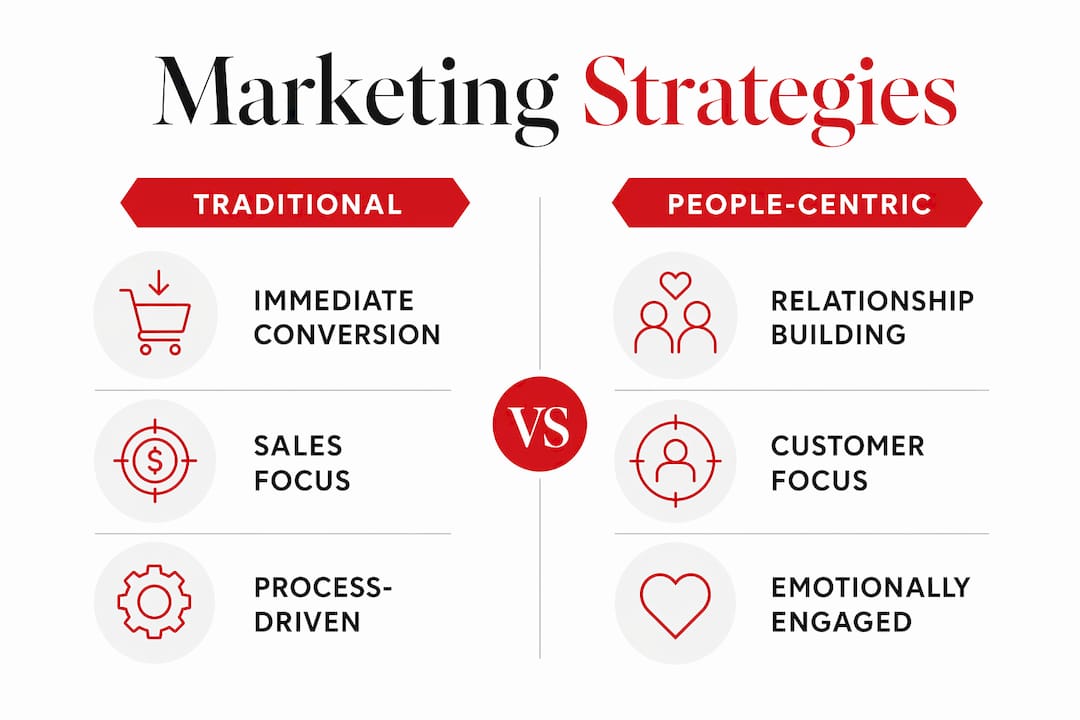
Traditional marketing is built around the conversion event. People-centric marketing is built around the relationship that makes conversion a natural outcome. That distinction changes everything from budget allocation to content tone.
Process-centric models treat customers as targets to move through a funnel. Human-centric models treat customers as people to understand and serve. The difference is not semantic. It produces different creative briefs, different channel strategies, and different long-term results.
The most dangerous middle ground is superficial human language inside a high-pressure sales structure. Misaligned messaging reads as manipulation. Customers recognize the pattern immediately, and the trust damage is difficult to repair. Authentic alignment between what your brand says and what your customer service actually delivers is non-negotiable.
| Dimension | Traditional marketing | People-centric marketing |
|---|---|---|
| Primary goal | Drive immediate conversions | Build lasting relationships |
| Customer role | Passive recipient of messages | Active participant in brand dialogue |
| Success metric | Short-term sales volume | Customer lifetime value and retention |
| Content approach | Product features and promotions | Customer stories, empathy, and education |
| Trust model | Credibility through authority | Credibility through consistency and care |
Customer lifetime value is where the financial argument becomes undeniable. A customer who trusts your brand spends more per transaction, returns more frequently, and costs far less to retain than to replace. Shifting from conversion-first to connection-first requires sustained focus on long-term trust metrics, which most organizations find uncomfortable at first.
Pro Tip: Audit your last five campaigns. If every one of them leads with a product benefit rather than a customer reality, your messaging is still process-centric. Rewrite the opening line of each to reflect what your customer is feeling before they encounter your brand.
What practical steps can marketing leaders take to implement people-centric marketing?
Implementation is where most organizations stall. The philosophy is easy to endorse. The operational shift is harder. These steps give you a concrete path forward.
-
Conduct empathy-driven audience research. Go beyond demographics. Interview customers about their frustrations, aspirations, and decision-making process. The goal is to understand the emotional context around your product, not just who buys it. Surveys give you data. Conversations give you insight.
-
Audit your messaging for authenticity. Authentic alignment between brand values and customer experience is the foundation of trust. Read your current copy as a skeptical customer would. Identify every claim that your customer service team cannot consistently deliver.
-
Prioritize transparency and informed consent. Be clear about what you offer, what it costs, and what customers should expect. Clarity at the top of the funnel reduces friction, refunds, and negative reviews downstream.
-
Build owned channels for sustainable engagement. Email lists, community groups, and loyalty programs give you direct access to your audience without depending on platform algorithms. Personalized content through owned channels produces higher engagement than paid reach alone.
-
Align internal culture with connection-first values. Your marketing team cannot deliver human-centric messaging if your customer service team operates on a script designed to deflect complaints. The customer experience must be consistent across every touchpoint.
Pro Tip: Start with one customer segment and build a complete empathy map before scaling. Trying to personalize for everyone at once produces generic content that serves no one well.
What role does emotional connection and storytelling play?
Emotional connection transforms brand perception from transactional to relational. Customers do not just buy products. They buy the version of themselves that the product represents. Storytelling is the mechanism that makes that transformation feel real.
A brand that tells authentic stories becomes relatable. Relatability builds trust. Trust reduces the perceived risk of purchase, which is the single biggest barrier in premium and luxury markets. This is why people-oriented marketing strategies consistently outperform feature-led campaigns in high-consideration categories.
The competitive advantage of emotional storytelling is difficult to copy. A competitor can match your price, replicate your product, and outspend you on media. They cannot replicate the specific emotional relationship you have built with your audience over time. That relationship is a genuine moat.
Effective storytelling in a human-centric framework includes:
- Customer narratives: real stories from real buyers that reflect your audience’s aspirations and challenges
- Behind-the-scenes content: showing the people and process behind your brand builds authenticity
- Two-way dialogue: listening and responding to feedback in real time turns customers into active participants rather than passive recipients
- Consistent brand voice: a recognizable, human tone across all channels reinforces trust at every touchpoint
The brands that win in saturated markets are not the ones with the largest budgets. They are the ones whose customers feel genuinely seen and understood.
How can people-centric marketing drive results in the luxury sector?
Luxury marketing operates on a different set of psychological rules than mass-market marketing. Price is not the primary decision driver. Emotion, identity, and belonging are. That makes the advantages of customer engagement through human-centric methods even more pronounced in this sector.
Luxury brands that apply people-centric principles see stronger personalization, higher retention, and greater brand equity. The luxury customer expects to be known, not just targeted. Generic campaigns signal that a brand does not understand its own audience, which is fatal in a category built on exclusivity and attention to detail.
The practical applications in luxury include:
- Deep buyer behavior analysis: understanding the psychological triggers behind premium purchase decisions, not just the demographic profile of who makes them. Corradomanenti’s approach to analyzing buyer behavior treats psychology as the primary lens.
- Hyper-personalized communication: luxury customers respond to messaging that acknowledges their specific preferences, history with the brand, and aspirational identity
- Experience-led brand building: building brand loyalty in luxury requires creating moments that feel curated for the individual, not manufactured for the many
- Long-term relationship investment: the luxury customer’s lifetime value is exceptionally high. Investing in the relationship rather than the transaction produces compounding returns
The relationship between personalized content and loyalty is especially strong in luxury, where customers have the means to choose any brand and select based on how a brand makes them feel.
Key Takeaways
People-centric marketing produces measurably better business outcomes because it builds the trust and emotional connection that drive long-term customer loyalty and profitability.
| Point | Details |
|---|---|
| Profitability advantage | Customer-centric brands are 60% more profitable than product-first or process-first competitors. |
| Retention through alignment | Customers who arrive informed and aligned with brand values generate fewer refunds and higher lifetime revenue. |
| Personalization converts | 80% of customers are more likely to buy when they receive personalized experiences. |
| Authenticity is non-negotiable | Superficial human language inside high-pressure sales structures damages trust and is recognized immediately. |
| Luxury amplifies the stakes | Luxury consumers buy on emotion and identity, making human-centric methods the most effective approach in premium markets. |
Why I stopped measuring success by conversion rates alone
The hardest shift I made in my own practice was letting go of the conversion rate as the primary success metric. For years, I optimized campaigns around it. The numbers looked good in reports. But the brands I worked with kept cycling through the same problem: strong acquisition, weak retention, and a customer base that felt no particular loyalty to the brand.
The turning point came when I started applying my psychology background more deliberately to the marketing process. I realized that most campaigns were designed to win the transaction, not the relationship. The messaging was technically accurate but emotionally hollow. Customers could sense it, even if they could not articulate why.
What actually works is winning hearts before wallets. That phrase sounds simple. Operationalizing it requires a genuine organizational commitment to understanding customers at a psychological level, not just a behavioral one. It means measuring trust, not just clicks.
The brands I have seen grow most sustainably are the ones where the marketing team and the customer service team share the same understanding of who the customer is and what they need. When those two functions are misaligned, no amount of clever copy fixes the gap. The customer feels the contradiction and disengages.
My advice to marketing leaders: pick one trust metric and track it with the same discipline you apply to conversion data. Net Promoter Score, repeat purchase rate, or qualitative customer sentiment all work. The act of measuring trust changes what you optimize for, and that changes everything.
— Corrado
How Corradomanenti’s expertise applies to your brand
Corradomanenti works with fashion, luxury, and lifestyle brands that want to grow through genuine customer connection rather than short-term campaign tactics.
The consulting approach combines psychology-driven research with practical marketing execution. Every strategy starts with understanding why your customers behave the way they do, not just what they do. That depth of insight shapes campaigns that resonate at an emotional level and produce results that hold over time. For brands ready to apply these principles with precision, the fashion brand growth tactics resource covers the full framework. If you want to go deeper on the psychological side, the guide on psychology in luxury branding is the right starting point.
FAQ
What is people-centric marketing?
People-centric marketing, also called human-centric marketing, is a strategy that prioritizes customers’ needs, emotions, and experiences in every marketing decision. It contrasts with product-first or process-first models by treating relationship-building as the primary goal.
Why are customer-centric companies more profitable?
Customer-centric companies are 60% more profitable because loyal customers spend more, return more often, and refer others, reducing acquisition costs while increasing lifetime revenue.
How does personalization support people-centric marketing?
Personalization is the practical expression of human-centric values. When messaging reflects a customer’s specific preferences and context, purchase likelihood increases by 80%, making personalization one of the highest-return investments in marketing.
What is the biggest mistake brands make with human-centric marketing?
The most common mistake is using empathetic language inside a high-pressure sales structure. Misaligned messaging reads as manipulation and damages trust faster than purely transactional messaging does.
Why does people-centric marketing matter more in luxury markets?
Luxury consumers make purchase decisions based on emotion, identity, and belonging rather than price. Human-centric approaches that deliver personalized, emotionally resonant experiences produce stronger loyalty and higher lifetime value in premium categories.