


TL;DR:
- High-end customer segmentation groups luxury clients by behavior, psychographics, and identity traits for personalized marketing. It is a continuous process that uses AI to update profiles in real time and improve engagement.
High-end customer segmentation is the process of classifying luxury consumers into distinct groups defined by spending behavior, psychographics, and identity traits to enable targeted and personalized marketing. This goes far beyond demographic splits or basic spending tiers. BCG research shows that top-tier luxury clients constitute less than 1% of the market yet generate 23% of the industry’s value. That concentration makes precision segmentation not a competitive advantage but a business necessity. For marketing professionals in the luxury sector, understanding what is high-end customer segmentation means understanding how to identify, profile, and engage the clients who drive the majority of revenue.
What is high-end customer segmentation in luxury markets?
High-end customer segmentation is a multi-dimensional process. It combines economic value metrics, psychographic data, behavioral signals, and identity markers to build profiles that reflect how luxury consumers actually think and spend. Standard demographic models fail here because two clients can share the same income bracket and spend similar amounts yet expect entirely different brand experiences.
Accenture’s 2026 study of 3,435 luxury customers across 13 countries confirms there is no single luxury customer. Instead, there is a mosaic of identities shaped by distinct expectations and interpretations of luxury. One client values heritage and craftsmanship. Another prioritizes exclusivity and social signaling. A third engages primarily through digital community and co-creation. Each requires a different approach.
The industry term for this practice is value-based luxury segmentation, though “high-end customer segmentation” captures the same concept in practical usage. Both refer to the same goal: moving beyond surface-level data to build profiles that predict behavior and guide personalized outreach.
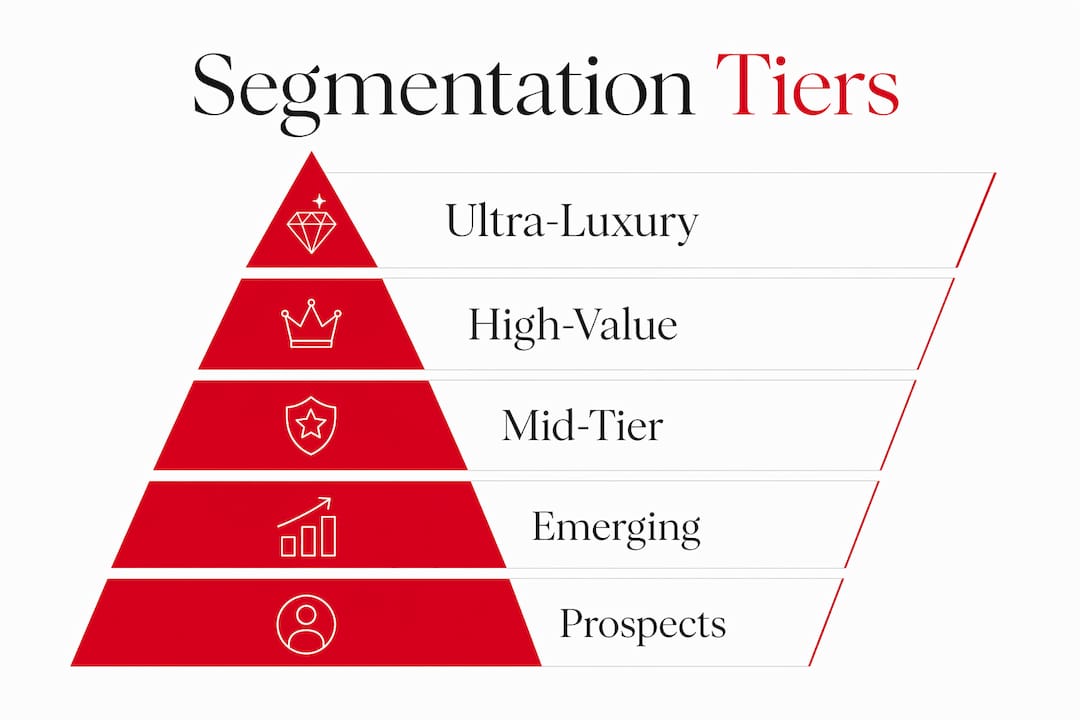
Luxury segmentation typically operates across three tiers:
- Premium tier: Clients who buy aspirationally, often during key moments like gifting seasons or personal milestones. They respond to brand storytelling and limited access.
- Luxury tier: Regular buyers with established brand relationships. They expect recognition, consistency, and curated recommendations.
- Ultra-luxury tier: The top-tier clients BCG identifies as generating outsized value. They require one-to-one engagement, proactive service, and deep relationship management.
Pro Tip: Do not treat the ultra-luxury tier as a spending category alone. Define it by relationship depth, engagement history, and future value potential, not just past transactions.
Psychographic data supplements but does not replace traditional demographics in high-end luxury segmentation. It explains the “why” behind purchasing behavior, which is what makes campaigns resonate rather than just reach.
How do modern data and AI tools enhance luxury customer segmentation?
AI transforms luxury customer segmentation from a periodic exercise into a continuous, living system. Static models built once a year cannot keep pace with clients whose preferences, life stages, and spending patterns shift constantly. AI-powered segmentation updates profiles in real time as new signals arrive.

The most effective approach uses unified customer identity profiles. These profiles aggregate data from multiple sources: in-store purchases, e-commerce behavior, loyalty program activity, device-level browsing, and household-level spending patterns. Amperity’s case study with a luxury retailer shows that AI-driven segmentation combining device, household, and business unit data produces more accurate customer lifetime value (CLV) scores and stronger loyalty outcomes than single-channel data alone.
The practical steps for building an AI-enhanced segmentation model look like this:
- Unify identity data. Merge all customer touchpoints into a single profile. Remove duplicates caused by multiple email addresses or household members sharing accounts.
- Score for CLV. Calculate each client’s projected lifetime value using purchase frequency, average order value, category breadth, and recency signals.
- Apply propensity modeling. Identify which clients are likely to upgrade, lapse, or respond to specific product categories based on behavioral patterns.
- Assign dynamic segments. Place clients into segments that update automatically as their signals change, not just at onboarding.
- Empower non-technical teams. Make segment outputs accessible to client advisors and marketing teams so they can act on insights without needing data science support.
Unified customer identity profiles that aggregate household, device, and business unit data empower non-technical teams to apply segmentation outputs operationally across channels. That operational accessibility is what separates brands that segment well from those that segment and then fail to act.
Pro Tip: CLV scoring works best when it incorporates category affinity, not just total spend. A client who buys across ready-to-wear, accessories, and fragrance is more valuable than one who spends the same amount in a single category.
The comparison between static and dynamic segmentation models is clear. Static models assign clients to tiers based on a spending threshold set at a fixed point in time. Dynamic models update continuously and catch clients whose value is rising before competitors do. For luxury email segmentation and personalized outreach, the difference in response rates is significant.
What strategic benefits does targeted high-end segmentation deliver?
Precision segmentation delivers measurable growth for luxury brands. The most direct benefit is increased share of wallet from top-tier clients. When outreach is relevant and timed correctly, clients spend more across categories and return more frequently. When it is not, they disengage.
BCG research finds that 65% of top-tier luxury clients feel overwhelmed by irrelevant brand outreach. That figure signals a serious problem. Brands that contact their best clients too often with generic messages actively damage the relationship. Precision segmentation solves this by ensuring every communication is relevant to that specific client’s profile and moment.
The benefits extend across four areas:
- Clienteling quality: Advisors equipped with detailed profiles can hold conversations that feel personal, not scripted. They know the client’s purchase history, preferred categories, and upcoming life events.
- Marketing ROI: Campaigns targeted to well-defined segments consistently outperform broad sends. Fewer messages, better results.
- Customer satisfaction: Clients who feel recognized and understood report higher satisfaction and stronger brand loyalty.
- Retention of high-value clients: Identifying at-risk top-tier clients early through propensity modeling allows proactive outreach before they defect.
“Two clients can spend similarly but have wholly different engagement expectations requiring custom approaches.” — Accenture, Luxe Eternal 2026
Understanding high-end consumer behavior is the foundation for translating segment data into experiences that actually build loyalty. Segmentation without behavioral insight produces lists. Segmentation with behavioral insight produces relationships.
What challenges should luxury marketers know when implementing segmentation?
The most common failure in luxury segmentation is relying on static spending thresholds. BCG data shows that static spending thresholds miss about 70% of potential top-tier clients, leading to misclassification and missed revenue. A client who spent modestly last year but is entering a high-earning life stage is invisible to a static model. A dynamic model catches that signal early.
Other critical challenges include:
- Single-channel data silos. Brands that segment using only e-commerce data miss the in-store behavior that often defines their most valuable clients.
- Identity fragmentation. One client may appear as three separate records across CRM, loyalty, and e-commerce systems. Without identity resolution, segmentation scores are unreliable.
- Over-reliance on demographics. Age and income predict category interest but not engagement style, service expectations, or brand relationship depth.
- Segment decay. Client needs and preferences change. Segments built six months ago may no longer reflect current reality without continuous data refresh.
The best practice framework addresses each of these directly. Luxury segmentation must be identity-based and expectation-based, not just transaction-based. Brands need to know not only what a client buys but what kind of relationship they want with the brand.
Accenture’s research reinforces this point. Luxury segmentation strategies that refine value-based metrics with buyer relationship styles, including heritage appreciation, social status signals, and personalized service preferences, produce more accurate engagement models than spending data alone.
Pro Tip: Run a segment audit every quarter. Pull a sample of clients from each tier and verify that their recent behavior still matches their assigned segment. Drift is normal. Catching it early prevents misaligned outreach.
Cross-channel data unification is not optional. It is the infrastructure that makes every other segmentation practice work. Without it, even the best AI models produce incomplete profiles.
Key Takeaways
High-end customer segmentation is the practice of building multi-dimensional client profiles that combine CLV, psychographics, identity signals, and behavioral data to enable precise, personalized luxury marketing.
| Point | Details |
|---|---|
| Top-tier clients drive outsized value | Less than 1% of luxury clients generate 23% of industry value, making precise identification critical. |
| Static thresholds misclassify clients | Spending cutoffs miss up to 70% of potential top-tier clients; dynamic models catch rising-value clients earlier. |
| Identity diversity requires custom approaches | Two clients with similar spend can hold entirely different engagement expectations and relationship styles. |
| AI unifies data for better scoring | Unified profiles combining device, household, and channel data produce more accurate CLV and propensity scores. |
| Irrelevant outreach damages relationships | 65% of top-tier clients report feeling overwhelmed by generic brand contact; relevance protects loyalty. |
The part of segmentation most brands still get wrong
After years of working with luxury brands across fashion and lifestyle, the pattern I see most often is this: brands invest in segmentation technology and then use it to send more messages, not better ones. They build a top-tier client list and immediately increase contact frequency. That is the opposite of what the data recommends.
The clients who generate the most value are also the most sensitive to irrelevant outreach. They have options. They notice when a brand treats them like a segment rather than a person. The segmentation work only pays off when it leads to fewer, more precise interactions that feel genuinely personal.
The other mistake I see is treating segmentation as a one-time project. Brands run a segmentation exercise, assign clients to tiers, and then operate on those assignments for 18 months. By then, the data is stale and the segments no longer reflect reality. Segmentation is a continuous practice, not a deliverable.
What actually works is building a feedback loop between segment data and client-facing teams. Advisors who interact with clients daily hold information that no algorithm captures. When that qualitative knowledge feeds back into the segmentation model, the profiles become genuinely useful. The brands that do this well treat their client advisors as data sources, not just data consumers.
The identity mosaic that Accenture describes is real. I have seen it firsthand. A client who appears as a heritage buyer based on purchase history may be actively shifting toward digital community engagement. A static model keeps them in the wrong segment. A team that listens catches the shift and adjusts. That is where behavioral segmentation becomes a genuine competitive edge rather than a reporting exercise.
— Corrado
How Corradomanenti approaches luxury segmentation consulting
Corradomanenti works with luxury and fashion brands that need to move from broad outreach to precise, relationship-driven marketing. The work starts with understanding the psychology behind client behavior, not just the transaction data.
If your brand is ready to build segmentation models that reflect how your best clients actually think and engage, Corradomanenti’s consulting practice covers the full process. From analyzing buyer behavior to building identity-based profiles that your client-facing teams can actually use, the approach is grounded in both data and human insight. For brands in fashion and lifestyle looking to grow their top-tier client relationships, the luxury market growth tactics framework provides a practical starting point.
FAQ
What is high-end customer segmentation?
High-end customer segmentation is the process of grouping luxury consumers by spending behavior, psychographics, identity traits, and engagement expectations to enable personalized marketing. It goes beyond demographics to capture why clients buy and what kind of relationship they want with a brand.
Why do static spending thresholds fail in luxury segmentation?
Static thresholds miss approximately 70% of potential top-tier clients because they only capture past spending, not future value or changing life stages. Dynamic models that update continuously based on real-time signals produce far more accurate tier assignments.
How does AI improve luxury customer profiling?
AI unifies data from multiple channels, including in-store, e-commerce, and household-level signals, into a single customer profile. This enables more accurate CLV scoring and propensity modeling, which helps brands identify high-value clients earlier and engage them more precisely.
What role do psychographics play in premium segmentation strategies?
Psychographic data explains the “why” behind purchasing decisions, including values, lifestyle priorities, and service expectations. Research confirms that psychographics supplement but do not replace transactional data in building accurate high-value customer profiles.
How often should luxury brands update their customer segments?
Segments should update continuously as new behavioral signals arrive, not just at onboarding or on an annual schedule. A quarterly audit of segment assignments helps catch client drift and prevents misaligned outreach to top-tier clients.