


Luxury brands face a critical challenge in 2026: creating emotional connections that transcend product features and pricing. While traditional marketing focuses on rational benefits, today’s discerning customers in fashion, hospitality, and automotive sectors demand deeper resonance with brand values and identity. This guide delivers actionable strategies for building authentic emotional bonds through storytelling, sensory engagement, and cultural relevance. You’ll discover proven frameworks to transform customer interactions into lasting loyalty that withstands market pressures and competitive threats.
Table of Contents
- Understanding Emotional Branding In Luxury Sectors
- Preparing Your Brand For Emotional Branding Success
- Executing Emotional Branding Strategies: Storytelling, Sensory Engagement, And Personalization
- Measuring And Refining Emotional Branding Impact
- Discover Expert Luxury Brand Growth Tactics
Key takeaways
| Point | Details |
|---|---|
| Emotional bonds drive loyalty | Emotional connection mediates purchasing behavior more powerfully than product features or price in luxury markets. |
| Digital touchpoints matter | 80% of luxury purchases are influenced by digital interactions, making emotional design critical. |
| Sensory experiences deepen attachment | Multi-sensory engagement creates memorable brand moments that rational marketing cannot replicate. |
| Heritage balances innovation | Successful luxury brands honor tradition while embracing contemporary customer expectations and values. |
| Measurement sustains impact | Tracking emotional engagement metrics ensures strategies remain effective and adaptable to evolving preferences. |
Understanding emotional branding in luxury sectors
Emotional branding transforms customer relationships by creating psychological bonds that extend far beyond transactional exchanges. This approach centers on three foundational elements: authentic storytelling that communicates brand heritage and values, sensory experiences that engage multiple touchpoints, and imaginative connections that allow customers to see themselves within the brand narrative. Unlike conventional marketing that emphasizes features and benefits, emotional branding operationalized through storytelling leverages brand love, emotional attachment, and symbolic interactionism to build loyalty immune to price competition.
For luxury fashion, hospitality, and automotive brands, emotional connections create competitive advantages that rational appeals cannot match. When customers form emotional bonds with your brand, they develop psychological ownership that influences repeat purchases, premium pricing tolerance, and advocacy behaviors. These relationships emerge from consistent delivery of experiences that resonate with customer identity and aspirations. The psychological mechanisms include attachment theory, where brands become extensions of self-concept, and social identity processes, where brand affiliation signals group membership and status.
In 2026, successful emotional branding luxury fashion strategies prioritize empathy, authenticity, and cultural meaningfulness. Customers increasingly scrutinize brand actions for alignment with stated values, making superficial emotional appeals counterproductive. You must demonstrate genuine understanding of customer motivations, fears, and aspirations through every interaction. This requires moving beyond demographic segmentation to psychographic profiling that reveals emotional drivers and cultural contexts shaping purchase decisions.
Key components of effective emotional branding include:
- Narrative consistency across all customer touchpoints that reinforces core brand identity
- Sensory signatures like signature scents, sounds, or textures that trigger brand recognition
- Personalized experiences that acknowledge individual customer preferences and history
- Community building that fosters belonging among brand enthusiasts
- Cultural relevance that connects brand heritage to contemporary social movements
Pro Tip: Invest in training your customer-facing teams to recognize and nurture emotional touchpoints during interactions. Employees who understand the psychological dimensions of luxury purchasing can transform routine transactions into memorable experiences that strengthen brand attachment.
Preparing your brand for emotional branding success
Before implementing emotional branding tactics, you need comprehensive understanding of your target audience’s emotional landscape and cultural context. This preparation phase determines whether your strategies will resonate authentically or feel manufactured and manipulative. Start by conducting deep psychographic research that identifies the emotional triggers, aspirations, and anxieties driving your customers’ relationship with luxury. Traditional demographic data reveals who your customers are, but emotional insights explain why they choose your brand over competitors.
Assess your brand heritage to determine the optimal balance between honoring tradition and embracing innovation. Luxury branding balances tradition and innovation through careful curation of historical elements that remain relevant while updating expressions to reflect contemporary values. Brands like Hermès maintain craftsmanship heritage while incorporating sustainable practices and digital experiences. Your assessment should identify which heritage elements strengthen emotional connections and which require reinterpretation for modern audiences.

Evaluate your digital ecosystem’s emotional impact since 80% of luxury purchases now involve digital touchpoints. Review your website, social media presence, email communications, and digital advertising for emotional coherence. Each interaction should reinforce your brand’s emotional positioning through visual design, copywriting tone, interaction patterns, and response protocols. Inconsistent emotional messaging across channels creates cognitive dissonance that undermines brand trust.
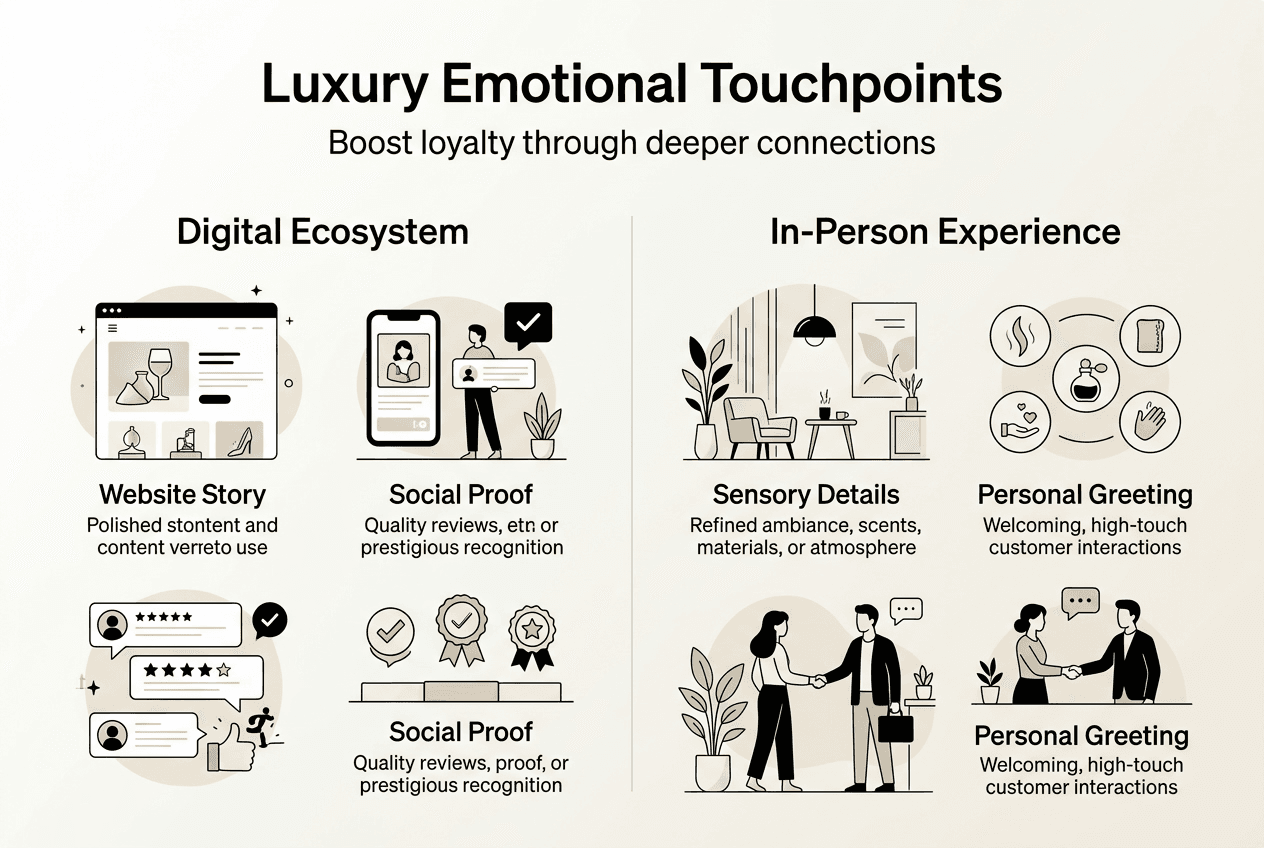
Develop brand narrative frameworks that align with audience values and cultural movements. Your stories should address universal human themes like belonging, achievement, legacy, or transformation while maintaining luxury positioning. These narratives become templates for content creation, campaign development, and customer service interactions. Document the emotional journey you want customers to experience from awareness through advocacy, identifying specific touchpoints where emotional reinforcement occurs.
| Brand | Heritage Emphasis | Innovation Balance | Emotional Strategy |
|---|---|---|---|
| Hermès | 85% tradition | 15% contemporary | Craftsmanship authenticity with selective digital adoption |
| Burberry | 60% heritage | 40% innovation | British identity merged with fashion-forward digital experiences |
| Tesla | 20% history | 80% future | Revolutionary identity through technological advancement |
| Ritz-Carlton | 70% classic luxury | 30% modern comfort | Timeless service excellence with personalized technology |
Prepare your organizational culture to support emotional branding by ensuring internal alignment on brand values and customer experience priorities. Employees must embody the emotional qualities you want customers to experience. This requires clear communication of brand purpose, ongoing training in emotional intelligence, and systems that reward behaviors supporting emotional connection. When internal culture contradicts external brand promises, customers detect the inauthenticity immediately.
Critical preparation steps include:
- Mapping customer emotional journeys across all touchpoints to identify enhancement opportunities
- Conducting cultural audits to understand regional emotional drivers and taboos
- Establishing baseline metrics for current emotional engagement levels
- Creating cross-functional teams responsible for emotional consistency
- Developing crisis protocols that protect emotional brand equity
Pro Tip: Use cultural insiders or specialized emotional analytics tools to refine your audience insights. Sensory branding luxury fashion experts can identify subtle cultural nuances that generic research misses, preventing costly missteps in emotional positioning.
Executing emotional branding strategies: storytelling, sensory engagement, and personalization
Crafting immersive brand stories requires moving beyond linear narratives to experiential storytelling that invites customer participation. Start by identifying your brand’s origin story, core values, and transformative promise. Then structure these elements into narratives that customers can enter and personalize. Immersive storytelling enhances brand perception by transforming passive audiences into active participants who co-create meaning. Your stories should feature authentic characters, emotional conflicts, and resolutions that mirror customer aspirations.
Implement multi-sensory engagement that extends beyond visual branding to create holistic experiences. Luxury hotels use signature scents in lobbies to trigger memory and emotion. Automotive brands engineer specific door-closing sounds that communicate quality and solidity. Fashion retailers design fitting rooms with flattering lighting and acoustic properties that enhance confidence. Each sensory element should align with your brand’s emotional positioning. Calming scents and soft textures communicate nurturing luxury, while bold fragrances and crisp sounds signal energizing sophistication.
Leverage artificial intelligence for personalized marketing that deepens emotional connection without sacrificing the human touch. AI analyzes behavioral data to predict individual preferences, optimal communication timing, and relevant content themes. Use these insights to customize product recommendations, email messaging, and website experiences. However, ensure AI-driven personalization feels intuitive rather than intrusive. Customers should perceive personalization as thoughtful attention, not surveillance. Balance algorithmic efficiency with opportunities for human interaction at critical emotional moments.
| Traditional Storytelling | Immersive Experiential Storytelling | Outcome Difference |
|---|---|---|
| Brand tells story to passive audience | Customer participates in co-creating narrative | 3x higher emotional engagement scores |
| Single-channel narrative delivery | Multi-sensory, cross-platform story world | 2.5x longer brand interaction time |
| Fixed story conclusion | Personalized story outcomes based on choices | 4x increase in perceived brand relevance |
| Product-focused messaging | Values-driven emotional journey | 60% higher purchase intent among engaged users |
Tiffany & Co. uses heritage and experience to maintain market relevance by honoring its iconic blue box and craftsmanship legacy while creating contemporary experiences like personalized engraving services and immersive flagship store designs. The brand’s “Not Your Mother’s Tiffany” campaign balanced respect for tradition with appeals to younger luxury consumers seeking self-expression. This dual strategy demonstrates how emotional branding can honor heritage while evolving to meet changing customer expectations.
Steps to build seamless personalized experiences across channels:
- Integrate customer data platforms that unify online and offline interaction history
- Develop dynamic content systems that adapt messaging based on individual preferences and behaviors
- Train staff to access customer profiles that inform personalized in-store interactions
- Create feedback loops where customer responses refine future personalization algorithms
- Establish privacy protocols that build trust while enabling data-driven personalization
- Test personalization strategies with small segments before full deployment
- Monitor personalization effectiveness through engagement metrics and direct customer feedback
Your storytelling luxury elevates prestige when narratives authentically reflect brand values while addressing customer emotional needs. Avoid manufactured stories that feel disconnected from actual brand history or capabilities. Customers quickly identify inauthentic emotional appeals, which damage trust more severely than generic marketing. Focus on genuine brand truths that create emotional resonance rather than fabricated narratives designed to manipulate feelings.
Implement effective storytelling luxury guide principles by ensuring consistency between story and experience. Every customer interaction should reinforce your narrative rather than contradict it. If your story emphasizes artisanal craftsmanship, rushed customer service or mass-production shortcuts undermine credibility. Align operational realities with emotional promises to build authentic connections that withstand scrutiny.
Measuring and refining emotional branding impact
Identifying key performance indicators for emotional engagement requires moving beyond traditional metrics like conversion rates and average order values. Track emotional KPIs including brand sentiment scores, emotional word usage in customer reviews, repeat purchase frequency among emotionally engaged segments, and social media engagement quality rather than just quantity. These metrics reveal whether your strategies create genuine emotional bonds or merely transactional relationships. Establish baseline measurements before implementing new emotional branding initiatives to quantify impact accurately.
Use qualitative feedback and ethnographic methods to gather deeper emotional insights that quantitative data cannot capture. Conduct in-depth interviews with loyal customers to understand their emotional relationship with your brand. Observe customer behaviors in retail environments or during product usage to identify unconscious emotional responses. These qualitative approaches reveal the “why” behind metrics, explaining which elements of your emotional branding resonate most powerfully and which fall flat despite strategic intention.
Leverage digital analytics to track interaction quality and sentiment across online touchpoints. Monitor time spent engaging with brand content, emotional language in comments and reviews, sharing behaviors that indicate emotional investment, and navigation patterns that reveal interest levels. Advanced sentiment analysis tools can identify emotional tone in customer communications, flagging potential issues before they escalate. Combine quantitative digital metrics with qualitative insights to build comprehensive understanding of emotional branding effectiveness.
Emotional branding proved effective during and after the pandemic by building resilient brand equity when rational product differences diminished. Brands that invested in emotional connection maintained customer loyalty despite economic pressures and supply chain disruptions. This demonstrates how emotional bonds create business resilience that purely transactional relationships cannot provide. Your measurement systems should track this resilience through customer retention during challenging periods and willingness to recommend your brand despite competitive alternatives.
Common pitfalls in emotional branding measurement and solutions:
- Focusing solely on positive sentiment while ignoring neutral responses that indicate weak emotional connection
- Measuring immediate reactions without tracking long-term emotional relationship development
- Relying exclusively on self-reported data that may not reflect unconscious emotional responses
- Failing to segment emotional engagement by customer lifetime value to prioritize high-value relationships
- Neglecting to measure employee emotional alignment, which directly impacts customer experiences
- Comparing emotional metrics across incompatible customer segments with different emotional drivers
Pro Tip: Regularly update your emotional branding strategy based on emerging trends and shifting customer sentiments. The emotional landscape evolves as cultural values change, generational preferences shift, and social movements gain prominence. What resonated emotionally in 2024 may feel tone-deaf in 2026. Establish quarterly reviews of emotional engagement data and cultural trends to ensure your strategies remain relevant and authentic.
Adaptability maintains emotional relevance by allowing your brand to respond to changing customer needs without abandoning core identity. Analyze buyer behavior luxury brands continuously to detect shifts in emotional priorities before they become obvious. Early adopters of emotional trends gain competitive advantages, while late responders appear disconnected from customer realities. Build organizational processes that balance consistency in core emotional positioning with flexibility in tactical execution.
Discover expert luxury brand growth tactics
Navigating the complexities of emotional branding in luxury markets requires specialized expertise that combines psychological insights with sector-specific knowledge. Corrado Manenti brings unique credentials in both psychology and luxury marketing to help fashion, hospitality, and automotive brands maximize their emotional impact. His approach integrates behavioral science with practical implementation strategies tailored to high-end contexts where emotional nuance determines success.
Explore proven fashion brand growth tactics luxury market strategies that transform emotional branding concepts into measurable business results. Whether you’re refining existing emotional positioning or building new emotional connections, expert guidance accelerates implementation while avoiding costly missteps. Discover how psychology luxury branding engagement 2026 principles can elevate your customer relationships beyond transactional interactions. Learn advanced techniques for emotional branding luxury fashion that resonate with today’s discerning customers while building lasting competitive advantages.
FAQ
What are the key emotional triggers in luxury branding?
Luxury brands activate emotions like pride, exclusivity, nostalgia, and belonging to foster loyalty that transcends rational decision-making. These triggers connect customers to brand identity and heritage, creating psychological ownership that influences purchasing behavior. Pride emerges from association with prestigious brands that reflect personal achievement. Exclusivity satisfies desires for distinction and rare experiences unavailable to mass markets.
How does sensory branding enhance customer engagement?
Multi-sensory experiences increase memorability and emotional impact by engaging more neural pathways than visual branding alone. Sensory branding luxury fashion creates distinctive brand signatures through carefully designed scents, sounds, textures, and even tastes. These sensory cues trigger automatic emotional responses and memory associations that strengthen brand attachment. Research shows sensory-rich experiences generate 70% higher recall rates than visual-only interactions.
What role does storytelling play in emotional branding?
Storytelling shapes brand identity and emotional resonance by transforming abstract values into concrete narratives that customers can relate to personally. Storytelling luxury elevates prestige by creating emotional journeys that mirror customer aspirations and challenges. Effective brand stories feature authentic characters, meaningful conflicts, and resolutions that reinforce brand values. These narratives become frameworks through which customers interpret brand actions and make purchase decisions.
How can brands measure the effectiveness of emotional branding?
Use customer sentiment surveys, engagement rates, repeat purchase frequency, and net promoter scores to quantify emotional connection strength. Qualitative ethnographic studies reveal deeper emotional insights through observation and in-depth interviews. Analyze buyer behavior luxury brands by tracking emotional language in reviews, social sharing behaviors, and willingness to pay premium prices. Combine multiple measurement approaches to build comprehensive understanding of emotional branding impact and identify optimization opportunities.