TL;DR:
- Luxury brands focus on personalized, AI-driven omnichannel journeys that foster private, intimate experiences. They emphasize exclusive digital access, visionary storytelling, and seamless phygital ecosystems to reinforce prestige and loyalty. Technology amplifies a brand’s cultural identity, requiring creative leadership and authentic narrative to succeed.
Luxury brands have never simply followed mainstream digital playbooks, and 2025 makes that gap wider than ever. Where mass-market brands chase reach and convenience, leading fashion and lifestyle houses are quietly building something far more sophisticated: boutique-level personalization delivered through AI-driven, omnichannel concierge journeys that feel more like private service than digital marketing. If your current digital strategy looks anything like your competitors in adjacent categories, you are already behind. This article maps exactly what separates elite digital strategy in luxury from everything else, and what you need to apply it in your brand.
Table of Contents
- Understanding the digital shift in luxury: What sets 2025 apart
- AI-powered concierge experiences: Beyond personalization
- Social ecosystems and micro-influencers: Amplifying trust and exclusivity
- Building loyalty: Phygital membership and VIP engagement hubs
- Why luxury brand digitalization is not just tech adoption—it’s an experience revolution
- Level up your luxury brand’s digital strategy
- Frequently asked questions
Key Takeaways
| Point | Details |
|---|---|
| Personalization leads digital | Luxury brands rely on AI-powered, boutique-level personalization to engage and keep high-value clients. |
| Omnichannel concierge journeys | Seamless phygital experiences, integrating digital and in-store touchpoints, set the new standard in 2025. |
| Social and influencer power | Micro-influencers and social platforms drive luxury product discovery, trust, and conversion. |
| VIP and members-only benefits | Exclusive digital hubs and loyalty programs deepen brand equity and customer retention. |
| It’s about experience innovation | The best luxury digitalization puts human connection above technology for true engagement. |
Understanding the digital shift in luxury: What sets 2025 apart
The biggest mistake luxury marketing executives make is treating digital transformation as a technology project. In 2025, it is a service philosophy expressed through technology. The brands winning right now are not the ones with the most sophisticated CRM platforms. They are the ones using those platforms to recreate the intimacy of a private appointment at scale.
At the core of this shift are three interconnected pillars that define how leading luxury brands operate digitally:
- AI-driven personalization is now the baseline expectation, not a premium feature. Customers expect the brand to recognize their taste, purchase history, and even browsing intent across every channel before they initiate contact.
- Phygital touchpoints connect the online experience directly to the in-store journey. A client who books a private styling session on your app should walk into the boutique and have a sales associate who already knows their preferred silhouette, their last three purchases, and what they looked at but did not buy.
- Exclusive digital access replaces generic loyalty programs. Think members-only previews of upcoming collections, early access to limited releases, and private digital events attended by invitation only.
These are not aspirational futures. They are the 2025 pattern in practice across dynamic, behavior-based personalization, VIP digital experiences, and phygital service ecosystems that sustain the appointment journey from screen to store.
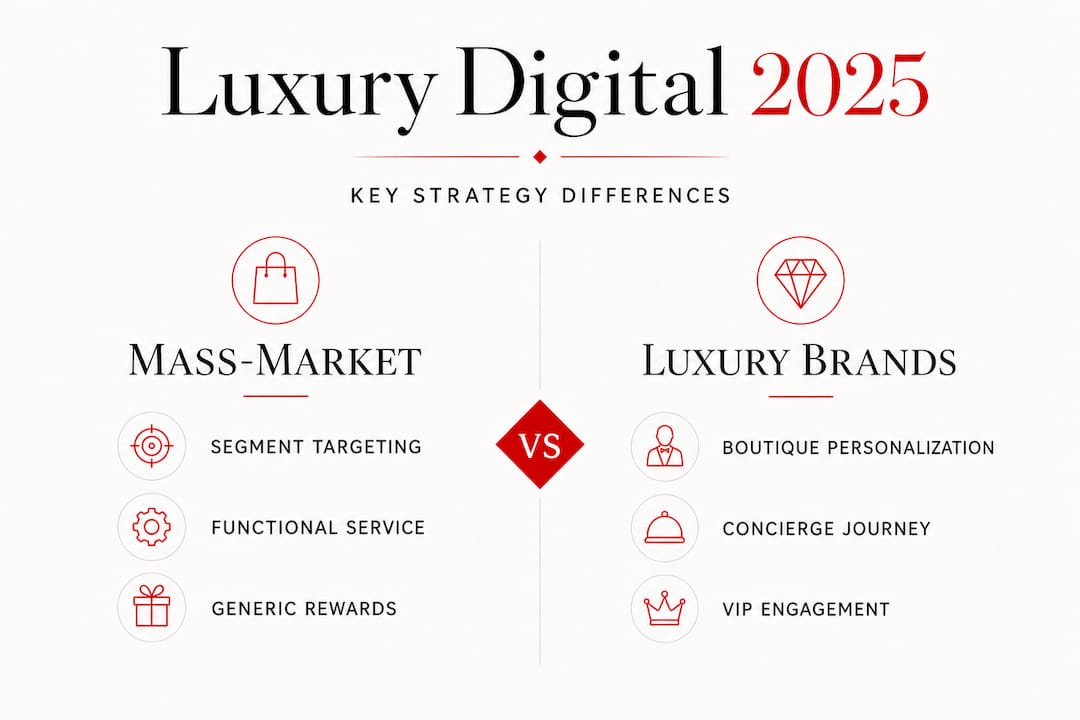
| Feature | Mass-market digital | Luxury digital 2025 |
|---|---|---|
| Personalization | Segment-level targeting | Individual behavioral modeling |
| Channel strategy | Multichannel convenience | Phygital concierge continuity |
| Loyalty mechanics | Points and discounts | Exclusive access and curated VIP programs |
| Content model | Volume and reach | Scarcity and editorial quality |
| AI deployment | Chatbots and recommendations | Predictive journey orchestration |
Understanding these differences is not just academic. It changes where you invest, what you measure, and how you brief your teams. Exploring personalized marketing types built specifically for luxury reveals how far these models diverge from generic personalization frameworks. If you want to understand the psychology underneath purchasing decisions, analyzing buyer behavior in high-end contexts is the first real discipline to build.
Pro Tip: Stop benchmarking your digital strategy against other luxury brands. Benchmark it against the best private service experiences in hospitality, wealth management, and art advisory. That is the competitive set your clients are actually comparing you to.
AI-powered concierge experiences: Beyond personalization
Personalization is table stakes. What separates elite luxury digital strategy in 2025 is the orchestration of an entirely seamless journey that feels individually designed at every step. That is what AI-powered concierge experience means in practice, and it is a significant architectural shift from anything traditional brands have done before.
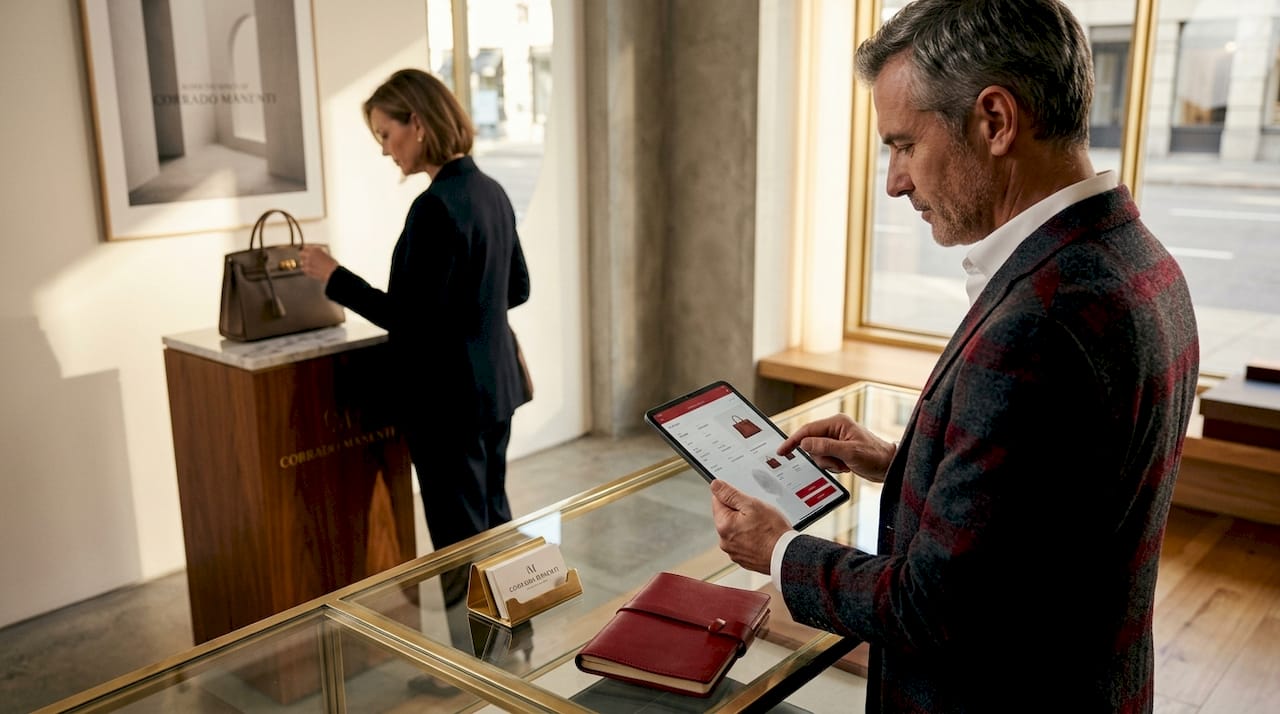
AI-driven omnichannel journeys are now central to luxury digital strategy, focusing specifically on service continuity from digital booking through to the in-boutique appointment. The client never feels the seam between online and offline. That is the standard.
Compare how luxury and mass-market brands deploy AI across the customer journey:
| Dimension | Mass-market AI use | Luxury AI use |
|---|---|---|
| Recommendation engine | “Customers also bought” logic | Taste-profiled curation based on wardrobe and lifestyle data |
| Customer service | Automated FAQ responses | Predictive outreach before issues arise |
| Booking and scheduling | Generic availability calendar | White-glove digital appointment with pre-loaded client profile |
| Post-purchase | Automated follow-up email | Personalized thank-you with curated next-step suggestion |
| Data activation | Segment modeling | Individual journey mapping in real time |
Here is what a VIP digital-to-physical concierge journey actually looks like in practice:
- Discovery and intent capture. A prospective client engages with editorial content on your brand’s platform. AI identifies behavioral signals: the product categories they revisit, the time they spend on lookbook pages, and the items they save without purchasing.
- Proactive outreach. A personalized message, not a generic email blast, reaches them through their preferred channel with a curated selection aligned to their observed taste. It feels editorial, not promotional.
- Private booking experience. The client books a private styling appointment through a seamless digital interface. Their profile, including past purchases, stated preferences, and behavioral data, is automatically shared with the boutique team.
- In-store continuity. The sales associate receives a brief before the appointment, knowing the client’s context. No repetitive questions, no friction. The appointment feels like a continuation of a relationship, not a cold start.
- Post-visit nurturing. Following the appointment, AI generates a personalized follow-up with curated recommendations based on what was discussed, not a generic “thank you for visiting” note.
This is not a fantasy scenario. Brands investing in AI in luxury personalization frameworks are already building these architectures. If you want context on how marketing trends for 2025 are shifting the investment priorities for luxury houses, the underlying mechanics become immediately practical.
Pro Tip: The biggest failure point in luxury AI deployment is the gap between digital data and in-store teams. Technology can do the analysis, but your retail staff needs to be trained to use the intelligence. Without that bridge, your AI investment disappears at the boutique door.
Social ecosystems and micro-influencers: Amplifying trust and exclusivity
Social media is not just a communication channel for luxury brands. In 2025, it is a discovery and purchase intent engine where the right partnership can shift a brand’s entire cultural positioning. The mistake is thinking this means celebrity endorsements and mass visibility. It does not.
Creators and social platforms remain central mechanics in luxury strategy because consumers use social for both discovery and purchase intent pathways. The nuance is in how you activate them.
“In luxury marketing, trust is the currency. A micro-influencer with 40,000 highly engaged followers in the right lifestyle niche can generate more purchase intent than a celebrity post seen by 10 million passive scrollers.”
The data supports this. What drives luxury purchase intention on social platforms is not reach. It is brand trust, perceived prestige, and the sense that the product or experience is genuinely unique. Those signals come through when creators speak with authentic authority, not when they read off a brand brief.
Here is what makes a micro and nano-influencer strategy work for luxury:
- Audience precision over follower count. A jewelry brand looking to reach affluent women in their 40s gets more ROI from a curator with 25,000 followers in that exact demographic than from a lifestyle influencer with 500,000 mixed-age followers.
- Long-term creative partnerships. One-off posts create noise. Multi-season partnerships build credibility. When an influencer’s audience sees them genuinely wearing the brand across months, the trust transfer to the brand is exponential.
- Exclusive access mechanics. Inviting select creators to private previews, behind-the-scenes archive tours, or ateliers turns them into authentic storytellers, not paid promoters. The content they create from these experiences is qualitatively different.
- Editorial versus promotional content. Brief creators for perspective and point of view, not product features. Luxury audiences are allergic to promotional language and respond to genuine aesthetic authority.
- Community seeding. A cluster of 10 to 15 aligned micro-influencers speaking about your brand simultaneously creates the perception of organic cultural momentum, which is far more persuasive than a single large placement.
For deep dives into how real brands are executing this, luxury influencer examples show what effective creative partnerships look like at the execution level. And for the business case, influencer impact in luxury clarifies how these relationships translate to measurable brand value.
Building loyalty: Phygital membership and VIP engagement hubs
Having AI-powered journeys and an intelligent social strategy brings clients in and keeps them engaged. But sustaining loyalty at the level luxury clients expect requires something more deliberate: a structured program that makes exclusivity feel permanent, not occasional.
VIP digital experiences including private previews, early access portals, and members-only hubs, paired with phygital service ecosystems, are the architecture for this sustained engagement. The goal is not loyalty points. It is loyalty identity. The client feels they belong to something.
Here is how to build a phygital loyalty structure that actually works:
- Define the inner circle. Not every client qualifies for VIP status. Define criteria based on purchase frequency, lifetime value, and engagement depth. Exclusivity that is too easy to achieve is not exclusivity at all.
- Create the digital hub. A private digital environment, accessible by invitation, where members get first access to new collections, direct communication with creative teams, and curated editorial content that non-members never see.
- Extend it into physical. VIP members receive private event invitations, exclusive in-store hours, or personal styling sessions that are unavailable through any public channel. The digital hub is the entry point; the physical experience is the reward.
- Build in recognition touchpoints. Every time a VIP member interacts with the brand, whether in-app, on the website, or in the boutique, they should feel immediately recognized. This requires robust data sharing between digital and retail systems.
- Curate ongoing exclusivity. The program must consistently deliver something genuinely rare: an archive piece, a first-look at a collaboration, or an invitation to a private creative conversation. The moment it feels routine, the prestige erodes.
The most common pitfall brands fall into is what I call “token exclusivity”: a VIP label applied to experiences that feel no different from what any client could access. That is a credibility killer. Your best clients know the difference immediately.
Pro Tip: Measure VIP program success by retention rate and share of wallet among members, not by how many people you’ve enrolled. A smaller, genuinely exclusive program that keeps top clients loyal for five or more years is worth more than a large program with high churn.
For a broader view of where the sector is moving, the analysis of key luxury marketing trends shows how phygital loyalty fits into the competitive landscape for 2025 and beyond.
Why luxury brand digitalization is not just tech adoption—it’s an experience revolution
Here is the uncomfortable truth that most digital strategy consultants won’t tell you: technology cannot save a brand that has lost its cultural clarity. The brands winning in 2025 are not winning because they have better AI. They are winning because they know exactly who they are, what they stand for, and what emotional territory they own, and they use technology to express that with greater precision.
The risk with the current wave of AI and digital investment is that it becomes a distraction from the harder, more important work of cultural positioning. Every tool described in this article, from concierge AI journeys to micro-influencer ecosystems to phygital VIP hubs, is only as powerful as the brand narrative it serves.
What most luxury houses miss is that the human and creative elements are not features you bolt onto a digital strategy. They are the strategy. An AI system can identify that a client favors a particular aesthetic. But the creative director’s vision, the ateliers’ craft, the brand’s historical codes: those are what give that aesthetic meaning. Technology amplifies. It does not originate.
The brands I have seen lose ground in digital are invariably the ones that outsourced the storytelling. They invested in platforms and automations, then filled them with content that lacked genuine editorial authority. Their clients felt it immediately. Luxury consumers are extraordinarily sensitive to the difference between a brand speaking with authentic conviction and one optimizing for engagement metrics.
My contrarian view is this: the most important digital investment a luxury brand can make in 2025 is not in AI infrastructure, though that matters. It is in the creative and cultural leadership that gives AI something worth amplifying. The most sophisticated 2025 digital marketing trends all point in the same direction: technology serves the experience, never the other way around.
Level up your luxury brand’s digital strategy
The frameworks in this article represent the frontier of what elite luxury brands are building right now, from AI-powered concierge journeys to phygital loyalty ecosystems and precision influencer strategies. Knowing the framework is step one. Implementing it with the nuance that luxury demands is where most teams need a strategic partner.
Corrado Manenti’s work sits at the intersection of consumer psychology, luxury branding, and digital innovation, which means every strategy is designed for the specific emotional and cultural dynamics of high-end markets. For executives ready to move from insight to execution, luxury brand growth tactics provides the operational foundation. The luxury digital strategy guide maps the architecture for long-term competitive advantage. And for forward-looking inspiration, fashion innovation examples shows what boundary-pushing brands are already doing next.
Frequently asked questions
What’s the core difference between luxury and mass-market digital trends in 2025?
Luxury prioritizes boutique-level personalization and AI-driven omnichannel concierge journeys, while mass-market brands focus on broader digital convenience and scale. The underlying logic, the emotional experience of the client, is entirely different.
How important are influencers in luxury digital strategies for 2025?
Micro and nano-influencers are critical because social platforms remain central to how luxury consumers discover and build purchase intent, particularly when creators bring genuine cultural authority rather than mass reach.
What does ‘phygital’ mean in the context of luxury brand engagement?
Phygital describes the seamless integration of physical and digital experiences, such as phygital service ecosystems that carry a client’s appointment journey from digital booking through to the in-store visit without friction or repetition.
How do luxury brands use AI differently than other sectors?
Luxury brands deploy AI for dynamic, behavior-based personalization and VIP access management, pushing well beyond standard chatbot automation into predictive journey orchestration at the individual level.
Why does exclusivity matter more for luxury brands online?
Online exclusivity translates directly into brand prestige and long-term loyalty. When clients access something genuinely rare through a digital channel, it reinforces the brand’s premium identity and creates an emotional attachment that discounts and generic loyalty programs simply cannot replicate.