

TL;DR:
- Psychology plays a crucial role in branding by tapping into subconscious emotional and cognitive processes to build recognition, trust, and loyalty.
- Brands that utilize emotional drivers, cognitive fluency, archetypes, and repeated exposure influence consumer behavior more effectively than feature-based marketing.
The role of psychology in branding is to systematically leverage human cognitive and emotional processes to build brand identities that consumers recognize, trust, and return to. Branding psychology, the recognized industry term for this discipline, explains why people choose one brand over another before rational thought even enters the picture. 90% of purchasing decisions are subconscious and driven by emotional triggers, meaning the brands that win are the ones that speak to the brain before the consumer realizes they are listening. For brand strategists, marketers, and business owners in fashion, luxury, and lifestyle sectors, understanding these principles is not optional. It is the foundation of every decision that moves a consumer from awareness to loyalty.
What psychological principles are central to effective branding?
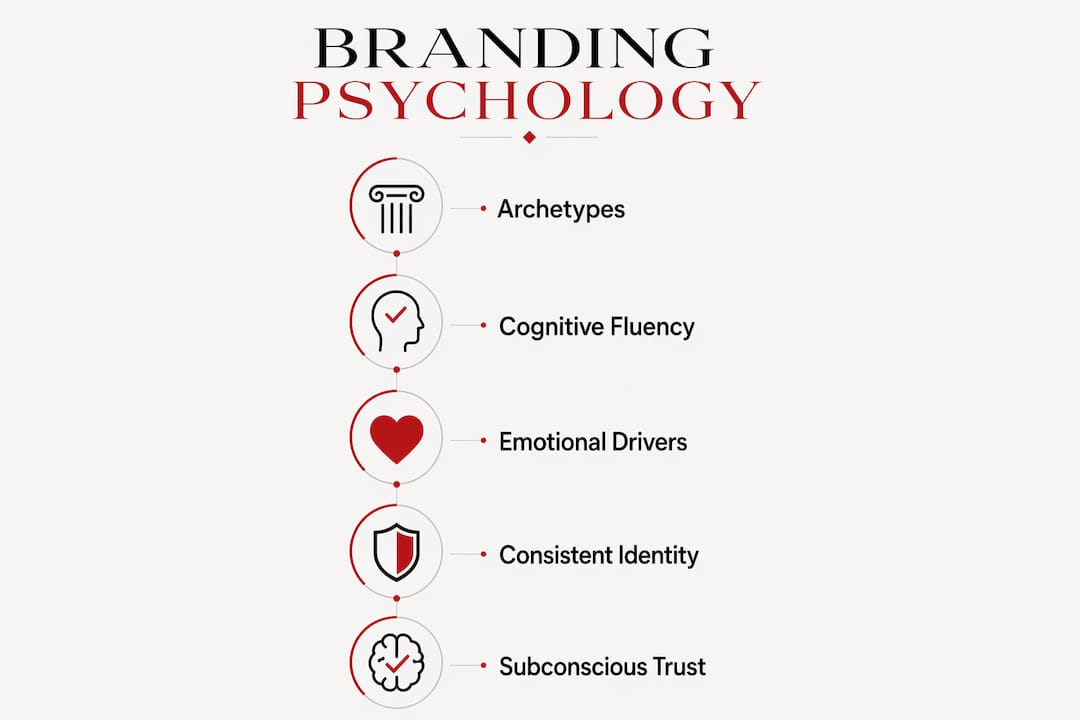
Branding psychology operates through several interlocking mechanisms, and the most powerful ones work below the level of conscious awareness. The first is emotional drivers. Paul Larche’s framework identifies three core drivers: heart (trust and belonging), gut (security and instinct), and status (identity and aspiration). Brands aligned with these drivers bypass rational skepticism entirely, which is why a luxury handbag sells a feeling of status long before it sells craftsmanship.
The second principle is cognitive fluency. The brain favors information it can process quickly and effortlessly. Brands that present simple, consistent visual and verbal identities feel more trustworthy and familiar, even on first encounter. This is not a coincidence. It is a measurable psychological effect that directly influences purchase intent.
The third is brand archetypes, a concept rooted in Carl Jung’s theory of the collective unconscious. Jungian archetypes bypass rational decision-making by tapping into universal symbols that humans recognize instinctively. A brand built around the Hero archetype (Nike) or the Caregiver archetype (Johnson & Johnson) activates emotional memory without requiring explanation. Consumers feel the brand before they analyze it.
The fourth is the Mere Exposure Effect. Repeated, consistent exposure to a brand increases positive feelings toward it, even without active engagement. This is why frequency and consistency in brand communications compound over time into genuine loyalty.
- Emotional drivers (heart, gut, status) create connections that logic cannot override
- Cognitive fluency makes brands feel safe and familiar faster
- Brand archetypes tap universal psychological symbols for instant recognition
- Mere Exposure Effect turns repetition into trust
Pro Tip: Pick one archetype and commit to it across every touchpoint. Mixing the Hero and the Jester in the same brand voice creates subconscious confusion, not personality.
How do emotional branding strategies influence consumer loyalty?
Emotional branding strategies produce measurable outcomes that traditional feature-based marketing cannot replicate. Emotional engagement leads to 306% higher lifetime value for emotionally connected customers compared to merely satisfied ones. That figure reframes the entire conversation about brand investment. Spending on psychological consistency is not a soft creative expense. It is a revenue driver with a documented return.

The mechanism is straightforward. Emotions are processed by the limbic system, the part of the brain that also governs memory and decision-making. When a brand consistently triggers positive emotional states, those states become associated with the brand itself. Over time, the consumer does not decide to be loyal. They simply feel drawn back.
Successful emotional branding tactics follow a recognizable pattern:
- Identify the core emotional need the brand fulfills (belonging, security, aspiration, excitement)
- Build every campaign around that feeling, not the product’s features or specifications
- Maintain psychological consistency across all channels, from packaging to customer service tone
- Reinforce identity through storytelling that mirrors the consumer’s self-image
“Successful brands stop selling features and start creating feelings, focusing on emotional drivers to connect.” — Paul Larche
Consistency is the multiplier. A brand that delivers the same emotional cue in a social post, a retail environment, and a post-purchase email trains the consumer’s brain to expect and seek that feeling. This is how psychological consistency compounds into a 23% revenue increase over time. Inconsistency, by contrast, creates cognitive dissonance that erodes trust faster than any competitor campaign could.
For luxury brands specifically, the emotional driver of status is particularly potent. Explore the emotional branding tactics that work specifically in upscale markets to see how these principles translate into premium positioning.
What role does logo psychology play in subconscious brand perception?
Visual identity is where branding psychology becomes most tangible and most underestimated. Color influences up to 85% of purchasing decisions through rapid emotional processing in the brain, before a consumer reads a single word of copy. That means your logo and color palette are doing psychological work the moment they appear on screen or shelf.
The table below maps key visual elements to their psychological effects:
| Visual element | Psychological effect |
|---|---|
| Blue (used by PayPal, Samsung) | Communicates trust, reliability, and calm |
| Red (used by Ferrari, Coca-Cola) | Triggers urgency, passion, and appetite |
| Rounded shapes | Suggest approachability, warmth, and safety |
| Angular shapes | Project precision, strength, and authority |
| Negative space | Creates secondary meanings that reward attention and deepen memory |
Negative space in logos creates subtle psychological effects by embedding secondary meanings that delight customers on discovery. The FedEx arrow and the Amazon smile-to-arrow are not accidents. They are deliberate psychological tools that improve brand story engagement and recall.
Cognitive fluency in logo design means simpler logos outperform complex ones in both trust and memory. The brain rewards what it can process quickly. A logo that requires effort to decode creates friction, and friction is the enemy of positive brand association.
Pro Tip: Before finalizing any visual identity element, test it with five seconds of exposure. If viewers cannot recall the dominant color and shape, the design is working against your psychology, not with it.
Effective logo psychology operates entirely below conscious awareness. Consumers cannot tell you why they trust a brand more after seeing its logo. They simply do. That invisibility is the point. Understanding the psychological triggers in luxury branding reveals how premium brands use visual cues to signal exclusivity without stating it directly.
How can brand strategists apply psychology to build stronger identities?
Knowing the theory is one thing. Translating it into a repeatable brand-building process is where most strategists fall short. The following framework converts psychological principles into operational decisions.
Anchor to one archetype and one emotional driver. Every piece of brand communication should be traceable back to a single archetype and a single primary emotional driver. Nike is the Hero driving achievement. Chanel is the Ruler driving status and exclusivity. Mixing archetypes across campaigns fragments the subconscious categorization consumers build over time. Inconsistent archetype usage across customer touchpoints causes a 15 to 20% conversion loss. That is a measurable cost of creative inconsistency.
Build a psychological style guide. Most brands have visual style guides. Few have psychological ones. A psychological style guide defines the emotional tone of every customer interaction, including response speed, humor level, vocabulary register, and the feeling every touchpoint should leave behind. Consistency in psychological style guides across tone, response speed, and humor strengthens subconscious brand coherence and conversion rates.
Design for simplicity and repeated exposure. Apply cognitive fluency principles to every asset. Reduce visual complexity. Standardize fonts and color usage. Increase exposure frequency through retargeting, consistent social cadence, and physical brand presence. The Mere Exposure Effect requires repetition to activate. You cannot build familiarity with sporadic appearances.
Audit customer touchpoints for psychological friction. Walk through every stage of the customer journey and identify moments where the brand’s emotional promise breaks down. A luxury brand that delivers aspirational advertising but a frustrating checkout experience creates cognitive dissonance that damages loyalty at the exact moment of conversion.
- Assign one archetype to the brand and document it in writing
- Create a psychological style guide alongside the visual one
- Simplify all visual assets to maximize cognitive fluency
- Schedule regular touchpoint audits to catch emotional inconsistencies
- Use semantic priming with archetypal imagery in digital ads to reduce cognitive load and improve sign-up rates
For a deeper look at how these principles apply specifically to fashion and luxury contexts, the psychology in luxury branding framework offers a structured approach to 2026 market conditions.
Key takeaways
Branding psychology works because it aligns brand identity with how the human brain actually processes emotion, familiarity, and trust, making psychological consistency the single highest-leverage investment a brand can make.
| Point | Details |
|---|---|
| Decisions are subconscious | 90% of purchasing decisions are emotional, so brands must speak to feeling before logic. |
| Archetypes build instant recognition | Jungian archetypes activate universal emotional memory, reducing the effort consumers need to trust a brand. |
| Visual identity drives perception | Color influences up to 85% of purchase decisions, making logo psychology a revenue-level concern. |
| Consistency multiplies loyalty | Emotional consistency across touchpoints produces 306% higher lifetime value for connected customers. |
| Inconsistency has a measurable cost | Fragmented archetype usage causes 15 to 20% conversion loss across customer touchpoints. |
Why most brands are only scratching the surface of psychology
I have worked with fashion and luxury brands long enough to see a consistent pattern. Teams invest heavily in aesthetics and messaging, then wonder why the brand does not convert the way the creative deserves. The answer is almost always the same: the psychology is decorative rather than structural.
What I mean is this. Many brands use psychological concepts as a finishing layer. They pick a color palette because it “feels right,” choose a brand voice because a competitor does something similar, and run emotional campaigns without anchoring them to a defined archetype. The result is a brand that looks coherent but feels hollow to the consumer’s subconscious.
The brands I have seen perform consistently well treat psychology as the architecture, not the decoration. They define the emotional driver first, build the archetype second, and let every visual and verbal decision flow from those two anchors. When a luxury client asks me why their engagement is dropping despite strong creative, I always start with the same audit: does every touchpoint trigger the same feeling? Nine times out of ten, the answer is no.
There is also a trap I see with sophisticated teams: overcomplication. Semantic priming, cognitive fluency, and archetype theory are powerful tools, but they work best when applied with restraint. A brand that tries to engineer every psychological response ends up feeling calculated rather than authentic. Authenticity is itself a psychological signal. Consumers detect inauthenticity faster than any focus group can measure it.
Psychology supports quality and delivery. It does not replace them. A psychologically perfect brand built on a mediocre product will accelerate churn, not prevent it.
— Corrado
Work with Corradomanenti to build a psychologically grounded brand
Corradomanenti combines an academic background in psychology with deep practical experience in fashion and luxury marketing to deliver branding strategies that work at the level of consumer behavior, not just aesthetics. If your brand is producing strong creative but inconsistent results, the gap is almost always psychological. From luxury brand psychology frameworks to custom archetype development and full emotional branding audits, Corradomanenti builds the psychological architecture that turns brand exposure into lasting loyalty. For brands in fashion, luxury, and lifestyle sectors ready to compete at the level of the brain, this is where the work starts. Explore the luxury market growth tactics that integrate psychological depth with commercial precision.
FAQ
What is the role of psychology in branding?
The role of psychology in branding is to align brand identity with the cognitive and emotional processes that drive consumer decisions. Since 90% of purchasing decisions are subconscious, brands that trigger the right emotional responses consistently outperform those that rely on rational persuasion alone.
How do brand archetypes work psychologically?
Brand archetypes tap into Jungian universal symbols stored in collective emotional memory, allowing consumers to categorize and trust a brand instinctively. Brands like Nike (Hero) and Chanel (Ruler) use archetypes to create recognition that bypasses rational analysis entirely.
Why does color matter so much in branding?
Color influences up to 85% of purchasing decisions through rapid emotional processing that occurs before conscious thought. Blue signals trust, red triggers urgency, and each color activates specific emotional associations that shape brand perception at the moment of first contact.
What is cognitive fluency and why does it affect brand trust?
Cognitive fluency is the ease with which the brain processes information. Simpler logos and consistent brand visuals generate more positive emotional responses and stronger recall because the brain interprets easy processing as a signal of familiarity and safety.
How does emotional branding affect long-term loyalty?
Emotionally connected customers deliver 306% higher lifetime value compared to satisfied but emotionally neutral customers. Consistent emotional branding trains the brain to associate positive feelings with the brand, making repurchase feel instinctive rather than deliberate.