

TL;DR:
- Consumers primarily buy premium products to avoid regret, focusing on longevity and trust rather than status or exclusivity. Younger buyers emphasize social proof, while older consumers value durability and anti-waste assurances, with social media presence influencing perceptions significantly. Brands succeed by building trust, curating scarcity, and emphasizing practical value through psychological drivers like scarcity and loss aversion.
Premium purchases are defined by one core motivation: the belief that paying more eliminates regret. According to Ipsos research, 48% cite longevity and 47% cite trust in brand quality as their top reasons for spending more. Exclusivity ranks far lower, at just 16%. This is the central finding that reshapes how we should understand what drives premium purchases. Consumers are not primarily buying status. They are buying confidence. The psychological term for this is “anti-regret framing,” and it sits at the heart of every successful luxury brand strategy. Younger buyers do factor in image and social proof, but even for them, the dominant logic is value certainty, not vanity.
What does the data actually say about premium purchase motivations?
The 2026 Ipsos Consumer Tracker delivers the clearest picture yet of why consumers pay premiums. Longevity, quality trust, and anti-waste assurance each score above 47%, while image scores just 12%. This means the dominant narrative around luxury, that people buy it to show off, is statistically marginal. Most buyers are making a calculated bet that the higher price protects them from a worse outcome.
Age creates a meaningful split in these motivations. 54% of consumers aged 55 and older cite longevity as their primary driver, compared to 41% of those aged 18 to 34. The image factor flips entirely: 21% of younger adults care about how a purchase reflects on them socially, versus only 3% of older buyers. This is not a trivial gap. It means the same premium product needs to carry two entirely different messages depending on who you are selling to.
NIQ’s 2026 research adds a dimension that pure product data misses: the role of social media and frontline staff in shaping perceived premium value. Nearly one-third of luxury consumers are deterred from a venue or brand by minimal social media presence. That is a direct revenue consequence of neglecting digital visibility. Meanwhile, 32% of consumers in premium drink categories say bar staff recommendations directly influenced their purchase. The person pouring the drink carries more persuasive weight than the bottle’s label.
| Motivation | 18–34 age group | 55+ age group |
|---|---|---|
| Longevity | 41% | 54% |
| Trust in brand quality | ~45% | ~50% |
| Image / social pride | 21% | 3% |
| Exclusivity | Higher relative weight | Lower relative weight |
| Anti-waste assurance | Moderate | High |
Source: Ipsos Consumer Tracker 2026
How psychology explains why people pay more
The behavioral economics behind premium buying behavior centers on a handful of well-documented mechanisms. Understanding them explains why certain brands command prices that defy rational cost analysis.
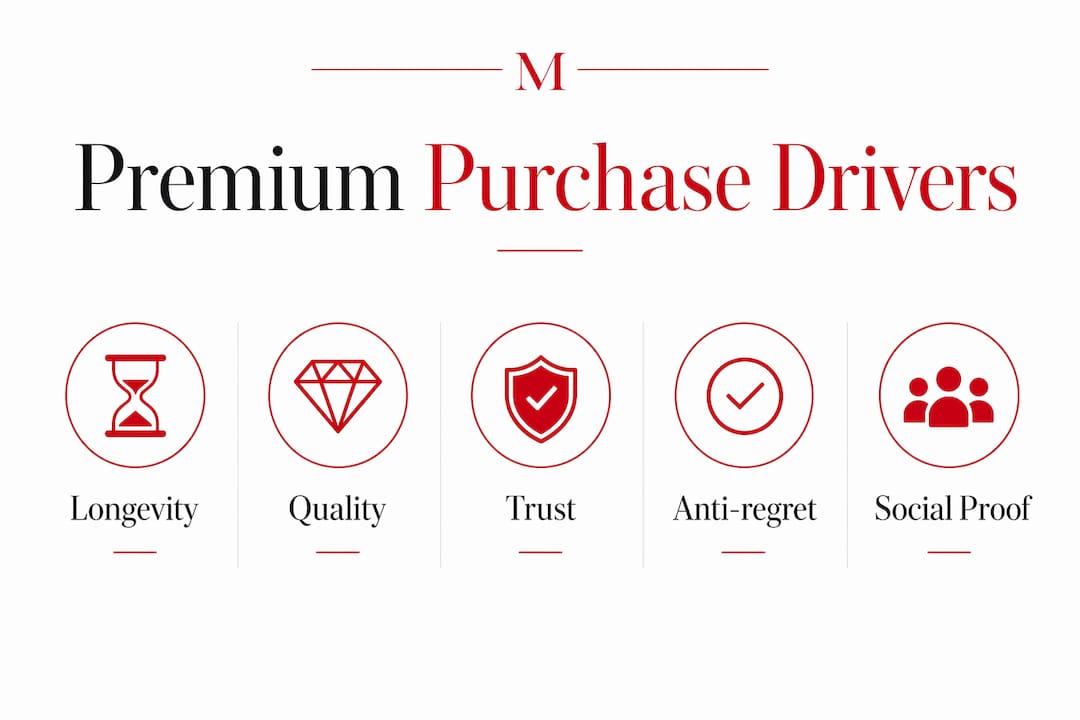
The key psychological drivers include:
- Scarcity effect: Limited availability increases perceived desirability. The Hermès Birkin waitlist is not a supply chain problem. It is a deliberate psychological architecture that makes ownership feel like an achievement.
- Reactance: When access is restricted, desire intensifies. Telling consumers they cannot have something makes them want it more, not less.
- Authority bias: Expert endorsement or a brand’s established positioning reduces the cognitive effort required to justify a purchase. A sommelier’s recommendation removes doubt.
- Paradox of choice: Fewer options increase conversion in premium categories. Curated selections signal expertise and reduce buyer anxiety.
- Loss aversion: Framing a premium purchase as avoiding a future loss (replacing a cheap product twice) is more persuasive than framing it as a gain.
Scarcity, reactance, and authority bias each compound the desirability of premium items in ways that product quality alone cannot replicate. A brand that makes its product harder to obtain is not losing sales. It is building a psychological case for why the product is worth more. This is why consumer behavior in luxury cannot be analyzed through a standard retail lens.
Pro Tip: Brands that deliberately introduce friction, such as application processes, waitlists, or invitation-only access, are not creating barriers. They are creating proof of value. The effort required to obtain something becomes part of the product’s perceived worth.
How motivations differ across demographics and luxury sectors
Premium purchase motivations are not uniform. They shift by age, culture, and the specific category being purchased. The Ifop Paris Luxury Summit 2025 findings confirm that luxury consumers now demand exclusivity, personalization, sustainability, and human creativity simultaneously. This is a more complex brief than luxury brands faced a decade ago, and it reflects a consumer base that has grown more sophisticated.
In prestige beauty, the NIQ data is unambiguous: trust and experience now outrank product specs as the primary differentiators. Shoppers assume quality. What they are actually buying is confidence in the shopping journey itself, including the staff interaction, the website experience, and the brand’s emotional resonance. A luxury skincare brand that invests only in formulation and ignores its retail environment is competing on the wrong dimension.
Luxury transportation and experiential categories like yachting operate on a different axis. The motivations behind premium yacht purchases center on freedom, identity expression, and investment logic, not just product quality. Similarly, luxury transportation trends show that buyers in this segment weight personalization and flawless execution above almost everything else. The vehicle is secondary to the experience of being transported.
| Consumer segment | Primary driver | Secondary driver |
|---|---|---|
| 18–34 consumers | Image and social proof | Quality assurance |
| 55+ consumers | Longevity and durability | Anti-waste confidence |
| Prestige beauty shoppers | Trust and experience | Omnichannel smoothness |
| Premium drinks buyers | Staff recommendation | Social media presence |
| Luxury fashion buyers | Exclusivity and creativity | Personalization |
| Experiential luxury buyers | Flawless execution | Identity alignment |
The sector-level pattern is consistent: wherever product quality becomes a baseline expectation, the competitive advantage moves to trust, experience, and emotional resonance. Brands that recognize this shift early gain ground that is very difficult for competitors to recover.
How brands and consumers can apply these insights
For brands, the practical implication of this data is direct. Marketing focused only on product specs consistently underperforms compared to strategies built around trust and holistic experience. Once your product quality is assumed, your brand story, your staff, and your digital presence become the actual product.
The most effective approaches for brands include:
- Building trust in luxury sales through guarantees, transparent sourcing, and consistent brand behavior across every touchpoint.
- Training frontline staff as brand ambassadors, since staff execution acts as a conversion valve that can confirm or destroy a buyer’s confidence at the final moment.
- Maintaining a social media presence that reflects the brand’s premium positioning, given that a weak digital footprint actively deters one in three luxury consumers.
- Using anti-regret framing in communications: emphasize durability, offer strong guarantees, and make the cost-per-use argument explicit.
For consumers, the insight is equally useful. The data suggests that the most satisfying premium purchases are those grounded in practical value, not social pressure. When you buy for longevity and quality confidence rather than image, you are statistically more likely to feel the purchase was worth it. The role of social media in luxury has made it easier to buy for the wrong reasons. Recognizing that pull is the first step toward smarter high-end spending.
Pro Tip: For brands balancing exclusivity with accessibility, the answer is tiered access rather than open availability. A public-facing product line paired with an invitation-only tier preserves the psychological architecture of scarcity while widening the revenue base.
Key takeaways
Premium purchases are driven primarily by longevity, quality trust, and anti-regret logic, not exclusivity or status signaling, and brands that build strategy around this reality consistently outperform those that do not.
| Point | Details |
|---|---|
| Anti-regret logic dominates | 48% cite longevity and 47% cite quality trust as top premium motivators, far above image at 12%. |
| Age shapes the motivation split | Younger buyers weight image and social proof; older buyers prioritize durability and anti-waste confidence. |
| Experience beats specs | Once quality is assumed, trust, staff behavior, and omnichannel experience become the real differentiators. |
| Scarcity is a strategy | Psychological mechanisms like reactance and loss aversion make restricted access a genuine value driver. |
| Social media deters or converts | Nearly one-third of luxury consumers are put off by weak brand social presence, making digital visibility a revenue factor. |
The real driver most brands still underestimate
After years of working with fashion and luxury brands, the pattern I keep seeing is this: brands invest heavily in product development and almost nothing in the psychological architecture around the product. They build something genuinely excellent, then market it as if the specs will do the selling.
The data from Ipsos and NIQ tells a different story. Consumers are not buying the product. They are buying the feeling that they will not regret the purchase. That is a psychological need, and it requires a psychological response. Guarantees, staff training, brand transparency, and curated scarcity are not soft extras. They are the core of what makes a premium price feel justified.
The Ifop findings from the Paris Luxury Summit 2025 add another layer: the luxury consumer of 2026 expects human creativity and genuine exclusivity at the same time as sustainability and personalization. That is a demanding combination, and brands that try to fake any part of it will be found out quickly. The consumers paying premium prices are, by definition, paying close attention.
What I find most interesting is that experience has become the final frontier. Product quality is table stakes. Trust is the price of entry. The brands that will define the next decade of luxury are the ones that make the entire journey, from first Instagram impression to post-purchase follow-up, feel as considered as the product itself.
— Corrado
How Corradomanenti helps brands understand and attract premium buyers
Understanding what drives premium purchases is one thing. Building a brand that consistently delivers on those drivers is another challenge entirely. Corradomanenti specializes in exactly this gap, combining psychology-based marketing with deep luxury sector expertise to help brands connect with high-value buyers at every stage of the decision process.
Whether you need to sharpen your positioning, analyze what your buyers actually respond to, or build a brand experience that converts at the premium tier, the resources and strategies at Corradomanenti are built for that work. Explore fashion brand growth tactics designed specifically for the luxury market, or go deeper with frameworks for analyzing buyer behavior in premium categories. The psychology behind luxury spending is learnable. The brands that learn it fastest win.
FAQ
What are the top factors influencing premium buying decisions?
Longevity, trust in brand quality, and assurance against wasted money are the three leading factors, each cited by around 47 to 48% of consumers according to Ipsos. Exclusivity and image rank significantly lower, at 16% and 12% respectively.
Why do younger consumers choose luxury for different reasons than older buyers?
Younger consumers aged 18 to 34 are more influenced by image and social proof, with 21% citing image as a driver compared to just 3% of those aged 55 and older. Older buyers focus almost entirely on durability and practical value.
How does social media influence luxury spending?
Nearly one-third of luxury consumers are deterred by a brand’s minimal social media presence, according to NIQ 2026 research. Social media functions as a trust signal and quality indicator, not just a marketing channel.
What psychological mechanisms drive high-value purchases?
Scarcity, reactance, authority bias, and loss aversion are the primary psychological drivers behind premium purchase attraction. These mechanisms make restricted access and expert endorsement more persuasive than product features alone.
How should brands use anti-regret framing in premium marketing?
Brands should emphasize durability guarantees, transparent quality proof, and cost-per-use logic to reduce buyer second-guessing. This framing directly addresses the 47% of consumers who cite anti-waste assurance as a core premium purchase motivation.