


TL;DR:
- Values-based marketing aligns brand actions and messaging with customer beliefs to foster emotional loyalty. It requires authentic integration into operations, not just marketing campaigns, to build genuine trust and long-term growth.
Values-based marketing is defined as a strategy where brands align their messaging, operations, and culture with the core values their customers already hold. It is not a trend. It is the most direct path to emotional loyalty in a market where consumers can see through hollow brand promises faster than ever. Brands with transparency and shared values achieve 25% higher customer loyalty and up to 15% revenue growth over three years. That gap between values-aligned brands and the rest is widening, not closing. Understanding what is values-based marketing, and how to execute it authentically, is now a core competency for any marketing professional or business owner who wants to build something that lasts.
What is values-based marketing and how does it work?
Values-based marketing is the practice of building brand identity around principles that your customers already believe in, then proving those principles through every business decision you make. The definition of values-based marketing separates it sharply from traditional marketing, which centers on product features, pricing, and promotional offers. Values-based marketing centers on belief.

The mechanism is straightforward. A brand identifies the values its best customers hold most deeply, such as sustainability, craftsmanship, freedom, or social justice. It then embeds those values into its products, hiring practices, supply chain, and communications. Every customer touchpoint reinforces the same message: “We believe what you believe.”
This approach works because it creates identification, not just preference. A customer who buys a product because it is well-priced will switch the moment a cheaper option appears. A customer who buys because the brand reflects who they are will stay, advocate, and forgive occasional missteps. That is the commercial logic behind purpose-driven marketing.
The industry term most practitioners use is “value-based marketing” or “values-driven marketing.” Both refer to the same core concept. The distinction from purpose-driven marketing is subtle. Purpose-driven marketing focuses on a brand’s “why,” while values-based marketing focuses on the shared beliefs between brand and customer. In practice, the two overlap significantly.
How does values-based marketing differ from CSR and traditional marketing?
This is where most brands get confused, and the confusion is expensive. Values-based marketing differs from CSR by embedding principles into the entire business rather than funding adjacent charitable initiatives. CSR is what a company does on the side. Values-based marketing is what a company is.
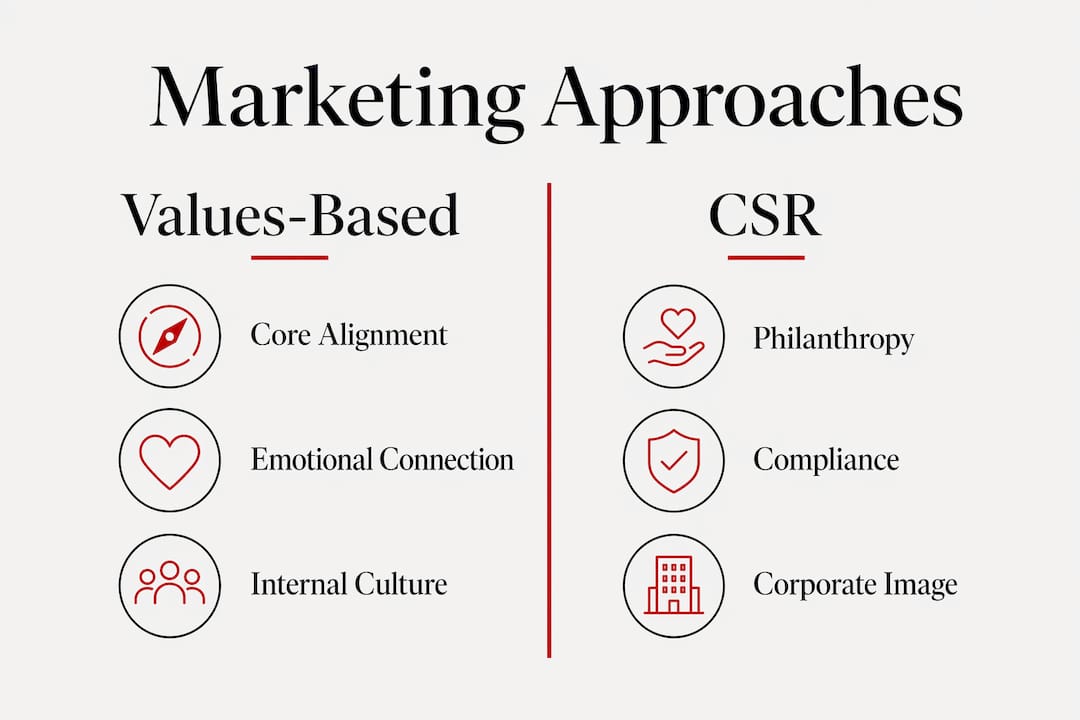
Traditional marketing asks: “What does our product do, and why should you buy it?” Values-based marketing asks: “What do you believe, and how does our brand reflect that?” The shift is from product-out to customer-in.
Three distinctions define the gap between these approaches:
- Traditional marketing focuses on features, benefits, and price. It targets demographics: age, income, location. It measures success through conversions and short-term sales lift.
- CSR involves separate charitable programs, sustainability reports, or community donations. These are real and often valuable, but they sit outside the core business model.
- Values-based marketing integrates principles into product development, hiring, supply chain, and brand storytelling. It targets psychographics: beliefs, motivations, and worldview.
The risk of confusing these categories is severe. Brands that run values-based campaigns without backing them with operational reality face accusations of “purpose-washing” or “woke-washing.” Consumers, especially Millennials and Gen Z, are skilled at identifying the gap between what a brand says and what it does. When that gap is visible, trust collapses faster than any PR campaign can repair it. Disconnection between marketing messages and operational reality risks performative accusations and severe trust damage.
What are the proven benefits of values-driven marketing?
The business case for values-oriented marketing strategies is not theoretical. The numbers are concrete and consistent across multiple research sources.
Brands with high perceived value relevance saw a 175% stock price increase over 12 years, compared to 86% for the S&P 500. That is not a marginal advantage. It is the difference between a brand that compounds and one that stagnates.
On the campaign performance side, values-driven targeting improves ad preference by up to 23 points and increases click-through rates 1.8X to 2X compared to traditional demographic targeting. Those gains come without increasing media spend. They come from better alignment between message and audience.
| Metric | Traditional marketing | Values-based marketing |
|---|---|---|
| Targeting method | Demographics (age, income, location) | Psychographics (beliefs, motivations) |
| Ad preference lift | Baseline | Up to +23 points |
| Click-through rate | Baseline | 1.8X–2X higher |
| Customer loyalty | Baseline | Up to 25% higher |
| Revenue growth (3 years) | Baseline | Up to 15% higher |
| Stock performance (12 years) | S&P average: 86% | Values-aligned brands: 175% |
The financial case is clear. Values-based marketing builds what no feature or price point can: an emotional moat. Customers who share your values do not comparison-shop the same way. They are already on your side before the sale begins.
Pro Tip: Map your top 20% of customers by lifetime value and run a psychographic survey. The values that cluster in that group are the ones your brand should be communicating, not the ones your leadership team assumes matter.
How does values-based marketing work psychologically?
Values in marketing correspond to deep-rooted motivations like achievement, security, pleasure, purpose, freedom, and tradition. These are not preferences. They are the filters through which people interpret every brand interaction. Behavioral science defines values as unarticulated motivations, meaning customers rarely say “I buy this brand because it reflects my need for achievement.” They just feel a stronger pull toward it.
Values-based marketing is often misunderstood as a moral stance when it is actually a science of motivation that predicts consumer behavior. This reframe matters enormously for how you build campaigns. You are not taking a political position. You are matching your message to the motivational architecture of your best customers.
Understanding psychological triggers in luxury brand engagement shows how values like exclusivity and achievement drive purchase decisions far more reliably than product specifications. The same principle applies across categories. A brand that speaks to a customer’s need for security will outperform one that lists product warranties, even if the warranty is better.
Campaigns that match values-based messaging to the right audience segments show measurable gains in ad likability and relevance across digital channels. The psychology of colors in marketing is one visible example of how psychological alignment shapes brand perception before a customer reads a single word of copy.
The practical implication is this: demographic targeting tells you who is in the room. Values-based targeting tells you what they care about. The second answer is far more useful for writing copy, designing experiences, and building loyalty programs.
Pro Tip: Use values segmentation alongside demographic data in your next campaign brief. Ask your creative team to write one version of the ad for a “security-motivated” customer and one for an “achievement-motivated” customer. The difference in tone and imagery will be striking, and the results will tell you which segment dominates your audience.
What operational changes does values-based marketing require?
Authentic values-based marketing cannot live only in the marketing department. It requires changes across the entire organization. This is the part most brands underestimate.
- Embed values into hiring. Your brand values must show up in job descriptions, interview questions, and onboarding. Employees who do not share the values will undermine them in every customer interaction.
- Align your supply chain. If your brand communicates sustainability but sources from suppliers with poor environmental records, the gap will surface. Audit your supply chain against your stated values before you publish them.
- Build values into product development. Every product decision should pass a values test. Does this feature, material, or design choice reflect what we say we stand for?
- Train leadership to model the values. Customers watch what executives do, not just what the brand says. Leadership behavior is the most credible signal of authentic values.
- Measure internal alignment regularly. Run employee surveys that specifically ask whether the company lives its stated values. Gaps identified internally are far cheaper to fix than gaps exposed publicly.
Strong alignment of external values with internal culture reduces turnover by up to 20% among Millennials and Gen Z. That retention benefit is a direct financial return on the investment in cultural alignment. Brands that treat values as a marketing exercise rather than an organizational commitment will see the opposite effect: high turnover, low morale, and campaigns that feel hollow to the very customers they are trying to reach.
True value alignment requires consistent internal culture matching external messaging to maintain trust. Nike’s endorsement of Colin Kaepernick is the most cited example of authentic values-driven marketing that required real business risk. Nike lost some customers and gained far more loyal ones. The lesson is not that controversy works. The lesson is that genuine commitment to a value, backed by real business decisions, builds a depth of loyalty that no promotional campaign can replicate.
For luxury brands, the stakes are even higher. Brand alignment in luxury fashion is not optional. Luxury customers pay a premium precisely because they believe the brand reflects their identity. Any gap between stated values and operational reality destroys the premium justification instantly.
How can you apply values-based marketing to build brand loyalty?
Implementing values-based marketing follows a clear sequence. The sequence matters because skipping steps creates the authenticity gaps that destroy trust.
Clarify your core values first. Do not start with what sounds good. Start with what your organization actually does consistently, even when it costs something. Those behaviors reveal your real values. Then ask whether those values overlap with what your best customers care about most.
Communicate values consistently across every touchpoint. Your website, packaging, social media, customer service scripts, and in-store experience must all carry the same values signal. Inconsistency reads as inauthenticity. Authentic storytelling is the most effective vehicle for communicating values because it shows the values in action rather than stating them as claims.
Design loyalty programs around values, not just transactions. A points program rewards spending. A values-based loyalty program rewards behaviors that reflect shared beliefs, such as recycling, community participation, or product customization. The second type builds identity, not just habit.
Monitor alignment continuously. Run quarterly audits comparing your external messaging to your internal operations. Ask customers directly whether your brand lives up to its stated values. The feedback will be uncomfortable at times. It is also the most valuable data you can collect.
Use data analytics to refine values-based targeting. AI-powered segmentation tools can now identify values clusters within your customer base at scale. Analyzing high-end consumer behavior shows how values-based psychographic profiling outperforms demographic models for predicting purchase intent and lifetime value in premium categories.
Key Takeaways
Values-based marketing builds durable competitive advantage by aligning brand operations and messaging with the deep motivations customers already hold, producing measurable gains in loyalty, retention, and financial performance.
| Point | Details |
|---|---|
| Core definition | Values-based marketing aligns brand operations and messaging with shared customer beliefs, not just product features. |
| Financial impact | Values-aligned brands delivered 175% stock growth over 12 years versus 86% for the S&P 500. |
| Campaign performance | Values-driven targeting raises ad preference by up to 23 points and doubles click-through rates. |
| Operational requirement | Authentic implementation requires embedding values into hiring, supply chain, and product development. |
| Employee retention | Internal culture aligned with stated values reduces Millennial and Gen Z turnover by up to 20%. |
Why most brands get values-based marketing wrong
After working with fashion and luxury brands across multiple markets, I keep seeing the same mistake. Brands treat values-based marketing as a campaign layer. They pick a cause, run a campaign, and expect loyalty to follow. It does not work that way.
The brands that build real emotional moats are the ones that make values-based decisions that cost something. They turn down suppliers that do not meet their standards. They hire slower because they will not compromise on cultural fit. They pull products that contradict their stated beliefs. Those decisions are invisible in the marketing materials, but customers feel them. They show up in the texture of every interaction.
The psychological dimension is what most marketing teams miss. Values are not preferences. They are identity anchors. When a brand reflects a customer’s core values, the customer is not just buying a product. They are affirming who they are. That is a fundamentally different relationship than brand preference, and it is far more durable.
My honest view is that values-based marketing will separate the brands that survive the next decade from the ones that do not. Younger consumers are not more demanding. They are more accurate. They can read the gap between stated values and operational reality with precision. The brands that close that gap will earn loyalty that no media budget can buy. The ones that do not will spend more and more to acquire customers who feel less and less connected.
— Corrado
How Corradomanenti approaches values-driven brand growth
Corradomanenti works with fashion and luxury brands that want to build genuine emotional connections with their customers, not just run campaigns that look good for a quarter.
The work starts with consumer psychology: understanding not just what your customers buy, but why they buy it and what values drive that decision. From there, Corradomanenti helps brands align their internal culture, product decisions, and communications into a single coherent values story. For brands ready to move from surface-level messaging to genuine values alignment, the fashion brand growth tactics framework provides a structured path from diagnosis to execution. For brands that want to understand the motivational architecture of their best customers first, the buyer behavior analysis service is the right starting point.
FAQ
What is the simplest definition of values-based marketing?
Values-based marketing is a strategy where a brand aligns its messaging and operations with the core beliefs its customers already hold. The goal is emotional connection and loyalty, not just product preference.
How does values-based marketing differ from purpose-driven marketing?
Purpose-driven marketing focuses on a brand’s reason for existing, while values-based marketing focuses on the shared beliefs between brand and customer. In practice, the two approaches overlap and often reinforce each other.
What are the measurable benefits of values-driven marketing?
Research shows values-aligned brands achieve 25% higher customer loyalty, up to 15% revenue growth over three years, and ad click-through rates 1.8X to 2X higher than demographic-targeted campaigns.
Can small businesses use values-based marketing effectively?
Small businesses often have a natural advantage because their values are more visible and consistent. The key is identifying the values your best customers hold and making sure every business decision reflects them.
What is the biggest risk in implementing values-based marketing?
The biggest risk is communicating values externally without aligning internal operations. When customers or employees see a gap between what a brand says and what it does, the resulting trust damage is difficult and costly to repair.