
Most luxury marketers believe exceptional products alone create devoted customers. They invest millions in craftsmanship, materials, and aesthetics while overlooking the invisible force that truly drives loyalty: psychology. Research shows emotional experiences drive 70% of luxury brand loyalty, yet many brands still focus narrowly on tangible features. Understanding how anticipatory service, scarcity perception, and psychological entitlement shape consumer behavior transforms customer experience from transactional to transformational. This guide explores research-backed psychological insights that luxury brands can apply immediately to deepen engagement and build lasting emotional bonds with discerning customers.
Table of Contents
- Key takeaways
- Unlocking psychological intimacy: anticipatory service in luxury
- Harnessing scarcity and exclusivity: psychology of desire in luxury marketing
- Effort, entitlement, and cultural nuances: deepening luxury value perception
- Applying psychology insights to elevate luxury customer experience
- Elevate your luxury brand with expert growth strategies
- Frequently asked questions about psychology in luxury customer experience
Key Takeaways
| Point | Details |
|---|---|
| Anticipatory service loyalty | Proactively addressing unspoken needs strengthens emotional bonds and drives lasting loyalty beyond product quality. |
| Dopamine driven bonds | Anticipatory service triggers dopamine release when surprises exceed expectations, creating lasting loyalty patterns. |
| Scarcity signaling balance | Scarcity boosts desire through reactance and FOMO but must be balanced with authentic signaling of rarity to prevent backfire. |
| Need for uniqueness | The need for uniqueness drives some luxury buyers to seek differentiated products and experiences. |
| Cultural democratization shapes exclusivity | Cultural factors and democratization trends influence how value and exclusivity are perceived in luxury markets. |
Unlocking psychological intimacy: anticipatory service in luxury
Anticipatory service represents the pinnacle of exclusive brand experiences by addressing customer needs before they’re voiced. This concept, rooted in Japanese omotenashi psychology, creates psychological intimacy that transcends typical service interactions. When brands predict and fulfill unspoken desires, they trigger neurological responses that cement emotional bonds far stronger than product quality alone.
The science behind this phenomenon centers on dopamine, the neurotransmitter associated with reward and pleasure. Anticipatory service triggers dopamine release when customers experience delightful surprises that exceed expectations. This neurochemical response doesn’t just create momentary satisfaction. It establishes lasting loyalty patterns as the brain associates your brand with positive emotional rewards.
Implementing anticipatory service requires moving beyond reactive customer care to proactive emotional intelligence:
- Recognize returning customers by name and reference previous interactions naturally
- Predict preferences based on purchase history and behavioral patterns
- Create seamless interactions that eliminate friction before customers notice obstacles
- Surprise customers with thoughtful gestures that demonstrate genuine understanding
The distinction between anticipatory service and manipulation lies in authentic care. Brands must address unspoken desires to enhance customer wellbeing, not exploit vulnerabilities for short-term gains. When a hotel remembers your preferred room temperature or a boutique stocks items matching your aesthetic before you ask, these actions demonstrate respect for your time and preferences.
Pro Tip: Train your team to document subtle customer preferences during every interaction. Build a culture where staff feel empowered to act on these insights without requiring management approval for small gestures that create outsized emotional impact.
“The best luxury service anticipates needs so seamlessly that customers feel understood at a profound level, creating loyalty that withstands competitive pressure and price sensitivity.”
Harnessing scarcity and exclusivity: psychology of desire in luxury marketing
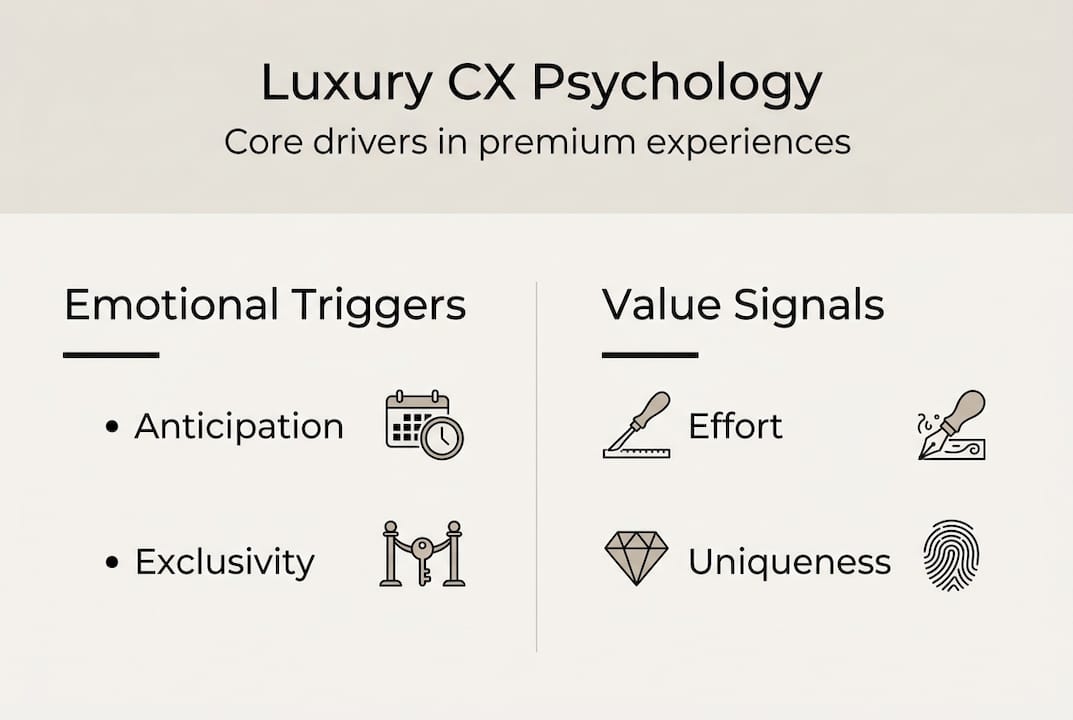
Scarcity operates as a powerful psychological lever in luxury markets, but its effectiveness depends on understanding the competing forces that drive consumer desire. Reactance theory explains why limited availability increases want. When options become restricted, people experience psychological reactance, an uncomfortable state that motivates them to restore freedom by acquiring the scarce item. This mechanism underlies the effectiveness of limited editions and invitation-only experiences.
Fear of missing out amplifies scarcity’s impact by adding social comparison anxiety to the equation. FOMO transforms individual desire into urgent action as customers worry about being excluded from experiences their peers enjoy. However, scarcity and uniqueness needs can conflict, creating strategic tensions luxury marketers must navigate carefully.
The need for uniqueness (NFU) drives some luxury consumers to seek products that differentiate them from others. For these customers, exclusivity in fashion matters more than social proof. They want items few others possess, valuing rarity over popularity. Conversely, status signaling motivates consumers who purchase luxury goods to communicate social position. These buyers prefer recognizable brands and items that clearly signal wealth to observers.
This creates a paradox. Scarcity campaigns that drive exclusivity can simultaneously attract uniqueness seekers while potentially alienating status signalers if the brand becomes too obscure. Understanding your customer segments determines which psychological trigger to emphasize.
| Psychological trigger | Primary effect | Secondary consideration | Optimal application |
|---|---|---|---|
| Scarcity | Increases urgency and perceived value through reactance theory | May reduce status signaling if too exclusive | Limited production runs, seasonal collections |
| Exclusivity | Enhances prestige and differentiation | Requires balance between aspiration and accessibility | Membership tiers, invitation systems |
| FOMO | Drives immediate action through social anxiety | Can create negative brand associations if overused | Time-limited offers, event access |
| Uniqueness | Appeals to self-expression and individuality | May conflict with mass-market aspirations | Customization options, bespoke services |
Cultural factors significantly moderate these effects. Asian markets often emphasize status signaling more heavily than Western markets, where uniqueness seeking dominates among certain segments. Younger luxury consumers increasingly prioritize experiences over possessions, shifting how scarcity creates value. Brands must calibrate their approach based on target demographics and regional preferences to maximize psychological impact.
Effort, entitlement, and cultural nuances: deepening luxury value perception
Deliberate friction in the customer journey paradoxically enhances perceived luxury value through two psychological mechanisms: effort justification and status signaling. When customers invest time or effort to acquire products, they unconsciously increase their valuation to justify the investment. This cognitive dissonance reduction makes the eventual purchase feel more valuable than items obtained easily.
- Identify strategic friction points where effort enhances rather than frustrates (waitlists, application processes, membership requirements)
- Communicate that friction serves quality control or community curation, not artificial scarcity
- Ensure the effort required aligns with your brand positioning and target customer expectations
- Monitor customer feedback to distinguish productive friction from unnecessary obstacles
- Celebrate customer investment by acknowledging their commitment during the acquisition process
Status signaling through effort works because observable investment communicates dedication and resources. When acquiring luxury goods requires time, connections, or persistence beyond money alone, ownership becomes a more powerful status symbol. This explains why brands maintain waitlists even when production could meet immediate demand.
Psychological entitlement, the belief that one deserves special treatment or superior outcomes, plays a complex role in luxury purchasing. Research demonstrates entitlement positively correlates with purchase intentions for luxury goods, as entitled consumers view premium products as rightful possessions rather than aspirational indulgences. However, mindset moderates this relationship significantly.

Consumers with fixed mindsets, who believe traits are unchangeable, show stronger links between entitlement and luxury purchase intentions. They view luxury consumption as reflecting inherent superiority. Growth mindset consumers, who believe abilities develop through effort, exhibit more nuanced motivations. They may purchase luxury goods as rewards for achievement rather than entitlement markers.
| Factor | Effect on luxury value | Cultural/mindset moderation | Strategic implication |
|---|---|---|---|
| Effort justification | Increases perceived value 15-25% | Stronger in achievement-oriented cultures | Implement strategic friction in acquisition |
| Psychological entitlement | Strengthens purchase intent | More pronounced with fixed mindset | Tailor messaging to entitlement vs achievement |
| Cultural value dimensions | Shapes what constitutes luxury | Varies by region and industry | Requires localized strategies |
| Democratization trends | Challenges traditional exclusivity | Affects pride of ownership | Counter with authentic scarcity |
Cultural intelligence proves critical because luxury value dimensions vary dramatically across regions and industries. What signals status in one market may seem ostentatious or irrelevant in another. Meta-analytic evidence shows cultural factors moderate the relationship between luxury perceptions and purchase behavior more strongly than previously recognized. Brands expanding internationally must invest in understanding local luxury codes rather than assuming universal appeal.
Democratization trends further complicate luxury value perception. As premium brands extend into accessible price points and mass retailers adopt luxury aesthetics, traditional markers of exclusivity lose potency. This shift threatens pride of ownership among core luxury consumers who valued scarcity. Brands must find new ways to signal authentic luxury beyond price and availability.
Pro Tip: Invest in emotional labor training for customer-facing teams so they can deliver psychologically sophisticated experiences that feel effortless to customers. Pair this with cultural intelligence workshops that help staff recognize and respect diverse luxury values across your customer base, maximizing perceived value through genuine understanding rather than scripted interactions.
Applying psychology insights to elevate luxury customer experience
Translating psychological theory into measurable business outcomes requires systematic implementation across customer touchpoints. The following strategies represent proven approaches that luxury brands can adapt to their specific contexts while maintaining authentic brand identity.
Actionable implementation steps include:
- Train all customer-facing staff in emotional labor techniques that enable authentic anticipatory service delivery
- Implement CRM systems that capture and surface preference data at relevant moments in the customer journey
- Design scarcity campaigns that balance exclusivity with accessibility based on your target segment’s uniqueness vs status orientation
- Create membership tiers or access levels that introduce productive friction while rewarding customer investment
- Develop culturally tailored experiences for key markets that respect local luxury values and status signals
- Establish feedback mechanisms that measure psychological impact beyond satisfaction scores
Benchmarking data validates these approaches. Hotels implementing anticipatory service techniques report up to 30% increases in repeat bookings as emotional bonds override price considerations. Fashion brands using strategic scarcity see higher margins and stronger brand equity compared to those pursuing volume strategies. The return on investment for psychology-driven customer experience improvements consistently exceeds traditional service enhancements.
Countering democratization effects requires authentic differentiation. Rather than competing on price accessibility, luxury brands should double down on experiences that cannot be replicated at lower price points. This means investing in bespoke services, cultivating genuine expertise, and creating consumer behavior insights that inform truly personalized interactions. When customers feel understood at a psychological level, they develop loyalty that transcends transactional relationships.
Integrating CRM tools strategically enables personalization at scale without sacrificing the human touch that defines luxury service. Technology should surface relevant customer insights to staff in real time, empowering them to deliver anticipatory service naturally. The goal is augmenting human emotional intelligence, not replacing it with automation.
Pro Tip: Maintain ethical boundaries in applying psychological techniques by ensuring all strategies genuinely serve customer interests rather than manipulating vulnerabilities. Build trust through transparency about how you use customer data and why you design experiences in specific ways. Customers increasingly value brands that respect their autonomy while delivering exceptional experiences.
Measuring psychological impact requires moving beyond traditional metrics. Track emotional engagement indicators like unprompted referrals, social media sentiment, and willingness to pay premium prices. Conduct qualitative research exploring why customers choose your brand over competitors. These insights reveal whether your psychology-driven strategies create genuine emotional bonds or merely temporary satisfaction.
Successful fashion brand growth tactics in luxury markets increasingly rely on psychological sophistication rather than product innovation alone. As luxury goods become more accessible and counterfeit quality improves, the experience surrounding acquisition and ownership becomes the primary differentiator. Brands that master the psychology of luxury customer experience will command premium positioning regardless of market conditions.
Continuous refinement based on customer feedback and behavioral analytics ensures your psychological strategies evolve with changing consumer expectations. What worked five years ago may feel manipulative or outdated today. Stay attuned to shifting values around sustainability, authenticity, and social responsibility that increasingly influence luxury purchase decisions. Analyzing buyer behavior for luxury brands must account for these evolving psychological drivers to maintain relevance.
Elevate your luxury brand with expert growth strategies
Applying psychological principles to luxury customer experience requires specialized expertise that bridges academic research with practical implementation. Corrado Manenti combines psychology training with luxury market experience to help brands translate behavioral insights into measurable growth. His approach integrates anticipatory service design, strategic scarcity deployment, and cultural intelligence to create experiences that resonate emotionally while driving business results.
Discover proven fashion brand growth tactics optimized for luxury market realities that account for psychological drivers like entitlement, effort justification, and status signaling. These strategies help you differentiate in increasingly competitive markets where product quality alone no longer guarantees premium positioning. Complement your growth initiatives by learning to analyze buyer behavior for luxury brands using frameworks that reveal the psychological motivations behind purchase decisions.
Explore comprehensive insights on psychology in luxury branding and engagement to stay ahead of evolving consumer expectations. Understanding how psychological principles shape customer experience positions your brand to build loyalty that withstands market disruptions and competitive pressure.
Pro Tip: Schedule a consultation to develop customized strategies that respect your brand’s unique identity while leveraging psychological insights proven to enhance luxury customer experience. The most effective approaches align psychological principles with authentic brand values rather than applying generic tactics.
Frequently asked questions about psychology in luxury customer experience
How can anticipatory service be implemented without seeming manipulative?
Transparency and genuine respect for customer autonomy prevent anticipatory service from feeling manipulative. Staff should be trained to deliver thoughtful gestures that enhance customer wellbeing rather than exploit psychological vulnerabilities for sales. When customers recognize that your brand truly understands and values them, anticipatory actions feel caring rather than calculated.
What psychological factors should be considered for international luxury markets?
Customization for cultural norms preserves authenticity while maximizing engagement across diverse markets. Understanding local interpretations of status, uniqueness, and exclusivity in luxury branding prevents strategy backfire. What signals prestige in one culture may seem inappropriate or irrelevant in another, making cultural intelligence essential for international luxury brands.
How does psychological entitlement affect luxury purchasing decisions?
Higher entitlement levels correlate positively with luxury purchase intentions, particularly among consumers with fixed mindsets who view premium goods as deserved possessions. Growth mindset consumers show more nuanced motivations, often purchasing luxury items as achievement rewards rather than entitlement markers. Brands can tailor messaging to resonate with different entitlement and mindset profiles.
What practical steps can marketers take to leverage psychology in luxury CX?
Train teams comprehensively in emotional labor and anticipatory service delivery to create authentic psychological connections. Use CRM tools strategically to capture preference data and surface insights that enable personalization at scale. Deploy scarcity campaigns thoughtfully, balancing exclusivity with accessibility based on target segment psychology. Continuously gather qualitative and quantitative feedback to refine psychological engagement tactics, ensuring they remain effective as consumer behavior in luxury evolves. Implement these fashion brand growth tactics for luxury markets systematically rather than as isolated experiments.