
TL;DR:
- Bespoke marketing focuses on deep understanding of consumer identity, aspirations, and psychological motivators.
- It uses behavioral data, AI, and psychological triggers to create personalized, emotional brand experiences.
- Success relies on human insight, strategic restraint, and authentic connection rather than technology alone.
Luxury marketing has long been misread as a synonym for exclusivity. Show the logo, raise the price, keep the velvet rope tight, and the buyers will come. But that mental model is cracking. The most competitive fashion and luxury brands today are winning not through gatekeeping alone, but through strategies that fuse behavioral data, artificial intelligence, and deep consumer psychology into something far more precise. This article breaks down what bespoke marketing actually means for luxury and fashion executives, how its core mechanics work, and how you can implement it without losing the authenticity your brand depends on.
Table of Contents
- Defining bespoke marketing for luxury and fashion brands
- Core mechanics: AI, behavioral segmentation, and real-time adaptation
- Psychology-driven messaging and VIP experience design
- Balancing personalization, privacy, and strategic restraint
- A new perspective: What most luxury brands miss
- Unlock your bespoke marketing advantage
- Frequently asked questions
Key Takeaways
| Point | Details |
|---|---|
| Bespoke marketing defined | It blends behavioral data, AI, and consumer psychology for luxury brand personalizations. |
| AI & segmentation are crucial | Luxury strategies use real-time AI and behavioral segmentation to target buyer motivations. |
| Psychology boosts engagement | Messaging based on identity, exclusivity, and status can lift engagement by up to 40%. |
| Balance personalization and privacy | Brands should use strategic restraint to protect buyer trust while delivering exclusive experiences. |
| Practical frameworks available | Luxury marketers can implement bespoke tactics with evidence-backed guides and expert insights. |
Defining bespoke marketing for luxury and fashion brands
Bespoke marketing is not a fancier word for personalization. Traditional personalized marketing says: “We know your name, here is a product recommendation.” Bespoke marketing says: “We understand your identity, your aspirations, and the psychological motivators that drive your purchasing decisions, and every touchpoint we create reflects that understanding.”
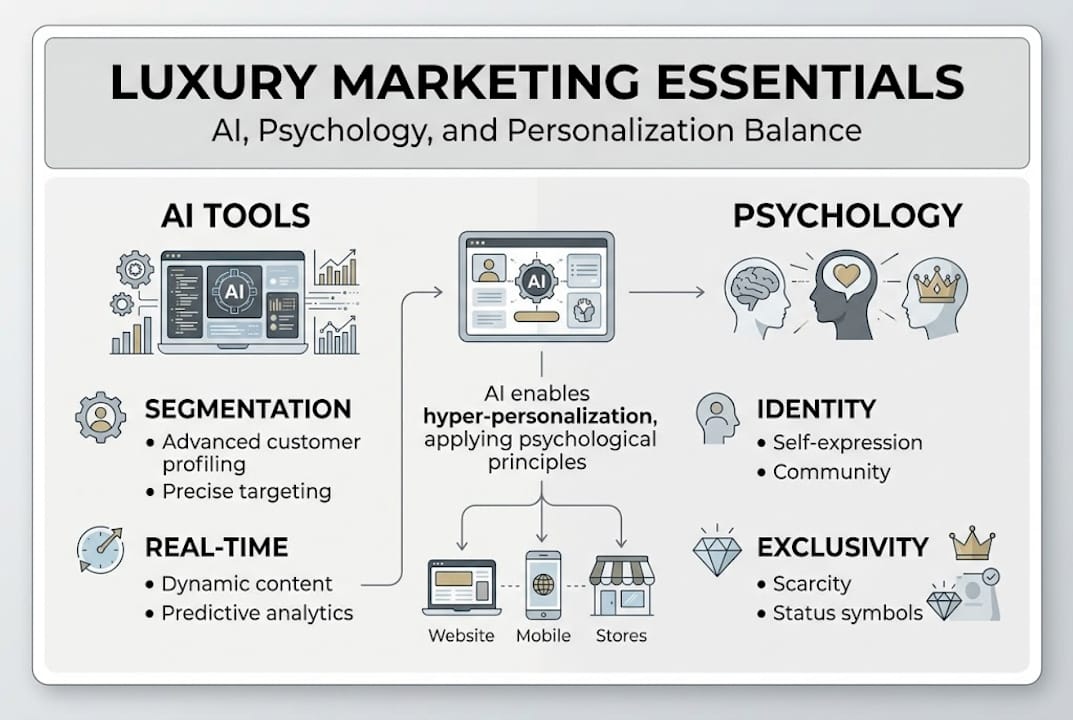
The distinction matters enormously in luxury and fashion. Your buyers are not responding to discount codes or birthday emails. They are responding to how a brand makes them feel about themselves. According to behavioral segmentation research, the mechanics of bespoke marketing involve data-driven behavioral segmentation, AI for real-time adaptation, and psychology-based messaging that targets the core luxury buyer motivations: identity, exclusivity, and status.
Here is how bespoke and traditional personalized marketing compare:
| Dimension | Traditional personalization | Bespoke marketing |
|---|---|---|
| Data used | Purchase history, demographics | Behavioral signals, psychographics, real-time intent |
| Messaging | Product-centric | Identity and aspiration-centric |
| Timing | Scheduled campaigns | Real-time, adaptive |
| Tone | Friendly, broad | Curated, intimate, exclusive |
| Goal | Conversion | Long-term emotional loyalty |
The most common misconception luxury marketers carry is that bespoke is simply “more expensive personalization.” It is not about budget. It is about depth of understanding. A brand that spends millions on a generic campaign targeting “affluent millennials” will consistently underperform against a brand that spends strategically on hyper-targeted messaging built around specific psychological profiles.
Key misconceptions to discard:
- Bespoke marketing requires massive data sets from day one
- It is only relevant for ultra-high-net-worth consumers
- Personalization at this level compromises brand mystique
- Technology alone can execute bespoke strategies without human interpretation
For a broader foundation, the fashion marketing guide offers a structured look at how luxury brands can build marketing systems that scale without losing their edge. And for ongoing luxury marketing insights, staying current on evolving consumer behavior is non-negotiable.
Core mechanics: AI, behavioral segmentation, and real-time adaptation
Once you accept that bespoke marketing operates on a different level than traditional personalization, the next question is: how does it actually work?

Behavioral segmentation for luxury buyers goes far beyond income brackets. It maps purchasing patterns, content engagement, social signals, in-store behavior, and even the timing of interactions. A buyer who browses a heritage leather collection at 11 PM on a Tuesday is sending a very different signal than one who clicks through a campaign during a flash sale. Both are data points. Bespoke marketing reads the difference.
AI for real-time personalization and behavioral segmentation drives luxury buyer engagement by enabling brands to adapt messaging, product recommendations, and even visual presentation dynamically, based on live behavioral cues rather than static audience profiles.
Here is how the core mechanics layer together:
- Data collection: Aggregate behavioral signals across digital and physical touchpoints
- Psychographic profiling: Map motivations, values, and identity markers beyond demographics
- AI-driven segmentation: Cluster buyers into dynamic, evolving micro-segments
- Real-time adaptation: Adjust content, offers, and experiences based on live behavioral feedback
- Continuous feedback loops: Use engagement data to refine and sharpen future messaging
The psychological triggers that matter most for luxury buyers are worth examining closely:
| Trigger | How bespoke marketing activates it |
|---|---|
| Identity affirmation | Messaging that mirrors the buyer’s self-concept |
| Exclusivity | Limited access signals, invitation-only framing |
| Status projection | Social proof from aspirational peers, not mass audiences |
| Scarcity | Time-sensitive or quantity-limited framing |
For growth tactics in luxury, AI is not a shortcut. It is a precision instrument. And like any precision instrument, it requires a skilled hand to operate.
Pro Tip: Never let AI run bespoke campaigns without human editorial oversight. Algorithms optimize for clicks. Your brand strategists optimize for long-term emotional resonance. The winning formula is both, working together through a step-by-step marketing process that keeps human judgment at the center.
Psychology-driven messaging and VIP experience design
Technology sets the stage. Psychology writes the script.
The three psychological frameworks that consistently drive luxury buyer behavior are identity affirmation, exclusivity signaling, and status seeking. Each requires a different messaging approach, and the most effective bespoke campaigns weave all three together without making the strategy visible to the consumer.
Identity affirmation works when your messaging reflects who the buyer believes they are, not just who they are demographically. A 45-year-old executive buying a bespoke watch is not buying timekeeping. They are buying a statement about discipline, taste, and legacy. Your messaging must speak to that narrative.
Exclusivity signaling is more nuanced than simply saying “limited edition.” It is about creating a felt sense of access. Invitation-only previews, early access programs, and personalized outreach from a named brand advisor all activate this trigger. Psychology-based messaging that targets motivations of identity, exclusivity, and status, combined with VIP exclusive experiences, consistently outperforms broad-reach campaigns in luxury contexts.
VIP experience design takes this further. Consider how brands like Chanel or Loro Piana handle their top-tier clients: private appointments, handwritten notes, curated product previews before public release. These are not perks. They are strategic psychological investments in long-term loyalty.
“Bespoke marketing is not about reaching more people. It is about reaching the right people in a way that makes them feel genuinely seen. That shift in orientation changes everything about how a brand communicates.”
For a deeper look at how buyer psychology shapes purchasing decisions, the frameworks around identity and aspiration are particularly relevant for fashion and luxury contexts. You can also explore psychology-driven sales steps that translate these principles into concrete brand actions.
Pro Tip: Strategic scarcity, when applied with precision, can lift engagement by 20 to 40%. The key word is precision. Manufactured scarcity that feels forced destroys trust. Authentic scarcity, rooted in genuine craft or limited production, amplifies desire and reinforces brand integrity. Understanding influencing luxury consumers at this level separates brands that grow from brands that plateau.
Balancing personalization, privacy, and strategic restraint
Here is the tension every luxury marketer eventually faces: the more precisely you personalize, the more data you need. And the more data you collect, the closer you get to a line your buyers do not want you to cross.
Privacy is not just a legal compliance issue in luxury marketing. It is a brand trust issue. Your buyers are sophisticated. They know when they are being tracked, and they have strong opinions about it. A misstep here does not just cost a campaign. It costs a relationship.
Hybrid AI-human methodologies that leverage psychological principles with a strategic restraint and privacy focus are crucial for luxury brand outreach. The brands that get this right treat data as a privilege, not a right.
Key principles for navigating this balance:
- Collect only what you need, and be transparent about how you use it
- Give buyers meaningful control over their data and communication preferences
- Avoid hyper-targeting that feels intrusive or surveillance-like
- Use behavioral signals to inform tone and timing, not to manipulate
- Treat privacy as a brand value, not a legal checkbox
Strategic restraint is perhaps the most underused tool in luxury marketing. Knowing when not to personalize is as important as knowing when to do it. Not every touchpoint needs to be optimized. Sometimes, a beautifully crafted, non-personalized brand moment creates more impact than a data-driven micro-targeted message.
The concept of personalization in luxury is not about maximizing touchpoints. It is about maximizing meaning. A brand that contacts its VIP clients too frequently, even with perfectly tailored messages, erodes the sense of exclusivity that makes those communications valuable in the first place.
Pro Tip: Build a “restraint protocol” into your bespoke marketing strategy. Define specific moments where you deliberately step back, let the brand breathe, and allow the consumer to come to you. Scarcity of communication can be as powerful as scarcity of product.
A new perspective: What most luxury brands miss
Most luxury brands that invest in bespoke marketing make the same mistake: they over-engineer the personalization and under-invest in the human connection that makes it meaningful.
They build sophisticated AI stacks, map every behavioral signal, and produce technically perfect campaigns. But the output feels cold. Calculated. The consumer senses the machinery behind the curtain, and the magic evaporates.
The brands that consistently win in bespoke marketing are not the ones with the most advanced technology. They are the ones that use technology to enable empathy, not replace it. The data tells you what a buyer values. The human strategist tells you how to honor that value in a way that feels genuine.
Strategic restraint and psychological depth will always outperform forceful digital targeting. The luxury consumer is not impressed by how much you know about them. They are moved by how well you understand them. That distinction is everything. For more thinking on this, the bespoke marketing strategies explored here reflect a philosophy built on that exact principle.
Unlock your bespoke marketing advantage
If this framework has shifted how you think about luxury marketing, the next step is putting it into practice with the right strategic partner.
Corrado Manenti works with fashion and luxury brands to build bespoke marketing strategies grounded in consumer psychology, behavioral data, and real-world luxury expertise. Whether you are refining your VIP experience design or rebuilding your segmentation approach from the ground up, the work starts with understanding your buyer at a level most agencies never reach. Explore the luxury brand growth tactics that are moving the needle for premium brands, follow the step-by-step marketing guide built specifically for luxury contexts, or discover how to improve luxury engagement in ways that protect and elevate your brand.
Frequently asked questions
How is bespoke marketing different from traditional personalized marketing?
Bespoke marketing applies advanced behavioral segmentation, AI-driven real-time adaptation, and psychological profiling to create hyper-personalized luxury experiences. Traditional personalization works with surface-level data like purchase history and demographics, while bespoke strategies reach the motivational and identity layers that actually drive luxury buying decisions.
What engagement improvements can luxury brands expect from bespoke marketing?
Brands that implement psychology-driven, AI-supported bespoke strategies can expect 20 to 40% engagement lifts compared to conventional campaign approaches. Results depend on the quality of behavioral data, the depth of psychological profiling, and the brand’s ability to balance personalization with strategic restraint.
How should luxury brands balance personalization with privacy?
Adopt hybrid AI-human approaches that use behavioral data to inform rather than manipulate, give consumers meaningful control over their data, and build strategic restraint into your communication cadence. Privacy in luxury is a brand value, not just a compliance requirement.
Which psychological factors matter most in bespoke marketing for luxury?
Identity affirmation, exclusivity signaling, and status projection are the three core triggers. Psychology-based messaging built around these motivations consistently outperforms product-centric campaigns in luxury and fashion contexts because it speaks to who the buyer wants to be, not just what they want to buy.